
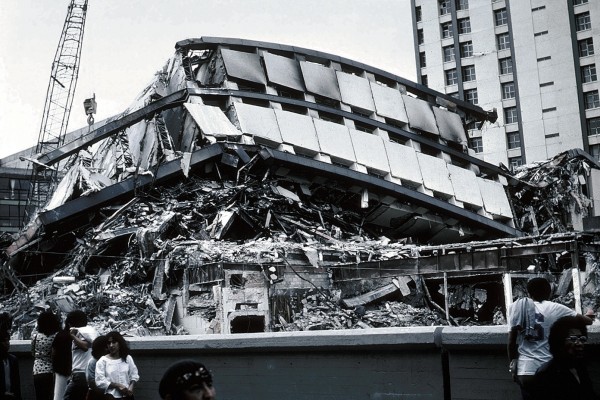
The 1985 earthquake revealed many homes’ poor condition, and the overcrowding many families were suffering.
Counting the death certificates in the civil registry one by one, Daniel Gallardo, arrived at 4,600 deaths as a consequence of the earthquake.
By Roxana Rodríguez Bravo
On September 19, 1985, at 7:19 a.m., a magnitude 7.9 earthquake shook Mexico City, officially known at the time as the Federal District, as it did with other regions of the country. 2025 marks the 40th anniversary of this event, which remains in the collective memory of the city’s dwellers.
Historical studies on the subject are scarce. Some have been done by practitioners of contemporary history and anthropology, and from researchers and disseminators of history such as Daniel Gallardo, who has done important work retrieving all kinds of material related to the 1985 earthquake. Gallardo is also very generous in sharing his evidence.
In my case, I have taken some data from his work. It should be said that, besides my own condition as a survivor and victim of the earthquake, I have devoted nearly 15 years to conducting professional historical research on this event.
One issue that has always been the source of trouble and controversy is the number of deaths. Initially, the Mexican federal government, led by then President Miguel de la Madrid Hurtado, tried to minimize as much as possible, through every means at his reach, the figures and literally, the corpses. Many bodies were buried among the rubble that arrived by the ton at mass graves in the San Lorenzo Tezonco Cemetery in Iztapalapa, the most populous, most marginalized of the 16 boroughs (mayoralties) shaping the current territory of Mexico City.
The government's monitoring policy was as terrible as the tragedy itself. For this reason, among other reasons, accurately calculating the number of deaths remains a very difficult task. The first to come close to an exact number was Daniel Gallardo, who, by counting the death certificates in the Civil Registry one by one, arrived at 4,600 deaths.
After reviewing the data from Daniel's research, I undertook the task of comparing the death certificates one by one through an open-access platform. A database was then created with the person's name, address, and place of death, which in many cases was the same as where they lived. It also included age, date and place of birth, recorded cause of death, date of the death certificate; people certified in the certificate; cemetery or final resting place, and profession.
This work, carried out intermittently, has taken me almost two years. The investigation is not yet complete, but here, our friends at the Los Angeles Press, supportive as always, are publishing for the first time some of these findings.
What names reveal
Unfortunately, in many cases, especially those involving homes, entire families died during the earthquake. There are some records of famous people who died, such as Rockdrigo González, then a relatively popular urban singer-songwriter.
Each name is a story, a narrative, deserving of a tribute to their memory. Here, one of many possible examples. At 7:15 a.m. on September 19, 1985, Otto Schumann Gálvez, the renowned anthropologist and linguist, was speaking on the phone with two Yucatecan workers from the Direction of Popular Cultures of the National Institute of Anthropology and History, José Tec Poot (anthropologist) and Miguel Ángel Arzapalo, who were guests at the Hotel Regis, which collapsed that fateful day. During the conversation, the call was cut off due to the earthquake that occurred at 7:19 a.m.
Hours later, Otto Schumann and Joaquín Becerra from the aforementioned Popular Cultures Direction arrived at what used to be the Regis Hotel to determine the whereabouts of the two Yucatecans. Hours, and then days, passed; due to the disaster and the explosion that followed the earthquake, the bodies of Tec and Arzapalo were never found. Therefore, on October 31, 1985, 42 days after the disaster, death certificates were issued for these individuals, in which a long note is taken from Schumann about what had happened.
As in the case of the two researchers, in many cases, the only thing the relatives received was a paper document certifying the death. Many other families were unable to receive a similar paper document, as the remains of their loved ones were never found. This is what is known as underreporting; what the earthquake took away.
Addresses and places of death
As we know, the neighboring areas of downtown Mexico City, including the Roma and Condesa neighborhoods, now areas of gentrification-related tension in Mexico City, were the most affected by the collapses and incalculable damage.
During my investigation, the deceased were grouped according to their place of death: streets in the first block of downtown Mexico City, mostly homes and single-family homes. The Ahorro Postal Street in the Postal neighborhood, near Calzada de Tlalpan, where a large number of families died.
Various homes, offices, and schools located in the Roma and Condesa neighborhoods; among many others, the Chapultepec College, a trade school teaching the then booming understanding of computers, and a then new building located at 112 Tehuantepec Street, where several high-income families lived, stand out.
One of the survivors filed a lawsuit. Various complaints and lawsuits against the construction company and the government were filed without success. One of the engineers involved in the construction later held government positions in Mexico City.
Several buildings affected were located on the Insurgentes Avenue, the longest in Mexico City, running all the way from North to South, notably those located on streets forming corners with Insurgentes Avenue, where vacant lots or parking lots still exist today.
Some of these buildings, affected by the 1985 earthquake, collapsed in the 2017 earthquake, which oddly enough happened on the very same fateful day: September 19. One of such building was located on the corner of the Chilpancingo and Insurgentes avenues, where a large complex of smart buildings built in 2018 now stands.
Of the buildings located on Chapultepec Avenue, the most notable collapse was that of Mexican media powerhouse Televisa. Recent video footage shows how many of the workers continued working among the rubble of the television station, even with the bodies of colleagues trapped in the most affected area. The standards and protocols we know today did not yet exist.
On Cuauhtémoc Avenue, the earthquake damaged several buildings, and many deaths occurred. For example, some people who arrived early to work at the Ministry of Commerce and Industrial Development died at their workplace. The same was true for the Pino Suárez government office complex at the heart of Mexico City’s downtown.
On Juárez Avenue, very close to Mexico City’s main square, the so-called Zócalo, the offices of the Ministry of the Interior and a campus of a community college known in Mexico as CONALEP (a half-way acronym of the Spanish full name Colegio Nacional de Educación Profesional Técnica) building behind them also collapsed. Some survivors of this latest collapse have testified about the tragedy.
A special case is the apartment building located at 13 Universidad Avenue in the Narvarte neighborhood, South of downtown Mexico City, where almost all of its inhabitants were families of Lebanese origin; there were no survivors.
The Juárez neighborhood, located in the Zona Rosa (Pink Zone), was also a high-mortality area. Not only Mexican nationals died there, but also several foreigners, artists, and performers who lived in the area.
The hospital district located on Cuauhtémoc Avenue suffered collapses and a large number of deaths. The General Hospital and some areas of the neighboting National Medical Center were among the places that recorded the most deaths.
The Juárez Hospital, then located at the oldest area of downtown Mexico City, also had one of the highest number of deaths. Many doctors, nurses, and healthcare providers are still remembered by their colleagues; some of these individuals’ remains were not found.
It should be said that the death certificates for healthcare workers, who died in some of these places, are much more comprehensive as to providing details of the cause of death than in other cases. This may be because medical colleagues took greater care in filling them out, perhaps as a tribute.
The Juárez Multifamily Housing Complex and the Nuevo León building in Tlatelolco suffered devastating collapses and a large number of deaths. The same was true for the Hotel Regis, located on Juárez Avenue, which, in addition to the collapse, suffered a gas explosion. Other hotels also suffered damage and several deaths, including the Versalles, Continental, De Carlo, Finisterre, Principado, Romano, and Windsor.
The collapse of a building at the corner of the Eje Central Avenue and the Victoria street, where a restaurant called Súper Leche used to operate, became a topic of interest. The owner, Mr. Fernández, was interviewed by then top nightly news broadcaster in Mexico, Jacobo Zabludowsky. He did so in real time as Mr. Fernández was returning from doing some exercise and found the tragedy where his entire extended family had died.
However, his 10-year-old niece was not found, leading to rumors that the girl may have been kidnapped in the midst of the tragedy. Another story from the earthquake was that of the boy Monchito, (a familiar name for people called Ramón in Mexican Spanish) who was trying to be rescued from a mansion in the Venustiano Carranza street at downtown Mexico City. It was eventually revealed that the boy’s uncle was trying to break into the crumbling building to retrieve a safe.
The earthquake revealed many homes’ poor condition, and the overcrowding many families were suffering. Buildings and homes destroyed in the Northern section of downtown Mexico City, where the La Lagunilla and other similar populous neighborhoods are located, were a common sight.
Years later, government support allowed some of these places to be rebuilt. For example, we can mention the La Lagunilla neighborhood, who have been inhabited by mariachis and musicians from Garibaldi and their vulnerable families.
The earthquake revealed other dire social issues. Corpses showing traces of torture were found hidden inside cars, which had been crashed by the falling rubble near the buildings occupied by the Mexico City Attorney General's Office.
Also, many seamstresses died in poorly equipped buildings near the San Antonio Abad subway station over at Calzada de Tlalpan (Tlalpan Avenue). To honor the memory of those underpaid female workers, the survivors founded the 19th of September Seamstresses’ Union.
In more than 200 cases, the death certificates of the deceased stated “unknown” as cause of death. Unidentified human remains arrived at the City’s Morgue, the so-called SEMEFO or the so-called 8th Precinct of the Mexico City’s police, practically unrecognizable.
Pantheons and other necro stories
The number of human-remains after the September 19 earthquake continued to accumulate at the City’s Morgue, and the 8th Precinct, located in the downtown Mexico City. At some point, they were unable to handle the demand for their services.
In the case of collapsed hospitals and other buildings, the rescued bodies began to pile up outside the facilities and were placed in coffins, while Civil Registry personnel, wearing face masks, using a table, a chair, and a typewriter, hurriedly prepared death certificates.
As a result, many of the certificates contain errors; almost all of them received a dispensation for some of the associated paperwork. This happened at the former Baseball Delta Park also known as Seguro Social Stadium, which became an immense killing field, where people visited to try to identify their relatives.
Today, a shopping mall sits on that land. Wealthier families, or those whose relatives were able to retrieve the remains quickly, hired funeral homes to handle all the paperwork. For this reason, some of the records contain certificates from these funeral homes.
However, the rescues continued, no longer of living people, but of bodies already in a severe state of decomposition. The rescues ceased in October 1985 by government’s order, and excavation work began to be carried out despite the presence of corpses. In fact, this was already being done since late September, but at that point it was official policy.
Many of the deceased's relatives did not have a place to bury their loved ones. To this end, the government of the Federal District, now Mexico City, led by Ramón Aguirre Velázquez (opens content in Spanish), in his capacity as head of that department or “regent,” as he was known in the popular parlance of the time, arranged several graves at the San Lorenzo Tezonco Cemetery in Iztapalapa, in Southeastern Mexico City.
Several of the gravediggers from those years have mentioned that they worked overtime digging graves and that the arrival of material remains with bodies was incessant until the beginning of October. In fact, this was the cemetery with the highest number of records of deaths from the 1985 earthquake. It is followed by the Pantheon of Our Lady of Sorrows (Panteón de Dolores) in Western Mexico City, where some of the bodies that took the longest to recover were cremated.
All of the above is just a sample of all the data that can be obtained through the analysis of death certificates and all the issues that remain to be investigated on this subject.
Translated and edited by Rodolfo Soriano-Núñez.