
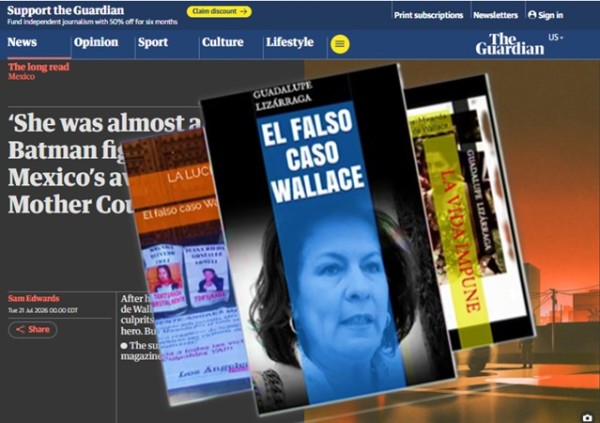
Guadalupe Lizárraga Viernes, 24 de Julio del 2026
The Guardian has been asked to correct the record and acknowledge the origin of the investigation of The False Wallace Case.
By Guadalupe Lizárraga
On 23 July, I sent Guardian News & Media a formal notice concerning the appropriation of the structure, evidentiary sequence and central findings of my investigation El falso caso Wallace, first published by Los Ángeles Press on 31 May 2014 and developed over the following twelve years.
The complaint was addressed to Editorial Legal Services, with copies sent to The Guardian’s editorial leadership, the editor of The Long Read and the author, Sam Edwards. It concerns the article “‘She was almost a Batman figure’: Mexico’s avenging Mother Courage”, published on 21 July 2026.
The article mentions my name only once. It places me in a subordinate sentence alongside journalist Anabel Hernández and states that we had “argued” that the case against the defendants was fabricated. That reference does not identify Los Ángeles Press, cite my investigation, state when the findings were published or describe the evidence underpinning more than a decade of high-risk investigative reporting.
A nominal mention stripped of the work, publication, dates and findings does not constitute attribution.
I have developed this investigation since 2014 through court files, official documents, expert evidence, recordings, interviews and testimony from people subjected to torture and arbitrary detention. The collection published by Los Ángeles Press contains more than 200 investigative reports, articles and interviews. I have also written four books on the case.
The Guardian’s report follows the investigative architecture established by my work: Hugo Alberto Wallace’s multiple identities and birth records; the contradictions surrounding his paternity; the unreliability of the DNA evidence; the failure to secure the apartment where he was allegedly murdered; the rental of the property between the two searches; the breach in the chain of custody; the evidence of torture; and the fabrication of criminal liability against the defendants.
These are not generic background facts or incidental details. They are the findings and documentary sequence that enabled me to dismantle the official narrative of the Wallace case.
In 2014, David Bertet provided documents to Los Ángeles Press. I verified, contextualised and published them. The Guardian, however, attributes the discovery of Hugo Alberto Wallace’s identities and birth records solely to Bertet. That account erases my discovery of a third identity record naming Carlos León Miranda—Isabel Miranda de Wallace’s first cousin and former husband—as Hugo Alberto’s biological father.
It also omits that I interviewed León Miranda and accompanied him to the prosecutor’s office in 2019, where we both gave formal statements concerning Hugo Alberto’s biological paternity and the irregularities surrounding the DNA evidence. No public record shows that Ricardo Raphael—whom the article presents as an authority on the investigation—ever interviewed León Miranda.
That finding was brought into the public record by Los Ángeles Press and was subsequently introduced into the judicial proceedings as documentary evidence by Jacobo Tagle Dobín’s then public defender, Alejandro Garduño Real. His legal work on the case made him the target of two attacks and forced him to seek asylum in the United States.
The Guardian’s report also presents as a discovery made by former public defender Salvador Leyva in April 2021 the fact that the apartment where Hugo Alberto was allegedly murdered had not remained secured and had been rented out between the two searches. Los Ángeles Press documented and published that fact in its first report, dated 31 May 2014.
The chronology constructed by The Guardian transfers to later actors the recognition owed to my journalistic investigation, published seven years before the date on which the article says Leyva made the discovery.
The article also places Ricardo Raphael at the centre of its framing and emphasises that he “has written extensively about the case”. That portrayal omits that El Fabricador, the fourth book in the El falso caso Wallace series, documents Raphael’s appropriation, plagiarism and distortion of my findings.
I am currently engaged in litigation against him over the appropriation of this same investigation. By presenting him as an authority while omitting the documented authorship dispute and the ongoing legal proceedings, The Guardian alters the origin of the findings and legitimises a later account built upon my work.
The appropriation of this investigation cannot be reduced to a dispute over professional recognition. My work exposed the fabrication of criminal liability, torture and the prolonged imprisonment of people by the Mexican state.
The reprisals I suffered for documenting these facts include persecution, torture documented through a positive Istanbul Protocol assessment, two attempted kidnappings, threats, the dissemination of my personal information and a break-in at my home.
Erasing the authorship and chronology of this investigation reproduces the pattern of appropriation and silencing that has accompanied the case for years.
In my letter, I demanded that Guardian News & Media publish a prominent correction both on the article itself and in its corrections and clarifications column. I also requested that Guadalupe Lizárraga and Los Ángeles Press be identified as the journalist and publication that documented and published these findings beginning in 2014, with direct links to the original reports.
The complaint demands corrections to the attribution and chronology concerning the identities, birth records, paternity, DNA evidence, failure to secure the apartment, its rental between the searches and the resulting breach in the chain of custody.
Investigative journalism has authorship, dates, sources and consequences. The international prestige of a news organisation does not entitle it to appropriate the work of an independent journalist, alter its chronology and transfer her findings to those who came later.
Authorship does not disappear when a larger news organisation reproduces the findings. The Guardian must correct the attribution, restore the chronology and publicly acknowledge the origin of this investigation.