
Rodolfo Soriano-Núñez Lunes, 17 de Noviembre del 2025
As good as the meeting and the probe are, his choice of commissary to finalize the suppression of the Sodalitium raises doubts among abuse victims at that Peruvian organization.
Over 2025, three German dioceses have published reports on abuse. Whether Latin America will ever have similar reports remains an open question.
By Rodolfo Soriano-Núñez
November brought a combination of sequels and somehow new and unexpected developments on many of the fronts of the global clergy sexual abuse crisis.
On Saturday 8, Pope Leo XIV held a meeting with Belgian survivors. He did so, after appointing on November 6, the archbishop of Arequipa, Peru as the adjunct commissary to oversee the suppression of the Sodalitium, while in Germany, the dioceses of Trier and Augsburg published reports with details about the scale of the crisis there.
On Monday 10, news of the first ever canonical inquiry of a sitting bishop in Spain emerged, followed by the sudden, fast-track, laicization of an Argentine priest the next day. Near the end of the week came news of an open conflict between the archbishop of Santo Domingo, Dominican Republic, and Rome over the appointment of his coadjutor archbishop.
Taken together, some of the news seem to imply that there is some will to address some of the most pressing issues, but doubts remain.
The uncertainty surrounding the Papal agenda itself remains a key element. For instance, nothing has been known so far about the meeting Pope Leo XIV had with the emeritus archbishop of Lima, Juan Luis Cipriani, early in October.
This silence is relevant because Cipriani is still influential in Catholic circles in the Spanish-speaking Catholic world, and he is a key figure in the Opus Dei, which also is in the process of advancing a reform process, leaving open the question of whether Leo XIV will increase pressure on that entity to curb sectarian practices or address abuse accusations within its communities. Even the future of the restrictions set by Pope Francis on Cipriani are unknown.
What is clear, however, is that Pope Leo XIV is signaling his interest on the crisis, as evidenced by his October meeting with Ending Clergy Abuse (ECA)—an activity that moved in the right direction, even if affected by the way his underlings in Rome reported it (or failed to report it) to the different editions of the daily Bollettino of the Holy See.
A Roman afternoon
Starting at 4:30 pm, Pope Leo held on Saturday 8, a new meeting with survivors of abuse from Belgium, one of the last countries visited by Pope Francis, back in September 2024. When the Argentine Pope was there, he faced severe criticism from local groups and authorities regarding the disastrous handling of abuse cases there going back to the mid-20th century.
Back in 2010, the Adriaenssens Commission published a report (available here, but only in French and Dutch) tearing away the veneer of respectability of the Catholic Church there. It did so by exposing a widespread network of complicities, involving almost all of the nine Catholic dioceses there.
The report documented 476 instances of abuse and revealed abuse as a deeply embedded phenomenon. The investigation showed that the response was not one of sincere respect for the victims but of calculated concealment, leading to the systematic underreporting of clergy sexual abuse.
One of the earliest installments of this series in 2023, found that following an estimate developed by the authors of the French Sauvé report it would be possible to set a minimum of 8,437 to a maximum of 21,262 victims of clergy sexual abuse, at the hands of at least little over a hundred predator clergy there. The story, with the data and the explanation of the calculation of such numbers appears after this paragraph.
When Francis visited Belgium, even if Prime Minister Alexander De Croo welcomed the Pontiff, he also “blasted the Church's legacy of clerical sex abuse and cover-ups, demanding “concrete steps to come clean with the past and put victims’ interests ahead of those of the institution,” as a story from France 24 and other European media told.
Following Francis’s steps
Leo XIV’s meeting with Belgian survivors of clergy sexual abuse was greeted by the 15 survivors in attendance as a continuation of sorts of the difficult encounter they had with his predecessor in September of 2024.
Sadly, the Bollettino of Saturday November 8 lacks any reference to such a meeting. Apparently, the reason to avoid including it was that the activity was listed as private, although one would guess that if the Pontiff is trying to send a clear message to the rest of his Church, it would be better to keep a full, public, officially available record of these meetings, even if their nature and dynamics remain private.
So far, the only Holy See entity reporting the meeting is Vatican News. Beyond that source, the most detailed account of the meeting, comes from Belgian Dutch-speaking medium Otheo (contents in Dutch, also see here in English).
At that report one learns about Pope Prevost is aware of how, as a consequence of mistreatment of some of the victims by the Belgian Catholic hierarchy, they are now non-believers, something the meeting’s agenda called “the rape of the survivors’ souls.” On top of that, the agenda included conversations about the need to actually advance on prevention of abuse, as to achieve a “never again” goal, and to achieve some kind of understanding regarding the issue of compensations for the victims.
If one follows Otheo’s account of the meeting, stretching for more than two hours, as told by Aline Colpaert, one of the 15 survivors in attendance, there was some time devoted to the issue of the existing abyss between Rome’s and the Pope’s attitude towards survivors, and the local bishops’ attitudes towards them.
The fact that said abyss exists even in countries such as Belgium where there is a national report and there is plenty of evidence about the scale of both the abuse and the cover up, is more telling when one compares it to what survivors experience in Latin America, where many bishops, incite their most radical lay leaders to chastise, discredit, and attack survivors, even if they do so privately.
Back to the Andes
And that is not merely a hypothetical. One of Leo XIV’s most recent decisions, appointing Javier Augusto Del Río Alba, the current archbishop of Arequipa, Peru, as one of three “adjunct apostolic commissaries” to help the appointed apostolic commissary, Spaniard priest Jordi Bertomeu, to continue the process to suppress the Sodalitium of Christian Life, an entity, similar to an order, which has been the subject of several installments of this series over the last two years.
It was Del Río’s diocese who told the world about the appointment, as this media release, available only Spanish, details. With him Rome appointed also lay males César Arriaga Pacheco, and Juan Velásquez Salazar, who is a Peruvian lawyer.
Del Río’s appointment was hardly cheered by survivors of abuse in the Sodalitium, and even Peruvian priests, journalists, and observers from other countries who have been following what has happened there, had a hard time trying to understand why Leo XIV’s, a former bishop in Peru, with deep knowledge of the scale of the abuse at the Sodalitium and how able are their leaders up until now to resist whatever directive that comes from Rome.
For starters, Del Río’s vicar general in the archdiocese is a full member of the now suppressed Sodalitium. If one goes to this page at the archdiocese’s website it is possible to read that, after Alberto Cristián Ríos Neyra’s name there are the “S.C.V.” initials, signaling he is a member of the Sodalitium Christianae Vitae, the Sodalitium of Christian Life.
Some of the less pessimistic observers of Del Río’s appointment, such as Martín Scheuch (contents in Spanish) who is himself a survivor of abuse at that group, sees it as a way to avoid the kind of resistance from the diehards of that “order” who, as Giuliana Caccia did (see the story linked after this paragraph), were willing to falsely claim to be a victim of abuse, just to discredit the whole process.
Even if that was the case with Del Río he has made a name for himself trying to minimize the scale of the abuse at the Sodalitium while insisting in the “a few bad apples” approach as to imply that there was a way to keep the Sodalitium alive without suppressing it.
Del Río is also famous for calling the survivors of clergy sexual abuse in Peru to keep their complaints quiet, under wraps, “modest.” The Spanish-language video linked after this paragraph, has Del Río disparaging about a “sexualized” culture in Peru and elsewhere.
By the end of the video, Del Río implicitly links “gender ideology” with clergy sexual abuse crisis. Even if he was quoting Pope Francis’s critique of “gender ideology”, his take on the relationship between said “ideology” and abuse comes straight from Benedict XVI’s excuses to dismiss the responsibility of the Catholic Church when preventing abuse.
Audio available in Spanish. Captions in English available over YouTube’s control panel.
As the story linked after this paragraph explained at the time of the suppression, one way for the Sodalitium to remain alive is if local bishops where that “order” has been active are willing to let them exist as diocesan associations of the faithful in t their dioceses or, if bishops such as Del Río keep the members of the organization in positions of power, where they will be able to limit the reach or practical consequences of the suppression as such.
It is hard to imagine Leo XIV actually accepting that but sadly, as proven by the ongoing discussion in Spanish-speaking media, both in Peru and elsewhere, Del Río's appointment as commissary, even if adjunct and theoretically under Bertomeu’s lead, leaves the door open to wonder if Pope Prevost is trying to amend the reach of Pope Bergoglio’s decision regarding the Sodalitium.
The German reports
In Germany, the dioceses of Trier and Augsburg published partial reports on abuse in their territories. Trier’s document (available in German here) and Augsburg’s report (available as PDF document in German here) join a similar report published back in April by the diocese of Würzburg (available as a document in German here).
The three reports on sexual abuse in these dioceses are part of a continuing, broader examination of abuse within the Catholic Church in Germany, to compensate for the collective failure to publish a full national report back in 2013.
Eventually, after a national scandal over the restrictions the German conference of bishops and Rome tried to set on the authors, it would be released as the MHG Report after the universities conducting it: Mannheim, Heidelberg, and Giessen. A summary of the report is available in English here.
As it happened at its time with the John Jay Report in the United States in the Aughts, and later in France with the Sauvé Report, the MHG Report findings were shocking and revealed a profound institutional failure to address the crisis. You can find more information about MHG in this series in the installment linked after this paragraph.
After that failure, several German dioceses have commissioned similar studies revealing strikingly similar historical patterns of victimization and institutional failures spanning between 1945 and the early 2000s. Now the dioceses must have victim advisory boards and clearly stated procedures to report and handling abuse cases.
In Würzburg’s case the report goes from 1945 through 2019, while Trier’s is the most recent of a series of reports going over, in this case, 2001-21. Augsburg’s goes from 1946 to 2014.
Across all three dioceses, the default administrative practice was a strategy of institutional self-protection and cover-up, a reflection of the so-called “Ratzinger system.” Before 2002, this involved downplaying allegations, prioritizing the cleric's career and the Church’s reputation over the victim’s welfare, and, most commonly, implementing a policy of “insulation.”
Geographic solution, again
This “insulation” manifested through what this series has identified over several installments as the “geographic solution,” that is to say, transferring priests—often under the guise of “health reasons”—to new posts without disclosing their history.
Similarly, Würzburg noted a historical lack of sanctions and attempts to suppress files, while Trier acknowledged that “old habits sometimes persisted” well into the new millennium.
The most significant and synchronized turning point across all three reports is the introduction of the 2002 guidelines by the German Bishops’ Conference, which served as the common “inflection point” that began to systematize accountability. All three dioceses saw a resulting shift towards stricter sanctions.
This mandated process established formal procedures for investigation, material aid for victims, and mandatory reporting to both canonical and civil authorities, leading to a clear, measurable reduction in “inappropriate” institutional reactions.
The consistent adoption of these guidelines, followed by subsequent papal documents like Vos estis lux mundi already during Pope Francis’s papacy, cemented a shared path of procedural complexity aimed at consistent transparency and accountability, despite the tension this caused with public expectations.
Finally, the reports share a common, devastating statistical reality that underscores the long-term impact of the cover-up. In all three cases, the perpetrators were overwhelmingly diocesan priests. They analyzed the “light field”, that is to say, what is actually known about the historical incidents found in the archives while explicitly acknowledging an unknown “dark field.”
Crucially, the studies highlight the massive delay in reporting; for instance, Würzburg cited an average delay of 25.7 years between the crime and the diocese becoming aware. This shared delay means that the vast majority of the documented historical abuse cases, even with the current diocesan administrations’ commitment to “zero tolerance” and state reporting, are already past the statute of limitations for legal prosecution.
In Würzburg’s case it must be noted that the report was prepared an Independent Commission to Process Sexual Abuse (UKAM after its German acronym) with the support of a prestigious lawyer Hendrik Schneider and his firm, so there is a clear emphasis on the rather weak institutional response to an issue that, as it is usually the case, goes from one bishop, to the other and more.
Extent of the abuse
The so-called “comprehensive expert opinion” from Schneider analyzed the extent of abuse, scrutinized the institutional response, and identified structural factors that enabled or concealed sexual violence between 1945 and 2019.
To do so it combined methods of quantitative and qualitative research, primarily involving an in-depth analysis of diocesan records, including the internal “Verschlusssachenregistratur” (VSR-files) and personnel files, as well as conducting numerous interviews with current and former bishops, officials, and survivors.
The study identified 51 perpetrators with a “plausible or proven” suspicion of having committed at least one act of abuse, 43 of whom were clerics (priests, deacons). The number of explicitly documented abusive acts linked to these individuals totaled 449. However, by extrapolating from known details about series of offenses, the estimated number of total acts rises to 3,053.
The study provides an “abuse burden rate” as the percentage of active clerics in a given year accused of at least one plausible case of abuse. This rate ranged between zero and 1.1 percent during the period under consideration.
The age of perpetrators at the time of their first known offense averaged 40.5 years. The victims, overwhelmingly minors, were on average 9.8 years old at the time of their first victimization, which is slightly lower than in the more comprehensive MHG study for Germany.
Although, it should be noticed also, that MHG found a larger share of the total population of priests, going to 4.4.
In Würzburg three out of each four cases primarily fell into the 6- to 13-year-old age range. The majority of the documented crimes fell into four distinct categories of severity (out of thirteen total), generally corresponding to sexual abuse of children and protégés with physical contact, but beneath the most severe penal thresholds.
A brotherly story
A diocese particularly relevant for the present and future of the German Catholic Church is that of Trier as, at some point, early in this century, the bishop there was Cardinal Reinhard Marx, the current archbishop of Munchen, but also because Trier is a suffragan diocese of Köln or Cologne, the archdiocese headed by Cardinal Reiner Maria Woelki who is a frequent target of accusations and complaints for his proven difficulty to address the issues behind the clergy sexual abuse crisis.
As far as Marx is concerned, his tenure in Munich is even more complex as said archdiocese was once headed by Joseph Ratzinger himself (1977-1982), but also and, perhaps more troublingly, because he never actually lost control of the diocese.
If that was not enough, there is the issue that Benedict XVI’s brother Georg Ratzinger used to be a priest and head of a choir in the diocese of Regensburg, a suffragan diocese of Munchen where there have been, in recent years, reports of abuse.
First in 2010 and later in 2017, news emerged of large scale abuse, estimated in 2017 at a minimum of 547 victims of different types of abuse, at the hands of 49 clerics and lay persons associated to the diocese of Regensburg, with 67 cases of clergy sexual abuse.
In that regard, Marx’s tenure at Trier (2001-7) cannot be detached from his longer but equally troubled ongoing tenure at Munchen. So troubled that, at some point, in June 2021, he offered his resignation to Pope Francis (see here and here too). The Argentine Pope ultimately declined.
A feature worth mentioning of some of the reports, Augsburg’s included, is that the authors had access to information unavailable to the team that originally gathered the information for the MHG report, especially when it comes to the access to the so-called private, reserved, or secret archives of the diocese.
In Augsburg there was evidence of 1,507 clerical files with markers of abuse, sexual or otherwise, with accusations against 77 clerics (5.1percent of the examined population). These 77 named clerics could be definitively linked to offenses against 156 victims. The vast majority of perpetrators were diocesan priests (82 percent), with 79 percent actively engaged in pastoral ministry at the time of the offense.
Most reports are about clerics in their 30s. Almost three of each four offenses were committed by men between 30 and 59 years old. Despite the fact that repeat offenses were common, only some cases have a record of post-offense behavior. The report coming from Augsburg is notable for the number of documented cases of female victims, one in each three.
A first ever in Spain
Over the early days of November, a “first” happened in Spain. More specifically, Rafael Zornoza Boy, the bishop of the small diocese of Cádiz, suffragan of Seville in Southern Spain, jumped for a few hours to the frontpages of Spaniard media as first sitting bishop subject to canonical inquiry in that European country,
The accusation against Zornoza Boy involves the alleged sexual abuse of a seminarian during his time as a professor and headmaster of the seminary of the diocese of Getafe in the 1990s. Given the fact that he is already a bishop under the archdiocese of Seville authority, and that Getafe is under that of the archdiocese of Madrid it is a rather complex probe.
He is already 76, so he is already a double anomaly. On the one hand, as the first prelate in Spain to ever be publicly accused and put under a canonical probe, and, on the other, as one of the very few bishops still in office after reaching 75. It is unclear why he remains a bishop.
Sadly, the opacity with which the Catholic Church handles the appointments and resignations of bishops and priests forces plenty of guessing in cases such as this. Zornoza has been the target of frequent complaints for the way he handles the finances of the diocese.
The first goes all the way back to 2013-4, roughly two years after his appointment as bishop there. At the time, local priests complained about the financial demands made by a prelate described in the Catholic media in Spain a “obispo señorito,” which translated would mean a “nepobaby bishop” or something to that effect.
At least two priests in Cádiz, Antonio Casado and Rafael Vez Palomino, have been calling out Zornoza Boy’s hubris for the last ten years or so. A landmark in their criticism of the bishop’s mismanagement of the diocese, was a letter they sent to Pope Francis back in 2018 where they offered an account of what was happening already then at that diocese, available here but only in Spanish.
As it is usually the case, both Casado and Vez Palomino have been paying the price of their criticism with frequent attacks, public and private, from both Zornoza Boy and his sympathizers, showering them with the usual flurry of adjectives to discredit them. In that regard it is possible to guess that he has been in the nunciature to Spain’s radar for a while.
More significantly, despite its long tradition of denying any accusation, Luis Argüello García, the current president of the Conference of Catholic Bishops and head of the archdiocese of Valladolid and Cardinal José Cobo Cano, the archbishop of Madrid, where Zornoza Boy begun his ecclesiastical career, both agree the accusations are credible.
Sadly, local media in Cádiz, Spain, went to war on Zornoza Boy’s behalf, with the usual flurry of ifs and buts. The most notable of them all, the fact that the crime he is accused of, abusing a seminarian when he was the headmaster of the diocese of Getafe’s seminary and secretary of the now deceased then bishop there, Francisco José Pérez.
Madrid is relevant not only because of the weight of the country’s capital city, but because Zornoza Boy was originally a priest there, and Getafe is its suffragan diocese, so Cobo Cano was somehow involved, even if it is unclear at this point the extent of his involvement in the canonical process.
It should be noted that Zornoza was at the time a protégé of the then almighty Cardinal Antonio María Ruoco Varela, who back in the 1990s and Aughts bragged about his influence in Rome during John Paul II’s and Benedict XVI’s pontificates.
Zornoza was originally trained by the archdiocese of Madrid and was incardinated (assigned) there for 16 years (1975-1991), when the then new urban development of Getafe made necessary to create the eponymous diocese, Zornoza went there.
There he was secretary of the bishop, professor and headmaster of the seminary, member of the diocesan council of advisors (as his bio in the Spanish-language version of the Wikipedia tells, with far more detail than the English-language version). Eventually, in 2005, Zornoza became auxiliary bishop there and, six years later, on August 2011, Benedict XVI sent him to lead Cádiz, a suffragan diocese of Seville.
It is worth noting that, despite the many limitations and hurdles, Leo XIV allowed a Spaniard sitting bishop probe to continue. The case is relatively safe as it is penally prescribed, so there is no risk of a penal trial or jail for Zornoza. Is this a signal to the Spaniard bishops regarding the need to address their many pending cases?
Zornoza’s canonical probe is more relevant as, early in the week, the national government of Spain, held a meeting with survivors of 22 different associations of survivors of clergy sexual abuse. Félix Bolaños, a top official, talked about an upcoming deal with the Catholic Church that will include a fund to compensate survivors.
Argentinean double standards
Finally, it is impossible not to wonder about the decisive, fast-track laicization of Argentine priest Rodrigo Enrique Vásquez of the diocese of San Nicolás on November 11. The laicization stemmed from a canonical process initiated after Vásquez launched harsh public criticism, including innuendos about the sexual identities, of two key Argentine figures: the archbishop of Buenos Aires, Jorge García Cuerva, and the prefect of the Dicastery for the Doctrine of the Faith, Víctor Manuel Fernández, back in 2023.
The canonical process took little less than two years in Argentina, from August 2023 through June 2025. At that point, the file was sent to Rome. The Dicastery for the Clergy received the file in August, and soon after, in October of this year, the Dicastery for the Doctrine of the Faith, headed by Fernández, ruled to expel Vásquez from the “clerical state”, to defrock him.
It is hard to imagine Vásquez’s punishment as a loss for the Church, he had been having issues with his superiors ever since his days as a seminarian in the diocese of San Isidro which ultimately expelled him, so he was ordained for the Argentine military diocese. He also had troubles there, and that is how he ended up in San Nicolás de los Arroyos, 140 miles or 220 kilometers North of Buenos Aires.
But even if it would be hard to imagine someone missing Vásquez as a priest, it is impossible to dismiss the fact that there are convicted sexual predators in Argentine jails, such as Julio César Grassi who, despite a sentence for the sexual abuse of minors under his care, is still a priest. The first of the seven stories of clergy sexual abuse in the installment linked after this paragraph offers more details about Grassi.
In that regard, it is clear that there is an issue with how the hierarchy uses a powerful device such as the laicization of a priest. How is it possible that a case barely elevated to Rome in August of this year, has such a fulminant resolution for attacking archbishop García Cuerva and Cardinal Fernández, while Grassi remains a priest?
It is impossible not to see Vásquez fulminant laicization as a striking demonstration of hierarchical control, a dismissal for hierarchical dissent, showing the Roman Curia’s capacity for immediate, decisive action when one of its top leaders is criticized, while there is no will to actually punish Grassi.
A Dominican affair
Finally, the small Caribbean nation of the Dominican Republic is in shock after the current archbishop of Santo Domingo decided to play victim after Rome sent an archbishop coadjutor back in October.
Archbishop Francisco Ozoria Acosta welcomed at first Rome’s appointment of archbishop Carlos Tomás Morel Diplán, a former auxiliary at Santiago de los Caballeros, and former bishop of La Vega, as his coadjutor. The archdiocese of Santo Domingo Facebook account posted a celebratory message of the appointment of the "coadjutor archbishop," as can be seen after this paragraph or here.
According to Dominican media Rome appointed Morel Diplán as coadjutor at Ozoria Acosta’s request. Despite that, on Thursday, November 14, both Listín Diario and El Caribe, the largest newspapers in the Spanish-speaking half of Hispaniola, published stories displaying Ozoria Acosta’s anger at Rome for his new situation, one where he only kept the titles as primate of the Dominican Republic and the Americas at large while all the effective, actual, faculties have been transferred to Morel Diplán.
Oddly enough, that is what happens when Rome appoints a coadjutor and not an auxiliary. When Ozoria Acosta celebrated the arrival of his coadjutor he should have been aware of what was happening. Morel Diplán’s appointment was known back on October 18, as reported by the Holy See’s Bollettino.
It is unclear at this point what is actually happening in the oldest Catholic diocese in the Western hemisphere, but it was noticeable that both Listín Diario and El Caribe traced some parallelism with what happened, eleven years ago, in Santo Domingo when Joszef Wesolowsky, until then the Polish nuncio to the Dominican Republic and other territories in the Caribbean was sent back to Rome to face a trial for the sexual abuse of underage males.
The week ended on Thursday with Pope Leo XIV calling to protect children from the influence of Artificial Intelligence.
It is clear that some reflection is required when dealing with the potential effects of AI on minors, but one has to wonder if the Church’s calling on that subject would not be more meaningful had the powers of the Papacy be actually committed to address the Catholic Church’s own issues with clergy sexual abuse, which predate the era of AI.
A summary of this installment of the series is available for listening after this paragraph.
Your browser doesn't support HTML5 audio. Here is a link to the audio instead.
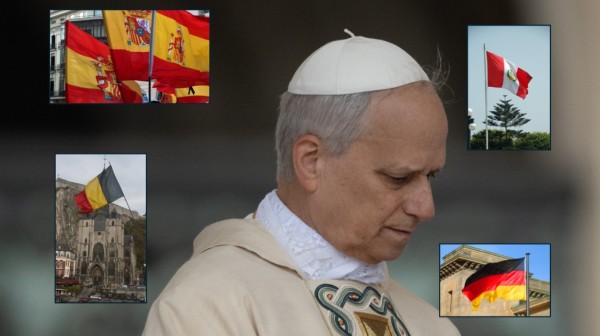
Note: The main picture includes the large picture of Leo XIV by Mazur, Catholic Church of England and Wales @ www.flickr.com/photos/27340278@N03/54529630490. It also includes pictures by:
- Elena Romera of the German flag @ www.flickr.com/photos/89471682@N00/406853141.
- Matthew Black of the Belgian flag @ www.flickr.com/photos/60099286@N00/4101931415;
- Kent Quirk of the Peruvian flag @ www.flickr.com/photos/28939035@N00/2699489517 and
- Elentir of a set of flags of Spain @ www.flickr.com/photos/96937621@N00/418286338.