
Guadalupe Lizárraga Sábado, 04 de Abril del 2026
The La Jolla property intensifies scrutiny over opaque CESPM salary disclosures and the family wealth structure behind the purchase.
By Guadalupe Lizárraga
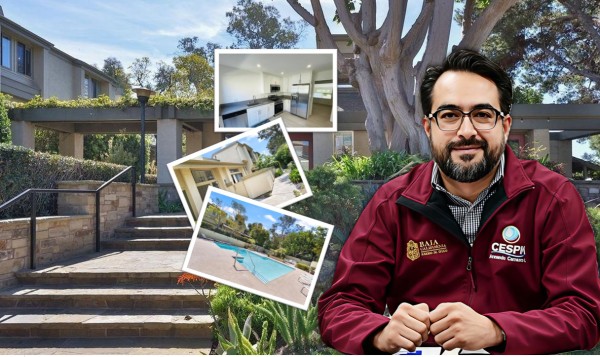
LA JOLLA, California — A townhouse at 3233 Caminito Eastbluff Unit 23, inside La Jolla’s Eastbluff complex, formally left the control of the Luken family — a name with deep business and political roots in Tijuana — on October 15, 2024. The property was transferred into a corporate vehicle bearing the hallmarks of asset shielding: JACM LTD LIABILITY CO.
In recent days, the address surfaced in local Mexicali media as a possible property tied to Armando Carrazco López, director general of the Mexicali State Public Services Commission (CESPM). Publicly accessible online records do not, on their own, place the residence in the official’s personal name. But the paper trail points to a tightly held corporate structure connected to Carrazco and his family circle.
Property and MLS records show that Unit 23 changed hands within the Luken family at least six times between 2003 and 2024, through dissolutions, affidavits of death and internal transfers. The last individual owner, Armando Reneaum Luken, closed the 2024 sale for $1.05 million.
The buyer was no longer an individual. Instead, title moved to what appears to be a paper company: Jacm Ltd Liability Co LLC, listed at the La Jolla address and managed by Norma Graciela Monge Grajeda and Armando Carrazco López, who was then serving as head of CESPM.
The property’s mortgage history also reflects a $577,500 loan, recorded the same day, with Foundation Funding listed as lender and Mortgage Electronic Registration Systems, Inc. as beneficiary of record, in the name of the LLC and tied to Carrazco and Monge.
The transaction is preserved in the official index of the San Diego County Assessor/Recorder/County Clerk. Instrument 2024-0277412 records the transfer from Luken Armando Reneaum to JACM LTD LIABILITY CO LLC. The immediately consecutive filing, 2024-0277413, confirms that the same entity assumed the mortgage obligation through a deed of trust.
The documents lay out the mechanics of the purchase: the LLC not only took title, it also became debtor on the $577,500 mortgage recorded that same day, within a transaction totaling $1.05 million.
The structure mirrors patterns previously documented in Los Angeles Press investigations into cross-border real estate involving Baja California business figures and public officials: a long-held family title exits, a newly formed LLC enters, a private mortgage is recorded the same day, and the ultimate beneficiaries remain obscured. In this case, the recorded loan covers slightly more than half of the closing price, while the remainder of the capital does not appear in any additional financing reflected in the public index, suggesting a direct equity contribution.
Los Angeles Press consulted a Chula Vista real estate adviser, whose identity is being withheld, for an assessment of the transaction tied to the public official. What drew the adviser’s attention, he said, is that a deal like this could have closed with a cash contribution of roughly $100,000, in addition to the mortgage, rather than requiring half a million dollars in liquid funds.
That kind of down payment, he explained, is often required for foreign buyers because it involves moving capital from Mexico into the United States. In those cases, banks typically require 40 to 50 percent of the total sale price. Had the same transaction been carried out by a U.S. buyer with that level of cash, he said, the scrutiny would likely have been far more intense.
In the San Diego border market, the adviser added, such transactions are no longer unusual. In recent years, luxury purchases have increasingly moved through what he described as “gray zones,” where the financial structure may not be outright illegal, but remains far from fully transparent.
Following the Mexicali outlet Brújula News initial report, Armando Carrazco López issued a written response. In it, he acknowledges that the property abroad is part of his family’s holdings, while maintaining that legal title belongs to his spouse, a U.S. citizen, and that the purchase was made through a 30-year mortgage that remains active. He attributes the financial capacity behind the acquisition to his wife’s independent income as an orthodontics specialist and to business activities conducted on both sides of the border. He also denies any use of public funds and says he has complied with all required asset-disclosure obligations under applicable law.
That response takes on added significance when set against the official salary disclosures.
Transparency records from CESPM, updated on October 1, 2025, continue to list Armando Carrazco López as director general within the agency’s administrative structure, yet report a gross and net monthly salary of just 200 Mexican pesos — a figure incompatible with the rank of the position and unsupported by any public breakdown of additional compensation, benefits or outside income.
Carrazco’s clarification to the Mexicali press leaves the documentary trail intact. The records still place the transaction within the corporate shell of Jacm Ltd Liability Co LLC, while leaving unresolved questions about the structure used for the purchase, the identification of its ultimate beneficiaries, and the gap between the family’s apparent wealth capacity and the opacity that persists in CESPM’s salary disclosures.
Salary
That gap now collides with a $1.05 million La Jolla acquisition, executed through a recently formed LLC and backed by a $577,500 private mortgage recorded on the day of purchase. The distance between the income reflected in public salary disclosures and the apparent wealth behind the transaction opens an unavoidable line of public scrutiny — not only into the true ownership of the residence, but into how public officials and their family networks use California corporate entities to shield high-value assets outside Mexico.
The La Jolla purchase reveals something deeper than a straightforward real estate transaction. Behind the Luken family’s exit from title and the arrival of a paper LLC lies a pattern that has become increasingly familiar in Baja California: wealth positioned outside Mexico, opaque public income disclosures and family structures shielded behind newly formed corporate entities. The residence is no longer merely an address leaked in Mexicali. It now stands as a direct line of public interest into political power, real assets and the secrecy surrounding Armando Carrazco López.