
Rodolfo Soriano-Núñez Lunes, 15 de Junio del 2026
As luminous as his defense of migrants was, Leo XIV missed a chance to move forward the debate on clergy sexual abuse.
On top of the mystery as to how and why the six survivors were selected, there is no official record of the meeting, a troublesome feature of Leo XIV’s tenure as Pontiff.
By Rodolfo Soriano-Núñez
Pope Leo XIV’s visit to Spain perfectly encapsulates the duality of his pontificate—prophetic and seemingly able to spot the nodes of a large scale global structural crisis, yet structurally hamstrung and compromised by two issues. On the one hand, the ongoing crisis of abuse and, on the other, his need to build an internal coalition to carry his pontificate over the coming decade at least.
For those intent on finding out breakthroughs, for the first time in history, a Roman Pontiff addressed a joint session of the national Parliament in Madrid, explicitly challenging the state’s conscience on issues relevant for Spain, Europe and the Spanish-language world.
His itinerary was deeply symbolic: balancing the grandeur of dedicating the Tower of Jesus Christ at Barcelona’s Sagrada Familia with raw, frontline encounters at the port of Arguineguín in the Canary Islands, and several meetings with NGOs and other groups allowing Pope Prevost to insist on the so-called Catholic Church’s “social Gospel.”
Yet, the trip ultimately exposed the deep, unresolved fracture at the heart of the modern Catholic Church—an institution capable of prophetic clarity when dealing with migration and the criticism of warfare, but hopelessly defensive when confronting its own internal rot as, proven by the Pope’s heavily criticized closed-door meeting with survivors.
In doing so, the June 2026 visit to Spain exposes a profound structural tension, a contradiction of sorts. One feels compelled to cheer the Pontiff’s call in the Canary Islands to protect migrants, but one has to wonder why his message is not as clear when it comes to abuse.
On migration, Leo XIV’s message was nothing short of luminous. His statements collided head-on with a bleak geopolitical backdrop: the European Union had just enforced rigid new border restrictions, while across the Atlantic, the United States remained deeply fractured by Donald Trump’s inhumane policies.
Speaking directly from the Canary Islands—Spain’s primary migration hotspot—the Pope did not merely offer safe theological platitudes. He demanded a substantive, systemic overhaul of Western migration policy, framing the treatment of migrants not as a security puzzle, but as a direct metric of a nation’s moral health, while calling the migrants’ traffickers and the complex networks behind them to stop and “repent while there is still time.” It was a brilliant, necessary intervention that highlighted the Holy See’s unique position as a global moral referee. He even goes as far as to explicitly call those who profit off the migrants to “make amends as much as you can.”
Rotten egg
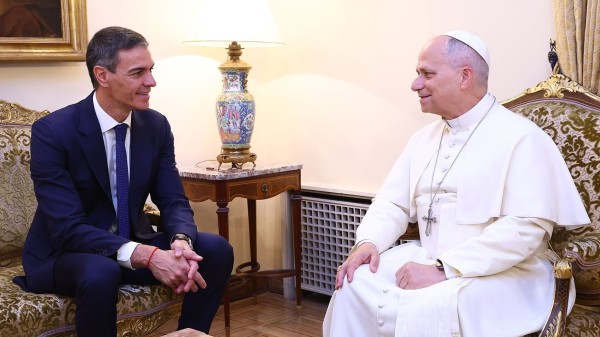
However, the “rotten egg” of the trip happened before the trip to Canary Islands, on June 8, at the Apostolic Nunciature in Madrid. The Pope’s highly anticipated meeting with six abuse survivors—lasting barely an hour and strictly managed by the local Catholic Church—was immediately criticized by victim advocacy networks as a controlled public relations exercise rather than a genuine attempt at solving once and for all the many issues related to abuse.
To be clear, there is nothing wrong there. It is a good sign, one of goodwill. Survivors who see having such meeting as a goal must have it. A problem in that respect is how access to such symbolic gathering was allocated and who grants or deny such privilege.
If, as several media outlets in Spain published, access to the meeting was dependent on obedience to a Catholic Church authority able to grant such wish, then even the very participation in such meetings becomes suspicious, to say the least, as it is possible to see in several Spanish-language outlets in these days.
The other issue is that for a good share of survivors meeting the Pontiff is neither a major nor a relevant goal. Many have left the Church and any practice associated with it after years, probably decades, of confronting the gaslighting tactics of diocesan curias pretending to do something but actually trying to derail the survivors’ efforts to achieve justice.
On top of that, many of them are fighting off dangerous, debilitating illnesses both physical and psychological related one way or the other with the abuse they suffered at some point in their lives. For them and for most victims, at least those who are not independently well off, the main concern is finding the necessary support to overcome the devastating effects of sexual abuse.
In both cases, given the limits a Pope has on his time when traveling, the best way to avoid the scandal soiling these meetings during Papal trips would be to address the issue of reparations.
And, as this series has emphasized as recently as May of this year in the story linked after this paragraph, the main problem when dealing with abuse is how systems of justice in each country deal with abuse happening within their territory. Back then, the series stressed the contrast between speedy probes, trials and sentencing when dealing with clergy abuse, Catholic or otherwise, in the United States, while in Latin America it is really hard to find reasons to be hopeful about actual change, by comparing the local systems of justice responses in Texas and Chihuahua.
Dismissing survivors
Despite that fact, it would be misleading to dismiss the Catholic Church’s own responsibility when dealing with clergy sexual abuse, as the Pope’s recent visit to Spain proves.
As this series has informed before, in Spain there was a recent agreement to let the Nation’s ombudsman rule on so-called “historic” cases, that is to say, cases where the statute of limitations or the death of the predator prevents action on penal courts.
However, such agreement came after an ill-fated attempt at the Catholic Church doing its own probe, that backfired when the number of cases was so low, even practicing Catholics in Spain had trouble believing such statistics. It was only then than the Catholic bishops in Spain had to accept the ombudsman’s intervention.
Despite that merit, the Pope’s visit to Spain was affected by how the Conference of Catholic Bishops got its way when setting up a meeting with a very small group of survivors who happened to have links to the so-called Repara (Spanish for Repair, content only in Spanish) project and how that entity is connected to the Archdiocese of Madrid (content only in Spanish). In that regard this is not a “gotcha moment” to try to discredit them.
The Archdiocese of Madrid is transparent when talking about its relationship with Repara. There one can read how Repara was “created by the Archdiocese of Madrid to provide care for those who are victims and to prevent abuse.” That is a plausible endeavor.
The Repara-Archdiocese of Madrid relationship is a known and documented fact, but precisely because of that it is harder to dismiss the criticism about who had a chance to meet the Pope. Was it just because of the abuse they suffered at some point in their lives. Was it because of the abuse they suffered, or because some Monsignor pushed their names ahead of others? Is the Church using access to the Pontiff as a “carrot” of sorts to reward the “well-behaved”?
Leo XIV himself had to acknowledge the difficulties in deciding how many victims would have the chance to meet him. Although there was no inflight press conference this time around, on his way to Spain, during an informal exchange with reporters on June 6, Leo XIV admitted being aware of the difficulties to select the six survivors who ultimately met with him.
Scarcity
Survivors understand time is a scarce asset during a visit, but the Vatican would also have to acknowledge that not all survivors are able to do long trips to Rome to meet with the Pontiff. More so when the cumulative experience of many survivors show that the actual chances of a solution to their cases coming from such a meeting are rather scarce. And also when taking into consideration how expensive it could be for survivors to do such trips.
But even if for whatever reason there was no way to accommodate the many requests for audiences, the way to free the Papal agenda from such demands would be to address the survivors’ substantial requests: reparations.
The Pope’s visit was also affected by some of the bishops’ devastating takes on the Pope’s response to abuse. During Leo XIV’s visit, Fernando Prado, bishop of San Sebastián (Donostia), in Northern Spain, openly admitted there were “other priorities,” when deciding how much time will the Pope spend with survivors (content in Spanish).
Prado came short of admitting a bias in choosing the victims, but the Spanish-language Catholic sphere was full of criticism towards Rome and Prado himself, as he saw fit to justify Leo XIV’s approach. The bishop claimed Leo XIV meets regularly with survivors from different countries in Rome. What is worse, Prado never accepted the existence of a bias in who was admitted and who was not at the meeting at the diplomatic representation of the Holy See in Madrid.
The meetings at the nunciatures have been a frequent source of conflict in Papal visits, as they reveal how some groups are able to shape the Pontiff’s agenda during such trips.
Back in September 2015, when Pope Francis traveled to the United States and Cuba, the meeting at the nunciature in Washington, D.C., became the source of tension as then Nuncio Carlo Maria Viganò, a now excommunicated cleric, brought in for a meeting with Pope Jorge Mario Bergoglio, Kim Davis, a former clerk in Kentucky, who became a figure of sorts of the opposition to gay marriage in the United States.
A few weeks after the incident, NPR published a report on how Davis was invited to the Nunciature, and the kind of gymnastics the Holy See had to perform to put the issue behind, as Davis saw the invitation as validation for her far-right politics and her stance against gay marriage.
Precedent
One year later, during his visit to Mexico, Francis avoided, as his predecessor, Benedict XVI did back in 2012, a meeting with victims of abuse. Even if that time there were no accusations of a bias or preference for some “type” of survivors as compared to others, as it happened in Spain this year, back in 2016, the unavoidable comparison was with the United States.
If one goes to the online Vatican archives, one is able to find how, on Sunday, September 27, 2015, Pope Francis met with survivors of clergy sexual abuse at the Catholic Seminary in Philadelphia. When one goes to the archive with the information about the 2016 visit to Mexico, there is nothing similar. A screenshot from the the Vatican's website for the trip to the United States appears after this paragraph.
The idea of a potential meeting of Pope Bergoglio with victims of clergy sexual abuse remained a possibility up the very last days before his arrival at Mexico City’s airport. Proceso, then a weekly magazine, ran a piece about the possibility for such a meeting weeks before the Argentine Pope’s arrival (content in Spanish).
Even if there are rumors up until today about a secretive meeting at the Mexico City Nunciature actually happening back in 2016, there is no way to prove or disprove it. The fact that ten years later, the meeting at the Nunciature in Madrid is also off the official books, unlike the one in 2015 in Philadelphia, reveals one of the most negative aspects of how the Catholic Church handles this issue and why it is hard to actually trust their commitment to finding a lasting solution to the issue.
If one goes to Vatican’s official schedule for Leo XIV’s visit to Spain there is no specific reference to a meeting with survivors as the one Francis had in Philadelphia a decade before. Nothing appears in the prime source, the Italian language version of the schedule, and nothing in either the English-language or the Spanish-language version of the schedule. How should one interpret such absence is anybody’s guess. A screenshot from the Pope's itinerary in Spain appears after this paragraph.
It would be possible for some, those in the crowd ever willing to find a positive spin in whatever a Pope does, to celebrate the fact that in Spain a meeting happened, as restricted as it was. That is an attitude closer to that of a cheerleader than to that of someone trying to actually address the clergy sexual abuse crisis.
Known unknowns
To further complicate the issue, one must keep in mind that the meeting at the Nunciature in the capital of Spain is not the only case when, for reasons only known to the Papal Household, such meetings are not part of the official record.
As this series has proved, the Holy See under Leo XIV is actually unwilling to acknowledge the very existence of those meetings as official acts of the sitting Pontiff, as they are absent from the Holy See’s official record, the so-called Bollettino, the daily publication offering a summary of the Pope’s official public activities for any given day.
In some cases, the only record of these meetings comes from survivors willing to share pictures over social media or when they offer details of the meetings to a specific medium. In some other cases, there is a record over at Vatican News, the Holy See’s media operation, but there is no guarantee as to whether or not the coverage will be homogeneous over all its editions.
The differences in how Vatican News hides or highlights certain aspects of Rome’s take on the clergy sexual abuse are beyond anecdotical, as they reveal how the Catholic Church itself sees its own audience’s response on the issue as varying depending on the language. The story linked after this paragraph goes into the details of how different is Vatican News’ coverage of the Catholic hierarchy’s performance on the issue.
There is, in this respect, a clear clash, a contradiction, between his prophetic take on migration in the Canary Islands, an archipelago off the coast of West Africa and how he and major figures in the Catholic Church’s hierarchy, systematically undermine their will to speak truth to power when the very hierarchy of the Catholic Church is unwilling to actually move forward on the issue of abuse.
Again, as this series has proved, the major advances, the real improvement survivors are able to experience, probably with the exception of what is happening these days in France and Germany, comes from the ability of the national systems of justice to actually probe and punish sexual abuse.
A measure of justice
Main problem as of now is that, putting aside France and Germany, jurisdictions such as Mexico or Peru where it is clear that the national judiciaries are unable to deliver a measure of justice to survivors, the Catholic Church remains unwilling to go beyond the liturgies of pardon and repentance as it happened in late May in Peru with the victims of land grabs for the benefit of the Sodalitium.
As the story linked after this paragraph proved at the time, even in that case it is really hard to grasp how committed is the actual Catholic Church with finding a solution to the issue. Yes, Cardinal Carlos Castillo Mattasoglio presided over a funeral Mass for one of the victims of the land grabs in rural Peru, and he did so with the help of a very small group of bishops.
It is possible to believe that Castillo, a close ally of Prevost, is actually bothered and worried by the scale of the abuse at the Sodalitium. More so as he has been a permanent target of a campaign from the now suppressed “order” and its allies in the United States.
The problem is how other bishops, especially those who were not celebrating that Mass in the epicenter of the land grabs by the Sodalitium see this issue. In other words, is the comeuppance about the Sodalitium limited to Pope Prevost, Cardinal Castillo and the most loyal in the Peruvian Conference of Catholic Bishops?
Is this just a case of selective rage, a religious organization capable of calling out the objective excesses of both Brussels and Washington, D.C. when dealing with migrants, but unable to teach itself how to avoid conflict when dealing with clergy sexual abuse?
The question is harder to answer when one puts aside the attempt at suppressing the Sodalitium, and wonders why other predatory and sectarian organizations, such as the Legion of Christ, Opus Dei or the Institute of the Incarnate Word get a pass for their behavior.
If that is the case, Pope Leo XIV’s recent trip to Spain as much as his recent encyclical dealing, among other issues with the risks of Artificial Intelligence, would be nothing but the performance of the head of an administrative apparatus that prioritizes factional alignment over universal mission, and a philosophical critique of technology that fails to accept that a share of the Catholic Church’s own current troubles stem from its own rather blind adherence to an “algorithm” of sorts dictating how to deal with abuse.
The issue is more relevant as this trip to Spain was one of the last managed, media wise by Matteo Bruni, the current prefect of the Dicastery for Communications, as by this year’s end, it is expected that María Montserrat Alvarado will take over.
One must wonder about the appointment not only because of Alvarado’s current position as head of EWTN, a conservative media operation that made a name for itself supporting some of the worst causes the Catholic Church in the United States has endorsed, as in the case of the systematic, relentless siege on Pope Francis and whatever decision he was willing to take as Pontiff.
Ecosystems
Again, there is a whole ecosystem of Catholic media intent on supporting whatever decision Pope does at any point even if such decision stands in clear contradiction with a relatively recent decision in an opposite way. Such approach is as dangerous when trying to understand complex institutions as the Catholic Church as it was EWTN’s attitude towards Pope Francis.
Alvarado’s appointment is more troubling as more details of other troubling associations with the U.S. and Latin America far-right emerge. The fact that she is about to become the guardian of the Pope’s communication and the Vatican’s media operation at a time when the Catholic Church desperately needs transparent, genuinely universal crisis management to handle systemic rot, there are few reasons to be hopeful about this development as her record suggests an inability to shed partisan, ideological baggage.
If EWTN stood for something was, as one of many possible examples, to dismiss the accusations of clergy abuse at the Sodalitium and at many other “order-like” similar organizations or movements with a clear sectarian profile. Even if EWTN’s stance on the Sodalitium was the consequence of the influence Alejandro Bermúdez Rosell has there and not necessarily Alvarado’s choice, it is hard to imagine a radical change in EWTN attitude towards the Sodalitium and what needs to happen in Peru, and other countries, including the United States, to actually suppress that organization and, above all else, to actually repair the damage caused to their many victims.
One must keep in mind that in Peru, Bermúdez and his allies remain opposed to the very idea of abuse ever actually happening at the Sodalitium. They insist that the whole set of accusations leading to its suppression is a hoax, the same way Donald Trump insists he was the victim of election fraud in 2020: with little or no evidence and with open disregard for the rulings against them, turning the issue, instead, into a cultural battle.
If that was not enough, they claim there was no crossed ownership between the Sodalitium and the façade non-profits created and managed by that order-like organization.
Sadly, regardless of expectations, Alvarado’s appointment seems poised to make it harder for Vatican News to foster a global, objective, and credible communication apparatus capable of navigating a complex media landscape. Her appointment signals a retreat into defensive, factional optics, leaving the Holy See unequipped to provide truly universal coverage or transparent accountability.
And even worse, her appointment seems to stand in contradiction with the need to curb the kind of sectarian attitudes so common in the far-right Catholic ecosystem where EWTN is what Fox News is to the U.S. political landscape. In the context of Leo XIV’s pastoral trip to Spain, this matters because control over communication shapes how events such as the restricted meeting with survivors are framed—or ignored.
If anything, EWTN proved repeatedly how willing it was to challenge Pope Francis’s takes on migration, just to name the most obvious of them all, but it was even sharper when he decided to restrict the use of the so-called Latin Mass because of how EWTN-adjacent organizations attack, up until today, Pope Paul VI’s decision to modify how Mass is celebrated in the Catholic Church.
The issue is more relevant as the Church confronts a real need to figure out how to perform as the moral guardian of the West when dealing with the risks of Artificial Intelligence. In that regard, Leo XIV issued back in May his first major theological document, Magnifica Humanitas, dealing among other issues with the risks of extreme dependency on Artificial Intelligence.
The document, a so-called encyclical, is useful on its own, as it stresses some of the major risks stemming from the abuse of such technology, but it also provides a teachable moment for the Catholic Church itself.
If one tries to find one of the systemic causes of the clergy sexual abuse crisis in the Catholic Church it would be really difficult not to see the rather large corpus of documents dealing with human sexuality, sexual ethics, and other issues as a prototypical Large Language Model (LLM) that the Catholic Church has been building for the last 20 centuries or so.
The main problem of such LLM is not the absence of information or data. It is how, when dealing with the information and data contained in such corpus, the prime directive of the Catholic Church itself, its own algorithm is not its members’ wellbeing, but the Catholic Church’s prestige, and how to protect it: institutional self-preservation.
The history of the clergy sexual abuse crisis is, in that regard, the history of how the Catholic Church, its bishops, priests and many of its most ardent lay members do their best to dismiss any accusation of clergy sexual abuse with little or no respect for the survivors.
If the Catholic Church wants to show the world how to avoid the many traps of a one-sided algorithm, the risks of a prime directive enforced above all else, it can do it by breaking apart its own prime directive, its own algorithm, when dealing with clergy sexual abuse and replacing the institution with the dignity of the survivors, just as Leo XIV asked the European Union and the United States to do so when defending the dignity of the migrants in the docks of Gran Canaria.
* * *
A summary of this piece is available as audio after this paragraph.
Your browser doesn't support HTML5 audio. Here is a link to the audio instead.
Note on production: The text of this summary was written and edited solely by the author. The delivery of the audio summary was achieved using a high-quality, text-to-speech engine Microsoft Word for Web. The AI was used for voice generation only, not content creation.