
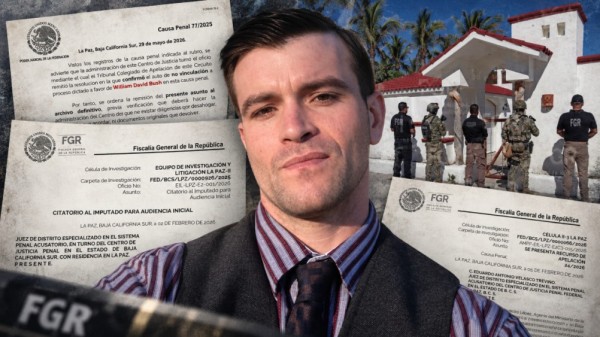
Guadalupe Lizárraga Jueves, 17 de Septiembre del 2026
Court records document allegations against William Bush involving dispossession, drugs and firearms, an unlawful detention and an ongoing prosecution over 17 cartridges.
The Punta Pescadero residence claimed by William Bush remained under government control even after the dispossession case against him was rejected by a federal judge and closed on appeal.
PART I
By Guadalupe Lizarraga
Updated 11:12 AM h, September 17, 2026.
LA PAZ, Baja California Sur — A dispute over possession of a residence in Punta Pescadero has left William David Bush facing the threat of pretrial detention over 17 cartridges allegedly found during a search by Mexico’s Attorney General’s Office, the Fiscalía General de la República (FGR). By then, the same property had already led to a dispossession charge, investigations involving drugs and firearms, and a detention that a federal judge declared unlawful.
Bush, a U.S. and British citizen, provided Los Ángeles Press with court files, prosecutorial records, interviews conducted by the Federal Ministerial Police, appeals, documents from the Institute to Return Stolen Property to the People (INDEP), official correspondence and complaints filed against officials of the Fiscalía General de la República.
The records reconstruct how criminal charges were built, one after another, around the same property and the man claiming possession of it.
On August 28, 2026, Bush said he was warned that he would face pretrial detention in criminal case 25/2026 over possession of ammunition reserved for Mexico’s Army, Navy and Air Force. Only days earlier, he told Los Ángeles Press, a court in La Paz had authorized him to travel to the United States for work without objection from the prosecutor handling the case.
Bush says that same prosecutor proposed that he accept responsibility for the cartridges found inside the residence in order to avoid prison. He also says the official told him he would face personal consequences if he withdrew the charges he had filed.
The immediate origin of that prosecution was a search carried out on December 18, 2025. By then, the criminal dispute surrounding the Punta Pescadero residence had been underway for more than a year.
The Punta Pescadero house
The residence is located on Vía del Sol, Lot 29, in Punta Pescadero, in the municipality of La Paz. The property had been seized in 2008 as part of a preliminary investigation by the former Attorney General’s Office, the PGR, and over the years came under federal administration.
INDEP identified it as SIAB 1857505 and contracted security services under agreement INDEP/00289/2022. Years later, the case against Bush would state that a company identified as CEPIVER — referred to as SEPIVER in other records — was responsible for guarding the property.
On July 5, 2024, one of the company’s security guards reported that people were inside the residence, that the notice indicating the property was under federal custody had been removed, and that he found a document from the Federal Electricity Commission connected to Bush.
Based on that report, the FGR accused Bush of secretly occupying the property and preventing the security company from carrying out its work, conduct prosecutors said had deprived INDEP of the administrative possession it claimed over the residence.
Eighteen days later, on July 23, the FGR opened investigation FED/BCS/LPZ/0000503/2024.
The investigation first reached court as CP 15/2025. A hearing scheduled for March was canceled after the defense requested an alternative dispute-resolution mechanism, and the case was placed in administrative archive, although the FGR kept the criminal action open.
Bush told Los Ángeles Press that he refused to sign the documents proposed under that mechanism because he believed they would affect the legal position he maintained over possession of the property. He also asked that INDEP participate directly in any agreement.
The same investigation was later brought back to court as CP 77/2025.
The request for an initial hearing was dated April 24, 2025. Article 310 of Mexico’s National Code of Criminal Procedure provides that when prosecutors ask the court to summon a person who is not in custody for an initial hearing, that hearing must be held within 15 days of the request. In Bush’s case, the hearing did not take place until April 17, 2026, 358 days later. An administrative complaint filed by Bush documents months of postponements, translation requirements and other proceedings that left his legal situation unresolved.
During that period, the property remained tied to separate FGR proceedings. The delay left Bush’s legal situation open for nearly a year while the residence remained subject to measures imposed under different case files.
On April 17, Judge Eduardo Antonio Velasco Treviño issued an order declining to bind Bush over for trial. The FGR appealed, and a federal appellate court upheld the decision. On May 29, 2026, CP 77 was permanently archived.
By then, the Fiscalía had already opened another criminal case involving the same residence.
From a drug complaint to an interview about firearms
While the dispossession investigation remained open, the FGR opened another case file in 2025: FED/BCS/LPZ/0000926/2025.
Among its records is an anonymous interview dated November 30. The person questioned said they knew William and knew where his residence was, although the form contains no name, identification, telephone number or other information that would make it possible to identify the supposed witness. The statement did include one qualification: the person said they did not know whether Bush sold drugs.
Eleven days later, another interview was recorded.
Federal Ministerial Police agent Víctor Irán López Vallejo is listed as the interviewer. This time, the document attributes to a man identified as Juan Carlos Fuentes Meza the claim that he had seen William carrying a firearm in his waistband and had heard gunshots coming from the property. The form states that the interviewee did not provide identification, and the second page does not contain a clear signature in the space reserved for the witness.
Juan Carlos Fuentes’s information was not new to the FGR. In January 2025, during the investigation into the alleged dispossession, the same agent, López Vallejo, had conducted another interview with Juan Carlos Fuentes Meza. That document contains his address, occupation and personal information, a signature in the section corresponding to the interviewee and a copy of his identification.
Interview attributed to Juan Carlos Fuentes Meza, included in case file FED/BCS/LPZ/0000926/2025. Unlike the anonymous statement, this form does include his name, address and other personal information, although it states that the interviewee “did not present” official identification. Document: PGR.
Months later, the second interview used those details and added the allegations involving a firearm and gunshots.
Bush located Juan Carlos and showed him the document. According to a complaint later filed against Víctor Irán López Vallejo, Fuentes denied having given that statement, denied having seen William carrying a firearm, denied hearing gunshots, denied writing or signing the interview and denied authorizing the use of his personal information. He also expressed his intention to obtain legal advice so he could appear before the authorities and formally correct the record.
Bush then filed a complaint against López Vallejo over the possible fabrication of the interview and asked investigators to determine who placed it in the case file, who knew its contents and whether it was used before a judge to obtain the search carried out one week later.
The documents establish a central point in the fabrication: by January, the FGR already had Juan Carlos Fuentes’s name, address and identification. In December, a new interview attributed to the same man appeared without identification or a clear signature and introduced allegations involving firearms and gunshots that Fuentes says he never made.
A narcotics search ends with cartridges
On December 17, 2025, an investigative measure involving the Punta Pescadero residence was authorized, and the FGR carried out the search the following day.
Information released after the operation said the intervention had originated with an anonymous complaint involving a possible drug offense. According to that version, a foreign man was selling narcotics in Punta Pescadero, and the Public Prosecutor’s Office had gathered the information needed to seek judicial authorization for the search.
Ministerial records prepared later describe the same case as an investigation involving Mexico’s Federal Firearms and Explosives Law.
The discrepancy appears even within a single FGR document. A summons in which the Public Prosecutor’s Office requested an initial hearing for William Bush on February 2, 2026, states in its opening pages that criminal proceedings were being brought for possession of ammunition. On another page of the same electronic file, however, appears Article 476 of the General Health Law, which concerns possession of narcotics for purposes of sale or supply. The electronic validation attached to the document certifies that the signature is valid and that the file has not been altered.
The full warrant application should show which alleged offense, testimony and evidence prosecutors presented to the judge who authorized the search.
The outcome of the search is recorded in the FGR’s own files: no narcotics were found. Agents reported finding 17 cartridges.
The inventory lists 11 rounds marked “9MM AGUILA,” another five of the same brand and one deteriorated cartridge. The FGR catalogued the ammunition and seized the entire residence, although the records reviewed contain no comparable inventory of the furniture, equipment and personal belongings that remained inside when the seals were placed.
That finding led to CP 25/2026, for possession of ammunition reserved for the Army, Navy and Air Force.
Bush says he did not know the ammunition was there and was not at the property when the search was carried out. He maintains that no evidence places him buying, handling or putting the cartridges inside the residence. He also told Los Ángeles Press that Juan Carlos Fuentes said the cartridges had been planted.
Determining who placed them inside the residence will require a review of the complete video recording of the search, the photographs taken when the evidence was found, the exact location of each item and the chain of custody from the moment the cartridges were collected.
Bush reported damage weeks after the search
On January 17, 2026, Bush wrote to FGR officials and the Federal Criminal Justice Center asking for the complete search report and a copy of the judicial order authorizing entry into the residence.
In the same email, he reported damage inside the house and missing property, and asked which authority was responsible for the police and military intervention carried out in Punta Pescadero.
The residence remained under government control when, on January 31, federal agents found Bush inside the property and detained him. The episode gave rise to investigation FED/BCS/LPZ/0000066/2026 and criminal case CP 24/2026.
The appeal later filed by the FGR itself states that the agents had gone to the property because the seals were no longer in place and intended to reinstall them.
The judge who reviewed the detention declared it unlawful. During the hearing, he said that the authority responsible for securing a property was required to establish effective measures to preserve it and questioned how Bush could be treated as having been caught in the act when the exterior seals were not in place and custody of the residence was the responsibility of the Fiscalía itself.
The FGR appealed that ruling.
Months later, William reported that police officers had entered and remained inside the house, used sofas, the kitchen, refrigerators and other property, and that the residence had been damaged and belongings were missing. In his complaint, he asked authorities to preserve access logs, security records, inventories, keys, photographs and the names of the officers responsible for guarding the property.
“Five criminal accusations, all bullshit, drained me of resources, used a falsified investigation excuse to seize my residence, and then they trashed my house, and the police were camping sleeping inside my house using my kitchen, bathrooms, sleeping on my couches while claiming it was federally sealed under protection,” Bush told Los Ángeles Press.
That warning took on added significance: the same authority that had seized the residence was also responsible for protecting it.
The seizure shifts to another case file
On March 4, 2026, the FGR ordered another seizure of the residence, this time under investigation 0503/2024, the dispossession case. The house was described as the alleged object and instrument of the offense and ordered preserved to prevent its alteration, concealment or destruction.
On April 6, prosecutor Luis Alberto Vázquez López reported that there were no further investigative steps to be carried out regarding the property in 0926/2025, the investigation connected to the search and the cartridges. In the same official act, he placed the residence at the disposal of the prosecutor handling the dispossession investigation.
Eleven days later, the court declined to bind Bush over for trial in CP 77.
The FGR’s appeal did not change that result. The federal appellate court upheld the decision, and CP 77 was permanently archived on May 29.
The house remained under government control.
The documents reviewed do not show that the residence was returned to William, that a complete exit inventory was prepared or that possession was ever formally restored after the case was closed. In May, the FGR acknowledged that the house remained at its disposal and under seal. During the same period, it maintained that Bush’s personal belongings were not formally under seizure.
Bush also told Los Ángeles Press that INDEP has opened an internal investigation into the handling of the property. He maintains that the agency cannot continue administering a property indefinitely once court proceedings have ended, unless there is an active investigation or an asset-forfeiture proceeding that provides a legal basis for continued federal control.
According to Bush, the Punta Pescadero residence remained under federal administration for years while payments to private security companies continued, a practice he considers irregular and which, he says, may have involved the misuse of public funds.
Official letter EIL-LPZ-E2C3-411/2026, signed on April 6, 2026 by federal prosecutor Luis Alberto Vázquez López, in which the FGR stated that no further investigative steps remained regarding the property in case file 0926/2025 and placed it at the disposal of the prosecutor handling the alleged dispossession case. The document also confirms that the residence remained under surveillance by the State Preventive Police.
“Hundreds of thousands of dollars in theft from the property while under FGR control,” Bush said.
Investigation 0503/2024 returned to court on July 14, 2026.
The new proceeding was registered as CP 145/2026 and identified CP 15 and CP 77 as prior cases.
Bush again requested the return of the property, an inventory and a review of the seizure. On August 10, the judge held that he lacked jurisdiction to review the Public Prosecutor’s refusal to return the residence. Bush filed an appeal.
The same dispossession investigation had by then generated three criminal cases.
The threat of prison now rests on 17 cartridges
The case that now places William Bush under threat of imprisonment is CP 25/2026.
Bush told Los Ángeles Press that the prosecutor handling the case proposed that he accept responsibility for the ammunition in exchange for an outcome that would keep him out of prison. According to his account, the official also told him that he would face personal problems if he withdrew the charges he had filed.
Only days before August 28, a judge in La Paz had authorized William to travel temporarily to the United States for work, and the Fiscalía had raised no objection.
He was then warned that he could face pretrial detention in the same case.
The prosecution over the cartridges stems from the search that was publicly presented as part of an investigation into the sale of narcotics. Agents found no drugs.
Among the interviews obtained before the operation is the statement attributed to Juan Carlos Fuentes, in which he supposedly said he had seen William carrying a gun and had heard shots coming from the property. Fuentes denies making those statements, and the agent who produced the document already had his name, address, occupation and identification from months earlier.
By then, the dispossession charge had been rejected by a federal judge and that decision upheld on appeal, while William’s detention inside the residence had been declared unlawful. The house nevertheless remained under government control and tied to different investigations opened by the Fiscalía.
The case involving the 17 cartridges keeps open the possibility that William Bush could be sent to prison. The FGR will have to explain what evidence establishes that the ammunition was in his possession and what evidence it presented to the judge to obtain the search warrant that allowed federal agents into the residence where the cartridges were allegedly found.
---
If you have information, documents or records related to this case, you may contact the author at info@losangelespress.org. Requests for confidentiality will be respected.