
Rodolfo Soriano-Núñez Lunes, 14 de Septiembre del 2026, 00:00
Catharina Verboonen, a Brazilian prosecutor, issued a 17-page statement to archive a years-long probe of the sectarian and abusive practices at the Heralds of the Gospel or Arautos.
Besides powerful supporters in Brazil, the Arautos, an order founded in 1999, are Colombian President De la Espriella’s favorite brand of intransigent Catholicism.
By Rodolfo Soriano-Núñez
This is a story about how a Latin American nation acknowledges its inability to offer a measure of justice to its citizens and whoever is a victim of a crime in its territory. This is not an opinion of who writes these lines.
That is the final resolution of a Brazilian government official who is neither exonerating nor dismissing the crimes perpetrated against young aspirants to join the Heralds of the Gospel, or Arautos do Evangelho, a relatively new order-like religious organization founded in that country in 1999.
The officer, São Paulo State Prosecutor Catharina Verboonen (content in Portuguese), explains this over 17 legal sized pages of an official document. While she repeatedly characterizes the Arautos’ practices as reprehensible and acknowledges several human-rights violations, her document ultimately concludes that criminal prosecution is impossible.
It is a story that ends, at least up until now, in São Paulo, one of the largest metropolises of Brazil and Latin America, but with roots and branches in other Latin American countries, in Canada, and all over the Catholic world, as the Arautos have been able to develop, through their close relation with Tradition, Family, and Property, a political action committee of sorts originally founded in 1960 in Brazil by Plinio Corrêa de Oliveira.
It is impossible at this point to go deeper into the origins of the Arautos and how they crown, in more than one respect, Corrêa de Oliveira’s political and religious project in both Brazil and Latin America at large.
Traces of Tradition, Family and Property’s ever-expanding influence in different polities are evident for whoever wants to look at them, in Brazil, where they support the Bolsonaro family, in the English- and German-speaking worlds, where there are sister organizations bearing some variation of its original Portuguese denomination as Tradição, Família e Propriedade or simply “TFP” as it is known for short in several western languages.
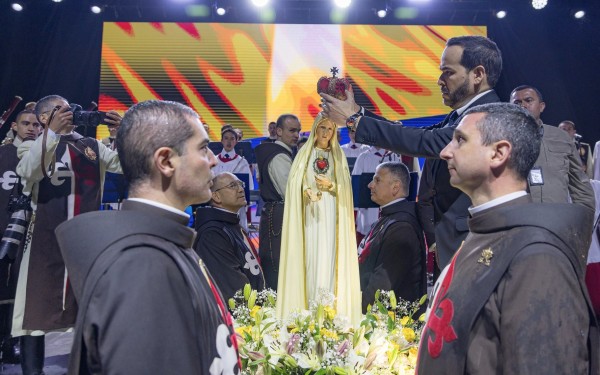
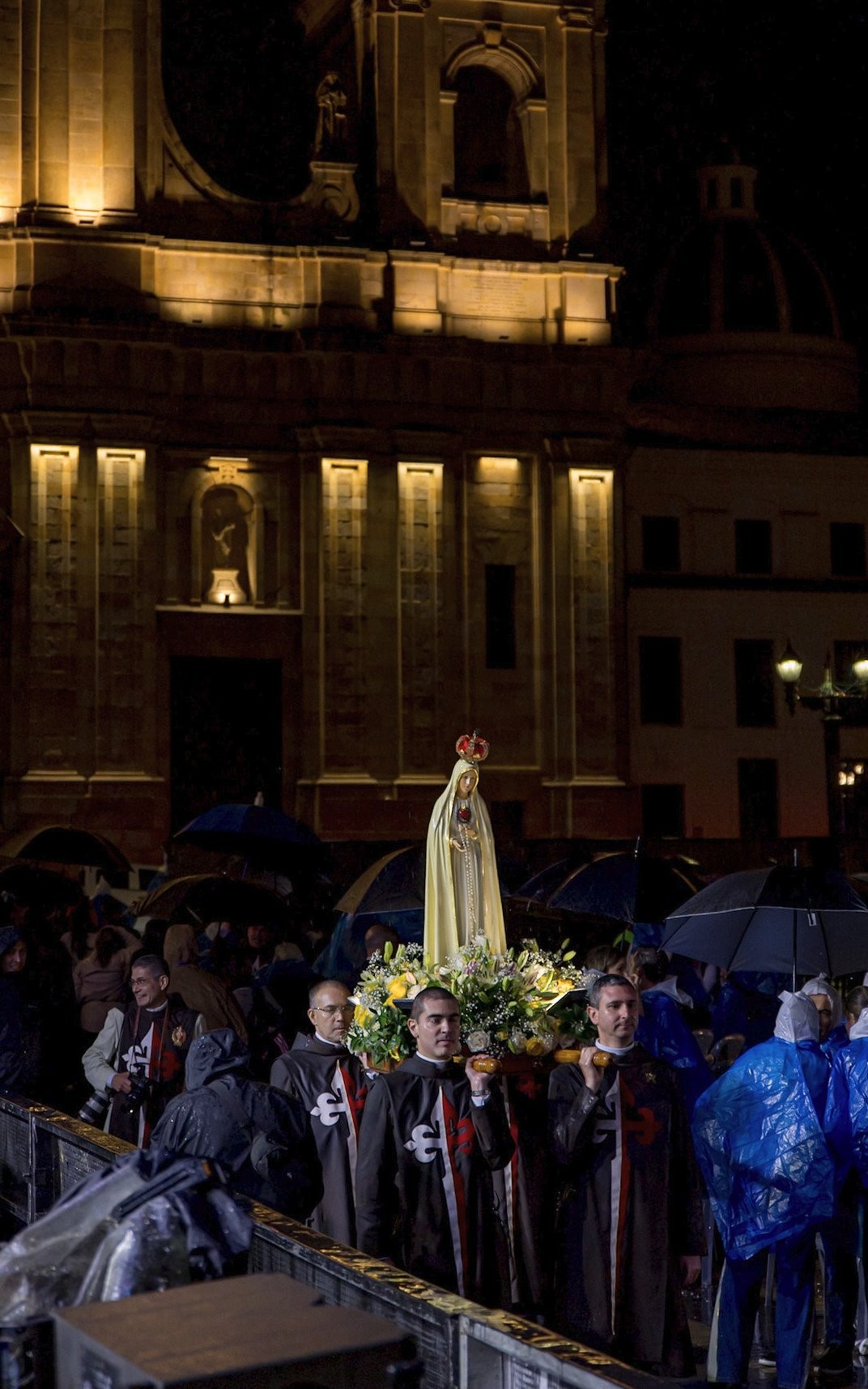
In Latin America, the most recent and massive expression of TFP’s influence happened on Friday August 28 at the Bolívar Square, a landmark in Bogotá, Colombia, where Abelardo de la Espriella, the recently installed President, attended a massive public vigil organized within the context of the Colombian government response to the August 10 earthquakes.
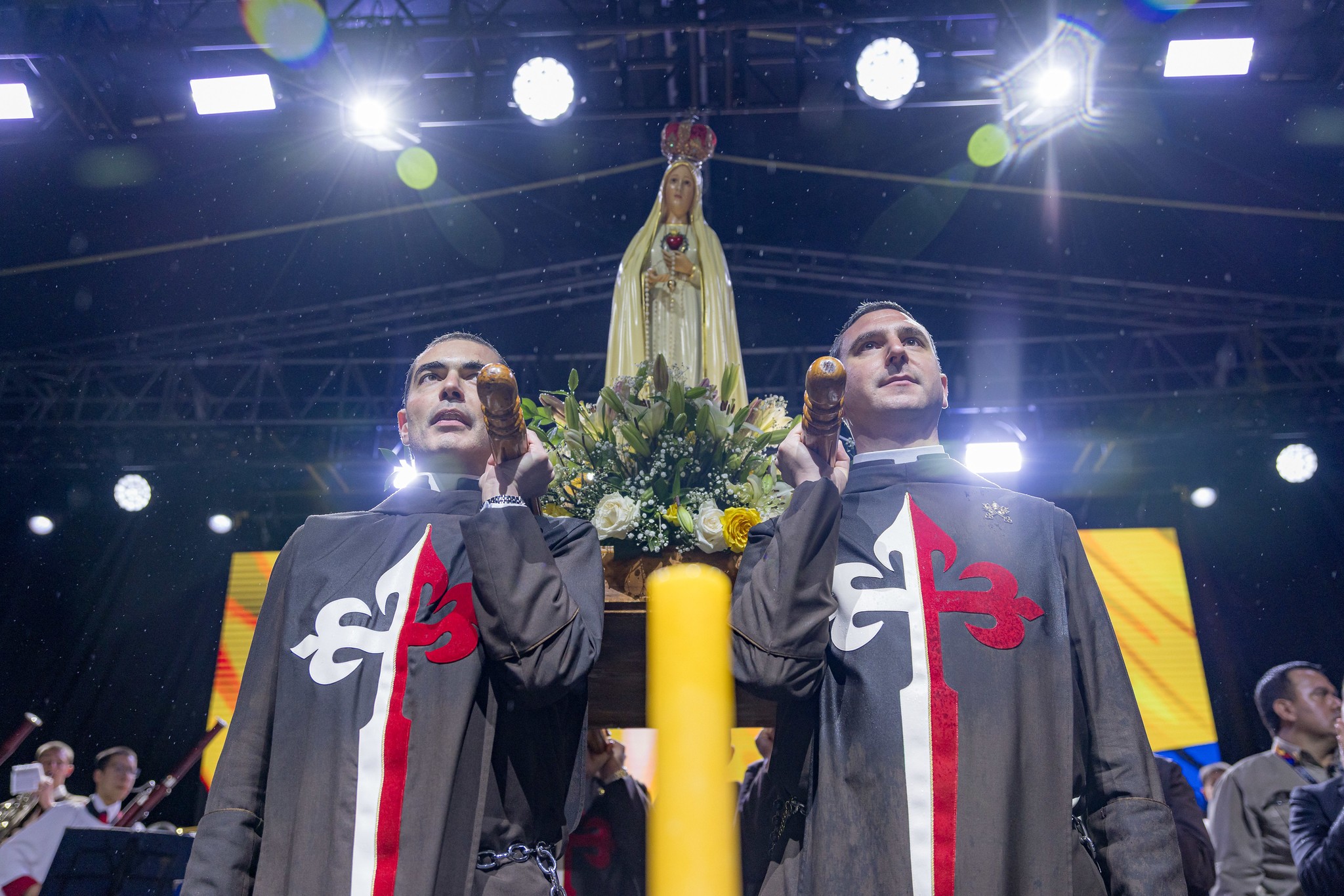
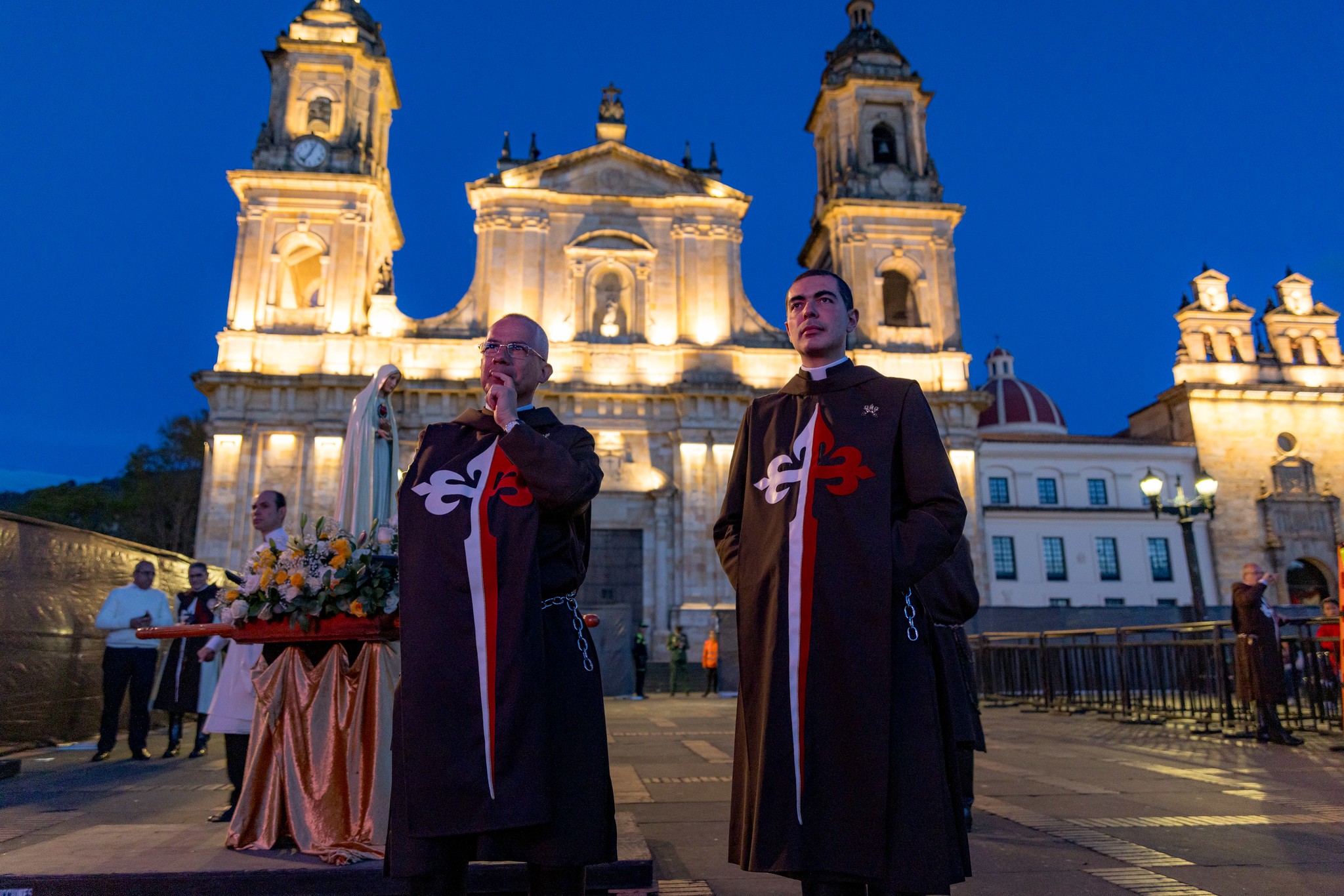
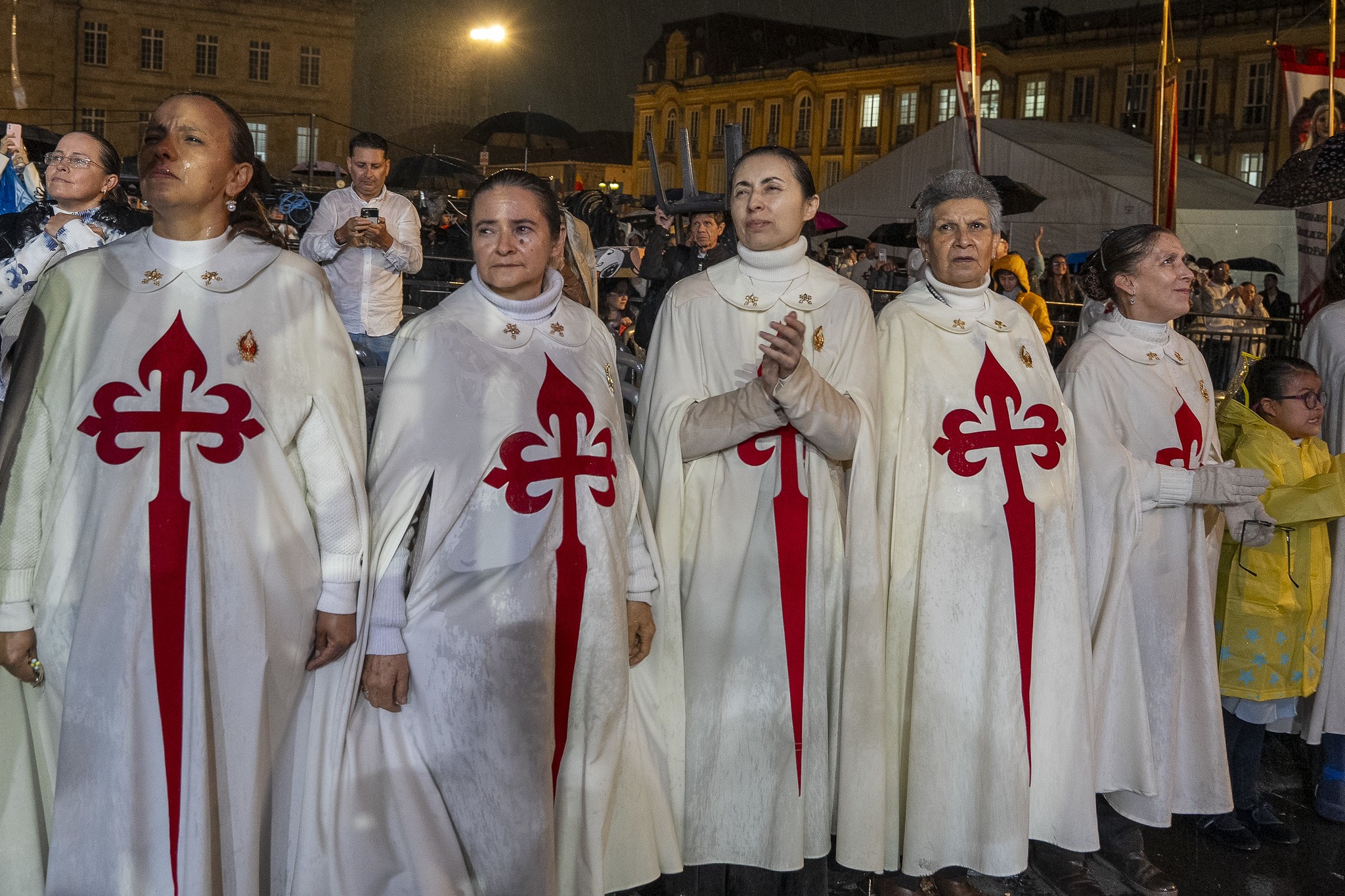
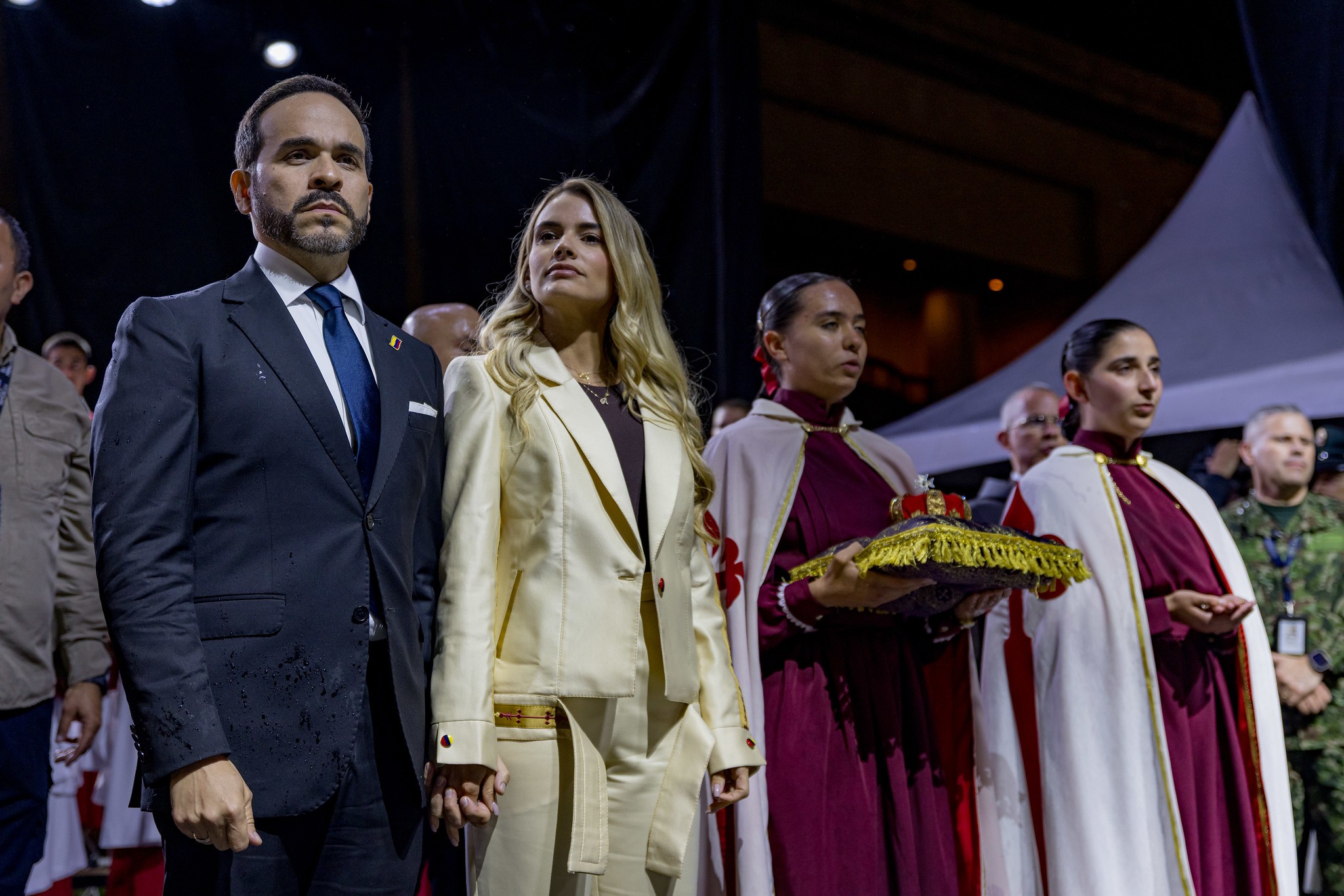
Among the many celebrities, politicos, and captains of industry attending, it was possible to see, dressed in their peculiar, knee-length “medieval-style” tunics designed to show off high riding boots—a far cry from any traditional floor-length friar's habit—at least six priests from the so-called Knights of the Virgin, a branch of the Arautos family, who helped De la Espriella to crown a sculpture of Our Lady of Fatima.
In that respect, even if today’s is a story about how the authorities of São Paulo state, Brazil, with roughly 45 million inhabitants, almost as many inhabitants as Argentina or Canada have on their own, acknowledge reprehensible practices and yet only conclude prosecution is impossible, it has repercussions all over the Catholic world.
Not only because São Paulo is Brazil’s economic engine and the most populous state, but because before his April 2025 death, Pope Francis had launched, at the bequest of Brazilian prelates, a probe, a so-called Apostolic Visitation, of the Arautos.
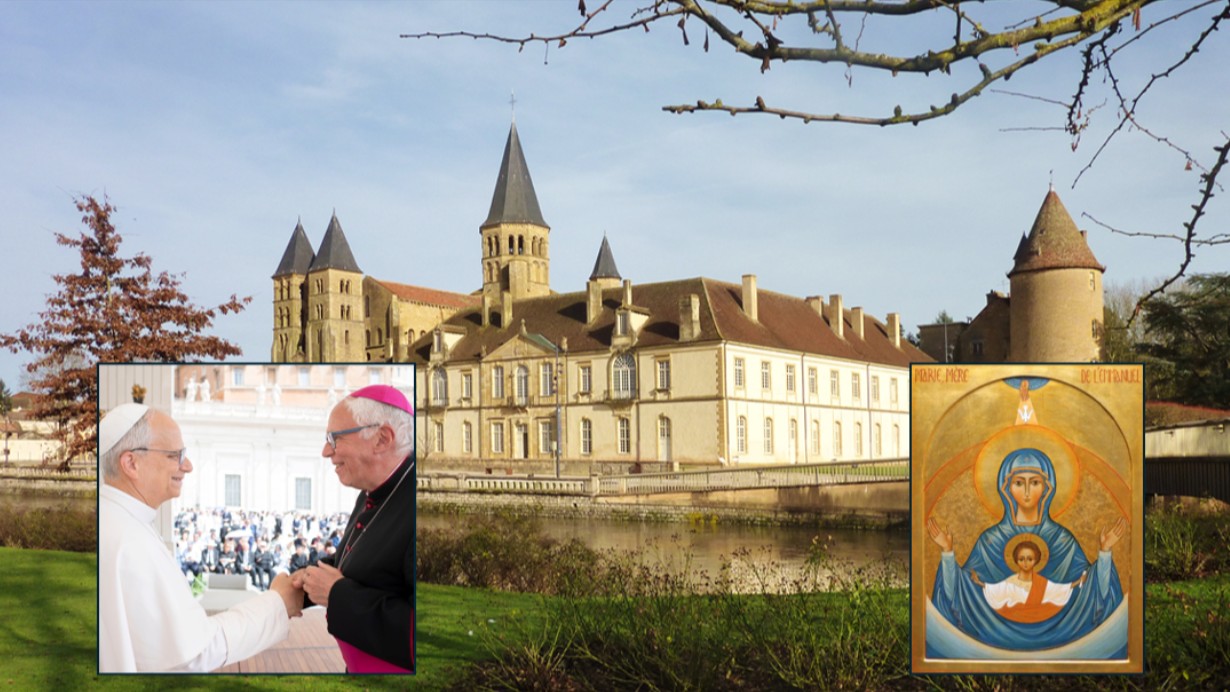
Previous installments of this series, linked before and after this paragraph have explained what an Apostolic Visitation entails as a mechanism used by the Catholic Church to intervene in a diocese or order, and probe what is happening there.

One only needs to compare the nothingness emerging from Brazil and Latin America at large, with the kind of developments currently surfacing in France, where over 200 Catholic priests and religious, women and men from 37 different dioceses or orders signed an open letter asking Pope Leo XIV to really address the root causes of clergy sexual abuse in their country (content in French).
The Arautos case is more relevant as, despite the many failures in the Brazilian Conference of Bishops handling of the clergy sexual abuse crisis, similar to the rest of Latin America, as it has been unwilling to come forward and acknowledge the true scale of the clergy sexual abuse crisis in its dioceses and orders, as it has happened already in the United States, Canada, France, Germany and Spain, it is necessary to stress that Francis launched the probe in response to Brazilian prelates’ requests to do so.
The Arautos themselves blame Brazilian bishops for the Apostolic Visitation. Following some of the most common strategies in the Catholic Church to try to influence the response from the Roman Curia and, ultimately, from the sitting Pontiff, they published a book and countless pieces over their magazines and websites, not only in Portuguese, but in as many Western languages as they are able to do so, to portray themselves as the victims of overzealous Brazilian prelates unwilling to acknowledge the value of their work.
Ever since Pope Francis’s death, the very active social media operation of the Arautos has been trying to put pressure on Leo XIV to put an end to the Apostolic Visitation and ultimately to let them go to their practices that include the enrollment of underage candidates to religious life in “internados,” that is to say boarding schools, where the students are under the absolute control of the religious orders running these facilities.
In some cases, these boarding schools are even rendered as seminaries, so-called minor seminaries, but the fact is that already during Benedict XVI Rome did its best to discourage the practice of having these kinds of “minor seminaries,” as they have been identified as places prone to different types of abusive practices.
That is where many of the most damaging practices acknowledged in Verboonen’s memorandum happened, and those “minor seminaries” are frequent targets of accusations. Also, they have become the hill where many of the most sectarian organizations decide to die challenging Rome rulings.
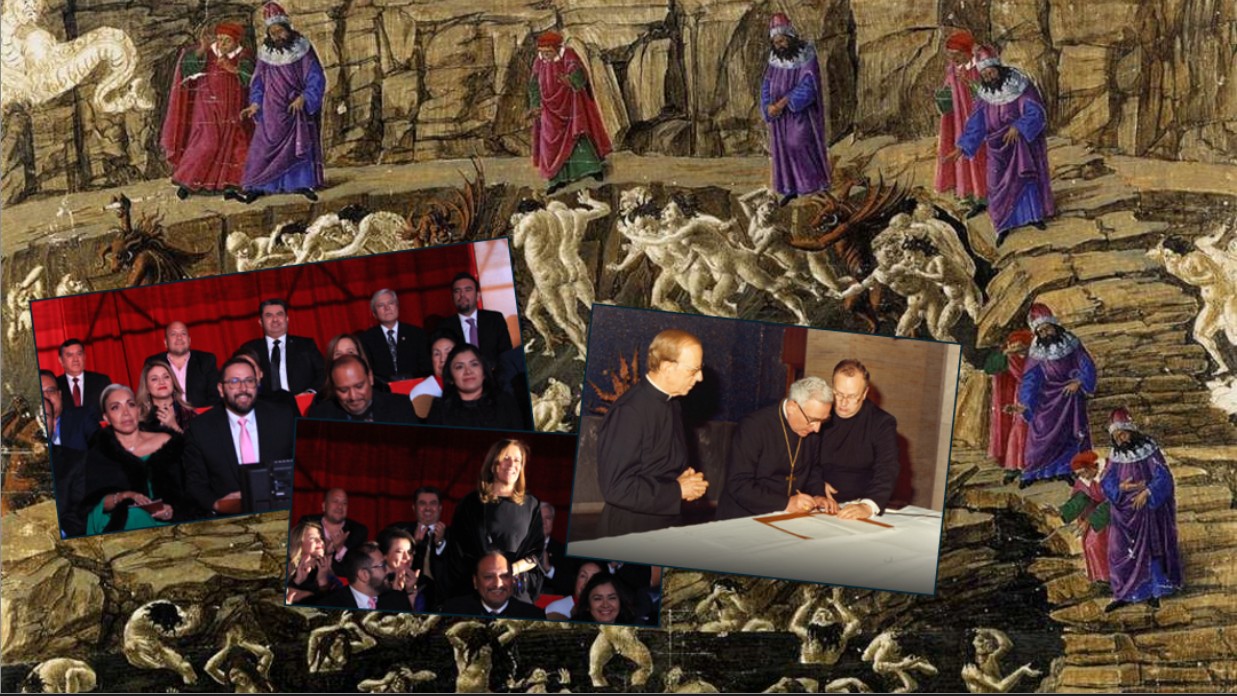
In the “Post Data” section of the story linked after this paragraph, there is an example of how Isidro Puente Ochoa, a priest of the Mexican archdiocese of Tijuana, who was authorized by a former head of that diocese to run a “minor seminary” was rather willing to enter into a schism with Rome, with support from Traditionalist organizations in the United States, than to accept the new rules forbidding the enrollment of underage candidates to religious life.
It is relevant to emphasize that, for the most part, the Arautos’ reaction against the Apostolic Visitation and the intervention happens not in Portuguese, but in Italian and, up to a certain extent in English.
To see how the Arautos have been challenging the restrictions set by Rome on their operations one must scour the web for “Araldi del Vangelo” (Italian for Arautos do Evangelho) and read what they publish regularly on two primary platforms. The first operates out of www.araldimissioni.it as their official Italian portal and blog.
While framed as a devotional site, it has been used to push back against the Vatican intervention. Under sections like “Araldi del Vangelo Commissariati” (and related press releases published alongside their international media campaign), they host statements criticizing the 2017 Apostolic Visitation and the 2019 Pontifical Commissariato ordered under Pope Francis.
Their messaging frames the intervention as an act of persecution by overzealous Vatican/Brazilian hierarchy, alleging a lack of due process, procedural irregularities, and an ideological attack on Traditionalism, a rather complex subculture of Catholicism, close in some aspects to schismatic organizations such as the Society of Saint Pius X, that claim, despite those affinities, to be “truly Catholic.”
The second outlet is Rivista Araldi del Vangelo (www.rivistacattolica.it), loosely translatable as Review of the Heralds of the Gospel. It is the Italian edition of their official monthly Portuguese publication (Revista Arautos do Evangelho). Alongside spiritual and biographical pieces on their founder João Scognamiglio Clá Dias and Plinio Corrêa de Oliveira, the magazine's editorial line challenges, criticizes and attacks the ongoing Vatican intervention by exalting Clá Dias as a scapegoat (vittima espiatoria) of Vatican elites.
It portrays the order's internal regime as an unyielding bastion of orthodoxy under siege from modernizing forces in Rome. Additionally, conservative Italian Catholic outlets that closely amplify the Arautos’ anti-Francis pushback include La Nuova Bussola Quotidiana (content in Italian), which regularly publishes defense pieces framing the Vatican probe as part of a broader arbitrary crackdown on traditionalist orders.
One will find a similar narrative when going over their vast social media operation, where the use of their uniforms seems to imply the kind of military-like conviction one would find in a seasoned high-ranking military officer.
Sadly, they are hardly pioneers on that respect. One only needs to go over the Legion of Christ’s defense of their “charism” and their founder as a victim of “the reds” or “the communists” to watch a remake, in Italian or Portuguese, of an old Mexican telenovela.
The authorities’ role
More tellingly, however, the news about the archiving (arquivamento) of the Arautos’ official probe in Brazil is a story showing how relevant civil authorities are to understand impunity as the norm in Latin America when it comes to sexual abuse, clergy or otherwise.
That does not exempt Rome from its own responsibility when it comes to enforcing an effective global policy, with teeth, to deal with the crisis, but it is clear, that the Brazilian Conference of Bishops (content in Portuguese), as one of many possible examples, could see the archiving statement from State Prosecutor Catharina Verboonen as something similar to an exoneration even if it is not.
And when one looks all over Latin America similar signs emerge. As these lines are written in Mexico City, news from Santiago de Chile tells the story of yet another case in which victims of sexual abuse see their claims rejected on grounds of the statute of limitations, as this brief from the Chilean network of survivors tells (content in Spanish).
In that regard, bishops in the region seem to be in a rather comfortable place, with little or no pressure to actually enforce their own rules, while following Rome’s script on prevention, with the organization of short seminaries to talk the talk, but no evidence of being actually willing to walk the walk. The fact that Tutela Minorum’s latest Latin American activity happened in Brasilia, the capital of Brazil (see the Facebook post after this paragraph), the very country where justice simply cannot happen, is just an additional irony of this story.
A sharper, starker irony emerges when one contrasts the official responses coming from European and Latin American bishops to the issue of what to do with the mosaics built by Marko Rupnik, the predator former Jesuit but still a Catholic priest, in the Basilicas of Our Lady of Lourdes, France and Our Lady of Aparecida, Brazil.
Whatever shortcomings one is able to identify in the French bishops’ response to the clergy sexual abuse crisis in their country, and there are many, it is impossible to dismiss the fact that they are willing to hide from public view Rupnik’s mosaics in Lourdes. Meanwhile, almost 5,370 miles or 8,640 kilometers away, the Brazilian bishops are more than willing to find excuses to keep Rupnik’s mosaics in full display in Aparecida while other conferences of bishops, as in the case of that of Spain, are unwilling to follow the lead of their French brethren.

English Edition
Berríos and Rupnik, the parallel lives of predator priests
It is as if some wings in the Catholic Church are still willing to bet big on collective amnesia, as if, somehow, some way, in the future, people will forget about Rupnik’s abuse. To make matters worse, as the second canonical trial of the former Jesuit remains in some kind of limbo, Rome seems to be unable to choose between the French acknowledgment that Rupnik committed heinous crimes or the cynical Brazilian attitude one finds in Aparecida, preferring the kind of cognitive dissonance created by this case.
More tellingly, it is a story fitting the pattern this series has been documenting over several installments about how in Latin America, the Catholic Church, with the active support of other elites, does its best to pretend “nothing happens.”
“Nothing happens” because, as today’s case proves, even if Verboonen herself acknowledges abuse, sexual or otherwise, in the Arautos facilities, she also declares herself unable to probe and prosecute the many instances of such practice.
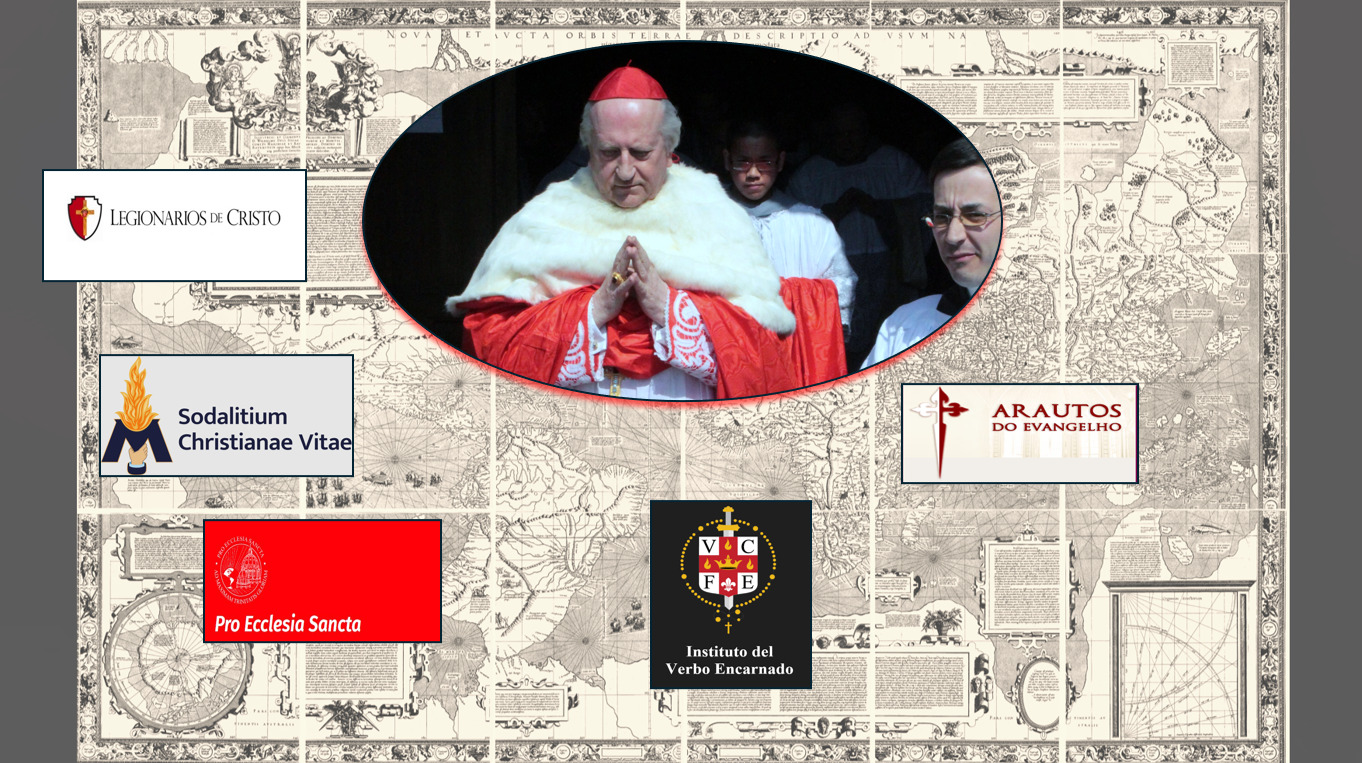
If that were not enough, it is a story similar in many respects to those of Opus Dei in Spain, of the Legion of Christ in Mexico, the Institute of the Incarnate Word in Argentina and, among many other potential examples, the Sodalitium of Christian Life in Peru.
It is a paradigmatic case that explains why the Vatican created, over the last century the kind of “perfect storm” conditions for the clergy sexual abuse crisis by legitimizing and incentivizing, especially during John Paul II’s long pontificate, the brand of apocalyptic, end-of-times Catholicism that facilitates abuse, sexual or otherwise, in sect-like groups and organizations like the Arautos and many others considered over several installments in this series.
English Edition
Cardinal Rodé, the sexual abuse missing link
But it is also a paradigmatic case to understand why the Latin American republics have been the kind of fertile milieu where abuse has abundant chances to happen. Why police, prosecutors and judges are able to simply dismiss many cases and why, when possible, they do their best to discourage any kind of reckoning about the scale and prevalence of sexual abuse.
Not that abuse is exclusive to order-like groups like the Heralds, the Sodalitium or the Neo-Catechumenal Way. One finds large-scale abuse in seemingly liberal, by Catholic standards, orders such as the Jesuits, as the ongoing scandal in Bolivia proves. It is that abuse in the Heralds, Opus Dei or the Sodalitium is mixed also with a sect-like worldview that not only rejects the “world” as, in theory, every Christian is called to do, but that also leads their members to reject the leadership of their own Church as “world-tainted” or “world-adjacent.”
The anatomy of impunity
It would be impossible to translate the document where the São Paulo Public Prosecutor’s office goes over a large corpus built over several years documenting the abusive, sect-like practices of the Arautos. The mechanics of how this impunity functions in practice are spelled out directly in the São Paulo prosecutor’s official archiving order available in its original Portuguese language after this paragraph as a PDF.
The full document in Portuguese after the English translation.
The Public Defender acknowledges having interviewed more than forty former members or aspiring members of the organization. In doing so, it was able to assemble a picture of the Arautos leading the Brazilian authorities to frame the Arautos as a “total institution.”
That is not a compliment. Back in the 1960s, Canadian sociologist Erving Goffman developed the notion of “total institution” as one where depersonalization, forced isolation and strict hierarchy were not accidental byproducts but main features of how control of relatively large human groups happens. Goffman and his disciples developed a series of studies of the pervasive effects that these “total institutions” had on people participating in them out of their own volition or forced due to several circumstances.
In the Arautos’ case the “total” character of the institution is what facilitates the recurring accusations of abuse not limited to sexual abuse. They included the destruction of family bonds, isolation from society, depersonalization, unconditional obedience, military-style discipline, physical punishments, psychological abuse, child labor, racial discrimination, anti-LGBT discrimination, neglect of health needs, and sexual abuse allegations. The Defender's Office concluded that these practices represented a grave pattern of rights violations affecting children and adolescents.
This is a pattern, by the way, all too similar to what is known now about the recruiting and formation practices of the Mexican Legion of Christ, Opus Dei, whether in Spain, Argentina or the United Kingdom, the Institute of the Incarnate Word in Argentina, and the aforementioned Sodalitium in Peru, where the practices went as far as to force the aspiring members to eat what some would consider a disgusting combination of foods, but also to publicly practice something similar to sex with chairs and other inanimate objects.
Verboonen accepts the allegations and the supporting evidence as serious enough to justify opening a criminal investigation. And some victims were interviewed, while additional evidence was gathered.
Verboonen explains how the lawyer representing one of the alleged victims then attempts to widen the investigation. The requests are revealing. The lawyer wants authorities to investigate the legal structure of the Heralds, affiliated corporations, schools, finances, administrators, chains of command, methods of discipline, operational structures, and connections among multiple organizations. The argument is essentially that the abuse allegations cannot be understood without understanding the institution that produced them.
Sadly, Verboonen rejects these petitions as she argues that Brazilian criminal law is concerned with identifiable perpetrators, not with broad examinations of institutional structures. She repeatedly returns to the idea that Brazilian criminal law generally punishes natural persons, not religious organizations as such.
Since the investigation is criminal in nature, she sees little value in exploring the broader organizational architecture of the Arautos. The inquiry is therefore narrowed from a question about an institution to a question about whether specific individuals committed specific crimes.
What follows is almost repetitive in its structure. The prosecutor acknowledges that the evidence points toward serious wrongdoing. Verboonen explicitly states that the investigation uncovered various violations of human rights. She repeatedly refers to the practices of the Heralds as reprehensible. She never depicts the institution as innocent in any broad sense. Yet each category of abuse runs into barriers that eventually make prosecution impossible.
The disciplinary system described by former members is one example. Witnesses describe “chapters,” a word that in the Portuguese- and Spanish-speaking worlds is evocative of Medieval and Colonial practices and culture in which members were subjected to collective humiliation, accusations, and scrutiny. Once again, for whoever has read about what used to happen at the Sodalitium in Peru or at the Pious Priestly Union in Santiago de Chile, the diocesan clergy organization controlled by Fernando Karadima, the story is way too similar to dismiss as mere coincidence.
These and other practices are key to understand how senior leaders “broke in” aspiring members, how they tested how far they were willing to abide or openly obey the leaders. Something similar must be said about the “peculiar” habits of the Arautos.
As the image from one of their public gatherings near the Basilica of Our Lady of Aparecida proves, they are the very definition of “Catholic kitsch,” brown as the Franciscan friar full habit, but short enough to let them show their military-like boots and with a large cross covering most of their body, as some manga-like illustrations of the soldiers participating in the Crusades depict them.
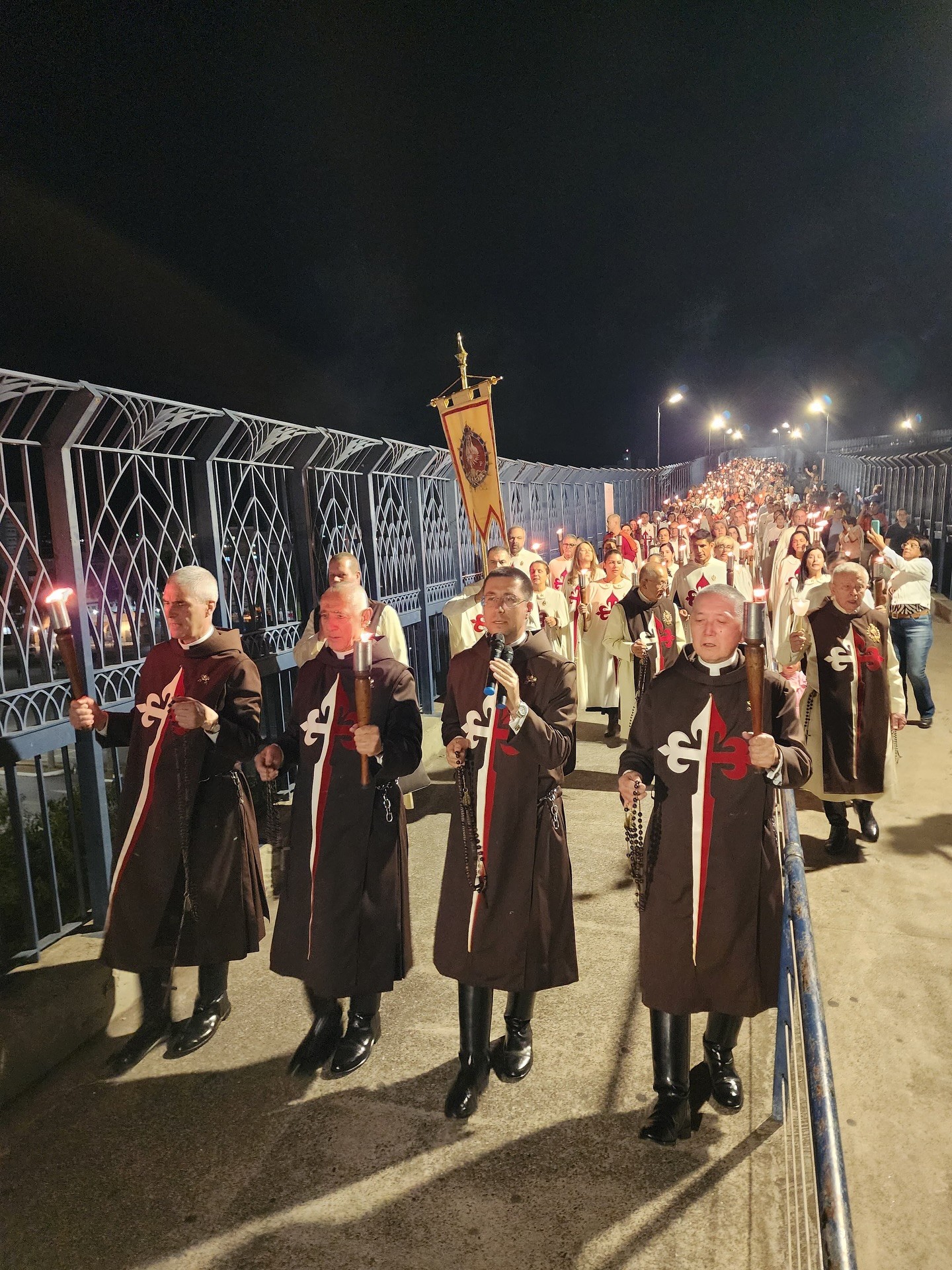
When looking at them, it is impossible not to think of them as an attempt to become the very embodiment of what the Peruvian Sodalitium claimed as the ultimate goals for their members: half-monk, half-soldiers.
That is, by the way, the title of Pedro Salinas's and Paola Ugaz's groundbreaking exposé on the Sodalitium: Mitad monjes, mitad soldados. Searching for such individuals, a sort of Catholic chimera, has been a recurring theme in Catholic orders ever since the so-called military orders participating in the Crusades to reclaim as Christian territory the Holy Land, but as the very case of the most famous of such orders, the Knights Templar, proves they become a headache for the church they claim to protect.
As is often the case, military-like organizations become so self-referential that their members are increasingly unwilling to take orders even from the Pope himself. Again, the similarities with the Sodalitium and how, to protect that organization, its members were willing to attack Pope Francis, are not simply an oddity. The attitudes at the Sodalitium and at the Arautos of rendering themselves as victims of Pope Francis are drops of water drawn from the same well.

English Edition
What makes the Sodalitium so relevant?
Verboonen goes further to describe punishments involving hunger, forced marches, carrying burdens, prolonged physical discomfort, and public shaming. The prosecutor does not deny that these practices occurred. In fact, she explicitly states that methods of discipline producing physical or psychological suffering are not permitted under Brazilian law.
Yet she concludes that prosecution cannot proceed because the individuals responsible cannot be identified with the degree of certainty required in criminal proceedings. The practices appear to have been widespread. Unfortunately, from her perspective, their very diffusion makes prosecution harder rather than easier.
The same logic appears in relation to racial discrimination. The prosecutor writes that there is no doubt Black members were disproportionately assigned to cleaning and kitchen functions and prevented from advancing to positions associated with clerical status. Yet she concludes that criminal prosecution for racism cannot proceed because responsibility cannot be tied to clearly identifiable individuals. The discriminatory pattern appears institutional. The law, however, demands identifiable actors.
The racial discrimination issue is ever more sensitive as these days one axis of the conflicts between Argentina and Brazil, reminiscent, up to a certain point, of the wars of tariffs and words between the United States and Canada, has to do with the arrest of Argentine tourists accused of disrespecting non-white Brazilians while visiting Brazil.
A similar analysis is applied to anti-LGBT discrimination. Witnesses describe environments in which adolescents perceived as homosexual were collectively confronted, denounced, or pressured. The prosecutor characterizes these practices as extremely reprehensible. Yet, again, the conduct is described as generalized, collective, and diffused throughout the institution. Since specific perpetrators cannot be isolated, prosecution becomes impossible.
The sexual abuse allegations produce perhaps the most striking section of the document. Here the prosecutor discusses the allegations involving the so-called “ósculos,” kisses in Portuguese, allegedly given by João Scognamiglio Clá Dias, the organization’s founder, to selected girls on their mouths.
Verboonen also mentions an allegation involving a boy in the 1990s and another allegation discussed in an HBO documentary recently broadcast in Brazil. Yet the central fact dominating this section is that João Scognamiglio Clá Dias is dead. Because criminal liability dies with the defendant, virtually all discussion surrounding him ends at that point. Other allegations run into prescription problems or previous archive orders. Thus, even where criminal conduct may have occurred, the procedural path toward accountability no longer exists.
The discussion of labor exploitation follows a similar pattern, almost indistinguishable from those reported in Opus Dei, Regnum Christi, the “lay” branch of the Legion of Christ, and the Sodalitium among many other Catholic organizations.
Another key feature is that the Arautos, as much as Opus Dei and many other order-like Catholic religious organizations, have actively recruited underage candidates, as they are perceived by the leaders of these organizations as more malleable, more willing to integrate themselves “voluntarily” into what Goffman and his disciples call a “total institution.”
That is one of the issues the Apostolic Visitation launched by the Vatican focused on, and that is also how Canadian citizens became part of the global tragedy that is abuse, sexual or otherwise, in the Arautos. More on this in an upcoming installment.
Once again, Verboonen reviews allegations concerning unpaid work, fundraising campaigns, humiliating collection practices, and international donation drives. Some former members reported years of labor without compensation. Yet these claims are either diverted toward labor-law remedies, blocked by statutes of limitation, or undermined by the inability to identify personally responsible actors.
Throughout Verboonen’s official document, a curious inversion emerges. The more institutional a practice appears, the harder it becomes to prosecute. If a witness says that everyone engaged in a practice, that the practice was part of the culture, that it was taught as normal and administered collectively, the prosecutor repeatedly treats that very fact as a legal obstacle.
The conduct may have been pervasive. Yet because it was pervasive, individual responsibility is harder to establish. What appears sociologically as evidence of an institutional system appears legally as an evidentiary problem.
The document therefore arrives at a conclusion that is extraordinary in tone. The prosecutor does not say the allegations are fabricated. She does not say the victims are dishonest. She does not say the Arautos behaved appropriately. She explicitly states that various human-rights violations were identified during the investigation.
She explicitly characterizes the institution's practices as reprehensible. Yet in the final pages she argues that prosecution is unfeasible, that the evidentiary basis is too weak to sustain criminal proceedings, and that she sees no further investigative measures capable of changing that reality. The case is therefore archived.
Enough happened to describe the institution's practices as reprehensible and to identify serious violations of rights, yet not enough can now be done to transform those findings into criminal accountability.
Once again, for whoever has read about the allegations of abuse, sexual or otherwise at Opus Dei, Legion of Christ, Institute of the Incarnate Word, Sodalitium of Christian Life, and many other recently created order-like Catholic organizations, the song could possibly have lyrics in other languages, but the tune remains the same.
That is what gives the archive order its unusual and deeply unsatisfying quality. It is not a declaration of innocence. It is a detailed explanation of why acknowledged wrongdoing cannot become the raw material for what in Canada or the United States would be a landmark case leading to convictions and ultimately to validate Pope Francis’s decision to launch the June 23, 2017, Apostolic Visitation enhanced by his September 28, 2019 decision to appoint Cardinal Raymundo Damasceno Assis as Pontifical Commissioner.
Back to Bogotá
Despite the many shortcomings in Verboonen’s memorandum ending the probe and archiving its findings, it becomes now a ticking bomb in Rome’s lap. Pope Leo XIV now must decide if he ignores Verboonen’s findings, or if, building upon such findings, he decides what is next for the Arautos.
Sadly, whoever pays attention to the future of the Apostolic Visitation to the Arautos also must acknowledge how they were, in more than one respect, the main characters in vigil at Bolívar Square in Bogotá.
It is not as if there is no experience in Bogotá as to how deal with the contacts between religion and politics. Unlike the allegedly rigid separation one sees in Mexico between religion and politics, in Colombia there is a well-established tradition of priests, bishops and cardinals sharing the dais with the President and any other public figure there.
When going over the ceremony at Bolívar Square, it is unavoidable to wonder why instead of the choir of Bogotá’s Cathedral of the Immaculate Conception of Mary, a choir of the Arautos carried the musical side of the vigil.
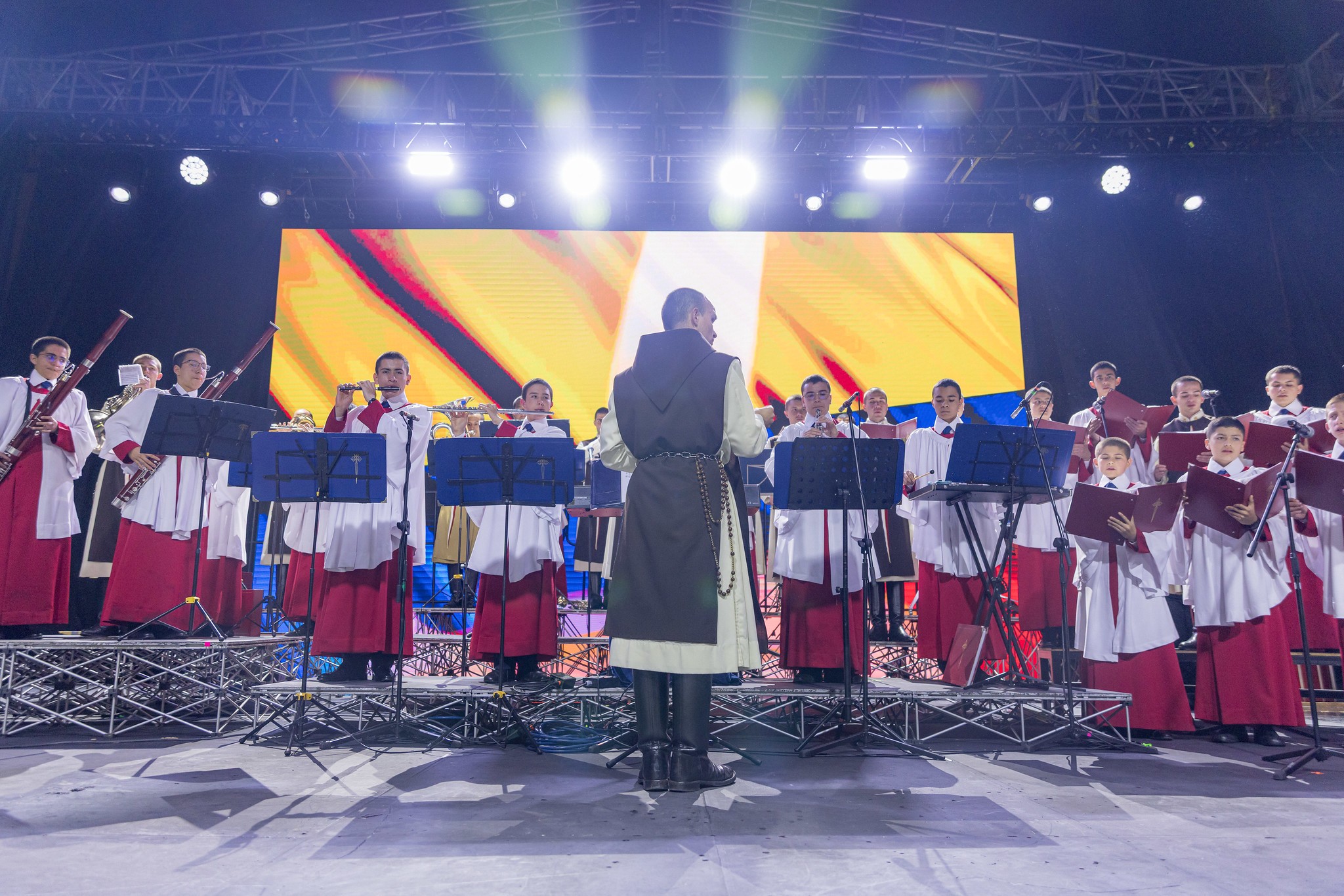
More significantly, why it was up to those six half-monk/half-soldier members of the Arautos to help President De la Espriella crown not a sculpture of the Immaculate Conception, not even one of Our Lady of Chiquinquirá, the official Catholic advocation of Mary chosen by Rome itself to be Colombia’s patroness, but Our Lady of Fatima.
Whoever has spent enough time as a Catholic or as an observer of what transpires in Catholic culture knows how Our Lady of Fatima, unlike other advocations of Mary the Virgin, is the unofficial patroness of religious intransigence, apocalyptic thinking and religious practice and radical conservative attitudes. In that respect, it is hard to imagine De la Espriella’s attempt at using the vigil to unite Colombia after the earthquakes, when he chose to use a rather polarizing religious symbol as Our Lady of Fatima, instead of Our Lady of Chiquinquirá.
The fact that the crowning ceremony of Our Lady of Fatima was not performed or even assisted by the Dean of the Cathedral of Bogotá, by any other diocesan priest in Colombia, or even by the Archbishop of Bogotá is, in itself, a sign of what strings the Arautos are able to pull at a time when Rome, sooner or later, will have to come up with some ruling regarding the future of this order-like organization.
Moreover, was De la Espriella’s decision to showcase his government’s preference for the Arautos a message to Rome, a way to let Leo XIV know that the Colombian government is willing to support the Arautos if there is any appetite in Rome to go for the suppression of the Arautos?
This is more relevant as the Arautos have now the unlikely merit of being the lone Latin American order-like Catholic religious organization with a documented record of systemic abuse, acknowledged as such, not by some network of clergy sexual abuse survivors in Brazil or by some independent media in Brazil or Colombia, but by São Paulo State Prosecutor Catharina Verboonen.
And to be clear, it is not as if Verboonen was doing all within her power on this issue. Even if hers is probably the first Brazilian official document willing to acknowledge the scale of abuse at the Arautos facilities and operations, her decision to archive the three- or five-year probe, depending on how one measures it, dismisses the possibility of finding alternate routes to offer a measure of justice to the 40 victims of abuse, sexual and otherwise, of the Arautos who were willing to trust the process and came forward with some testimony about what happened to them and indirectly to their families and friends.
There is no mention, as one of many possible examples, of the jurisprudence emerging from the Inter-American Court of Human Rights that repeatedly has rejected the very notion of the statute of limitations as a reason to prevent access to justice.
This is the first of several installments that will go over the details of what happened there, and what other issues one needs to keep in mind how abuse happens in Catholic contexts in Latin America and why it is so hard for victims to access justice.
What must be clear, in any case, is that Verboonen's decision is not merely a Brazilian criminal file sent to the morgue. It is a window into a transnational religious and political ecosystem that stretches from São Paulo to Rome, from Canada to Colombia, capable of influencing both religious and public life despite the abuses documented in its own ranks.
* * *
A summary of this piece is available as audio after this paragraph.
Note on production: The text of this summary was written and edited solely by the author. The delivery of the audio summary was achieved using a high-quality, text-to-speech engine Microsoft Word for Web. The AI was used for voice generation only, not content creation.