Andrés Gil Sábado, 08 de Noviembre del 2025, 10:54
“They treat us like animals (ICE) — they judge us by the color of our skin and the way we speak. And we have a president who behaves like a child,” says Manny Chávez, sharing his testimony about Trump’s anti-immigrant policies.
By Andrés Gil
It’s not just the fear of what might happen to you. It’s the paralyzing terror of what could happen to your loved ones — the uncertainty of whether today will be the last time you see them before an ICE patrol picks them up, sending them to a detention center and ultimately deporting them to their country of origin — or to some other place, even somewhere in Africa, where they have no roots at all.
Since U.S. President Donald Trump returned to the White House, town halls across the country have been holding community sessions where residents speak directly to their representatives, describing the daily anguish caused by the stepped-up police pressure on people who live and work in their neighborhoods.
This past Tuesday in Hillsboro — a city of about 100,000 residents in Oregon, a state led by Democratic Governor Tina Kotek — the town hall hosted a five-hour public session to hear from those affected by Trump’s anti-immigration policies.
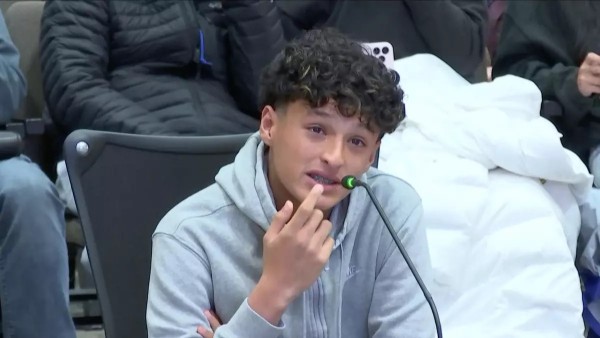
About three and a half hours in, after numerous testimonies had already been shared, 16-year-old Manny Chávez, the U.S.-born son of immigrant parents, took the microphone. His voice trembled as he delivered an emotional three-minute plea:
“I just want to say that I truly hope you’ll stand with us. Everyone here is fighting for what’s right and for our rights. I just want to tell you that I’m scared — scared that when my parents leave home for work, I might not get to say goodbye. Maybe I’ll never see them again.”
“My parents fought so hard to come here and build a life for their children,” Manny went on. “They treat us like animals, judging us by the color of our skin and by how we speak. And we have a president who acts like a child — and a police force that does nothing about it. I hope you listen to what everyone here is saying, because we’re all afraid. I’m afraid I might never see my friends again. I’m afraid our parents might be gone one day, that we’ll be left alone. I’m afraid that one day, at school, I could be taken by people I don’t know — people who don’t even identify themselves because they wear masks. I’m afraid I’ll never see my loved ones again.”
He concluded:
“They treat us like dogs, like animals — no one cares about us because of the color of our skin. I’m tired of this. I can’t keep living like this at sixteen. I shouldn’t have to live in fear — I should be focused on school.”
Manny’s plea — which went viral after being shared by the Hillsboro Herald — came after several legal experts at the public hearing explained why the city, like many others across the United States, has no authority to prevent arrests carried out by federal immigration agents.
What does exist, however, is the option for closer cooperation through the so-called 287(g) program. Under these agreements, some local jurisdictions allow their officials to operate as de facto immigration agents, working in direct coordination with ICE.
The 287(g) agreements are designed to expand the reach of Trump’s deportation machinery — effectively making local governments do ICE’s work at their own expense. Critics say the program leads to racial profiling, civil rights violations, the isolation of immigrant communities, and the separation of families.
At the Hillsboro hearing, one woman stood up and said:
“I’m here as a mother and as a citizen, and I’m tired of being told there’s nothing we can do. How do I explain to my children, when they come home from school every day, that civil rights don’t apply equally to all of us — that it depends on the color of our skin or our hair? I have to carry my passport with me at all times, because it’s not a question of if I’ll be stopped, but when. My civil rights don’t apply because I’m Hispanic. And right now, there are no civil rights for any of us — for my community, for Latinos.”
She went on to describe how her children come home from school not to share their academic progress, but to recount stories of classmates being questioned about their legal status — solely because of how they look, because they don’t “fit the profile.”
“The people being deported,” she said, “are just workers whose only crime has been fighting for a better future for their families.”
In October, Hillsboro Mayor Beach Pace and Police Chief Jim Coleman announced that the city was considered a sanctuary city—meaning it does not target immigrants simply for their immigration status—. They also emphasized that the local police department does not cooperate with federal immigration authorities.
Still, both officials acknowledged the limits of local authority:
“The Hillsboro Police Department has no jurisdiction over U.S. Immigration and Customs Enforcement (ICE) or any other federal immigration personnel. Hillsboro police officers cannot interfere with ICE operations, nor can they assist or protect individuals from federal arrests or legal consequences if they attempt to interfere with those operations.”
That same day, the Washington County Board of Commissioners declared a state of emergency in response to immigration-related concerns. Local organizations that serve migrant communities had requested additional support to deal with the fallout, and the county approved $200,000 in funding for migration-related services, according to Hillsboro News Times.
English Edition