
Guadalupe Lizárraga Sábado, 13 de Septiembre del 2025, 00:00
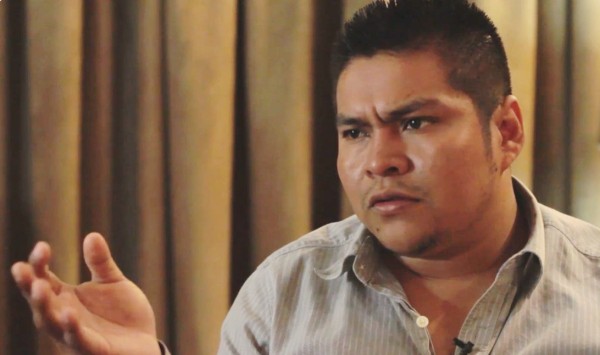
The statement by Iguala Holding Judge José Ulises Bernabé García is among the ten most important in the Ayotzinapa case, according to the Pascal Report.
By Guadalupe Lizárraga
The testimony of Judge José Ulises Bernabé García became the deepest crack in the Ayotzinapa case file. On the night of September 26, 2014, while the students were being taken to the Iguala municipal command, he stated in his declaration that “the students were not brought to the Holding Cell.” However, witnesses saw him speaking with the detainees inside the very same building, and in later interviews he admitted what he had tried to hide: the students had indeed been there.
The Pascal Report identifies his statement as one of the ten most important in the entire case, because it places the Army at a “hot site” of disappearance. From that fissure unfolds a network of responsibility: the presence of the Federal Police in parallel operations, the participation of Omar García Harfuch in meetings in Guerrero despite denying he attended, and the continued involvement of the operators behind the fabricated Wallace case in creating scapegoats and cover-ups. Even the media narrative of journalist Anabel Hernández—who interviewed the judge twice but failed to highlight the direct role of SEDENA—ends up forming part of the web of concealment.
The significance of the judge’s words goes beyond the PGR case file (Volume 67, pages 509–513). In two interviews with Anabel Hernández, first in Mexico and later in the United States—where Bernabé sought asylum—the judge revealed that after testifying before the Public Prosecutor he was placed under military surveillance: soldiers prowled around his house and harassed him with their constant presence. Yet Hernández omitted the most forceful detail from those interviews: the presence of SEDENA at the Command on the night of the crime.
Anabel Hernández’s Interviews with José Ulises Bernabé
Thus, the figure of Ulises Bernabé embodies the crack in the case file: a judge who first denies and then confirms, a testimony pursued by the Army yet at the same time used in the media without pointing to military responsibility. In neither of her two interviews does Hernández clearly underscore SEDENA’s involvement at the crime scene, reinforcing the Pascal Report’s observation of her media omission.
Bernabé’s voice, however, opens the way to reconsider the map of the disappearance of the 42 students, since soldier Julio César López Patolzin—an infiltrator planted by SEDENA in the Ayotzinapa Rural Teachers’ College—was rescued from the Iguala municipal command by Captain José Martínez Crespo, as was demonstrated in an earlier installment. Witnesses saw him leave alive minutes after midnight, and his iPhone 5 was reactivated at 11:56 p.m. in downtown Iguala, confirming his movement.
Narrative Excerpt: The Voice of the Holding Judge
- In his testimony before the Attorney General’s Office (pages 509–512 of case file PGR/GROI/1198/2014), Judge José Ulises Bernabé García repeatedly denied having received the Ayotzinapa students at the Iguala Command.
“At no time did I receive any large group of people, nor did anyone identify themselves as students of the Ayotzinapa Rural Teachers’ College,” he declared under oath.
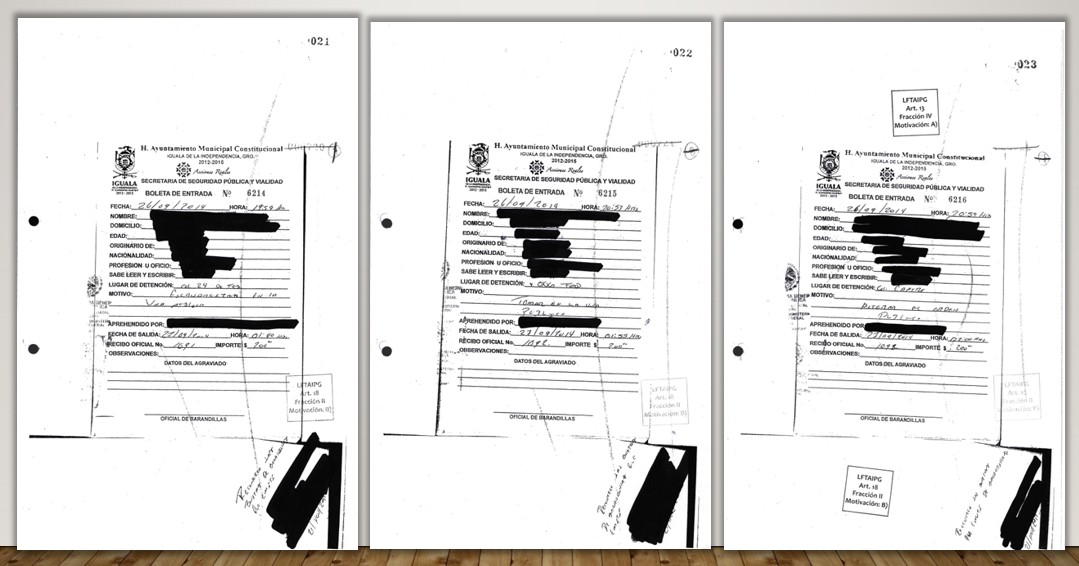
- His official statement focused on asserting that only six detainees arrested for administrative offenses entered that night, that intake slips were issued, and that they were released after paying fines of 200 pesos each between 1:40 and 2:27 a.m. on September 27, 2014.
“No, at no time did I receive any group of people who identified themselves as students… No, only the intake slips of those arrested for administrative offenses,” he reiterated several times.
- The statement also mentions the presence of local commanders, among them Iguala’s then–police chief:
“…at approximately 1:10 a.m., Commander Felipe Flores Velázquez arrived, accompanied by ministerial agents.”
- Despite his denials, witnesses placed him speaking with the students inside the Holding Cell that same night. The Pascal Report highlights this contradiction as one of the gravest in the case file: a judge who denies on paper what, in practice, he later admits in interviews.
The Six Administrative Detainees: Invisible Witnesses
In the early hours of September 27, 2014, six men who had been arrested for minor administrative offenses walked out of the Iguala municipal command with release slips in hand. The memory of what they had seen inside would never leave them. They had been detained for drunkenness, brawling, and disturbing public order—offenses that Holding Judge José Ulises Bernabé García described as “impertinent,” fining each of them 200 pesos.
Their names were recorded in the Ayotzinapa case files, yet they were never summoned to testify as key witnesses: Juan Peralta Rojas, Juan Alberto Ruiz, Emmanuel Pérez Estrada, Ricardo López Brito, Rogelio Sandoval Salas, and Jesús Castro Rosas (Volume 133, pages 483–492; Volume 65, pages 21–27).

Emanuel Pérez Estrada: The Witness Who Was Never Heard
The federal case file confirms that the government had full identification of Emanuel Pérez Estrada, one of the six men detained for administrative offenses at the Iguala Command on the night of September 26, 2014.

Translation
Emanuel Pérez Estrada
- On April 13, 2016, at 6:35 p.m., attorney Víctor Jesús Alvarado Navarro, Federal Public Prosecutor assigned to the Office of Investigation of the Deputy Attorney General’s Office for Human Rights, Crime Prevention, and Community Services, recorded within the preliminary investigation AP/PGR/SDHPDSC/OI/001/2015, the receipt of police report SN/2016, which stated that information was obtained regarding the person named Emanuel Pérez Estrada. Volume 189. Rosetta page 689.
- On April 13, 2016, at 6:50 p.m., attorney Víctor Jesús Alvarado Navarro, Federal Public Prosecutor assigned to the Office of Investigation of the Deputy Attorney General’s Office for Human Rights, Crime Prevention, and Community Services, recorded within the preliminary investigation AP/PGR/SDHPDSC/OI/001/2015, the receipt of police report PF/DGAJ/4831/2016, which stated that information was obtained regarding the person named Emanuel Pérez Estrada, forwarding the records. Volume 189. Rosetta page 689.
- On April 30, 2016, official communication number CTSERC/DJ/00350/2016 was received, through which the Technical Coordinator of the Civil Registry System of the Government of the State of Guerrero forwarded two civil registry certificates of Emmanuel Pérez Estrada (Volume 113, pages 548 to 557).
The case of Emanuel Pérez Estrada illustrates the pattern of deliberate concealment of civilian witnesses—one of the keys to institutional cover-up in Ayotzinapa.
Ulises Bernabé’s formal denial that the students had ever set foot in the Command collapses in the face of the voices of the six men detained in Iguala that night for minor administrative offenses. They not only crossed paths with the students in the Holding Cell’s corridors but were direct witnesses that the Ayotzinapa students were alive inside the building, accompanied by police officers and soldiers.
Official records show that their release took place between 1:40 and 2:27 a.m. What was not recorded is that, upon leaving, their phones reactivated within that same time frame and they immediately began making calls and sending messages. They told relatives and friends that they had been held alongside the Ayotzinapa students, that they had seen them alive in the Command’s corridors, and that they even recognized the infiltrated soldier, Julio César López Patolzin.
While Bernabé was denying in his sworn statement that the students had ever set foot in the Holding Cell—“At no time did I receive any large group of people, nor did anyone identify themselves as students of the Rural Normal School,” he repeated several times—these six men recounted that the students had indeed been there, that they saw them, and even spoke with some before being released.
Francisco Salgado Valladares: the transfer from La Barandilla
Images of the Iguala Police Headquarters included in the case file provide direct evidence of where the students were held, according to the Pascal Report. In one photo, the signature of Francisco Salgado Valladares, deputy director of the Iguala Police, appears in his own handwriting on the official document identifying him as responsible for moving the students from La Barandilla to the Loma de Coyotes checkpoint (Volume 109, pages 146 and 170–173).
This evidence—overlooked by official investigations and barely mentioned in GIEI reports—confirms Salgado Valladares’ operational role in the disappearance chain and directly links the Municipal Police to the clandestine transfer of the students.
One of the investigators from the Pascal Group told Los Ángeles Press that those six witnesses “were saved by chance because they paid a 200-peso fine—while the standard, according to testimonies, was 300 pesos—and they were not part of the group marked for disappearance. The official investigation rendered them invisible: their fine receipts were filed away, their phones were never traced, and their testimonies were never requested.”
The Pascal Report highlights this omission, noting that it was not an oversight but a deliberate action. These witnesses could have confirmed that the 28 students and soldier López Patolzin were indeed at the police headquarters.
When they gave their first statements, both Captain José Martínez Crespo and Sub-Lieutenant Fabián Alejandro Pirita Ochoa provided their phone numbers. As active-duty soldiers, their devices—including cellphones and official units—also had GPS tracking enabled. This clue, so far ignored, could legally and scientifically establish their presence at La Barandilla at the same time cited by Judge José Ulises Bernabé García.
“With this lead, they could be legally located at the municipal Barandilla at the time Ulises Bernabé mentioned. The geolocation of both soldiers can still be performed,” the Pascal Group investigator emphasized.
The case of undercover soldier Julio César López Patolzin reinforces this line of investigation. According to the Pascal Report, after being rescued from the headquarters by Crespo, his iPhone 5 activated at 11:56 p.m. in downtown Iguala, just minutes after leaving. This connection left a trace at the Benito Juárez antenna, and the device continued emitting signals with different SIM cards until December 2014. The soldier-student’s phone itself is geolocation evidence: it proves he left La Barandilla alive and remained under military custody, the report highlights.
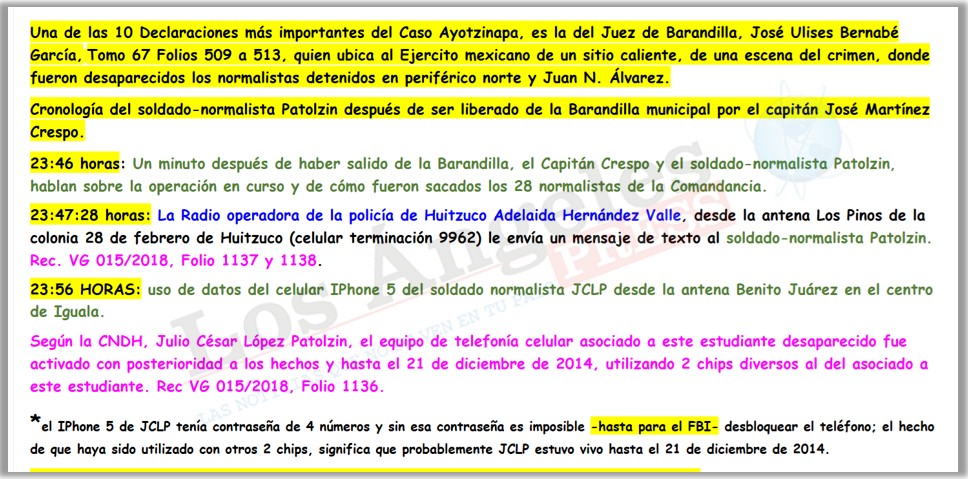 Excerpt from the Pascal Report regarding the testimony of the Iguala Barandilla judge, José Ulises Bernabé.
In this way, triangulating the official statement of Judge Bernabé, the testimonies of the six detainees, and the pending geolocation data of soldiers Crespo, Pirita, and López Patolzin could allow a minute-by-minute reconstruction of the scene: the students being transferred to the police headquarters, the rescue of the undercover soldier, and the disappearance of the 42 students under the custody of police and military personnel.
The Pascal Report demonstrates that the omission was deliberate: witnesses were rendered invisible, evidence was ignored, and media attention was diverted from SEDENA, whose presence at La Barandilla on the night of September 26 was excluded from both official and mainstream journalistic narratives.
Since 2014, the PGR and later the FGR obtained CDRs (Call Detail Records) from numbers associated with the students and police officials. In addition, active-duty soldiers (such as Crespo and Pirita) and official patrol vehicles were equipped with GPS devices that could be tracked, all documented in ministerial records and telecommunications reports cited in the case file. Based on this, the Pascal Group concludes that the same technology used to monitor the students—CDRs, GPS in patrols, and official cellphones—can still today serve as a tool to disprove the “official version.”
More than a decade later, civilian voices provide independent proof confirming that the students were seen alive under police and military custody. And it is there, at La Barandilla in Iguala, where the deepest crack in the Ayotzinapa case file appears: the certainty that the State chose to remain silent.
Key points of this installment
- Official statement of Judge José Ulises Bernabé García.
- Testimonies of the six administrative detainees.
- Pending geolocation data of Crespo, Pirita, and Julio César López Patolzin.
- Invisibility of civilian witnesses.
- Ignoring evidence documented in case files.
- Diverting attention from SEDENA, present at La Barandilla but erased from official and media narratives.
- Technology as Silenced Evidence
- Independent civilian proof
