
Rodolfo Soriano-Núñez Domingo, 13 de Octubre del 2024
The “fear of closing doors” sets in the German delegation to the Synod, while the German public cheers rules defunding churches after years of sexual abuse scandals.
In the United Kingdom, a new study reveals the depth of the effects of the clergy sexual abuse crisis, while numbers from Latin America show the undermining of Pope Francis’s leadership.
By Rodolfo Soriano-Núñez
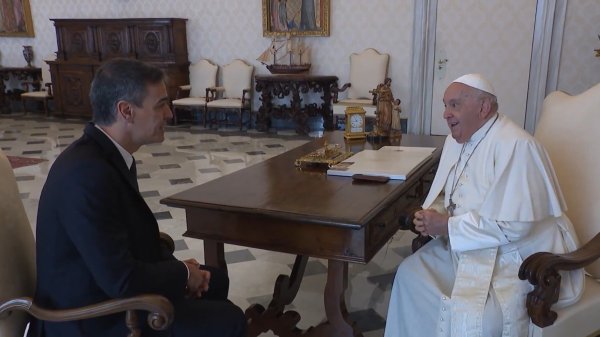
Back on Friday October 11th, despite a growing domestic crisis in his own government, Pedro Sánchez, the Prime Minister of the kingdom of Spain spent some time in Rome with Pope Francis.
Both shared smiles and exchanged gifts as protocol dictates. After his meeting with the Pontiff, Sánchez had one more with Cardinal Pietro Parolin, the secretary of State of the Holy See and the secretary of Relations with the States of the Holy See, British archbishop Paul Richard Gallagher.
After the meetings, at the see of the Cervantes Institute in Rome, Sánchez briefed the media. Sánchez talked about the war in Ukraine, and then he stressed the will of his government to reach an agreement with the Roman Catholic Church to compensate the many victims of clergy sexual abuse in Spain.
Prime Minister Sánchez at the garden of the Cervantes Institute in Rome.
It is not as if Sánchez’s government is exempt from issues in his home country. The next day, even if most newspapers highlighted his visit to Rome, with pictures and frontpage headlines, most of them were actually stressing the latest corruption scandal engulfing his administration.
The issue will keep some relevance in Spain and in the Spanish-speaking world since, on Tuesday, Ángel Gabilondo the Spanish ombudsman will attend a session of the Parliament in Madrid. There, Gabilondo, will go once again over the numbers, data, and suggestions he offered back in April of this year, when his office published the report available, only in Spanish, here.
Back on July 15th, Los Ángeles Press published a story, linked above, dealing with the evolution of the clergy sexual abuse crisis in Spain and the competing reports. One published by the office of Ángel Gabilondo, the Spaniard Ombudsman; and one more from the Spaniard Conference of Catholic Bishops, that somehow is related to a report commissioned by the bishops to a private consulting firm whose main partner, Javier Cremades, is a member of Opus Dei.
Keep it quiet
It is hard to believe that either Gabilondo’s new hearing at the Parliament or Sánchez's talks with Pope Francis, Cardinal Parolin, and archbishop Gallagher will be enough to solve the differences in the formalistic, minimalistic approach taken by the Spaniard bishops, and the position taken by the Ombudsman, but there lies the crux of the issue for the Roman Catholic Church in Spain and elsewhere.
Even if politicians and legacy media do their best to keep the issue as quiet as possible, the issue just keeps emerging all over the Spanish-speaking world. Chilean President Gabriel Boric's recent decision regarding a national probe on abuse proves it.
Back in May, 2022, Boric seemed to be willing to launch a probe including abuses in the Roman Catholic Church. However, almost two years later, in June 2024, the actual probe ended up being less wide than expected.
It was actually limited to cases at the so-called Servicio Nacional de Menores, or SENAME, an office similar to the bureaus of child services in the United States but, given the centralist nature of public services in Chile, concentrated under the authority of the national government there.
Boric’s final decision to limit the scope of a probe on abuse to the cases happening in publicly owned facilities, brought anger to the many survivors of clergy sexual abuse in Chile who, even if willing to acknowledge the relevance of the SENAME cases, were disappointed by the way their government avoided their cases.
On the other side of the Andes, in Pope Francis’s homeland the issue is in no way less relevant. Quite the opposite. For the last two years or so, even legacy media usually reluctant to report on the clergy sexual abuse crisis and less so when dealing with the Opus Dei, has been doing so.
Back on November 13th, 2023, La Nación, the paper of record in Argentina, published in the pages of a supplement a detailed report on the abuse happening at Opus Dei.
Psychological crushing machine
The editors of the El Berlinés (The Berliner) supplement, aptly titled their piece “psychological crushing machine,” as to emphasize the effects of being a member of Opus Dei, what used to be, back in the 1990s, Karol Wojtyla’s favorite new “order”, whose only rival at the time was the Mexican Legion of Christ.
What that supplement told there is a story familiar to whoever has had some knowledge of members of the so-called Regnum Christi, a branch of the maze that the Legion of Christ has been for the last 70 years or so, as it is similar to the stories of the many branches of Sodalitium of Christian Life in Peru, Brazil, Colombia, and the United States.
The names of the leaders, the places, and the victims change, but the patterns one finds in the Opus Dei, the Legion of Christ, the Sodalitium or the German response to these so-called “new religious movements,” an order called Das Werk (the work) are the same.
El Berlinés’s piece, full of the usual details about the kind of attitude towards self, family, life, property, and religious practice required to be a member of Opus Dei, was a follow up of sorts of a report published by Paula Bistagnino.
Los Ángeles Press published her report back then. It is available in Spanish before this paragraph. The Buenos Aires Herald published an English-speaking version of that report back in May 2024.
There the story was not that of the members of wealthy Argentines leaving Opus Dei after the many abuses, but a story about girls brought to Buenos Aires from the rural areas of Argentina, and from Bolivia and Paraguay to become maids.
And there is nothing new in the story of young girls going to Buenos Aires to become victims of some kind of abuse. That is the backstory of many tangos from the early 20th century.
The issue is that the Opus Dei leaders took these women to Buenos Aires under false assumptions. Opus Dei offered them a chance to study, to get a job. Instead, they forced the women to remain as maids for the all- male elite leading Opus Dei. Once again, comparable stories exist with many women from rural Mexico brought to the Regnum Christi’s houses in Monterrey or Mexico City, to serve Marcial Maciel’s disciples at his “religious order”.
What is worse, now the leaders of Opus Dei are in campaign to defend what they say are free choices of those who decided to remain as maids. Main problem, of course is that if we have learnt something from Bistagnino’s and other’s reports on what happens at the Opus Dei is that their decisions are anything but free.
A text that is presented as a plea from the so-called “auxiliary members of number”, one of the many categories of membership within the Opus Dei, is available only in Spanish here.
Religious abuse across borders
And it is not only in the Spanish-speaking world. Back in March of this year, British newspaper The Financial Times published a detailed account of how this has been happening also in the English-speaking world.
The original piece is available, behind a paywall, here, and Antonia Cundy, her author has been providing updates.
Another valuable source of information for how abuse happens at Opus Dei in the English-speaking world has been over the last ten years or so, Steven Hassan, a former member of another secretive and abusive religious organization, the so-called Moonies.
He has been posting videos over his YouTube channel dealing with religious abuse in many organizations, from his own experience as a former Moonie, the so-called Unification Church, to what is happening at the Mexican Luz del Mundo, or the Opus Dei in videos with Eileen Johnson, a former member who used to work at the British and French houses of that order.
A video of Hassan and Johnson.
More recently, Hassan spoke with Gareth Gore, the author of one of the most detailed reports on the order originally founded by Josemaría Escrivá de Balaguer in the Post Civil War Spain of the 1930s.
A video of Hassan and Gore.
Last week, when Argentina was in the middle of one of the most recent mobilizations to protest Javier Milei’s brutal economic policies, Gore posted on his social media a picture of the raid carried by the Argentine federal police at Opus Dei’s South American headquarters in Buenos Aires.
As I write these lines, it is unclear what will be the effect of the raid. The Nation Attorney’s office published a press release, available in Spanish here.
Although the release is lengthy and it talks about former and current leaders of the Opus Dei, the actual details are scarce. It stresses how the orders’ leaders forced these females into dependency and had little or no actual ability to decide about their future.
Studying was about preparing them to provide services as cooks, maids, seamstress, and the like. They had no actual chance of pursuing degrees or a professional career, despite the many claims of the leaders of Opus Dei about their members being able to pursue whatever career they want to.
On Saturday October, 12th, Bistagnino published a thread at what used to be Twitter with summaries of the stories of some of the females abused by the leaders of the Opus Dei in Argentina.
And since these cases go all the way back to the days of Jorge Mario Bergoglio as archbishop of Buenos Aires, there is a chance, even if small that the probe will implicate him at some point.
Politicization
The politicization of the issue runs against the Church’s interest. Even in countries as Canada, where the public trust their police corps, nation attorney’s, and judges, there is the intent from Catholic priests and bishops to prevent the occurrence of official probes dealing with these issues.
However, politicization is the best chance for the victims of sexual abuse, clergy or otherwise. That is the lesson one can draw from the experiences in countries where there have been some real advances on the issue, as the United States.
In Latin America, where trust in police, nation attorney’s, and judges is low, there has been no national or even subnational probes as the ones that have happened recently in U.S. states such as Illinois or Maryland, to name only the two most recent.
That is one of the reasons why the Pope’s reaction to Giuliana Caccia Arana and other members of the Peruvian Sodalicio was as stark as the story linked above told last week.
The distrust in the authorities is an element of the defense strategies followed by the dioceses’ attorneys to bring the victims of clergy sexual abuse into a maze of bureaucratic procedures that, on top of being extremely expensive, are arcane even in countries as Mexico where the Church enjoys no special formal privilege.
Mexico and Peru are going through complex processes of reform of their judiciary. In the Mexican case it is hard to expect significant changes; the Mexican government “sold” the reform under false assumptions, and it follows the Bolivian reform from the 2000s that, as far as the clergy sexual abuse crisis, has provided little or no hope to the victims, as the story linked below proves.
How long will the Church in Latin America keep playing this game is hard to measure. It is clear that there are countries where the chances of a bishop dismissing accusations are higher than in others, they assume that there are no consequences as long as they keep predator priests out of jail, but the overall outlook of the crisis is dire.
One third loss
As dire as the numbers coming from a study recently published by the University of Durham at the United Kingdom. Back in April 2024, that university offered the results of a vast analysis of the available evidence coming from parishes in England and Wales.
They found that “a third of Catholics who previously went to Mass have reduced their attendance or stopped going altogether as a result of the child sexual abuse crisis in the Catholic Church.”
The full study, aptly titled The cross of the moment, is available here as a PDF, and some of its main findings can be found here.
The Roman Catholic hierarchy was well aware of the potential impact of the clergy sexual abuse crisis, but as arrogant and dismissive as the bishops are, they have done everything within their power to either peg the crisis on mythical creatures as the “lone predator” or to blame same-sex preference, as if having such sexual preference was, on its own, enough to become a sexual predator.
Main problem with that interpretation is that even the most homophobic Roman Catholic “news” outlets as EWTN have to acknowledge that sexual orientation is not necessarily related with being a sexual predator as in the case from Chiclayo, a Peruvian city in the Pacific coast analyzed in detail in the story linked above or as in the story from Brazil linked below. In both cases the accused priests attacked females.
If the numbers from the British study are somehow similar in other countries, that should explain why the angst one sees in the German delegation to the ongoing Synod in Rome these days.
German bishop of Limbourg, Georg Bätzing, called his fellow German Catholics attending the Synod and those following it from home to be patient. Sadly, back in Mexico, the papers of large archdioceses as Guadalajara render the German delegation to the Synod and more broadly, German Roman Catholicism as the culprits of a synod dead on arrival.
The Tablet, a British Roman Catholic magazine felt the need to stress the low expectations about the ability of the Synod to address the many needs of a Church deep in a crisis of its own making.
The consequence of this a new disappointment as far as the will of the Church to produce some solution to the many issues fueling the clergy sexual abuse crisis, is the same as in the British study: leaving a Church unwilling to address the issues fueling violence against their own members.
One only needs to go over the frociaggine affair to see how even the less aggressive members of the Roman Catholic leadership, as Pope Francis, are too eager to find ways, reasons, moments, to blame gay priests or to question the right of females to find a new understanding of what it means to be Roman Catholic.
Torschlusspanik: Fear of the closing door
If the numbers coming from England and Wales talk about a steep reduction in the people willing to participate in Roman Catholic masses and other activities, the numbers about religious affiliation in Germany and Austria talk about a deeper crisis, with consequences hard to measure at this point, but that tell the story of an ever-decreasing flock and the difficulties to find new ways to grow.
German think-tank Forschungsgruppe Weltanschauungen in Deutschland, the Research Group on Worldviews in Germany, has published over the last weeks a series of papers about religious affiliation in Germany and Austria that tell a somber story.
Back on September 30th, they published their most recent analysis of German religious affiliation. Their summary is that, since the early 1990s, “membership of the two major churches (Roman Catholic and the Evangelical Lutheran) has decreased by 17.2 million members”.
A 31 percent decrease from the numbers on record back in the 1970 and, as many other studies in different countries find, there is an acceleration of that trend even in countries that used to be somehow isolated from these trends as it was the case of the United States.
If one goes over the numbers in neighboring Austria, the situation is similar: a little more than 56 000 persons have been leaving the Catholic Church in Austria over the last 30 years. That amounts to that think-tank to a loss of little more than one million 800 thousand, in a country of little more than nine million inhabitants.
You can go over the details for Germany here and for Austria here.
The bad news coming from Germany for the Roman Catholic Church do not end there. More data from the same source tells that the German public approves the expected defunding of the two major churches in that country.
Almost half of the sample, a 48.5 percent, said they had a very positive opinion about the decision to defund the two major churches. An additional 12.5 percent said it was somehow good, with 18 percent of those in the sample (n= 5,066) having no opinion and around 22 percent having a very negative or somehow negative opinion of the measure.
The details are available here. There is a specific word in German for the kind of feeling one gets when going over those numbers: Torschlusspanik, the fear that the doors are closing on you.
Even in Mexico, the analysis of the data from the 2020 national census (in Mexico there is a specific question in the census about religious affiliation) show a significant increase in the numbers (relative and absolute) of people declaring themselves as religiously unaffiliated.
And what is worse for the Roman Catholic Church is that bishop Bätzing’s call to be patient with the Synod not only fails to address the concerns of the few “liberals” still willing to even pay attention to the Synod. It fails to even address the more virulent, violent, rejection of the Synod coming from the most conservative quarters of the Catholic Church, unwilling to acknowledge any mistake on their own.
Patience, what German bishop Bätzing asks from his fellow German Catholics is hard to find even in Latin America. The Pew Research Center recently published the data from their most recent study dealing with the Roman Catholic populations of six Latin American countries: Argentina, Brazil, Chile, Colombia, Mexico, and Peru.
The results (available in English here and a brief summary in Spanish here) tell a story about the loss of trust in Pope Francis’s ability to provide meaningful leadership at a time of crisis for his Church.