Rodolfo Soriano-Núñez Domingo, 15 de Septiembre del 2024
If Cardinal Prevost did something wrong as bishop in Peru or now as a key figure in Rome he must resign, but the key issue is the victims’ wellbeing.
The Latin American bishops could learn from the recent decision of the French bishops to open their files on Abbé Pierre to probe his record on clergy sexual abuse.
By Rodolfo Soriano-Núñez
This is a story that proves how global is the clergy sexual abuse crisis undermining the Roman Catholic Church. Its main characters are Peruvian females, priests, and bishops, but it involves a Cardinal born in the United States who Pope Francis promoted to a key position in Rome.
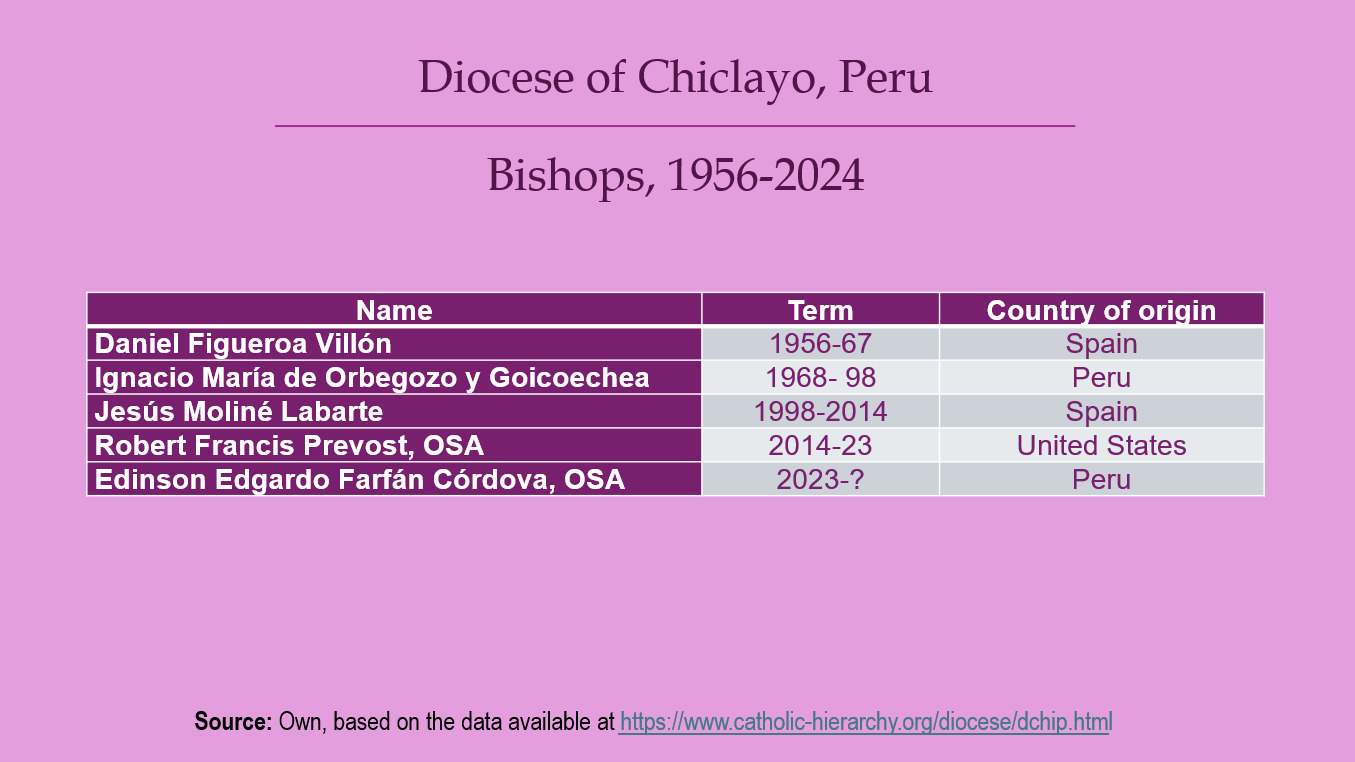
The Cardinal is Robert Francis Prevost, originally an Augustinian friar, born in Chicago in 1955, he became the global leader of his order, one of the oldest in his church, in 2001 and remained as such for twelve years.
Pope Francis appointed him as bishop of Chiclayo in 2014, and he remained there until 2023, when Jorge Mario Bergoglio brought him to Rome as both prefect of the Dicastery of the Bishops and chair of the Pontifical Commission for Latin America.
Both positions had been, until then, occupied by Canadian Cardinal Marc Armand Ouellet. Although Ouellet was already on his way out of the Roman Curia, due to his age, at the end of his tenure, a Canadian female named Ouellet for attacking her when he was archbishop of Quebec, in the first decade of this century.
Ouellet is one of 80 Roman Catholic clerics named in a class action suit targeting the Archdiocese of Quebec so, even if the Vatican cleared him and he has threatened with suing the woman who named him, the issue is far more complex.
As far as Latin America was concerned, Prevost’s appointment was hailed as an improvement. He had actual pastoral experience in Latin America, a novelty of sorts for the commission he was about to lead.
Created in 1958, at the height of the Cold War, the Commission has been headed mostly by non-Latin American Cardinals. The longest tenure, 14 years (1984-98), belongs to Bernard Gantin, a cleric from Benin, Africa who, up until then, had little or no actual experience in Latin America.
After him, with 13 years on the job, was Ouellet (2010-23), The third longest tenure there belongs to Italian Cardinal Giovanni Battista Re, who was there from 2000 through 2010. The Commission has been headed by a Latin American national only from 1998 through 2000, when John Paul II appointed Brazilian Cardinal Lucas Moreira Neves, who died in office.
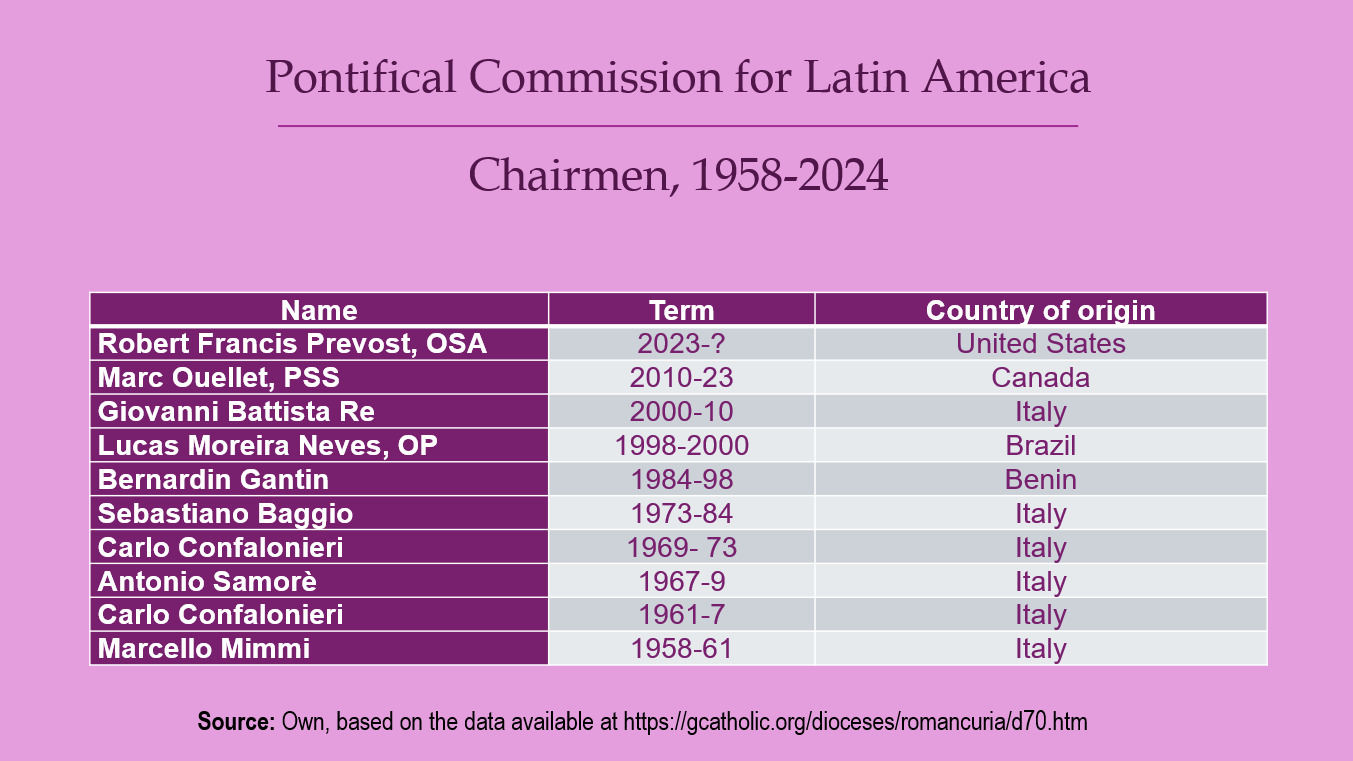
In that regard, even if one could raise many objections to his appointment before the most recent scandal, he was not the best possible choice, as there are plenty of Latin American bishops who would be able to lead that commission, but certainly not the worst possible choice.
The episode prompting this story happened sometime earlier this century, in Chiclayo, a city on the Peruvian coast, home of 600 thousand inhabitants, 680 kilometers or 420 miles North of Lima, the capital of that country, as can be seen in the map after this paragraph.

Prevost brought to Chiclayo some of the expertise of the United States Conference of Catholic Bishops to deal with clergy sexual abuse. Fidel Purisaca Vigil, a local priest and head of communications in the diocese, adapted the materials and policies developed by U.S. Roman Catholic bishops since the early years of this century.
In the box after this paragraph, you can find a handbook edited by Purisaca Vigil for the diocese of Chiclayo during Prevost’s tenure.
Cuidado del menor. The book authored by Purisaca Vigil at Chiclayo.
The handbook, available only in Spanish, can be downloaded here.
It is not clear if the adaptation has been faithful with the practice in most Roman Catholic dioceses in the United States, but as compared to Latin America, where the many suggestions, callings, admonitions, and even “orders” of Pope Francis regarding the clergy sexual abuse crisis have been dismissed, the work done by Prevost and Purisaca cannot be easily dismissed.
This series has argued previously that the key to understand the differences in how Roman Catholicism deals with clergy sexual abuse in the United States and Canada as compared to Latin America has to do with the larger, broader, institutional setting of the system of justice.

That was the underlying argument of a piece on the differences between the Mexican diocese of Ciudad Juárez, Chihuahua, and the American diocese of El Paso, Texas, linked before this paragraph.

It was also the leading proposition in the pieces devoted to what has happened in the dioceses of California in the United States, linked above this paragraph, and the dioceses of the states of Baja California and Baja California Sur in Mexico, linked below this paragraph.

Baja California and the clergy sexual abuse crisis
In that regard, victims in Latin American countries face mind-blowing demands as far as the burden of proof is concerned. Not to mention the statute of limitations that Mexico and Chile eliminated but remains in force in all the other countries in the region.
At the same time, nation’s and districts’ attorneys in Latin America lack many of the tools that the states’ attorneys in the United States use to force the bishops into more transparency and accountability.
The most evident case of the differences in that regard comes from the United States, from California and New York to be more specific, where lawmakers were willing to open the so-called look-back windows to allow victims whose cases had already prescribed to seek a measure of justice in civil courts. Something like that has never occurred south of the Rio Grande.
Padre Lute
No wonder the victims in this specific case are angry at the diocese of Chiclayo and the local authorities for what they perceive as a cover up operation to protect the priest at the eye of this storm, Eleuterio Vázquez Gonzáles.
It is not as if Vázquez Gonzáles has a spotless record. Main problem is that Chiclayo, as many other dioceses in Peru and Latin America, do not provide a mechanism to make their own faithful aware of what is the current situation of any given priest.
In this series, Los Ángeles Press has proved how one of the largest archdioceses in Latin America, that of Mexico City, lacks a website able to provide updated information on its priests.
Cardinal Carlos Aguiar Retes, the head of the primate see in Mexico is overly concerned, as most Latin American bishops are, with “false priests,” so there is a way to know if a person presenting himself as priest in Mexico City is registered as such, but that is as far as their website will go.
That was a key element of the story on Sergio González Guerrero, a Mexican priest arrested early this year told over three pieces. The first of those pieces, where I used that system to identify priests in Mexico City, appears after this paragraph. If you read Spanish, you can get the details there.

As far as Los Ángeles Press has been able to verify, only a handful of dioceses in Latin America have functional websites allowing to track the changes and potential dismissal of priests. In Chile, the capital Santiago has a website where it is possible to track down appointments. In Mexico, only the diocese of Saltillo, in the state of Coahuila offers that kind of information.
Often times, when running the pieces in this series, its author has to go over the Facebook pages of dioceses, seminaries, and parishes, to figure out the whereabouts of priests facing credible accusations of clergy sexual abuse.
Although useful, it is not optimal, as it is almost impossible to figure out when or why there are changes in the professional lives of Roman Catholic priests and what are the reasons behind those changes.
Some dioceses are highly active at putting out celebratory pictures of their bishops or leading priests, but actual information is hard to find.
That is the case with Vázquez Gonzáles in Chiclayo. Although the diocese has a website where one can find the current appointments of priests, it is not possible to track down the changes for each priest. At least not easily.

Despite the claims made by the diocese of Chiclayo in a four-page statement that appears before this paragraph and can be downloaded here, it is clear that Vázquez Gonzáles is in some kind of trouble. An English-speaking version of the statement is available here.
It is possible to say that because he is not listed as active in the diocesan roster of priests, and because his digital footprint is, unlike those of other priests from that and other dioceses in Peru and Latin America, hard to track down.
When Vázquez Gonzáles was in good terms with his diocese, before the accusations surfaced, back in 2018 or 2019, it was possible to find references to him in the diocese’s Facebook profile.
Here is a relevant fact. He used to be some sort of local celebrity in Eten, a township in the diocese of Chiclayo. Before the allegations against him, he was the pastor of a notorious parish, home to a local devotion that was able to get a pontifical acknowledgment. It was frequently quoted and mentioned.
During the pandemic, Vázquez Gonzáles got praise from diocesan superiors and the local media for his ability to set up a local kitchen to help people find food under the circumstances.
Even before his arrival to Eten it is possible to figure out Vázquez Gonzáles career. As the posting from another parish in the same diocese of Chiclayo proves, now emeritus bishop Jesús Moliné Labarte appointed Eleuterio Vázquez Gonzáles as pastor in San Martín de Porres back in 2007.

The diocese’s Facebook profile used to greet him for his birthday, as the image after this paragraph proves. Even after the worst of the pandemic was over, Vázquez Gonzáles received birthdays greetings in messages at the Facebook profile, as the greetings in the image after this paragraph prove.
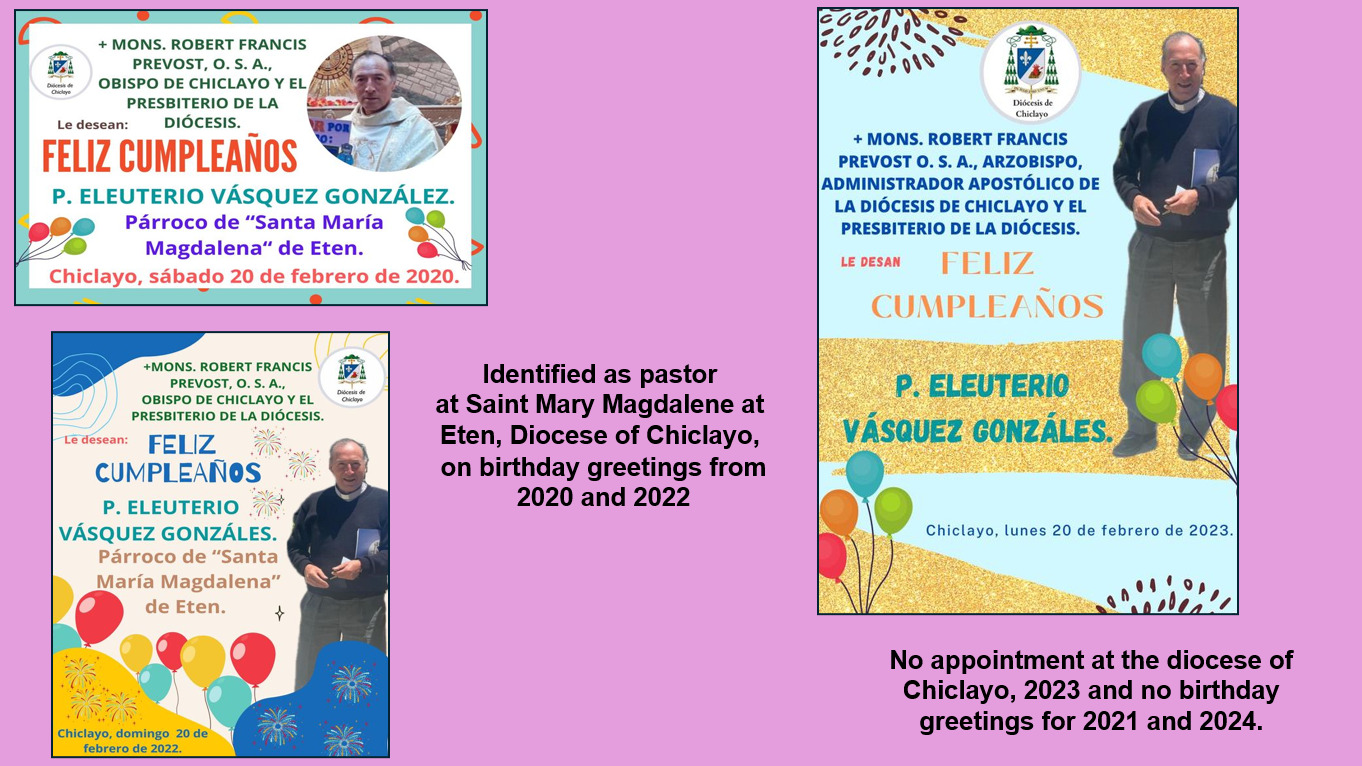
Until it did not. As the previous image proves, in February 2023 his birthday greetings do not acknowledge him as head of a parish, as the greetings from 2019, 2020, and 2022 did. And despite there was no mention of his birthday back in February 2024 at the diocese’s Facebook profile.
So, what happened with Eleuterio Vázquez Gonzáles?
That is a hard to answer question because the dioceses in Latin America hardly ever answer requests for comment on these issues. Trapped in the idea that any person doing journalism on these issues is a dangerous enemy, we can only figure out the whereabouts of the priests named in this type of accusations on our own.
One has to thank the Peruvian bishops, or at least the current bishop of Chiclayo, Edinson Edgardo Farfán Córdova for publishing the full name of the priest accused in this case.

It would have been delusional to try to censor his name, but as the story published a month ago about an Ecuadoran priest proves, linked after this paragraph, bishops in Latin America still believe that they can achieve something by hiding behind the use of initials when dealing with priests named in these cases.

Suicide at the Congress
So, it is clear that there are holes in the way the diocese of Chiclayo is dealing with this issue. It is impossible at this point to agree with the victims’ claim that Cardinal Prevost is actively protecting Vázquez Gonzáles, but in other similar cases, cover up operations are more creative.
Sometimes, the priests are appointed to incredible assignments, as in the case of the Mexican auxiliary bishop of Culiacán, Sinaloa, and current general secretary of the Honduran Conference of Catholic Bishops, Emigdio Duarte Figueroa, who was “sent to study in the Holy Land” when something went wrong with him back in the first decade of this century, and—out of the blue—resigned his position three years after his consecration as bishop.
So, yes. It is possible that Cardinal Prevost is somehow protecting Vázquez Gonzáles or, it could be that he is doing what almost all bishops in Latin America do in cases like this: pretending that nothing happens, while sticking to the benefits derived from the expiration of the statute of limitations.
To be clear. I fully believe in the accusations made by at least three females about sexual harassment and sexual attacks from Vázquez González as a priest in the diocese of Chiclayo, while he was providing some kind of service to the Catholic Youth Movement.
This is a very troubling fact that Vázquez Gonzáles shares with the Brazilian priest from the diocese of Coari, that was the subject of a previous installment on this series, Paulo Araújo.

The crime of Father Araújo
The victims were underage girls and, as it is usually the case, Vázquez Gonzáles had developed a close relation with the parents of at least one of the victims. She talks about how her mother would bake a birthday cake and it would be up to her to deliver it to the priest.
If you read Spanish, you can go over this story with testimonies from the victims of Vázquez Gonzáles.
Given these accusations it is necessary to trace Vázquez Gonzáles development as parish priest, even before his days in San Martín de Porres, to try to find other potential victims.
The stories of many other cases on record prove that priests do not start all of the sudden to attack the faithful under their care. As the stories considered in piece linked after this paragraph prove, predators follow a pattern of development forcing them to leave some trace, some memory of previous attacks.

Seven stories of clergy sexual abuse
Main problem in Chiclayo, all over Peru and Latin America is the unwillingness of the bishops to be transparent, to open their archives, their records, and to allow for thorough reviews of each of these cases.
That is yet another key difference between what happens with clergy sexual abuse in Latin America and what one can find in the United States where the political and judicial institutions force the bishops to change their behavior and to be more transparent and accountable.
And not only the United States. A few weeks ago, this series focused on the case of Abbé Pierre, a priest, national hero of the French Resistance to Nazi Germany, and the founder of Emmaus, a global NGO devoted to helping homeless people all over the world.

Hero, priest, and sexual predator: the story of Abbé Pierre
Back on Thursday, September 12th, the Conference of Catholic Bishops of France announced their decision to open their files regarding Pierre. The announcement was made over what used to be Twitter, as the posting after this paragraph shows:
That is the kind of institutional behavior that is unknown in the Spanish- and Portuguese-speaking Roman Catholic world in Latin America.
In Mexico only a few people have had access to portions of the files related to Marcial Maciel many instances of clergy sexual abuse and the dismissive attitude of the bishops in Mexico, the United States, Spain, Italy, The Vatican, and other countries.
Something similar happens with Fernando Karadima and Renato Poblete in Chile, as in many other cases where the bishops and superiors of religious orders stick to rules set to protect predators that, no wonder, come to bite the ends of their cassocks.
All about timing
Then there is the issue of the timing. Even if there is no way to question the legitimacy of Cuarto Poder, the Peruvian medium that brought this issue back to prominence with their most recent report available at Facebook in the box after this paragraph or here, the case has been there at least since December 2023.
Back then, Radio Programas de Perú, published the story (available only in Spanish) linked here.
It is in that regard that it rather hard to understand why, all of the sudden, this case from a rather rural diocese in Northern Peru receives the attention it is drawing from media that, for the most part, dismisses the very possibility of giving voice to victims of clergy sexual abuse, much less to victims in Latin America, and even less when said victims are, as in this case, females who do not provide yet another chance for that media to play on the idea of clergy sexual abuse as related to the very existence of gay priests.
For the victims, it is clear that the attention is welcome, given the dismissive attitudes of both the Catholic hierarchy in Rome and elsewhere and the national governments of the countries in the region, way too busy with other issues to pay attention to what they see with fear about potential backlash for the ruling coalitions in each country, affected by cases of sexual abuse.
Kill the pawn to get the bishop
One aspect on this case is how U.S. Conservative media use the victims of clergy sexual abuse as pawns in their own game against Pope Francis. If there was a legitimate interest in the clergy sexual abuse crisis, there are plenty of dioceses facing numerous accusations that would deserve the time and effort put these days in Chiclayo.
One must keep in mind also that less than a month ago, Rome issued an ineffective “sanction” against Luis Fernando Figari, the head of the so-called Sodalitium of Christian Life, a religious “order” of sorts to which this series devoted a full story linked after this paragraph.

Even if the ruling on Figari amounts to almost nothing, it lends credibility to the many accusations brought not only against Figari himself, but against the Cardinals, bishops, and priests that fostered the growth of that order in Peru, the United States, Chile, Brazil, and other countries. Some of the details are in the aforementioned story.
It is almost impossible to miss the fact that this case from Chiclayo is “discovered” by English-speaking media who would hardly ever publish stories about the clergy sexual abuse crisis in Latin America, right after Rome's ruling on Figari.
Again, the allegations of clergy sexual abuse are real. If the Peruvian bishops were wise, they would follow the example of their French colleagues and open the files on Vázquez Gonzáles and other predators roaming their parishes. Keeping suspect priests as Eleuterio Vázquez Gonzáles in the limbo I have described forces people like the author of these lines to look over the most obscure corners of the Internet, but it is not a sensible solution to the real issue.
Prevost is doing what the vast majority of the Peruvian and Latin American bishops do with accusations of clergy sexual abuse brought through their church inner channels, which amounts to little or nothing.
That was his mistake during his tenure and it sure is the mistake of current bishop Farfán Córdova. The new bishop reopened the case but sticks to the benefits of the expiration of the statute of limitations.
What is worse, he keeps Vázquez Gonzáles’s records under seven locks, while allowing to occasionally celebrate masses and to perform other priestly activities, as both Radio Programas de Perú and Cuarto Poder claim in their stories on this case.
What comes out of that mess is what we are witnessing now. The limbo where Vázquez Gonzáles resides is not enough. It forces victims of clergy sexual abuse to raise all kinds of questions about why priests like Vázquez Gonzáles are allowed to go back, even if temporarily, to perform priestly duties, while allowing for the kind of campaigns that the U.S. Catholic far-right media launched with this case against Prevost and Pope Francis.

That was the core of the story linked above about a female victim of the Mexican diocese of Atlacomulco who sees, in the small town where she lives, how the priest who repeatedly attacked her when she was an underage girl, goes back into ministry. If you read Spanish, you can know about these cases in the stories linked before and after this paragraph.

Something similar can be said in many cases from other Latin American countries where bishops stick to punctilious interpretations of either the civil laws or their internal rules as Roman Catholic Church that create the tension with the victims of clergy sexual abuse that, on top of their own pain, have to deal with the attitude of many priests and bishops who assume everybody should follow the rules of their Church.
That is the case of the Ecuadoran priest Franklin Germán Cadena Puratambi (story available here), who has not been stripped of the religious orders because he abused an underage boy under his care before he was ordained as priest.
What is even worse is that the very bishops of the Roman Catholic Church are actually unwilling to follow those rules. Readers who are interested in going over a preliminary report on how the national conferences of Roman Catholic bishops in each Latin American country have responded to Pope Francis 2019 reform can read the story linked above, published earlier this year.

Los Ángeles Press published, before, a more specific story on Mexico, linked after this paragraph. Both are useful to better understand Prevost’s approach to clergy sexual abuse in his former diocese.

From writing both stories it is clear for me that even if some dioceses have a large pool of resources at their disposal, almost always the case of archdioceses, a title usually granted to larger, more populated, districts in the internal structure of the Roman Catholic Church, sometimes, the better designs come from smaller dioceses, while large archdioceses, as it would be in the case of Mexico that of Tijuana, remain unwilling to comply with this requirement from the leader of their own church.
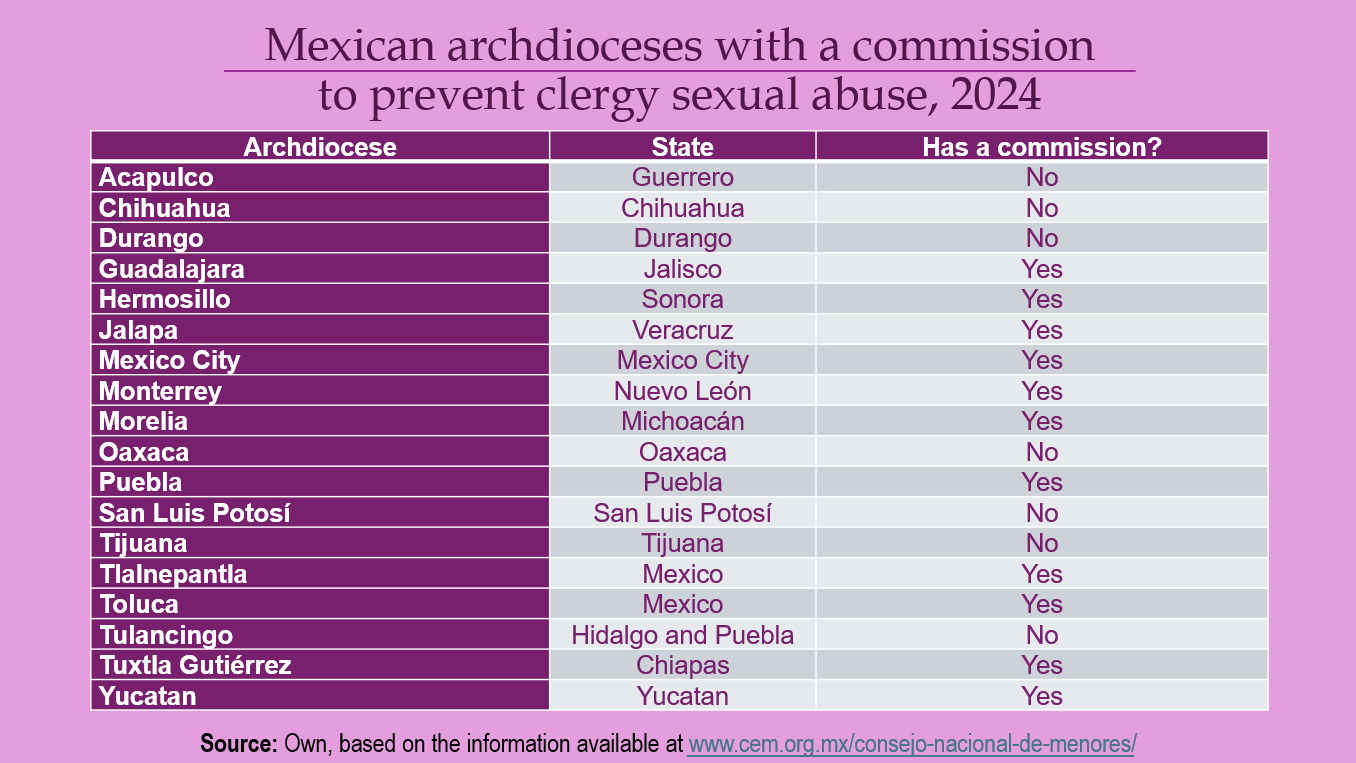
Unlike dioceses with known cases of clergy sexual abuse such as Ciudad Juárez in Mexico or Galápagos in Ecuador, which are unwilling to set up their commissions to prevent clergy sexual abuse, Chiclayo has one.
It is hardly the best possible design for such a commission, since it is heavily biased towards psychologists, but I have seen commissions in Mexican dioceses fully boarded with priests. In Chiclayo’s there are only two priests.
In the diocese of Veracruz, a port and city at the heart of the Mexican coast of the Gulf of Mexico, the nine members of the commission are local priests. In the neighboring archdiocese of Jalapa, the metropolis of Veracruz, eight of nine members of the commission are clerics.
In that regard, even if Prevost made mistakes in his former diocese, and I am sure he did, I would be unwilling to use him as the worst case in Latin America.

Again, it would be better to keep priests out of these bodies. The document issued by the diocese while Prevost was still the bishop there is not clear as to the actual authority of the diocesan body.
It exists only for the purposes of hearing potential victims and filtering them out, but even on that, the diocese of Chiclayo is hardly the worst example of what is happening in Latin America regarding the clergy sexual abuse crisis.
Even if the key issue is the wellbeing of the victims of Vázquez Gonzáles, there are other issues at stake here. Most notably the fact that there are no consequences for the dioceses unwilling to comply with article 2nd of Vos Estis Lux Mundi, the so-called Decree issued by Pope Francis back in 2019.
There, Pope Bergoglio said:
«§1. Taking into account the provisions that may be adopted by the respective episcopal conferences, by the synods of the bishops of the patriarchal churches and the major archiepiscopal churches, or by the councils of hierarchs of the metropolitan churches sui iuris, the dioceses or the eparchies, individually or together, must establish within a year from the entry into force of these norms, one or more public, stable and easily accessible systems for submission of reports, even through the institution of a specific ecclesiastical office. The dioceses and the eparchies shall inform the pontifical representative of the establishment of the systems referred to in this paragraph.» (Full document available here)
So, Pope Francis issued a one-year term to create these commissions but, as it is usually the case in the Church, there is no penalty for non-compliance. Even if one takes only the case of Mexico as an example, we know from the table appearing a few paragraphs above, that only eleven out of eighteen archdioceses or 44 out of a total of 96 dioceses have created their commissions or, as the Pope’s decrees calls them “public, stable and easily accessible systems for submission of reports”.
Not to mention, of course, the unwillingness of the national conferences of Roman Catholic bishops in Latin America to do what their French colleagues did last week: to open their archives to allow for a thorough understanding of the true reach of the clergy sexual abuse crisis.
Whatever Prevost did wrong in Chiclayo or is doing wrong nowadays in Rome, must be corrected. Moreover, he should be dismissed if that helps to solve the issues, but one must remain clear that there are larger issues at stake.