
Guadalupe Lizárraga Domingo, 31 de Agosto del 2025
Captain Crespo, accompanied by a sub-lieutenant, a corporal, and more than ten soldiers armed with MP5 submachine guns, stormed the municipal holding cells to extract him, while 42 Ayotzinapa students were being led into disappearance.
By Guadalupe Lizárraga
PART THREE
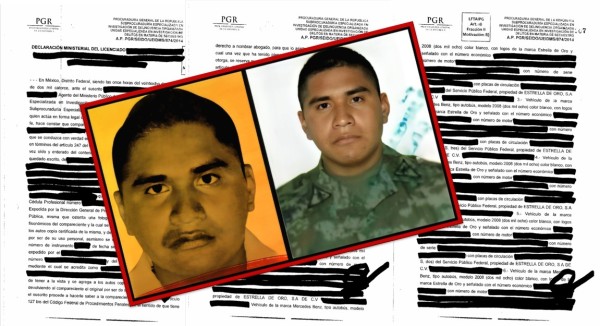
In the Ayotzinapa case files, the name of Julio César López Patolzin emerges as a key that reveals the Army’s direct involvement in the disappearance of the students. López Patolzin was officially registered as a student at the Isidro Burgos Rural Teachers’ College, but in reality, he was an active-duty soldier from the 50th Infantry Battalion, assigned to military intelligence in Chilpancingo. This was confirmed by General Salvador Cienfuegos himself.
The Pascal Report —produced by a citizen intelligence group under the pseudonym Pascal Bourne and delivered exclusively to Los Ángeles Press, as noted in previous installments— states in section GL 1, p. 56:
“General Salvador Cienfuegos Zepeda acknowledged that among the disappeared there was one —Julio César López Patolzin— who ‘matches an active element’—a soldier. What the general essentially admitted was the existence of a soldier-student, López Patolzin, infiltrated among the ranks of the Ayotzinapa Normal School.
The commander of the 50th Infantry Battalion in Chilpancingo, Guerrero, according to email SIIO/18978, reported that soldier Julio César López Patolzin belonged to that military unit and had authorization—with full salary and benefits—to pursue studies in civilian educational institutions.”
On the night of September 26, 2014, López Patolzin was traveling aboard the Estrella de Oro bus 1531, which was intercepted by municipal, state, and federal police at the Chipote Bridge, in front of the Iguala Palace of Justice. There, 14 students were arbitrarily detained and taken to the El Tomatal checkpoint, while López Patolzin was taken to the municipal police headquarters.
How Anabel Hernández Served the Army (SEDENA)
Bus 1531 did not only carry the 14 students who were later disappeared: it was also the bus in which Julio César López Patolzin, the infiltrated soldier, was traveling. Around this vehicle, media narratives were constructed to divert attention toward an alleged drug shipment.
In her book La verdadera noche de Iguala (The True Night of Iguala), journalist Anabel Hernández claimed that the students took buses Estrella de Oro 1531 and 1568 on September 22, 2014, and that they were transporting a heroin shipment valued at two million dollars. This hypothesis, with no documentary basis, was endlessly repeated in the media and even in a Netflix documentary series as the explanation for the attack on the students—treating them as drug traffickers.
The Pascal Report dismantles this narrative step by step with evidence from its opening pages. According to the testimony of the legal representative of Estrella de Oro (Volume 43, folios 5 to 9 of the PGR), the students took five buses on September 23—and not on the 22nd, as Hernández asserts: Estrella de Oro 1577, 1568, 1539, 1531, and 1556.
Bus 1531 had verifiable routes in the days leading up to the massacre. On September 24, it traveled with students to Mexico City to take part in a march and returned to Tixtla the same day without incident. On September 25, one day before the disappearance, it went to Marquelia, Guerrero, to pick up students and returned to the Normal School that same day. Even on the morning of September 26, buses 1531 and 1568 were used for fundraising activities at the Rancho del Cura crossroads and returned to Ayotzinapa around 1:00 p.m., without being stopped by any authority.
“If the Estrella de Oro 1531 bus had been carrying heroin or cash, as Anabel Hernández claims, it could easily have been stopped on any of these trips —to Mexico City, to Marquelia, or during its fundraising run toward Iguala. Yet it was never bothered,” notes the Pascal Report (GL 1, p. 11).
And it adds categorically (GL 1, p. 12):
“We can sum up that Anabel Hernández’s hypothesis falls to pieces for the following reasons:”
- The Estrella de Oro buses 1531 and 1568 entered and left the Ayotzinapa Normal School on September 24, 25, and 26, 2014, without ever being stopped or followed.
- The PGR’s canine units found no trace of drugs or money.
- The Federal Police X-ray unit, under the command of officer Iván Paul Valenzuela López, also found no hidden compartments or evidence of drugs in any of the inspected buses.
- Before the bus of the Avispones soccer team was attacked at the Santa Teresa crossroads, six other civilian vehicles had already been assaulted. Was it the case, then, that Taxi 785, Collective Taxi 12, Taxi 972, a cargo truck, a brown Chevy Monza, and a Dodge RAM 1500 fruit truck were all mistaken for an Estrella de Oro bus supposedly loaded with heroin? “What Anabel Hernández claims is utter nonsense.”
The evidence from the Pascal Report shows that bus 1531 was not transporting drugs, but rather an infiltrated military intelligence soldier. Anabel Hernández’s narrative diversion worked as a cover for the Army (SEDENA): it shifted media attention away from the military’s direct involvement and reinforced the idea that the students had been mistaken for, or co-opted by, drug traffickers. A narrative that, in the words of the Pascal Report, served to conceal the essential truth: the crime of state and the extermination operation directed by SEDENA.
The Rescue Led by Lieutenant Crespo
At 11:30 p.m., Captain José Martínez Crespo, in command of a unit from the 27th Infantry Battalion and carrying an MP5 submachine gun, stormed the Iguala municipal police headquarters. He did not go alone. He was accompanied by Sub-Lieutenant Fabián Alejandro Pirita Ochoa, Corporal Santiago Muñoz Pilo, Soldier Francisco Narváez Pérez, and at least four other troops. The pretext was the supposed loss of a motorcycle belonging to military intelligence agent Ezequiel Mota Esquivel.
However, the analyst leading the Pascal Bourne group explained to Los Ángeles Press that “if it had been an ordinary inquiry—‘like asking about some damn junky little moped,’ as he put it—it would have been enough to send Sub-Lieutenant Pirita with a small group. But that was not the case. The one leading the raid was the duty officer himself, armed with a Heckler & Koch MP5, and alongside him went more than a dozen soldiers. The scale of the deployment makes it clear that this was not an administrative errand but a priority operation: to rescue the infiltrated soldier Julio César López Patolzin and erase all trace of his detention.”
The Heckler & Koch MP5 submachine gun carried by Crespo, standard issue in the Mexican Army, was capable of firing up to 800 rounds per minute with 30-round magazines. Chambered in 9 mm, its design for urban operations made it a highly accurate and lethal weapon at short range. Bursts from the MP5 could have easily pierced the windows and bodywork of the buses carrying the students. However, an analyst from the Pascal Bourne group confirmed to Los Ángeles Press that the armed attacks against the students did not come from the Army, but from the police forces.
As published in the Pascal Report, from its very first section, it demonstrates that it was municipal, state, and federal police who opened fire with AR-15 rifles (caliber .223) and 9 mm pistols, shooting at the buses and causing the first casualties before reaching the central square and at the roadblocks on Periférico Norte.
“The Army was not behind the buses firing,” said the Pascal researcher. “Its role was focused on operational control, real-time surveillance, and the raid on the Iguala police headquarters.”
The analyst further emphasized that Captain Crespo carried out the task of rescuing the infiltrated soldier Julio César López Patolzin and ensuring that no student survived as a witness to the tragic events. Thus, while the police carried out the attacks, SEDENA guaranteed the cover-up and the protection of its own agent within the operation.
The Pascal Report, in section GL 1, pp. 31–32, sets this out with clarity.
“Using the pretext of a supposedly lost motorcycle belonging to soldier Eduardo Mota Esquivel, Captain Crespo sought to justify SEDENA’s raid (according to the statement of the municipal judge José Ulises Bernabé García, Volume 67, folio 510) on the Iguala municipal police headquarters at 11:30 p.m. This raid by SEDENA was carried out to make sure no student was left alive who could serve as a witness; that is, in the best-case scenario. In the worst, they ‘stormed’ the municipal headquarters to rescue Julio César López Patolzin, the soldier-student detained at the Chipote Bridge, thereby immediately erasing the traces of his infiltration.”
The Silence of the GIEI
Despite having access to ministerial statements and telephone records, the Interdisciplinary Group of Independent Experts (GIEI) avoided probing into the figure of López Patolzin. In its reports his name is barely mentioned among the disappeared, without asking what it meant for an active-duty soldier to be infiltrated at the Normal School, or what the consequences were of the Army secretly extracting him from the police headquarters. Nor did they demand Crespo’s testimony. While dismantling Murillo Karam’s “historical truth,” they sidestepped documenting the “military truth” that pointed directly to SEDENA.
The Pascal Report also shows that the GIEI had access to all the ministerial statements and the existing documentation on the case—information the group of international experts themselves acknowledged having reviewed.
The Military Chain of Command
Crespo’s operation was not an autonomous decision. The chain of command shows that his actions were subordinate to Colonel José Rodríguez Pérez, commander of the 27th Infantry Battalion, and in turn to General Alejandro Saavedra Hernández, head of the 35th Military Zone. Official documents reveal that López Patolzin was in real-time communication with Lieutenant Francisco Macías Barbosa, while his reports were verified by Eduardo Mota Esquivel, both from military intelligence. Thus, SEDENA not only knew what was happening: it was coordinating the operation in real time.
Map of the actors on the night of Iguala, September 26, 2014, prepared by Los Ángeles Press with information from the Pascal Report. The red circle marks the rescue of soldier-student Julio César López Patolzin and the support of military intelligence.