Guadalupe Lizárraga Martes, 26 de Agosto del 2025, 00:00
After the disappearance of Jorge Antonio Tizapa came an institutional cover-up, directed by Eber Omar Betanzos Torres — former Ayotzinapa prosecutor, now a senior official at the Federal Audit Office.
By Guadalupe Lizarraga
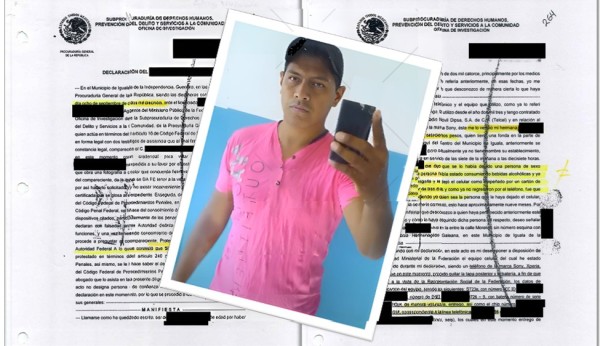
On September 8, 2016, two years after the disappearance of Jorge Antonio Tizapa Legideño, one of the 43 Ayotzinapa students, his cell phone was turned over to the Federal Prosecutor’s Office. During all that time, it had been used and repeatedly activated, beginning on October 4, 2014, by a Guerrero state police officer identified by the initials S.P.D.
The discovery was made by “Pascal Bourne,” the pseudonym of a citizen intelligence group that produced the Informe Pascal on the Ayotzinapa case, which stands as one of the most compelling pieces of evidence of collusion between state and federal authorities to shield those responsible for the disappearance of the 43 students from the Isidro Burgos Rural Teachers’ College.
According to the GIEI’s Second Report (p. 219), on October 4, 2014, the phone line of Jorge Antonio Tizapa registered activity on the Margaritas antenna, located next to the Palace of Justice in Iguala, with several text messages sent. That same record showed a change of IMEI, which the GIEI interpreted as a “device switch.” However, this reading —according to the Informe Pascal— is incomplete and misleading: it was not Tizapa who was using the SIM card, but rather a state police officer assigned to the Regional Police Training Center (CRAPOL) in Iguala.

The GIEI’s own Second Report (p. 219) states:
“On October 4, 2014, the phone line registered activation of the Margaritas antenna at the Palace of Justice, at the following times: 16:48:20, 16:48:56, 16:49:34, 16:50:12, 16:51:21, and 16:53:06. This was due to text messages being sent to the numbers 127373 and 7373. As in other cases described here, a change of IMEI was detected, from 011929004621390 to 359609054307130, that is, the SIM card was switched to a different cell phone.”
However, the Informe Pascal, submitted to Los Ángeles Press with precise observations and documentary evidence obtained from open sources, contradicts the GIEI and labels its work on Tizapa’s phone as a “deficient investigation.”
“The person using the phone line —only the SIM card— of Jorge Antonio Tizapa Legideño on October 4, 2014, was not at the Palace of Justice; in fact, it was a state police officer permanently assigned to the CRAPOL in Iguala,” the report specifies. And it raises the question: “Why did the PGR not investigate as a suspect the state police officer who, on September 8, 2016, handed over to the Federal Prosecutor’s Office the phone of student Jorge Antonio Tizapa Legideño —a Sony Xperia ST23a, with ICCIDPY7PM-0190, IC 4170B-PM190, IMEI 354388056397269?”.
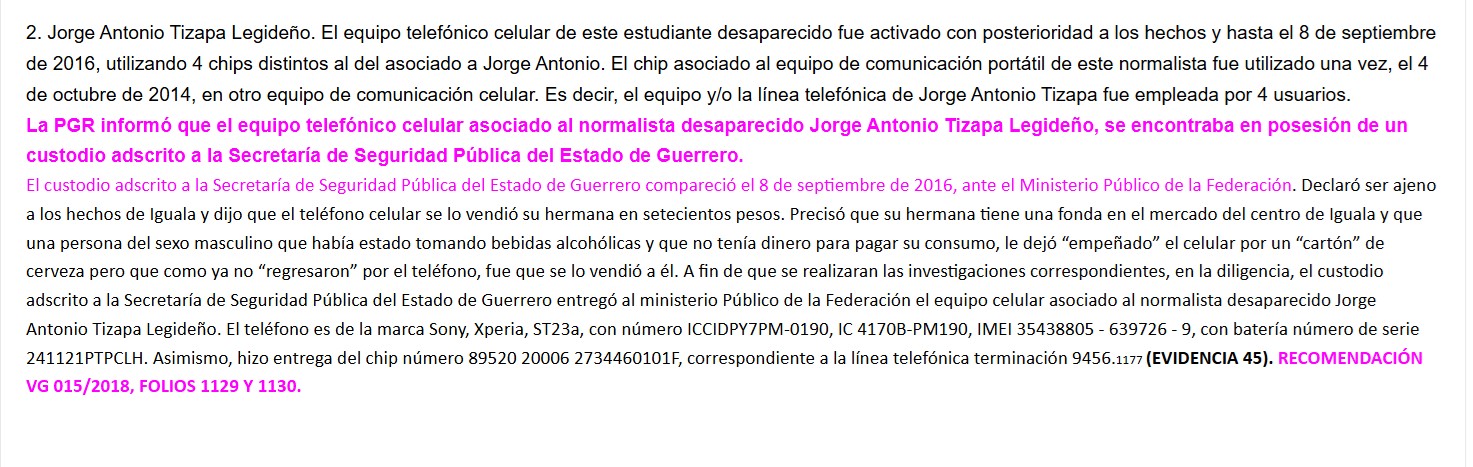
Evidence 45, Recommendation VG015/2018, Folios 1129 y 1130.
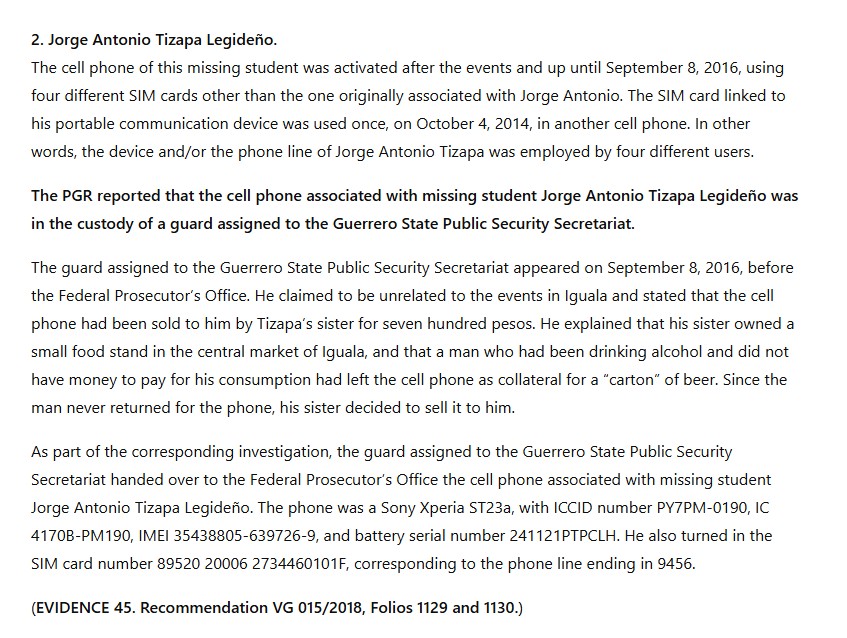
Evidence 45 (English version).
The National Center for Planning, Analysis and Information for Combating Crime had detected that the phone line remained active in the hands of the state police officer. However, instead of requesting a court order to intercept his communications, track his location, and form a special PGR task force —as the circumstances demanded—, the Deputy Prosecutor’s Office headed by Eber Omar Betanzos Torres leaked the information to the Guerrero Public Security Secretary, who in turn alerted the officer. This allowed him to prepare his alibi before testifying in Iguala.
The Pascal Report summarizes it bluntly:
“…Instead of doing that, someone from Deputy Prosecutor Eber Betanzos’s office leaked this invaluable lead to the Guerrero Public Security Secretary, who then called the state police officer to warn him and help him prepare his statement, a possible alibi, and everything he should say in Iguala on September 8, 2016, before the Federal Public Prosecutor (AMPF) sent there by Deputy Prosecutor Eber Omar Betanzos.”
The officer testified that same September 8, 2016, at 10:20 a.m., claiming he had bought the phone for 700 pesos from his sister, who owned a small restaurant in the Iguala Municipal Market. Later that same day, at 1:10 p.m., she stated that the device had been “abandoned” by some young men to whom she had sold meals and alcoholic drinks, and that three days later she sold it to her brother for 800 pesos.
The Pascal Report highlights the contradictions in the siblings’ account. On the one hand, Article 31 of Iguala’s Market and Street Trade Regulations orders the administration to prevent beer or any alcoholic beverages from being brought into the market premises. On the other hand, Article 32 of the same ordinance strictly prohibits the consumption of beer or alcoholic beverages in market stalls, even in municipal-owned outdoor areas. Only by special exception could a license be granted to a food establishment.
Local regulations banning the sale or consumption of alcoholic beverages in food stands inside the Iguala Municipal Market have been in place since 2007 and remain in force. In fact, both the Market and Street Trade Regulations and the Regulations for the Sale and Consumption of Alcoholic Beverages are compiled in the updated normative listings of the City Council up to 2025. This reinforces the argument that the police officer’s sister’s claim —that alcoholic drinks were served at her food stall— has no legal validity and does not correspond with the official regulations in force.
Furthermore, the inconsistencies in the amounts (700 pesos, as declared by the police officer, versus 800 pesos, as stated by his sister) and in the sequence of events point to a fabricated statement. Both versions were recorded in Recommendation VG/015/2018 of the CNDH (Section 22, Evidence 45 and 46).
An analyst from the Pascal Report told Los Ángeles Press: “What should have happened was for the state police officer to be arrested and flown to the PGR to testify, and only afterward should his sister have been located to take her statement without being forewarned. Instead, both were given advance notice; their appearances were scheduled and staggered on the same day at different times. This allowed both witnesses to align their accounts, which are contradictory.”
Statement by State Police Officer S.P.D. on September 8, 2016, at 10:20 a.m.
Statement of the state police officer's sister, September 8, 2016, at 1:10 p.m.
The Discarded Lead
Had the state police officer’s phone line been investigated, it would have been possible to geolocate his presence at the key sites on the night of September 26, 2014: Juan N. Álvarez, the Palace of Justice, and the subsequent disappearance of the students. His fixed Telcel plan, active prior to the events, would have made it easier to obtain his full call history.
A narrative map prepared by Los Ángeles Press shows the strategic location of the Northern Region CRAPOL barracks, situated in the Ampliación San Isidro neighborhood, at the corner of Emiliano Zapata and Benito Juárez streets. On the date the state police officer gave his statement, this base was under the command of Bladimir Guevara Santillán.
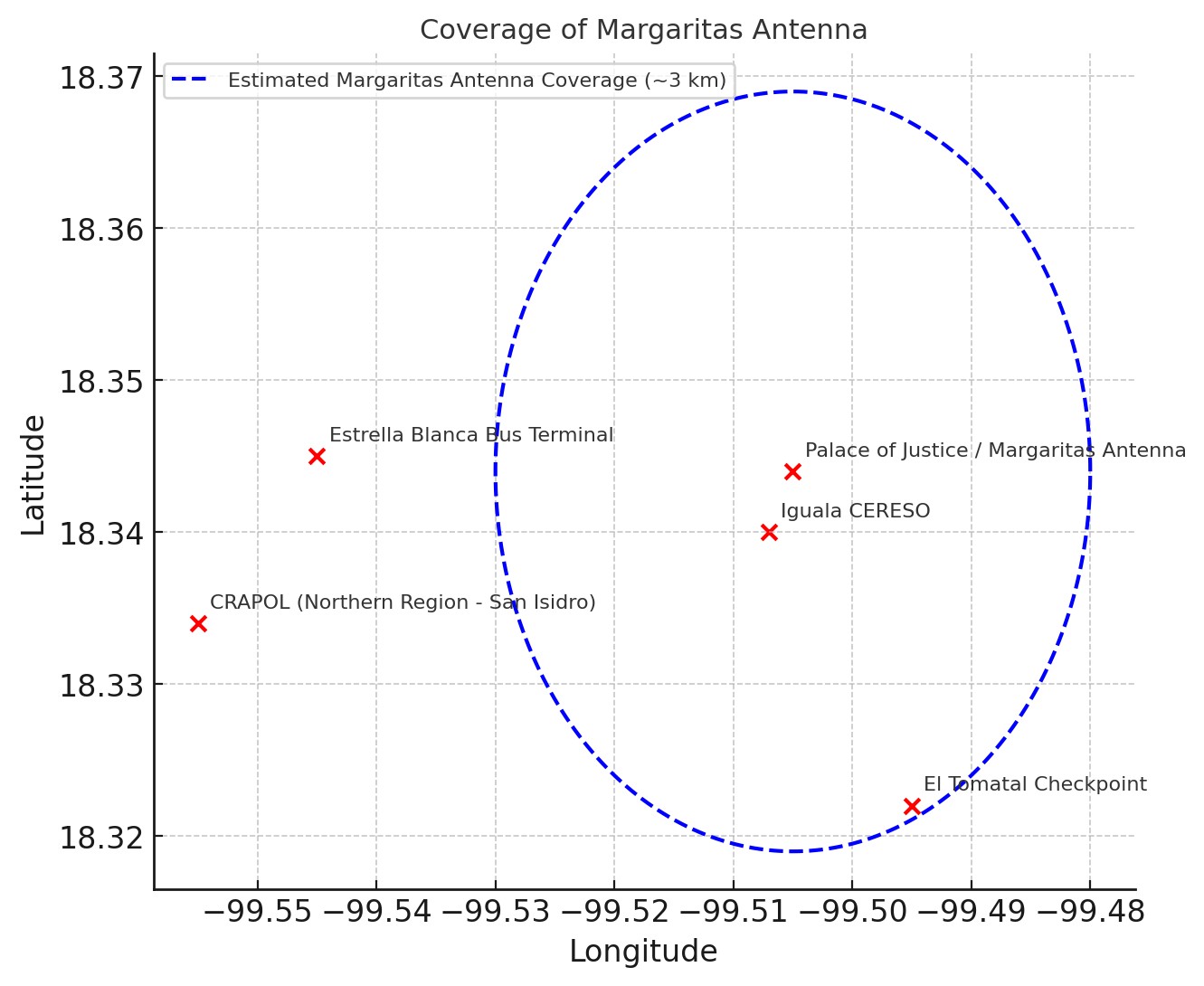
The dual chart shows how the Margaritas antenna, located next to the Palace of Justice, extended its ~3 km coverage to both the Iguala CERESO and the El Tomatal checkpoint. Together, these three sites formed a strategic corridor under the control of the State Police on the night of September 26, 2014. In contrast, CRAPOL and the Estrella Blanca Bus Terminal lay outside this signal range, confirming that the activation of Jorge Antonio Tizapa Legideño’s cell phone corresponded specifically to the eastern perimeter of the city, within key state-controlled facilities.
Far from being a minor detail, this proximity reinforces the hypothesis that the State Police not only had knowledge of what happened but also directly participated in the detention and disappearance operations on September 26, 2014. The fact that the police officer in possession of Jorge Antonio Tizapa’s phone was permanently assigned to that base links him unequivocally to the actions carried out that night. According to the Pascal Report, with this evidence he could have been arrested and charged with the crime of enforced disappearance. Instead, he was shielded by the PGR and the State Coordination of the Federal Police, further protected by the false statements of his relative.
Rather than clearly pointing out this irregularity, the GIEI limited itself to noting the “activity” and the “IMEI change.” In doing so, it overlooked one of the most compelling indications: that a state police officer used the phone of a disappeared student for two years, with the full knowledge and cover of local and federal authorities.
The Pascal Report underscores the following:
“This state police officer gave his statement and, on that date, handed over the phone that had belonged to student Jorge Antonio Tizapa Legideño —Evidence from the CNDH, Recommendation VG 015/2018, Section 22, Evidence 45. Astonishingly, the officer has never been linked to the enforced disappearance of the students; anywhere else in the world, this state police officer would have been arrested and tried for this disappearance.”
Evidence 45, included in the annexes of Section 22 of CNDH Recommendation 15VG/2018, documents how the state police officer assigned to CRAPOL turned in the cell phone of Jorge Antonio Tizapa Legideño. This file is available in the supplementary documents linked to the recommendation.
One of the Pascal Bourne analysts stressed to Los Ángeles Press the complicity of federal authorities with state authorities in the Ayotzinapa case:
“The PGR accepted the version that this officer was in Chilpancingo on the night of September 26, 2014, and that Jorge Antonio Tizapa Legideño’s phone had been acquired through his sister, who sold it to him for 700 pesos, claiming she owned a food stall upstairs in the Iguala Market. And we repeat: in the Iguala Municipal Market no alcoholic beverages are sold —least of all in a food stall.”
The same analyst concluded:
“It is indisputable that this state police officer directly participated in the detention of the students at the Juan N. Álvarez site, then at the Palace of Justice site, and finally in their disappearance. Accessing his phone records would have allowed us to geolocate his participation at the crime scenes at key moments on the night of September 26, 2014.”
Eber Betanzos and Institutional Shielding
Human Rights PhD. Eber Omar Betanzos Torres entered the public spotlight on May 16, 2015, when Attorney General Arely Gómez appointed him Deputy Prosecutor for Human Rights at the PGR, in the midst of the crisis over Jesús Murillo Karam’s “historical truth.” From that position he oversaw the offices for disappearances and human rights and maintained direct communication with the GIEI. It was in his office, in 2016, that the information about Jorge Antonio Tizapa’s cell phone in the hands of the state police officer was concentrated.
Instead of prosecuting him, Betanzos endorsed the leak that allowed the officer to prepare his alibi together with his sister. On September 8, the officer turned in the phone and repeated his sister’s fabricated story; the PGR validated it without objection. A month later, in October 2016, Betanzos was forced to leave the institution amid the rupture with the GIEI and found refuge in the Ministry of Public Administration as undersecretary.
The Iguala case will not be closed until the last person responsible is held accountable”: Eber Betanzos, prosecutor of the Ayotzinapa case (El País, April 27, 2016)
Today, far from being held accountable for the chain of omissions that shielded a state police officer linked to the disappearance of the students, he holds a senior position at the Federal Audit Office, from where he oversees the use of public funds.

Former Ayotzinapa case prosecutor Eber Betanzos. Photo: El País.
The case of Jorge Antonio Tizapa demonstrates that the GIEI’s investigation was deficient —as revealed by the Pascal Report— and that the Human Rights Deputy Prosecutor’s Office of the PGR, under the command of Eber Omar Betanzos and in collusion with the Federal Police and Guerrero authorities, shielded a state police officer directly linked to the disappearance of the students, despite Betanzos’s extensive background in public ethics and human rights.

Key Points of the Second Installment
The first part of this investigation established that Omar García Harfuch received institutional protection while denying his presence in Guerrero and claiming to be in Michoacán, despite official documents placing him in Acapulco giving orders for the ambush against the students.

English Edition
Ayotzinapa: A State Operation of Extermination
In this second part, the same pattern of protection is repeated: a state police officer in possession of Jorge Antonio Tizapa’s cell phone was exonerated thanks to the direct intervention of the Deputy Prosecutor’s Office headed by Eber Omar Betanzos Torres, which leaked information and validated a fabricated alibi.
They are two pieces of the same machinery of impunity: Harfuch rose in his political career backed by the “historical truth,” while Betanzos advanced within the Federal Audit Office as a guarantor of fiscal control. Both cases illustrate how the Mexican state rewarded those who covered up for the perpetrators and consolidated a system in which the disappearance of the 43 was not only a state crime but also an institutional cover-up project that remains in place to this day.
More than ten years ago, Los Ángeles Press conducted a telephone interview with José Antonio Tizapa, father of the missing student. Living in New York, he was among the first to publicly raise his voice demanding justice for Ayotzinapa after the disappearance of the students.