
President Trump said that his administration was examining U.S. Treasury debt payments for possible fraud and suggested that the country's $36 trillion debt load might not be as high as previously thought.
By Jeff Mason
U.S. President Donald Trump on Sunday said his administration was examining U.S. Treasury debt payments for possible fraud and suggested that the country's $36 trillion debt load might not be that high.
Speaking to reporters aboard Air Force One, Trump said administration officials who have been combing through payment records in an effort to identify wasteful spending have turned their attention to the debt payments that play a central role in the global financial system.
"We're even looking at Treasuries," Trump said. "There could be a problem - you've been reading about that, with Treasuries and that could be an interesting problem."
He added: "It could be that a lot of those things don't count. In other words, that some of that stuff that we're finding is very fraudulent, therefore maybe we have less debt than we thought."
It was not clear whether Trump was referring to debt service or other government payments made by the Treasury Department.
The United States currently has $36.2 trillion public debt outstanding, according to the U.S. Treasury, equal to more than 120% of GDP. Because the U.S. government spends more money than it collects, Trump and his fellow Republicans who control Congress will have to authorize more borrowing sometime this year to avert a debt default that could have catastrophic consequences.
Trump's proposed tax cuts would add trillions of dollars more in debt, independent budget watchdogs say.
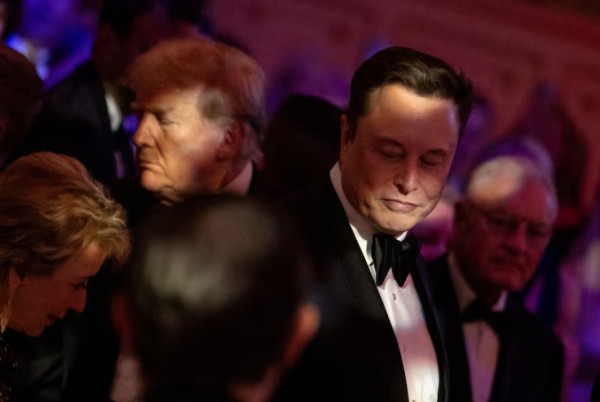
Trump has tasked Elon Musk with an ambitious overhaul of the federal government, sparking street protests in Washington and accusations that the Trump administration is breaking the law.
Musk's "Department of Government Efficiency" has disrupted operations at several federal agencies and has raised privacy and security concerns while accessing sensitive payroll and spending records.
A federal judge temporarily blocked Musk's team on Saturday from accessing government systems used to process trillions of dollars in payments, citing a risk that sensitive information could be improperly disclosed.
After the ruling, Musk said a do-not-pay list of entities that should not receive government payments should be updated at least weekly, if not daily.
Treasury Secretary Scott Bessent, a Trump appointee, said last week that Musk's team had "read only" access to the payment system, which would not give them power to make changes.
Trump's attempt to freeze wide swaths of domestic aid has been blocked in court, but project managers across the country say billions of dollars nevertheless have been withheld for clean energy and transportation projects.
Some health clinics say they have been forced to lay off staff and shutter facilities because they have not been able to access federal funding.
---
Reporting by Jeff Mason and Andy Sullivan; Writing by Andy Sullivan and Brad Brooks; Editing by Noeleen Walder and Andrea Ricci
The Pentagon's annual budget is nearing $1 trillion. In December, former President Joe Biden approved a bill allocating $895 billion for defense spending in the fiscal year that concludes on September 30.
WASHINGTON, (Reuters) - U.S. President Donald Trump said he expects Elon Musk to find hundreds of billions of dollars of fraud and abuse at the Pentagon during an audit that the billionaire will lead.
"I'm going to tell him very soon, like maybe in 24 hours, to go check the Department of Education. ... Then I'm going to go, go to the military. Let's check the military," Trump said in a Super Bowl interview with Fox News' Bret Baier, an excerpt of which was aired on Sunday morning.
"We're going to find billions, hundreds of billions of dollars of fraud and abuse," Trump said of the largest federal department.
The Pentagon's budget is approaching $1 trillion per year. In December, then-President Joe Biden signed a bill authorizing $895 billion in defense spending for the fiscal year ending Sept. 30.
Musk, who the White House says is a special government employee, has been tasked by Trump to lead an effort to slash the size of the U.S. federal workforce. As part of that initiative, Musk aides have sought access to confidential information in computer systems at various government agencies.
Critics say the efforts are likely illegal, risk exposing classified information, and in practice are gutting entire agencies without congressional approval.
National Security Adviser Mike Waltz suggested in a separate interview on Sunday that the Pentagon's shipbuilding processes could be an area of particular interest for the Department of Government Efficiency, and he characterized the Pentagon in general as full of unnecessary bloat.
"Everything there seems to cost too much, take too long, and deliver too little to the soldiers... We do need business leaders to go in there and absolutely reform the Pentagon's acquisition process," Waltz said in an interview on NBC's "Meet the Press."
"There is plenty to look into in shipbuilding, which is an absolute mess," Waltz added.
Leaders from across the political spectrum have long criticized waste and inefficiency at the Pentagon. But Democrats and civil service unions say Musk's Department of Government Efficiency lacks the expertise to restructure the Pentagon, and their efforts risk exposing classified programs.
Musk's companies also hold major contracts with the Pentagon, which has raised significant conflict-of-interest concerns.
---
Reporting by Gram Slattery; Editing by Ross Colvin and Mark Porter.