
Andrés Gil Miércoles, 03 de Septiembre del 2025
A 38-page document published by The Washington Post outlines the relocation of over two million Gazans as part of the post-genocide phase in the devastated Strip.
By Andrés Gil
Washington Correspondent — Two million forcibly displaced people. U.S. control. The disappearance of the Palestinian state as a long-term vision. And the Abraham Accords as the guiding geopolitical framework, establishing normalized relations with Israel. These are the pillars of the White House’s plans for what it calls the “Middle East Riviera” in Gaza — the phase following the Israeli genocide in the Strip.
A post-massacre plan for Gaza, currently circulating within the Trump administration and first reported by The Washington Post on Sunday, expands on President Donald Trump’s promise to “take control” of the devastated enclave and transform it into a U.S.-administered trust territory for at least 10 years — eventually turning it into a tourist resort and a hub for manufacturing and tech production.
The 38-page document published by The Washington Post envisions the displacement of over two million Gaza residents to another country or to restricted zones within the enclave. Gaza would be placed under a U.S.-run trust — handed over by Israel — for at least 10 years, requiring the relocation of the entire Gazan population, a proposal that amounts to ethnic cleansing.
According to The Washington Post, landowners would be offered a digital token by the Gaza Reconstruction, Economic Acceleration, and Transformation Fund (GREAT), in exchange for redevelopment rights to their property. This token could be used to finance a new life elsewhere or eventually be redeemed for an apartment in one of six to eight new AI-powered smart cities planned for construction in Gaza.
Each Palestinian who chooses to leave would receive a $5,000 cash payment, rental subsidies for four years elsewhere, and one year of food assistance.
The plan estimates that each individual departure from Gaza would save the trust fund $23,000 compared to the cost of supposedly temporary housing and so-called “life support” services in the designated safe zones for those who remain.
The proposal was developed by some of the same Israelis who created and launched the controversial Gaza Humanitarian Foundation (GHF), a system the UN has described as a “smokescreen for more violence,” overseen by Israeli troops and a U.S. security firm that “militarizes” humanitarian aid. The financial planning was carried out by a team then working for Boston Consulting Group, which stated that the trust fund plan had not been explicitly approved, and that two senior partners who led the financial projection were eventually dismissed.
Last Wednesday, Trump held a White House meeting to discuss ideas on how to end the nearly two-year-long war and decide what comes next. Participants included U.S. Secretary of State Marco Rubio; Special Presidential Envoy Steve Witkoff; Tony Blair, whose views on Gaza’s future have been sought by the Trump administration — in July, it was revealed that staff from the former British prime minister’s think tank were involved in a project to develop a postwar plan — and Trump’s son-in-law Jared Kushner, who oversaw much of the president’s Middle East initiatives during his first term and reportedly holds significant private interests in the region, according to The Washington Post.
“It’s unclear whether the detailed and complete proposal from the GREAT Trust fully reflects what Trump has in mind. But some key elements, according to two people familiar with the planning, were specifically designed to realize the president’s vision of a ‘Middle East Riviera,’” the newspaper reports. Neither the White House nor the State Department responded to The Washington Post’s request for comment, although the document appears to echo Donald Trump’s expressed ambition to “cleanse” Gaza.
The idea was first voiced by Trump on February 4, during Israeli Prime Minister Benjamin Netanyahu’s visit to the White House.
According to the document published by the U.S. outlet, the fund’s plan “does not rely on donations.” Instead, it would be financed through public and private investments in so-called “megaprojects,” ranging from electric vehicle factories and data centers to beach resorts and skyscrapers with apartments.
The plan’s calculations foresee a nearly fourfold return on investment—$100 billion over 10 years—with continuous “self-generated” revenue streams.
The release of the plan comes after the State Department denied visas to Palestinian officials seeking to attend the UN General Assembly in New York this September.
In February, Trump proposed that the United States take control of the Gaza Strip to turn it into the “Middle East Riviera,” after displacing its inhabitants to Egypt and Jordan.
Since October 7, Israel has killed more than 63,600 people in Gaza, mostly civilians, according to Gaza’s Ministry of Health. Israel’s military retaliation has systematically reduced the enclave to rubble, displacing hundreds of thousands and leaving nearly half a million facing what a global crisis observatory has called catastrophic famine.
Proposals for the post-genocide future of Gaza have proliferated since October 7, 2023, when Hamas launched a surprise attack on Israel, invaded southern Israel, killed around 1,200 people, and took roughly 250 hostages.
Trump, Chief Real Estate Developer
When he returned to address the crisis as president, Trump spoke about how he would use his real estate skills once Gaza’s residents had left. “I’ve seen a picture of Gaza — it’s like a giant demolition zone,” Trump told reporters as he signed a series of executive orders in the Oval Office two days after taking office. “It needs to be rebuilt differently. Gaza,” he said, “is a phenomenal location... by the sea, with the best climate. Everything is good. Wonderful things can be done with it.”
Two weeks later, at a White House press conference with Netanyahu, Trump declared that “the U.S. would take control of the Gaza Strip.” Outlining a “long-term ownership position,” he added that everyone he had spoken to about it “loved the idea.” “I’ve studied this very carefully for many months and looked at it from every angle,” Trump said. “I don’t want to be clever. I don’t want to be a know-it-all. But the Middle East Riviera could be something magnificent.”
Netanyahu, smiling beside Trump, called the plan “bold” and said Israel and the United States had a “common strategy.”
When asked the same day in a Fox News interview whether Gazans could return after the occupation, Trump replied, “No, they wouldn’t, because they’re going to have much better housing” elsewhere.
A week later, the U.S. president revisited the topic during a meeting in the Oval Office with King Abdullah II of Jordan. “With the United States controlling that territory,” he said, referring to Gaza, “there will be stability in the Middle East for the first time. And the Palestinians, or the people who now live in Gaza, will live wonderfully somewhere else.”
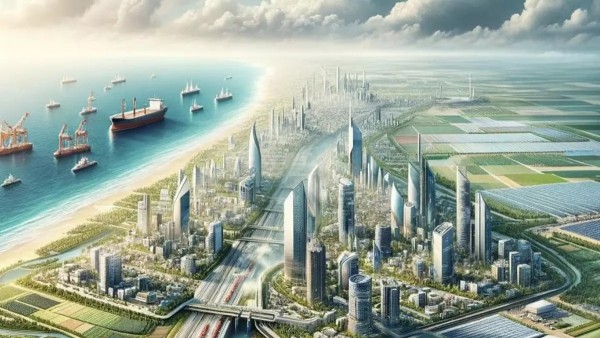
Shortly after, Trump posted an AI-generated video on social media depicting Gaza with gleaming skyscrapers, pristine beaches, money falling from the sky, and Trump and Netanyahu sunbathing on the coast. As a finishing touch, a golden statue of Trump towers over the landscape.
Meanwhile, Israel has continued its ongoing genocide, cornering Gaza’s roughly two million residents into a narrow coastal strip in the south, while preparing for an offensive in the north, in Gaza City.
The United Nations estimates that 90% of the enclave’s housing has been destroyed.
Trump’s February promise to acquire and redevelop Gaza served as both a green light and a roadmap for a group of Israeli entrepreneurs led by Israeli-American businessman Michael Eisenberg and former Israeli military intelligence officer Liran Tancman, The Washington Post explains.
In the spring, a Boston Consulting team hired to work with the main U.S. contractor responsible for establishing the GHF food distribution program was involved in financial planning for the GREAT Trust.
As described in the document, Israel would transfer “authorities and administrative responsibilities in Gaza to the GREAT Trust under a bilateral agreement between the U.S. and Israel,” which would “evolve” into a formal trusteeship.
The draft envisions final investments from “Arab countries and others,” turning the agreement into a “multilateral institution.”
Israel would retain “general rights to meet its security needs” during the first year of the plan, while nearly all internal security would be handled by unspecified “TCN” (third-country nationals) and Western private military contractors. Their role would gradually diminish over a decade as a trained “local police” force takes over.
The trust would govern Gaza for several years—estimated to last about ten—“until a reformed and de-radicalized Palestinian political entity is ready to take over.”
The document makes no mention of the eventual creation of a Palestinian state. The governing Palestinian entity “will join the Abraham Accords,” which established diplomatic relations between Israel and four Arab states.
The plan describes Gaza as “a crossroads,” giving the U.S. access to critical energy and mineral resources and serving as a logistics hub for the India-Middle East-Europe Economic Corridor, first announced under the Biden administration but disrupted by the Israel-Gaza war.
Reconstruction of Gaza would begin with the removal of large amounts of rubble and unexploded ordnance, along with rebuilding public services and the electrical grid.
Initial costs would be financed using 30% of Gaza’s land—deemed “public” property by planners—as collateral, which would immediately transfer to the trust.
Among the megaprojects financed by investors is the paving of a ring road and a tram line around Gaza’s perimeter, dubbed the “MBS Highway” by planners in honor of Saudi Crown Prince Mohammed bin Salman, whose endorsement of the initiative would greatly aid regional acceptance. A modern north-south highway running through central Gaza would be named after the President of the United Arab Emirates, Mohammed bin Zayed al-Nahyan. A new port and airport would be built at the southern end, with direct land connections to Egypt, Saudi Arabia, and Israel.
Saudi Arabia and the United Arab Emirates have publicly supported Egypt’s proposal for Gaza and the eventual creation of a Palestinian state, with no indication that they have accepted any part of the trust fund plan.
The GREAT Trust also includes plans for a desalination plant and a solar park on the Egyptian Sinai Peninsula to provide water and electricity to Gaza.
Gaza’s eastern border with Israel would become a “smart” industrial zone, hosting U.S. electric vehicle companies and regional data centers serving both Israel and Gulf countries. The enclave’s western coast would be reserved for the “Trump Riviera of Gaza,” featuring “luxury resorts” and the possibility of artificial islands similar to those built off Dubai, United Arab Emirates.
In the center of Gaza, between the coastal resorts and the industrial zone—which the plan claims would create one million jobs—apartment buildings up to 20 stories high would be constructed across six to eight “dynamic, modern, and smart planned cities powered by artificial intelligence.”
Mixed-use areas would include “residential, commercial, light industry, and other facilities such as clinics and hospitals, schools, and more,” interspersed with “green spaces, including farmland, parks, and golf courses.”
Families in Gaza who remain, or who leave and later return once residential areas are completed to redeem their property titles, would be offered ownership of new apartments measuring 167 square meters, valued at $75,000 each according to the plan.