
Guadalupe Lizárraga Jueves, 30 de Abril del 2026
Former federal officer remains under surveillance as authorities fail to present evidence linking him to the Ayotzinapa case
By Guadalupe Lizárraga
With videos and photographs, Emmanuel de la Cruz Pérez Arispe has documented years of living under constant state surveillance.
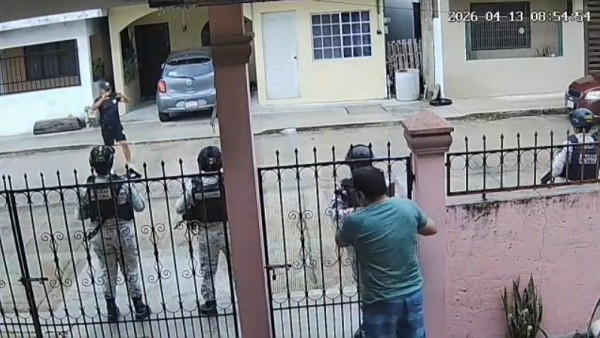
National Guard units and personnel linked to Mexico’s Defense Ministry (SEDENA) maintain a perimeter around his home in Tampico. Just meters from his house, they have set up a camp with roughly a dozen agents. Every morning, he steps onto his porch, signs a document handed to him through the bars of his gate, and allows a plainclothes agent to photograph the interaction.
The scene repeats daily.
It is not the result of a conviction based on established facts. It stems from an accusation that, more than a decade later, remains unsupported by material evidence.
Emmanuel de la Cruz is one of three former federal police officers accused in the disappearance of 42 students and one soldier who had infiltrated the Ayotzinapa teachers’ college as a student on the night of September 26, 2014. The other two officers are Luis Antonio Dorantes Macías and Víctor Manuel Colmenares Campos.
In addition to enforced disappearance, Emmanuel was accused of organized crime, allegedly linked to the Guerreros Unidos cartel. The claim relied on testimony from drug trafficker Gildardo López Astudillo, known as “Cabo Gil,” who later became a protected witness for the Attorney General’s Office (FGR) under the code name “Juan.” That testimony did not mention Emmanuel by name. It was not supported by forensic evidence, documentation, or eyewitness accounts placing him at the site where the students were detained. Still, the accusation gained traction in the public narrative through a media operation that relied heavily on reporting by journalist Anabel Hernández.
On October 8, 2014, a process began that has yet to establish Emmanuel’s involvement in the events of that night in Iguala. He has been under investigation since then and under house arrest since 2022. Emmanuel maintains—echoing what the case file reflects—that there is no evidence placing him at the scene where the students were deprived of their liberty. No one identifies him: not the surviving students, not the bus driver. His assigned unit, patrol car number 9908, does not appear in the material reconstructions of the disappearance.
Forensic reviews conducted by the Attorney General’s Office (PGR) in 2015, as well as by the Federal Police, found no biological traces, no ballistic matches, and no evidence linking recovered shell casings to his service weapons. Those weapons, according to official findings, were not fired that night or the following day.
The Federal Police structure in Iguala shows a clear chain of command. Emmanuel de la Cruz Pérez Arispe held the rank of sub-officer, with no decision-making authority or operational command. Above him were Officer Víctor Manuel Colmenares Campos, his immediate superior; Sub-Inspector Luis Antonio Dorantes, the operational commander in Iguala; Inspector José Antonio Cabrera Méndez, second in the state coordination; and, at the top, then-commissioner Omar García Harfuch. Relevant decisions and communications occurred at higher levels.
As a sub-officer, Emmanuel operated within a strictly subordinate role. This is reflected in the logbook of the unit assigned to him on September 26, 2014. The log records patrol routes, circulation reports, and routine observations during his shift. The official document, reviewed by Los Ángeles Press, contains no record of detentions, custody of civilians, transport of detainees, or use of force. Nor does it show any transfer of detainees to prosecutorial authorities. All entries correspond to preventive patrol duties.
- Between 10:20 p.m. and 1:30 a.m., the logbook for Federal Police patrol 9908 documents a sequence of communications. These include references to the code “PUMA”—the identifier for Iguala station chief Luis Antonio Dorantes Macías—as well as mentions of Public Security Director Felipe Flores and prosecutor José Manuel Cuencas Salomón.
- The recorded codes include 47 (“suspend transmission”), 18 (“concentration”), and 2 (“exercise extreme caution”), along with a reference to document 1187/2014. Taken together, these entries indicate instructions to interrupt communications associated with that operational identifier at a critical moment during the attacks on the students.
- The log reflects real-time interaction between Federal Police command, local public security authorities, and the Public Prosecutor’s Office. It documents a continuous sequence of communications, orders, contacts, and information requests during the events.
Los Ángeles Press reconstructed Federal Police timelines analyzed in the Pascal Report. According to its authors, the force was involved in monitoring and bus interception operations ordered by Omar García Harfuch, including control of the bus identified as Eco 3278, reported at 9:48 p.m. to the state coordinator.
The flow of communication moved upward to the command level led by García Harfuch. That same day, he held a morning meeting with Federal Police commanders. From that meeting came information note 1358/2014, which refers to a “working meeting at Base Vértice in Acapulco, Guerrero.”
This document contradicts García Harfuch’s claim that he was in Michoacán on assignment that day. It specifies that he convened a meeting at 9 a.m. with state Federal Police commanders and another at 7 p.m. with SEDENA officials.
The Federal Police ambush of the students’ buses is detailed in the Pascal Report. While no records show direct participation in the detention, transport, or custody of the students, there is documented evidence of traffic control and bus tracking carried out under García Harfuch’s orders. He received real-time updates from Dorantes, who in turn was informed by the officer on duty, Alexander Esquivel Hermenegildo. Esquivel simultaneously reported to CONTEL, the Federal Police operations center in Iztapalapa, Mexico City.
Cross-referencing these timelines with the patrol log places Emmanuel on active duty, assigned to unit 9908, performing patrol functions. There is no record placing him at the site where the attack on bus 1531 occurred. The official reconstruction does not situate him at the scene or at the moment when the alleged crime took place.
“There is no evidence that I was at the scene. None of the students identify me. Not the bus driver. No one—neither me nor my patrol,” he told Los Ángeles Press. He added that ten federal police officers were on duty that afternoon: “At first there were four of us and the shift supervisor, but as events unfolded more officers arrived to secure the facilities, plus the guard and the radio operator. But only three were charged—just two and me.”
According to his account, he and Officer Víctor Manuel Colmenares Campos were patrolling the Iguala–Cuernavaca highway at the time. They separated at 11 p.m. Colmenares is recorded at the office at 11:10 p.m., preparing an information note for Dorantes and responding to requests from prosecutor José Manuel Cuencas Salmerón. Sub-officer Alexander Esquivel Hermenegildo, the officer on duty, received information from the C4 command center and relayed it to his superiors and to Mexico City coordination. At 3 a.m., according to testimony, the second state coordinator, José Antonio Cabrera Méndez, arrived and spoke exclusively with Dorantes, head of the Iguala station.
The testimonies used to support the official narrative contain inconsistencies. The statement of Leonardo Octavio Vázquez Pérez—a retired Army lieutenant and then Guerrero’s Secretary of Public Security—refers to informing a state coordinator identified as “Cabrera,” while official timelines place Omar García Harfuch in that role at the time. The discrepancy does not alter the chain of command, but it exposes inaccuracies in the testimony underlying the accusation.
While the case remains focused on Emmanuel, other actors with greater authority and closer operational proximity have not been investigated. These include Alexander Esquivel Hermenegildo, the officer on duty receiving information directly from C4; José Carlos Hernández Romero, who reported in real time to Dorantes; José Antonio Cabrera Méndez, who met with Dorantes around 3 a.m.; and Arturo Gómez Gómez, who was patrolling the Iguala–Mezcala highway. All held command roles or had direct access to decision-making levels. Their omission shifts institutional responsibility toward a sub-officer with less than two years in the force.
The case file also reflects delays, requests to separate proceedings, and formal acknowledgments of undue delay. Prosecutors have not linked Emmanuel to any specific actions. What remains is his institutional affiliation and his presence on duty—not an established individual role in the crime.
The allegation that federal police officers fired on the students is not supported by forensic evidence in his case. Ballistic tests rule out any match with his weapons, according to PGR expert reports. Even so, later testimony—such as that of bus driver Gregorio Jaimes Reyna, modified six years after his initial statement—was incorporated to reinforce a narrative not supported by initial records, according to the Pascal Report.
“Because I was new, I had the most defective patrol car,” Emmanuel said. “They inspected my unit—the PGR and the Federal Police examined everything. They found no evidence that I transported anyone. None of the shell casings matched my weapons. They conducted forensic tests on both my long and short firearms. Nothing matched. Nothing links me to the events.”
He also emphasized that his weapons were not fired that day. “There are statements coached by the Prosecutor’s Office saying federal officers fired at the students. If we fired, then prove it.”
The Federal Police had a presence in the same operational corridor. They monitored movements, controlled another bus, and reported to the state coordinator in real time. That presence, however, does not establish participation in the detention of bus 1531 or in the students’ disappearance. The documented structure places information management and decision-making at higher levels, beyond the reach of a sub-officer without command authority.
The case against Emmanuel de la Cruz is defined less by what he did than by the position he occupies within an institution that operated that night under a chain of command that remains only partially investigated. The accusation persists without supporting evidence, alongside a gap in accountability at the levels where decisions were made.