
Guadalupe Lizárraga Jueves, 15 de Enero del 2026
Beyond immigration control, ICE emerges in the records as a domestic policing force with expanding authority and limited accountability.
By Guadalupe Lizárraga
San Diego, CA — For months, thousands of people were taken into federal custody without clear public explanation. Local communities were left in the dark. State authorities were not briefed. Congress received no meaningful account. Now, internal ICE records captured directly from agency computer screens and leaked to journalist Ken Klippenstein by a Border Patrol official provide the first detailed reconstruction of a period of quiet operations that dramatically expanded the reach of federal immigration enforcement inside the United States.
The records show that between late 2024 and spring 2025, ICE carried out at least 21 large-scale operations across the country. During that time, serious deportation errors were documented, including the case of Central American national Kilmar Ábrego. But these were not conventional immigration raids. What unfolded was a broader expansion of state control: intelligence-driven tactics, undercover agents, and interagency coordination conducted under a level of secrecy that effectively sidelined public oversight.
ICE Enforcement Operations
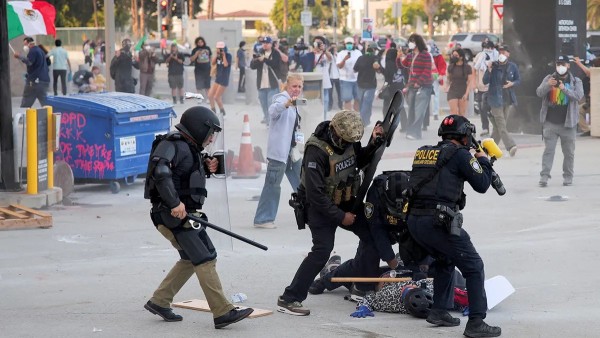
Taken together, the operations resulted in 6,852 arrests. For those affected, there were no official announcements and no advance warnings. Traffic stops, so-called “routine” checks, roadside assistance calls, and everyday encounters ended in detention. In other cases, operations escalated into physical violence, the use of tear gas, arbitrary arrests, and—in several cities—fatal shootings, including the recent killing of Renée Good in Minneapolis. In many of these incidents, the initial contact did not resemble a standard immigration enforcement action.
Internal reports describe a strategy centered on mass agent deployment within the country, sustained collaboration with local police, and the systematic use of detainees as intelligence sources. U.S. Border Patrol—traditionally associated with the U.S.–Mexico border—appears in the documents as an interior enforcement force operating in at least 19 cities, many far from any border.
Operations such as Benchwarmer and Abracadabra mark a turning point. ICE is no longer focused solely on arrests. It gathers intelligence, maps networks, generates prosecutorial leads, and extends its reach beyond an immigration mandate. The documents leaked to Klippenstein outline what amounts to a parallel policing structure—defined by public opacity and minimal accountability.
Detention as Intelligence
One of the largest initiatives, Operation Tidal Wave, targeted the Miami area and unfolded in two phases during 2025. ICE’s HSI and ERO divisions worked alongside local law enforcement. The outcome: 2,873 arrests carried out through ordinary interactions that, on their face, did not appear to be federal operations.
Operation Abracadabra articulates the logic more explicitly: detainees are treated as intelligence inputs. According to the document, the goal is to link information obtained during arrests to subsequent operations. The program generated 466 actionable events, many stemming from evidence storage facilities and cross-referenced databases.
Benchwarmer, meanwhile, deployed more than 2,000 intelligence assets nationwide. These efforts produced 492 prosecutorial leads and identified 135 properties tied to alleged criminal activity. Much of the information was collected outside formal interviews—through undercover agents embedded in transport units, restricted areas, and detention cells.
Arrests recorded by ICE operation between 2024 and 2025. The concentration of arrests in a small number of large-scale operations contrasts with dozens of low-intensity tactical deployments primarily aimed at territorial control and intelligence gathering. Graphic: Los Angeles Press.
A Quietly Expanding Authoritarian Power
The documents show ICE operating in close coordination with other Department of Homeland Security agencies, including the Federal Protective Service and the U.S. Secret Service. Lesser-known operations—such as Dust Off in Spokane and United Forces in Grand Forks—followed the same pattern: identify, locate, and detain individuals under the premise of alleged criminal histories.
Yet investigative reporting and human rights organizations have found that only about 7 percent of those detained had prior criminal records—undercutting official claims that these deployments were narrowly focused on serious crime.
This operational expansion occurred as DHS consolidated its position as the largest federal law enforcement apparatus in the country, surpassing the FBI in both personnel and budget, while ICE resources were increasingly devoted to policing functions.
Klippenstein corroborated the leaked documents with an official who confirmed that immigration enforcement was not the sole objective. “This is part of a broader intelligence-gathering strategy,” the official said on condition of anonymity, “one that includes cartels, social movements labeled as radical, and other targets defined as domestic threats.”
Communities Under Watch
In cities such as Miami, New Orleans, and Los Angeles, community organizations report a sustained climate of fear, tension, and anger. Recent events in Minneapolis have intensified protests and demands for accountability—led largely by U.S. citizens. Within immigrant communities, the impact is quieter but pervasive: people avoid leaving their homes, families withdraw from public services, and entire neighborhoods come to view any interaction with authorities as a high-risk encounter.
With Congress absent and the public denied basic information and effective guarantees of human rights protections, these operations continue unchecked—normalizing institutional violence and authoritarian practices. In effect, they redraw the boundaries of suspicion, determine who can be expelled, and strip others of even the minimal protections afforded by public scrutiny.