
Guadalupe Lizárraga Viernes, 26 de Junio del 2026
Victims in the Wallace and Ayotzinapa cases have asked a human rights exhibition in Lund, Sweden, to remove Mexican journalist Anabel Hernández over accusations they say were based on fabricated case files.
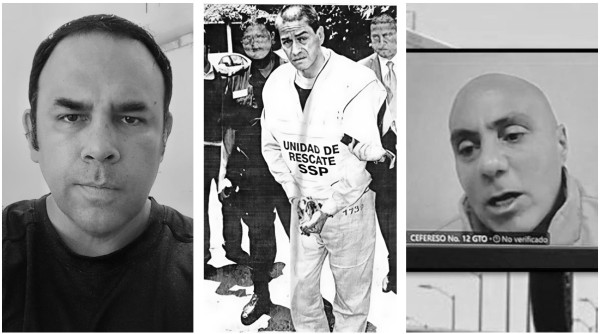
George Khoury, César Freyre and Emmanuel de la Cruz are calling on the exhibition to review the ethical implications of honoring Hernández as a human rights figure while her publications helped legitimize criminal accusations that led to torture, imprisonment and the public destruction of innocent lives.
By Guadalupe Lizárraga
The Swedish exhibition We Have A Dream — 10 years, inaugurated on June 5, 2026, in Lund, Sweden, presents itself as a public exhibition about human rights, courage and compassion. At its entrance, it poses a direct question:
“How much are you willing to endure for your own rights — and for the rights of others?”
From Mexico, that question has names, case files and bodies marked by torture.
George Khoury Layón, César Freyre Morales and Emmanuel de la Cruz Pérez Arizpe are part of investigations documented for years by Los Ángeles Press. The case files that implicated them were built with evidence fabricated by Mexican authorities. All three have denounced torture, arbitrary imprisonment, surveillance and processes of public criminalization.
The investigation by Los Ángeles Press also documented that Anabel Hernández reproduced and gave legitimacy to those accusations in her books, relying on files fabricated by the former federal Attorney General’s Office, known in Mexico as the PGR.
The exhibition presents Hernández as a figure linked to the defense of human rights and uses Narcoland, the English-language edition of Los señores del narco, as part of her international profile. That same book contains accusations against victims of torture and fabricated guilt.
In Narcoland, Hernández accused George Khoury and César Freyre in 2010 of taking part in the purported kidnapping and murder of Hugo Alberto Wallace Miranda. Since 2014, Los Ángeles Press has documented that the Wallace case file was fabricated by the Mexican state in 2005 through torture, arbitrary detentions, planted evidence and a public version designed to present innocent people as guilty.
The Wallace case became one of Mexico’s most visible criminal cases during the government of Felipe Calderón. The operation used Isabel Miranda Torres, the mother of the alleged victim, as the public accuser. She was given economic and political resources that helped turn the alleged kidnapping into a priority issue on the public agenda under Calderón and within the security project led by Genaro García Luna.
Khoury was sentenced to 20 years in prison. Los Ángeles Press has documented four episodes of torture against him, including electric shocks, beatings and asphyxiation, both during his detention on September 2, 2009, and inside the federal maximum-security prisons to which he has been arbitrarily transferred.
The United Nations Working Group on Arbitrary Detention called for his immediate release in 2017 after investigating his case. He remains imprisoned. Twice, he has been denied early release, even though he has already served 80 percent of his sentence.
César Freyre was sentenced to 131 years in prison. His Istanbul Protocol report — the internationally recognized medical and psychological standard for documenting torture — records ten episodes of torture used to force him to incriminate himself and his co-defendants.
His mother, María Rosa Morales, and his sister, Julieta Freyre, were imprisoned for a year and a half at the Santa Martha Acatitla prison in Mexico City as pressure to force him to plead guilty.
After four years of resistance, Freyre accepted self-incrimination following the torture he suffered on October 2, 2010, one month before Anabel Hernández presented her book, where she accused him of being the kidnapper of Hugo Alberto Wallace. Twenty days later, he was tortured again so he would ratify his supposed guilt. That same night, he was told that his sister had died.
His mother died in 2022. He was not allowed to attend her funeral either.
In 2020, Khoury and Freyre wrote to Anabel Hernández from prison to ask her to withdraw the false accusations and acknowledge that the information she published had come from the now-defunct PGR. Neither of them was heard.
The third case file raised by Los Ángeles Press involves Ayotzinapa, one of Mexico’s most internationally known human rights cases.
Emmanuel de la Cruz Pérez Arizpe, a former federal police officer, was accused without direct material evidence or witness testimony linking him to the disappearance of the 43 students from the Ayotzinapa rural teachers’ college. He spent more than three years in pretrial detention at Cefereso No. 1, El Altiplano, in the State of Mexico. He is currently under court-ordered house arrest and National Guard surveillance.
Anabel Hernández appeared in the media to publicly sustain his guilt. As in the Wallace case, she contributed to consolidating a public accusation that destroyed the life of Emmanuel de la Cruz and that of his family.
Los Ángeles Press documented contradictions, false routes, the exclusion of commanding officers from the accusations and the selective use of evidence in the Ayotzinapa case file analyzed in the Pascal Report. It also documented the coercion exerted against Pérez Arizpe by Ángela Buitrago, a Colombian judge and member of the Interdisciplinary Group of Independent Experts, known as the GIEI, an international panel that reviewed the files on the disappearance of the students.
Emmanuel also wrote to the organizers of We Have A Dream from his current condition of judicial restriction. In his letter, he stated that Anabel Hernández helped the Mexican state build a narrative of guilt against him, without evidence linking him to the events of September 26 and 27, 2014, in Iguala, Guerrero.
His letter asks the exhibition to review the ethics of presenting as a human rights defender a journalist whose publications helped criminalize innocent people and destroy families.
For that reason, Los Ángeles Press sent a formal request to the organizers of We Have A Dream, Albert Wiking and Oscar Edlund, asking them to remove Anabel Hernández from the exhibition.
The petition was accompanied by handwritten letters from the victims, English translations, court records, expert reports, legal resolutions and investigative reports published by Los Ángeles Press between 2014 and 2024. It also included material from El falso caso Wallace, a four-book nonfiction series on the fabrication of crimes, grave human rights violations and the persecution of victims and their families.
Anabel Hernández has been presented internationally as a journalist who challenged criminal and political power in Mexico. That image omits the harm her publications caused to people affected by cases built by the state itself to simulate police efficiency.
Khoury has spent 17 years deprived of liberty in a maximum-security prison. He has denounced four episodes of torture involving electric shocks, beatings and asphyxiation, as well as disciplinary isolation for writing letters to media outlets and human rights bodies about his case. That violence has been compounded by public stigmatization and by the continued presence of false accusations in a book sold internationally to honor the person he identifies as part of his victimizers.
Freyre has spent two decades in prison. His case file records ten episodes of torture, the imprisonment of his mother and sister, the death of both women without his being allowed to attend their funerals, and Raynaud’s syndrome as a lasting consequence of torture.
George Khoury, César Freyre and Emmanuel de la Cruz Pérez Arizpe now reach Sweden through letters, case files, expert reports, legal resolutions and years of life marked by the violence of the Mexican state. That violence did not end in interrogation rooms, prisons or courtrooms. It was also sustained through public narratives like those disseminated by Anabel Hernández, who is now being honored in Lund as a human rights activist.
Sweden is not required to know every corrupted judicial file produced in Mexico. A human rights exhibition, however, does have a minimum ethical obligation when it receives a direct petition from people who were publicly named as guilty: to listen, review and respond.
The organizers of We Have A Dream received a formal request for Hernández’s removal, accompanied by letters, expert reports, court resolutions and Los Ángeles Press investigations.
At the time this article was published, they had not responded.
The question posed by the exhibition therefore returns to its point of origin:
“How much are you willing to endure for your own rights — and for the rights of others?”
In Mexico, Anabel Hernández’s victims have endured torture, prison, surveillance, false accusations and years of institutional abandonment.
Now, the silence comes from Sweden.