
Rodolfo Soriano-Núñez Lunes, 21 de Septiembre del 2026
What prompted the development of so many Catholic groups with records so similar to that of the Brazilian Heralds of the Gospel?
This is not a “monster of the week” story. It looks at why papal documents from the 1980s triggered the global proliferation of groups similar to the Brazilian Heralds of the Gospel.
By Rodolfo Soriano-Núñez
Why did Catholicism, over the last century or so, develop a rather large number of order-like organizations with many of the markers of fringe or sect-like groupings? The question is relevant as a means to understand one of the most recent outgrowths of that process: the Heralds of the Gospel or, as they are known in their native Brazil and across Latin America, the Arautos.
This is not the usual story about the evil founder or founders of an abusive religious organization. There are already accounts of the route followed by João Scognamiglio Clá Dias, the official founder of the Heralds, and his relationship with Plinio Corrêa de Oliveira. They are readily available in Portuguese, English and Spanish.
In a nutshell, Corrêa de Oliveira (1908-1995) was a leader of the Brazilian and Latin American Catholic far-right. He was able to curry favor with wealthy Brazilian families, landowners and industrialists who helped him expand his influence to other Latin American countries and beyond.
He developed a political theology that took to the extreme the key notions of anti-Socialism and anti-Communism present in Papal teachings ever since Pius IX’s pontificate and the kind of intransigent rejection of any potential change to Catholicism stemming from the teachings of Pius X.
He added the most romanticized understanding of the Portuguese dictatorship of António de Oliveira Salazar, while using as much as possible the Cold War context to develop what could be seen as a Catholic version of U.S. McCarthyism that thrived during the military dictatorships in Brazil and Argentina.
His ideas thrived in Latin American far-right circles shocked at the triumph of the Cuban revolution (1953-9), helping spread them to the whole region and beyond. In Mexico, as in other Latin American countries, his ideas found fertile grounds among the members of the far-right groups already launching the so-called Yunque (anvil in Spanish) and the more ephemeral but far more violent MURO.
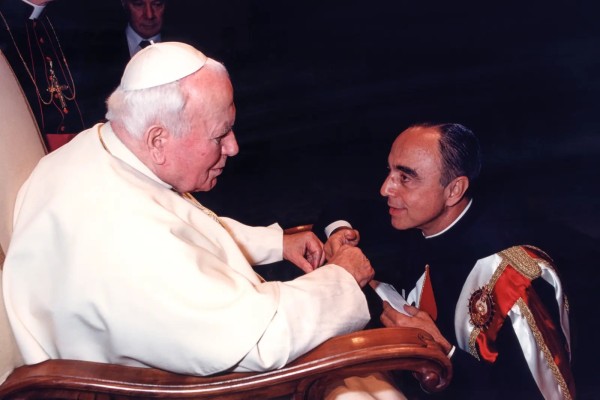
Clá Dias (1939-2024) originally met Corrêa de Oliveira in 1956, before the foundation of the organization of Tradition, Family, and Property, the project that tied them together for most of their lives. It was only rather late in life, after the 1999 foundation of the Heralds of the Gospel or Arautos, that Clá Dias was ordained as a priest (2005), when he was already 65. Three years later, he received the honorary title of Monsignor, something most Catholic priests will never achieve, and one year after, in 2009, Benedict XVI vested upon him the Pro Ecclesia et Pontifice medal, a distinction in theory reserved for individuals with a distinguished service to the Catholic Church.
Oddly enough, if only one were willing to add to the literature on character studies of abusive founders of a predatory order-like religious organization there is a record of Clá Dias being arrested on December 15, 1969 for his participation in what would be described in the English-speaking world as a trainee in a local paramilitary militia.
As a member of Tradition, Family, and Property in Brazil, he was more than willing to fight “the reds” to the death with a gun in his hands. How, despite that precedent, Italian bishop Lucio Renna was willing to lay hands on and ordain Clá Dias as a priest on June 15, 2005 is anybody’s guess.
But it should not come as a surprise as the day he was arrested, the Brazilian police also arrested Aldo di Cillo Pagotto who, on September 10, 1997 was appointed coadjutor bishop of Sobral by John Paul II.
Sadly, it was only in 2022 when Brazilian newspaper Estadão published some details of Clá Dias’s and Pagotto’s arrest as part of a column going over cases in which the Brazilian armed forces and the security agencies of the government were more than lenient when they dealt with far-right extremism. The column is still available over Estadão’s website, but only in Portuguese and behind a paywall here.
Despite the fast-track promotion to Monsignor and the pontifical award, by 2017, there were allegations of abuse forcing Clá Dias to resign his position as General Superior of the Heralds, the moment when Rome intervention began with no visible end in sight.
The risk of going further into the details of Clá Dias’s biography is to turn this into yet another piece about an evil founder, one able to destroy the lives of innocent people on his own with little or no support from the institution from which he derives his power.
That “abominable lone predator” approach has been the target of criticism in this series, precisely because it leaves out and even erases the responsibility of the religious institutions fostering this kind of order-like religious organizations. The most recent, linked below, was a critique of HBO’s miniseries Maciel, the Wolf of God.
Over the last two decades similar exposes have been done, mostly as books or long format essays and pieces, for Carlos Miguel Buela the founder of the Argentine Institute of the Incarnate Word, for the Chilean serial predator Fernando Karadima, and for both Germán Doig and Luis Fernando Figari, the founders of the now canonically suppressed Peruvian Sodalitium.
As useful as those works are, for the most part they center the explanation in the darkest, most predatory aspects of their personalities. In many respects they are the Catholic equivalent of Thomas Harris’s Hannibal series. Some of them are excellent studies of their psychologies and personalities, but often they overemphasize the narcissistic traits of personality in any of these famous predators at the expense of an explanation of why certain types of religious practice, especially those infused with some notion of an imminent “end-of-times” or committed to an extremely strict sexual morality, seem to be more at risk of facilitating the occurrence of abuse, sexual or otherwise.
In some cases, these studies centered on the founder of any of these order-like organizations offer extremely valuable contributions to understand how they were able to build their “orders” as façades for complex operations of abuse, almost always paired with some commitment to a cause dear to the Catholic Church, that allowed them to rub elbows with elites in the financial or political spheres of any given country.
These works are useful to understand the networks of informal relationships and power the founders of these order-like organizations were able to build over time. That is relevant because it helps to understand why, as one of many possible examples, the richest family in Mexico, the Slims, owners among many other assets of Teléfonos de México, remained loyal to Marcial Maciel until the bitter end of his life.
The same could be said of some of the richest families in Chile, notable among them, the Matte-Capdevilla linked to the holding CMPC, the so-called Papelera, a major player in the wood and paper sector in South America, whose commitment to Karadima included money for his legal defense, while also supporting the Chilean province of the Legion of Christ.
Features
The ability of these organizations, even extremely small ones, such as Karadima’s in Chile, that never went outside the boundaries of the Archdiocese of Santiago to attract elite patrons was not accidental but a key feature of a model.
After more than four decades of isolated chronicles of the repeated misadventures of the Catholic Church as a consequence of clergy sexual abuse, more than a new account of the “monster of the week,” there is a real need to explain how a pastoral model from the 1980s fueled tendencies toward clergy sexual abuse that were already present at the time.
The model incentivized the creation of abuse-prone organizations ranging from the Kikos in Spain and the Spanish- and English-speaking worlds, to the Emmanuel in the French-speaking world, down to the Arautos in the Portuguese language universe.
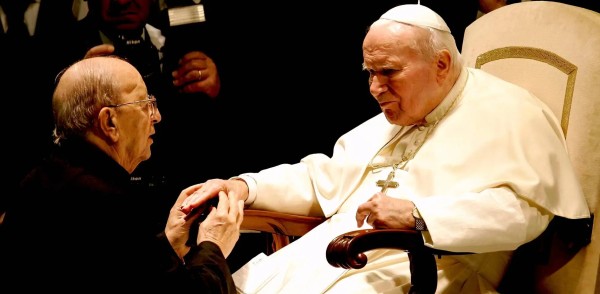
As in many other settings, the power of the predators derives from their ability to exchange material or symbolic goods with their patrons. In Maciel’s and Karadima’s cases, the exchange involved their help to canonically annul marriages, or to grant access to Cardinals or the sitting Pope himself.
And, on top of wealthy families with a business background, as in the Mexican Slims and the Chilean Matte-Capdevilla, there are the political patrons. The most recent evidence of such patronage was that of the Colombian President Bernardo de la Espriella and his Arauto-palooza in Bolívar Square, in Bogotá, of which the previous installment offered a series of pictures or watch the video after this paragraph.
Video produced by the Presidency of Colombia, audio available in Spanish only.
As relevant as the understanding of such relationships is, an extreme focus on the founders and their ability to gather that kind of support leads, to no one’s surprise, to the similar dead end that one finds in Catharina Verboonen’s memorandum regarding the Arautos.
In the document, the prosecutor of the Brazilian state of São Paulo, at the center of the previous installment of this series, linked after this paragraph, decided to archive a several-years-long criminal investigation and confirm what we already knew: abuse happened because Clá Dias and his inner circle were able to create the kind of “total institution” discussed last week. The main problem is that as useful as Verboonen’s memorandum is, it provides little or no chance to offer a measure of justice to the victims, their relatives and friends.
Verboonen’s document is a Brazilian example of how Latin American systems of justice are unable to figure out solutions to issues such as the statute of limitations or to acknowledge that when abuse happens in institutional settings, it is not only the individuals who do it, but also the institutions involved.
In that respect, as good as those accounts centered on the “abominable lone predator” are, they validate the “bad apple” narrative, one frequently pushed by the Catholic Church itself in the countries where such founders operated and in Rome, despite other, more robust takes on the systemic, institutional nature of abuse, sexual or otherwise, in religious contexts, Catholic or otherwise.
A symptom of how dangerous it is to rely on individual explanations of what happened in the Arautos or any other religious organization marred by sectarian practices and instances of abuse, is the fact that after Clá Dias’s death, the current leadership of the Heralds of the Gospel, does its best to delegitimize the intervention going as far as to use the very argument Verboonen used to explain her decision to archive the probe, as an excuse to try to force Rome into ending the intervention: Clá is dead.
And what is worse, this happens with little or no chance to actually find a long-term solution to these issues, because as far as it is possible to see, the leaders of the Heralds of the Gospel not only have now the full support of the Colombian authorities, but are also full aware of the limits of Brazilian Cardinal Raymundo Damasceno Assis, the head of the Apostolic Visitation to the Arautos, to actually achieve something.
He is already about to reach 90. Almost a year ago, on November 18, 2025, when it was clear time was not on his side, there were rumors about his imminent exit from the Apostolic Visitation. Ultimately, what happened is that the Vatican appointed two auxiliaries.
On the one hand, José Aparecido Gonçalves de Almeida, the head of the diocese of Itumbiara, who is the primary auxiliary commissioner to Damasceno Assis. Also, Sister Marian Ambrósio, IDP, a nun and currently the Superior General of the Sisters of Divine Providence, to handle primarily the issues in the women's branches of the Arautos.
Even if the Damasceno-Gonçalves-Ambrósio triumvirate was able to achieve its goals, it is necessary to look at what explains the very existence of the Heralds of the Gospel, aware of the fact that they are not an isolated occurrence in the Catholic Church’s recent history.
Pioneers
What seems to be lacking is an explanation of what made possible the emergence of the Heralds of the Gospel, when one takes into consideration that the Arautos, the Brazilian variant of predatory sect-like organizations in the Catholic world, are hardly pioneers in the field.
That is why it is necessary to look at the issue through a different lens, to ask what made possible the foundation of the Heralds of the Gospel at the very end of the 20th century.
The pioneers were Opus Dei out of Spain and the Legion of Christ in Mexico. The fact that both organizations emerged in countries ravaged by military conflicts where religion played a major role should not be perceived as an oddity.
Many of the features of both organizations, their military-style discipline, the conspiracy-infused understanding of their own role, the attributes of the leadership of their founders and how each perceive, up until now, their position in both the world at large and the Catholic Church itself, reappear like a recurring rhyme in a litany in other similar groups, from the Sodalitium of Christian Life in Peru, to the Institute of the Incarnate Word in Argentina.
Even organizations apparently less rigid such as the Neocatechumenal Way, the so-called Kikos, born in the second half of the 20th century in Spain where abuse is commonplace, share many of the features that, by the end of the 20th century, were taken to a new level by João Clá Dias when he created, in a symbiotic relationship with Corrêa de Oliveira’s Tradition, Family, and Property, the Arautos.
A major difference, perhaps, is that while Opus Dei, the Legion of Christ, the Institute of the Incarnate Word and the Sodalitium started out as “new ecclesiastical movements,” as a certain school of Catholic studies called them back in the late 1980s, and only later found their way into the political systems of the countries where they were active, the Arautos emerged from the very entrails of Tradition, Family, and Property, an entity that has been, at least since 1960, a “civic-political” organization, as it is defined in Brazil and some other Latin American countries.
The difference is not negligible. If one goes over the history of the Sodalitium there are claims about radical changes in the editions of their foundational books, where they dropped references to radical political thinking, they restrained the more obvious aspects of their political ambitions to please both Rome and the less radical wings of the Peruvian Conference of Bishops, while pretending they were obedient to the hierarchy and even moderating the claims about being “half monks, half soldiers,” the Arautos did the opposite.
A musical ensemble wearing several of the distinctive habits of the Heralds of the Gospel enters the sanctuary administered by the organization in Ypacaraí, Paraguay, in 2019. Photo: Heralds of the Gospel Paraguay/Facebook.
If the clerics associated to Opus Dei, the Legion of Christ, the Sodalitium or the Institute of the Incarnate Word were never willing to wear more than fancy cassocks or the occasional “clergyman” shirt with a pitch-black cashmere suit, the Arautos were able to come up with a “habit” that materializes the very notion of the “half monk-half warrior,” the Sodalitium only dreamed about in the early iterations of their foundational documents.
They do it with such crisp and immaculately pressed clothing, reminiscent of a starched white tuxedo shirt, while wearing the kind of leather boots one can only imagine being used by equestrians participating in Olympic dressage competitions. The Arautos are, in that and many other respects, a true Catholic chimera, something so convoluted that it looks closer to visuals straight out of the pages of a Japanese manga book than a copycat of the Bayeux tapestry.
And even worse, the Arautos were formally accepted as a diocesan entity by Emílio Pignoli, then bishop of Campo Limpo, Brazil, in 1999. That was the same year the Institute of the Incarnate Word was about to be suppressed in Argentina and two years after Jason Berry had published some of his most revealing stories on the Legion of Christ and its activities in the United States, and over a decade after he had been reporting on the scale of abuse happening at the Catholic dioceses of Louisiana.
At neck-breaking pace, the Vatican accepted them as International Association of the Faithful, two years later, in 2001, ten months before Bernard Law was forced to resign, in the midst of an international scandal, as archbishop of Boston, to take refuge in Rome.
New Pentecost?
Four years later, in 2005, the Arautos who happen to be priests and fully professed religious brothers, took their current official denomination as Clerical Society of Virgo Flos Carmeli, while keeping the Arautos or Heralds denomination for a much more complex amalgam of groups, reminiscent of the kind of set ups one finds in the relationship between the Legion of Christ and the many different groups within the Regnum Christi, or between the different groups associated to Opus Dei.
When Rome accepted the Arautos as International Association of the Faithful, Marcial Maciel’s excesses, among many other predators, were already the worst-kept secret in the Catholic Church. What is worse, when Clá Dias achieved that feat, he was well aware of how far Maciel had been able to move the goalposts in Rome and how easy it was for an ambitious founder to “grease the wheels” in Rome so as to bypass whatever pretense of the Arautos being just one more “new ecclesiastical movement” willing to partake in what Germán Doig, one of the founders of the Sodalitium, called a “new Pentecost.”
Such a notion brewed slowly over ten years. First, in 1988 John Paul II published what is now a seminal document, known by its Latin title as Christifidelis Laici or The lay faithful.
There, John Paul II was willing to open the gates to what he called, ten years later, “a providential response” to “a secularized culture” in the form of an unrestrained “pastoral creativity” to movements willing to embrace his own political theology, centered around the notion of a radical condemnation of abortion as the sole litmus test of Catholic action in the public sphere.
Section 30 of Christifidelis Laici outlines the “Criteria of Ecclesial Character” for lay associations. When thinking about Pope Wojtyła’s call it is hard not to think of what 30 years before Mao Zedong had done in China when calling for “a hundred flowers (to) bloom together.”
Looking the other way
Unlike previous approaches, John Paul II codified a framework that prioritized “pastoral zeal,” loyalty to the Magisterium, and public defense of Church doctrine above all else. In practice, this created an environment where orthodox alignment—especially around sexual morality and anti-abortion activism—became a self-authenticating shield as an excuse to legitimize any excess, as Donald Trump did first on May 17, 2023 or, before him, as Daniel Ortega did in Nicaragua.
As long as a movement demonstrated rapid growth, fierce loyalty and its will to engage in what later would be understood as the “culture wars,” Rome routinely looked the other way regarding internal governance, authoritarian structures, or early reports of abuse. More so when on top of those formal requirements, the blooming flowers were willing, as Maciel used to do, to “spread the joy of cash” among willing Roman monsignors eager to look the other way.
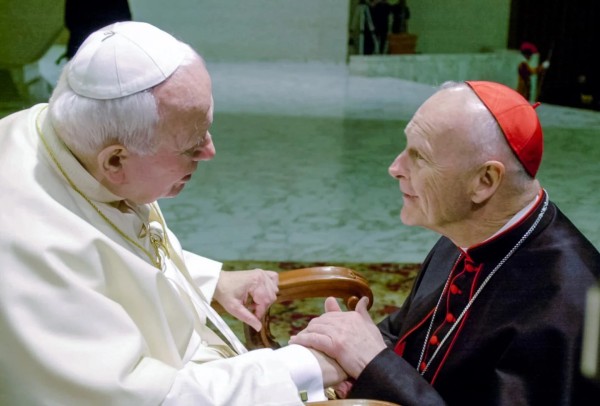
If the assertion about how Rome routinely looked the other way seems “too rich,” one only needs to remember how the Vatican itself, when addressing the aftermath of Theodore McCarrick becoming the main character of a series of articles going over how a super predator like him became the head of the Archdiocese of Washington, D.C., and a very influential Cardinal during John Paul II’s pontificate, published a report.
Over the 461 pages of the sole official report issued by the Catholic Church itself, it is clear that many times, over McCarrick’s 50-year ecclesiastical career, someone in Rome, in New York or elsewhere “dropped the ball,” accountability wise, allowing for McCarrick’s ordination, for his promotion to auxiliary bishop, his appointment as head of dioceses in New Jersey and, from there, straight to the U.S. capital see, until letting him become a member of one of the most exclusive clubs all over the world: the College of Cardinals.
If that was not enough, the report offered a tangled, partial, but useful window into how Carlos Miguel Buela, the founder and chieftain of the Institute of the Incarnate Word had in McCarrick the friends in high places in both Rome and Washington, D.C., that allowed for the continuation of abuse at that order-like organization which the Argentine Conference of Bishops (content in Spanish), with Jorge Mario Bergoglio as one of its members, unsuccessfully tried to suppress when, by the end of the 20th century, he was already Archbishop of Buenos Aires and Vice President of the Argentine episcopate.
The report is available here and it was a key component in the story published after McCarrick’s death in 2025, available after this paragraph.
John Paul II’s stance became a blanket sanctioning of “pastoral creativity” while calling bishops and the Roman Curia to welcome new movements with “filial affection” and avoid impeding the “spontaneity” of the Holy Spirit.
Movement leaders—most notoriously Maciel, Figari, Argüello and Clá Dias—used this precise papal language to bypass local episcopal oversight, framing any diocesan scrutiny or criticism as “resisting the Spirit” or acting out of “envy,” while looking for the local anti-abortion movements as partners, and doing their best to recruit and prove how effective their models were to secure the institutional reproduction of their model and the Catholic Church at large, by reporting what Catholic jargon identifies simply as “vocations.”
Calling out the monsters
By the time the 1998 Roman vigil with the New Ecclesiastical Movements, organized by Cardinal James Francis Stafford, then president of the Pontifical Council for the Laity in Rome, happened, one year before the official foundation of the Heralds of the Gospel in Brazil, John Paul II was willing to greet and endorse, among others, Jean Vanier, later accused of committing repeated acts of sexual abuse in the so-called L’Arche and Francisco José Kiko Argüello, the Neocatechumenal Way’s chieftain.
A few months after, one of the founders of Sodalitium, Germán Doig took John Paul II’s argument to its (theo)logical consequence claiming that the New Ecclesiastical Movements had been raised up by the Holy Spirit as a sort of “new Pentecost” of the Church in today's world. Sadly, Doig’s piece aptly titled in Spanish “John Paul II and the New Ecclesiastical Movements” no longer exists on the Internet. Up until 2021 it was available at a now defunct URL: www.clerus.org/clerus/dati/2004-06/25-15/catmovi, but it is still available via the Internet Archive, only in Spanish, here.
Oddly enough, if one was willing to believe the Polish Pope’s premise, the Holy Spirit was willing to dispense its blessing, dismissing Vanier’s, Maciel’s, Doig’s and many other predators’ abuses in the name of letting all types of far-right religious radicalism flourish.
And it was not only Pope Wojtyła. After his 2005 death, one of his allies in the Roman Curia, Slovenian Cardinal Franc Rodé, was willing to dismiss Maciel’s crimes as “peccata minuta,” as the story from this series linked after this paragraph told back in 2024.
As told there, despite the “punishment” set by Benedict XVI on Maciel, Rodé was as late as 2007, six years after the creation of the Arautos, rallying the Legion of Christ to keep the organization alive. In this story Rodé hails the Regnum Christi, while explicitly praising Marcial Maciel (available in Spanish here), despite the fact he was already “condemned” to the life of “prayer and penance” by Pope Ratzinger.
One year later, back in 2008, Rodé went to Mexico. There he decided to up the ante, as reported by the Associated Press at the time. After Maciel’s death he praised the founder of the Legion of Christ saying that given “that the (Legion’s) fruit is good, can we say the tree is bad then? Purely from a logical standpoint, I would say no.” So Rodé, the Cardinal charged with keeping the Roman Catholic religious orders’ discipline, went on to say: “I absolve Father Maciel. I do not judge him.”
Theological pirouettes
It is impossible to know if Rodé was aware of the kind of theological gymnastics he was displaying there. His words are, up until today, a somber reminder of how willing the Catholic Church has been to fall for the same means-and-ends trap into which so many smaller organizations fall.
Is it really possible to accept, as dismissively as Rodé did, the notion of “if the fruit is good”? How many instances of clergy sexual abuse are worth the “fruits” of Maciel’s labor? It is impossible not to wonder: what about the “alms” given by notorious Latin American drug lords to dioceses and parishes in marginalized regions of Mexico or Colombia? Are those “fruits” good enough to ignore the kind of violence cartels instigate?
Here it is important to stress that, even if sectarian practices and their worst effects, as in the case of clergy sexual abuse, have not been limited to conservative and far-right religious movements, the fact is that John Paul II’s late-20th-century Pentecost had a clear preference for right and far-right organizations, with little or no tolerance for movements coming from the opposite side of the political spectrum.
What is worse, more than forty years into the clergy sexual abuse crisis, it is necessary to acknowledge that during John Paul II’s tenure, the Catholic Church created a theological and ecclesial framework that systematically rewarded certain kinds of movements with a clear preference for sectarian practices that, no wonder, in their worst-case scenario, such as the Sodalitium, are more than willing to attack the reigning Pope himself. Except for the Sodalitium, that framework sprinkled with Holy Water by John Paul II himself in 1998, remains largely intact even as mounting evidence proves that many of those movements share recurring pathologies.
Sadly, the leadership of the Catholic Church seems to be unwilling to acknowledge that many organizations celebrated by John Paul II as signs of renewal were affected, already at birth, by recurring patterns of abuse, authoritarianism, secrecy, personality cults, or institutional impunity.
Still, the emergence of Arautos in the very last year of the 20th century poses yet another major question. As absurd and abusive as the practices of the Legion of Christ and Opus Dei are, they have some historical reason to explain them. Both order-like organizations emerged in the first half of the 20th century after major conflicts in their countries of origin. In both cases, there was a reason behind the military-like discipline, the secrecy, the full loyalty to the founder, and the support to their practices from Rome.
In Brazil there is no actual record of something similar to the Mexican 1917 Constitution’s old section 130, to the Cristero War (1926-9), or to the Civil War in Spain (1936-9). In that regard, whatever was behind Plinio Corrêa de Oliveira’s and João Scognamiglio Clá Dias’s design of the habit and the practices of the Arautos belongs in the realm of their own fears and it is almost impossible to understand them as a response, as misguided as it could be, to any actual (much less existential) threat to the Catholic Church in Brazil.
The most significant threat to it has come from its own inability to connect with younger, poorer, generations of Brazilians who back in the later decades of the 20th century used to join the many varieties of Pentecostal churches active in the country, but nowadays join, as it happens in most other countries in Latin America, Europe, the United States and Canada, the ever-growing category of the “nones,” as the stories linked before and after this paragraph told a few months ago.
That is what makes the Vatican’s 2001 decision to speed up the Arautos’ transition from a diocesan to an international association of the faithful all the more jarring. Why a process that, in the case of the Peruvian Sodalitium took more than 20 years, from their foundation in 1971 to 1997, when they were accepted as a Society of Apostolic Life of Pontifical Right, only required two years for the Arautos?
In doing so, Rome did what it had done before with other beneficiaries of the so-called “new Pentecost”: it incentivized sectarian practices and behavior, undermining the authority of the bishops, as there was always a chance to appeal to Rome while invoking Christifidelis Laici.
If that was not enough, there was already evidence of how to emulate Maciel’s behavior to “spread the joy” in Rome in carefully stuffed envelopes with enough cash to solve any issue.
Nobody should wonder, in that regard, as to why many of the so-called New Ecclesial Movements became fundraising machines, whose resources were frequently devoted to sustaining the lavish lifestyle of their founders, the monies required to expedite processes in Rome, along with the constant pressure to recruit members willing to devote their lives to the organization. Many of the existing accusations of labor exploitation in Opus Dei, the Legion of Christ-Regnum Christi, the Sodalitium and the Arautos are the consequence of this design.
If one were looking for a profile of these organizations, it would be necessary to add a vehement rejection of abortion as the sole criterion to have some kind of activity in the public sphere, which often opened opportunities to turn these organizations into key elements of voting blocs.
What one needs to keep in mind is that, during the Wojtyła era, Rome created and rewarded a model of ecclesial organization whose recurring pathologies became visible across multiple countries, founders and decades, yet continued to receive institutional legitimacy, sometimes at the expense of allowing for widespread corruption in the Catholic Church, as Jason Berry documented for the case of the Legion of Christ in his 2011 book Render unto Rome: The Secret Life of Money in the Catholic Church.
When he writes about Father A, he describes him as a man who had a way of “making friends” in Rome, while telling the story of him delivering an envelope to Cardinal Eduardo Martínez Somalo with 90 thousand USD (p. 195). Or when he talks about Father B and his “elegant way of giving a bribe” in the eponymous section starting at page 191, both in the chapter, “Maciel, lord of prosperity,” to see the full context.
Even if the Arautos were free of the bribes, what remains is the substrate of similarly predatory, sect-like practices, somehow justified on the notion that they represented the vanguard of movements to restore the Kingdom of God on Earth.
It should be noted that even if most of the Catholic Church during the 1980s and 1990s was willing to buy into such a notion, it has been only the devastating effects of the clergy sexual abuse crisis that have forced some of its members to go over the early warnings about how the Wojtyła era rewarded the model that made viable and protected, Opus Dei, Legion of Christ, Karadima, the Institute of the Incarnate Word, the now suppressed Sodalitium, and the Heralds or Arautos.
Back in the 1990s, when looking at the early effects of Christifidelis Laici, José María Mardones was already sounding all the alarms within his reach in his native Spain. He called out John Paul II’s Kulturkampf as a risky bet; he also warned against the abortion-centered moral reductionism and stressed the risk of betting big on the loose understanding of charisma that allowed founders of these religious organizations to be turned into living saints, despite the many troubling signs that already existed then.
After all, Spain was the incubator for both Opus Dei and the Neocatechumenal Way (the Kikos) and remains a key post in Maciel’s mythical narrative about the Legion of Christ’s success, making Mardones’s early warnings particularly sharp. Mardones was witnessing, first hand, the immediate local impact of Wojtyła’s pastoral shift from within one of its primary European strongholds.
Far from curtailing their sect-like behavior, Rome did its best to silence, dismiss and punish critics of this model, dismissing them as enemies of the Church, while rewarding foundations such as that of the Arautos.
* * *
A summary of this piece is available as audio after this paragraph.
Your browser doesn't support HTML5 audio. Here is a link to the audio instead.
Note on production: The text of this summary was written and edited solely by the author. The delivery of the audio summary was achieved using a high-quality, text-to-speech engine Microsoft Word for Web. The AI was used for voice generation only, not content creation.