Rodolfo Soriano-Núñez Lunes, 21 de Abril del 2025
The conflict at the Academy of Catholic Leaders highlights how hard is for Pope Francis’s church to control sect-like groups as the Yunque.
A holy water snafu, the ongoing strife confirms the worst intuitions about the risks stemming from the secretive behavior of groups like the Mexican Yunque.
By Rodolfo Soriano-Núñez
Over the last few months, the Latin American Catholic Church, has been witness of unusual exchanges. Reciprocal accusations of associations to secret organizations, supposedly devoted to defending the Catholic Church, have been crossing social and legacy media, undermining once again trust in that Church.
In doing so, far from acknowledging their own role in spreading the news about their conflicts and the kind of accusations they exchange, the members of the Academy of Catholic Leaders, from now on the Academy, blame repeatedly the media.
Oddly enough, in doing so, they fall back to the kind of mechanisms so familiar when dealing with the clergy sexual abuse crisis: blame the media, blame the victims, never accept your own responsibility and, above, all: deny, deny, and deny.
This story seeks to illuminate the conflict around the Academy, a relatively new organization in the Spanish-speaking Catholic world that by the mid-2010s sought to revitalize the institution and the ways it tries to engage with an ever more distant, less pious world.
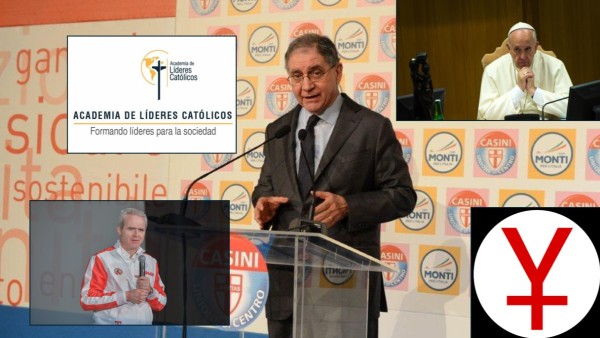
They were able to seize the limited chances for growth in religious involvement activities during the pandemic, but now they find themselves in a fight with themselves, in “a difficult crisis,” as described by the chairman of the Academy himself, Rocco Buttiglione, in a letter sent to most of the Catholic bishops in the Spanish- and Portuguese-speaking worlds.
Los Angeles Press had access to some of such letters, the one sent to the Archbishop of Bogotá, Colombia, Cardinal Luis José Rueda Aparicio. Said communication is available in its original Spanish-speaking version, with a translation to English in the box after this paragraph.
Buttiglione’s letter. An English translation after the Spanish original.
Buttiglione, a key figure in John Paul II’s own cultural wars, provides a detailed account of the Yunque’s excesses, its sect-like attitudes when he talks about the Yunque’s origins:
The Yunque is a Mexican association founded in 1953, during a period when religious freedom in Mexico was severely limited. Members were required to keep their membership secret and often infiltrated other legal organizations, trying to steer them toward a project of conservative Catholic reconquest.
It is Buttiglione himself who describes and emphasizes with the use of italics the nature of the Yunque’s project as one of “conservative Catholic reconquest.”
Buttiglione de-escalates his criticism when he says: "After the return of a democratic regime and religious freedom in Mexico, the Yunque began a process of transformation that included abandoning secrecy and assimilating the conciliar reform”, he also acknowledges that “the development of this process is uneven.”

Oddly enough, even if Buttiglione claims him and the Academy are able to keep their cool towards the Yunque, he acknowledges how they are able to be at least “aggressive”:
The Academy does not seek conflict with anyone; it defends itself if slandered, and it defends the Pope, and the bishops united with him if attacked. Regarding the Yunque, it defers to the judgment of the local ecclesiastical authority. Where the Yunque is aggressive and the bishops condemn it, the Academy does the same. Where the Yunque is in dialogue with the bishops, the Academy does not fight with the Yunque.
Moreover, he acknowledges what seems to be an unsolvable tension with the Yunque, when saying:
“We take care, in any case, not to be infiltrated and exploited by the Yunque or any secret organization.”
If the Yunque were a straight shooter, an organization one could trust, why would there be the need to prevent infiltration and exploitation from them?
Peronista Pope?
The Academy emerged as a player in the map of Spanish- and Portuguese-speaking Catholicism in 2014, around the same time when Buttiglione, back in September 2014, offered an interview to Real Clear Religion. There he dismissed Francis’s understanding of capitalism when his interviewer, Nicholas G. Hahn III, then a staff member at that outlet, raised the following question:
“Hahn: Which liberation theology is Francis influenced by?
“Buttiglione: He is not a Marxist. Politically, he is a Justicialista. Westerners might call it populist. Justicialismo in Argentina has been a tremendous movement, giving for the first time to the people the idea that they have dignity. They are anti-capitalist and anti-Marxist. There is an Anglo-Saxon model of capitalism, which is the “self-made man.” That’s American. But that’s not capitalism in Argentina. Capitalism there is where a few people use the contracts given by the State without taking the risk of the market make an enormous amount of money and oppress other people. It is a capitalism created by the State.
“If I could suggest to Pope Francis the reading of a book, I would suggest he read Friedrich Hayek's The Counter-Revolution of Science: Studies on the Abuse of Reason. This might help him.”
Buttiglione’s interview is available here.
Even if one gives Hahn a pass on his argumentative question about Pope Francis’s and the Liberation Theology, Buttiglione assumed Jorge Mario Bergoglio was ignorant about Hayek’s work. It could be that Hahn or Buttiglione or both were more nuanced in their exchange, but the published version of the interview goes from some lose exchange about John Paul II chastising dangerous theologians of Liberation to Buttiglione doing the same with Bergoglio and his understanding of economics.
It was around that time that the Academy came to exist and despite Buttiglione’s dismissiveness towards the “Peronista Pope,” Bergoglio saw fit to recycle the former member of the Italian Parliament, accepting him as having a role in the building of the Academy and having a role in tasks as Buttiglione himself describes them over his letter.
A few weeks after the interview, on December 29th, 2014, the Academy was registered as a non-profit organization, with Chilean Cardinal Jorge Arturo Medina Estévez and Mexican layperson José Antonio Rosas Amor as their leading founders.
Medina Estévez, now deceased was then, at 87, the emeritus bishop of Valparaíso, Chile, and the prefect emeritus of the Congregation for the Divine Worship and the Discipline of the Sacraments in the Roman Curia. Rosas Amor is a Mexican national who spends portions of his life in Chile.

The Academy was able to gather support from several Chilean colleges, including the Pontificia Universidad Católica de Chile, and the so-called Universidad Finis Terrae, the local college of the Mexican order, the Legion of Christ.
Their goals, as described in the three PDF booklets available at their website in Spanish are to train Catholic laypersons to become leaders in society, politics, and the economy, guided by Christian principles, and the Social Doctrine of the Church.
They were trying to develop “a new generation of Catholic leaders committed to the common good and social transformation”, through a series of courses (described here in Spanish) and other regular and special activities.
Evangelizing politics
Besides their emphasis on transmitting the Social Doctrine of the Church, they set as priorities the “evangelizing of politics,” and “serving the poor and excluded.” They were trying to become a “leading center for formation in the Social Doctrine of the Church in Latin America” promoting communion with the Church, leadership as service, political engagement for the common good. In doing so, unlike Catholic organizations in Latin America, acknowledged the need to identify “pluralism,” “interdisciplinary approaches,” and “professionalism,” as values to follow.
As far as Mexico is concerned, they were able to organize gatherings with leaders of the three major parties, including the current ruling party Morena or Movement of National Renewal, and the National Action (PAN), and the Revolutionary Institutional (PRI) parties. In other Latin American countries, they organized similar gatherings, while developing all over the region activities aimed at young people, teachers, businesspersons, journalists, and union leaders.
Unlike other Catholic groups active in the English-speaking world, way too interested in emphasizing their disagreements with Pope Francis, the Academy frequently emphasized their loyalty and closeness with Pope Francis and the bishops in their countries.
Although it never tried to become an order or a “new religious movement”, the biographies of many of their members resemble those of members of the recently suppressed Peruvian Sodalitium of Christian Life or the Spaniard Opus Dei, and—as Buttiglione’s letter states—from the Mexican Yunque.

Other portions of Buttiglione’s letter aim at offering some kind of disclosure regarding his own relation with the Mexican Yunque. He says:
“For completeness, I will now tell you about the contacts I have personally had with the Yunque:
“1. My daughter married a young Mexican man who is the son of one of the Yunque's leaders in recent years. This is Francisco (Xavier) Salazar (Sáenz), whom I knew as a politician of PAN (the Mexican Partido Acción Nacional) and then secretary (of Labor) to President (Vicente) Fox. He is a person of impeccable integrity whose honesty and fidelity to the Pope have never been questioned by anyone.
“2. During my campaign in defense of Pope Francis against accusations of having betrayed Catholic doctrine with the Apostolic Exhortation Amoris Laetitia, I met with the leaders of the Yunque to explain Amoris Laetitia and the substantial continuity (albeit with legitimate differences) between saint John Paul II and Pope Francis. I believe my mission was substantially successful because the Yunque did not join in the attacks against the Pope, except for some marginal sectors in polemics, even with the central authorities of the Yunque itself.”
The heart of the matter
Once again, Buttiglione himself acknowledges, on the one hand, how close he is to relatives of members of that organization and, on the other, how some members of that organization are ready to attack Pope Francis, even if Buttiglione minimizes the reach of those attacks.
To better understand the attitudes behind the Yunque and similar organizations in other Latin American countries it is necessary to see at the longstanding Church-State conflict in Mexico, as it prompted a secret organization willing to do what Buttiglione himself describes in his letter about the crisis at the Academy.
A 2001 report from the U.S. Department of State on the history of Church-State relations in Mexico, summarizes the issue as follows:
“After independence (…), the Church’s vast wealth and political influence spurred a powerful anticlerical movement that found political expression in the Liberal party.
“The Catholic Church was opposed to Liberal government policies and supported rebel Conservatives in the mid-19th century. It later welcomed the country’s French occupation. In the early 20th century, the Church’s collaboration with Porfirio Díaz earned it the enmity of the victors in the Revolution. Consequently, severe restrictions on the rights of the Church and clergy were written into the Constitution. The federal government's attempt to enforce those restrictions led to an open revolt by Catholic peasants and violent Government repression during the 1926-29 Cristero Rebellion.
“Tensions between the Church and the State eased after 1940. However, constitutional restrictions were maintained even as enforcement became progressively lax. In 1992, Mexico reestablished diplomatic relations with the Holy See and lifted most restrictions on the Catholic Church, granting all religious groups legal status, limited property rights, and lifting restrictions on the number of priests. The law continues to mandate a strict separation of Church and State.”
English Edition
The kidnapping of Our Lady of Guadalupe
The effectiveness of such “strict separation” is up for debate, as it provided little or no protection against clergy sexual abuse. Mexican victims of it suffer the same and even more revictimization as victims from countries where such separation does not exist (Peru) or where the separation was far less ambitious (Chile), or where it is a more recent development (Argentina).
What is worse, far from encouraging the emergence of an active Catholic civil society, it allowed for the enhancement of the most negative aspects of clericalism, which is the extreme control of clergy over laypersons.
The peculiar combination of the Mexican unrealistic written law coupled with the Church’s (Rome and the Mexican bishops) dealings with the Mexican government fostered, paradoxically, the development of organizations infused with cult-like behavior, more than willing to spread the idea of a betrayal from Rome.
A war on “Modernism”
At this point it is necessary to add yet another layer of complexity coming from Pius X’s anti-Modernist teachings. They are relevant since for many Mexican Catholics, the Cristero War and its aftermath, the subjugation of their Church was the realization of Pius X’s warnings against “Modernism” as described in Pascendi Dominis Regis, an Encyclical from 1907.
Instead of building a creative way out of their plight, Catholics developed a conspiracy-ridden take of Mexican and World history, where “betrayal,” conspiracy, and submission to the U.S. dictum was the key to success and failure. These Catholics sought to enact Pius X’s Pascendi, obsessing with machinations to setting up all kinds of strict controls of what Catholics can read, see, or think as to avoid “Modernist” mistakes.

Pascendi Dominis Regis, as the overall approach of Pius X’s understanding of Catholicism, leaves little or no room for laypersons to lead key processes within the Church. In that respect, far from allowing for some solution to clericalism and its negative effects on the Church, Pascendi reinforces the worst appetites of dismissive and abusive clergy, unwilling to be accountable to their faithful.
Key propositions in Pascendi, as the idea of setting up “diocesan watch committees” (no. 55 of the English-speaking version) to chastise whatever falls in the extremely wide “Modernist” category as developed by Pius X, the very “synthesis of all heresies” was so unattainable that none of Pius X’s successors ever tried to set them up.
The encyclical goes further. Back in no. 52 of the English-speaking version it actively calls for the censorship of books, newspapers, and magazines, as to prevent Catholics from even having a chance at reading or seeing what the Vatican was not willing to allow.
What the Yunque, as many other similar associations of radical Catholic faithful, were trying to achieve was that level of surveillance over the faithful suggested but never actually enforced by Pius X or his successors.
Even if one is willing to see Pius X’s proposition as somehow a visionary attempt to safeguard his Church against Modernism, there is no record of consistent implementation, while there is evidence of resistance within the Church and the negative consequences for the Church of trying to go down that road, as it is extremely hard to enforce doctrinal purity in a large and decentralized institution facing complex internal and external pressures.

English Edition
The Verástegui Network, a dystopian and authoritarian world
What emerged of that way to understand the Catholic Church is the Yunque, also known as the National Organization of the Yunque, now known officially as Organization for the Common Good (Organización para el Bien Común).
Although the Yunque has been trying to legitimize and normalize its online presence, losing some of the roughest corners of their profile, I am only aware of a website where one can download their magazine, available here only in Spanish.
One should be ready for the dog whistling when going over their magazine. On the one hand, a forge (forja in Spanish) is where blacksmiths use anvils (yunques) as tools to work with metals. It is not out of chance that their magazine calls itself Forja, as it not that their latest issue of that magazine is full of praise for Argentine President Javier Milei while dismissing Canada’s best hope for a conservative government: Pierre Poilievre.
The key is that for members of the Yunque Mr. Poilievre is not conservative enough. They only have eyes for Canada’s most radical political leader, the Popular Party’s Maxime Bernier. As stated in their latest number of Forja, the Popular Party is the only actual party of the right in the Great North.
As a Canadian friend of mine told me over Whatsapp when I shared with him their take on the election in his country: «they sure like losers.»
Anti-Semitic strains
An issue missing from Buttiglione’s rather rosy summary on the origins of the Yunque is the strong anti-Semitic stance one finds in their foundational documents, where they claim to be fighting a “Judeo-Masonic-Communist conspiracy,” while insisting in their Catholic identity.
As said identity changed as a consequence of the Second Vatican Council acknowledgement of the many mistakes of anti Semitism, members of the Yunque found themselves increasingly at odds with Pius XII, with John XXIII’s and, more so, with Paul VI’s call for a Catholic renewal. More so, because of Paul VI’s decision to change the Liturgy of Good Friday by removing the reference to Jewish people as “perfidious” and changing the order and meaning of the prayers for that day.

On top of those changes to the liturgy of one very special day of the year, there were the changes to the everyday mass, by dropping the use of Latin and changing the set up of the churches and allowing females to set foot near the altar, something barred before Paul VI and that up until today is the source of bitter confrontations with bishops unwilling to accept females doing the readings, distributing communion or helping the presiding minister at the altar.
Given how difficult it is to insist yet again on the anti-Semitic strains of Catholicism, the attention has shifted to the liturgic reforms brought by Paul VI in the aftermath of the Council, making him the target of the far-right’s attacks.
In that respect, the Yunque heightened its ties with other ultra-right wing, “Hispanist” organizations in both Mexico and Spain, and others with similar backgrounds, ideals, and attitudes, as the Brazilian Tradition, Family, and Property, among others, and it is to that kind of “project of conservative Catholic reconquest” that Buttiglione refers in his letter to the bishops about the crisis at the Academy.
English Edition
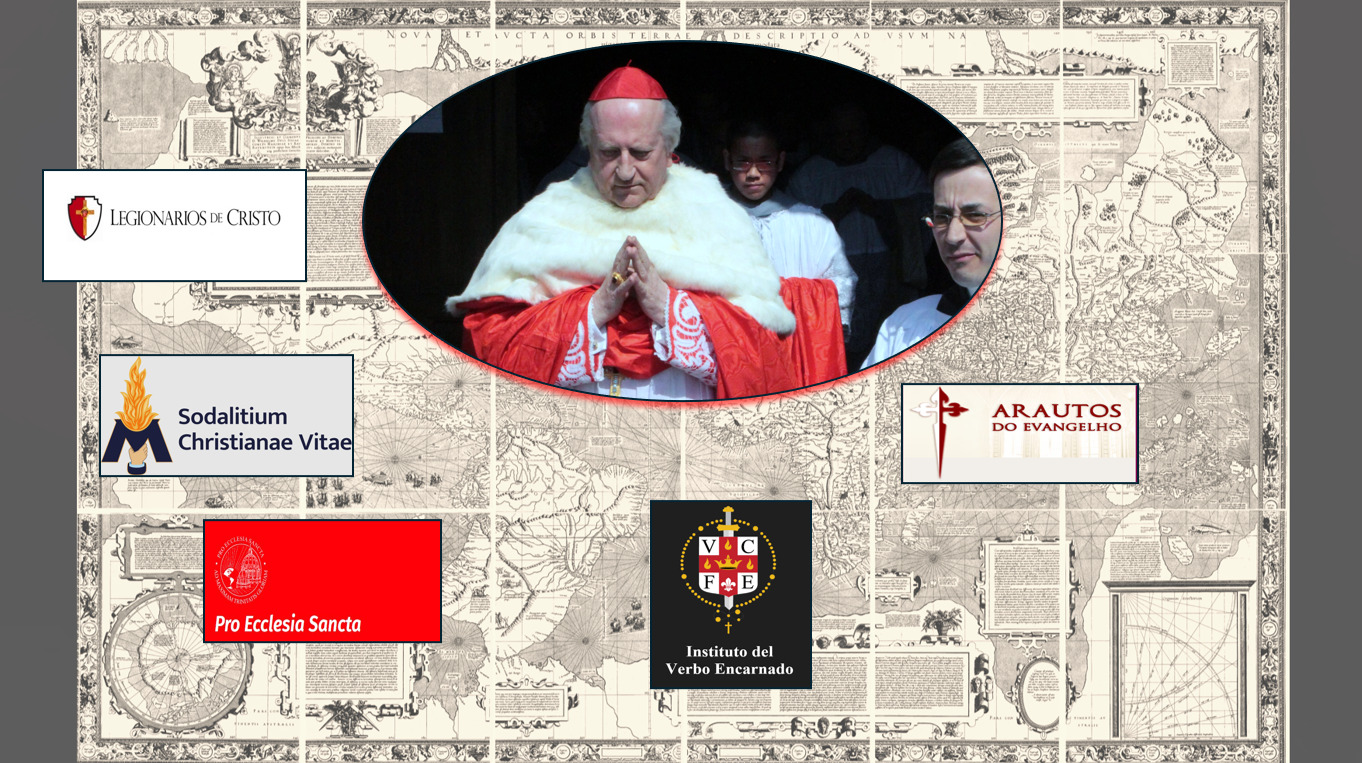
Cardinal Rodé, the sexual abuse missing link
The Yunque and other Catholic organizations have downplayed over the last 50 years or so their anti-Semitic strains, but stories published in Spanish and Portuguese in previous years have frequent references to such attitudes. Up to a certain extent it has been the by product of the Second Vatican Council, but also of laws in countries with significant populations of Catholics such as Germany, Austria, France, and more recently Spain, where antisemitism and other similar attitudes are actively prosecuted.
But in countries as Mexico or Argentina, popular editions of Adolf Hitler’s Mein Kampf or a classic of anti-Semitic literature such as The Protocols of the Elders of Zion are available at newsstands, and internet and bricks and mortar bookstores, as this links to the Gandhi bookstore in Mexico City and this one to the Waldhuter bookstore in Buenos Aires prove.
A report endorsed by the archdiocese of Toledo, Spain, back in 2010, notes on p. 5 the anti-Semitic attitudes of one of the original founders of the Yunque, Ramón Plata Moreno. The report is available as a PDF here, over at Scribd, only in Spanish.
Another source sees antisemitism as a feature bringing together Catholic far-right organizations in Argentina and Mexico. Mario Virgilio Santiago Jiménez provides an account of the links between the Argentine National Movement Tacuara and the Mexican Yunque, among other Latin American organizations who had Argentine priest Julio Meinvielle as a leading figure:
At the foundation of their ideological framework of the groups and the priest (Meinvielle) was an integralist-intransigent then dominant current in the Catholic hierarchy up until the second Vatican Council (1962-1965). Clearly anti Modernist, said current became the bridge between the groups and the priest and the 19th century conservative thinking, acquiring over the first decades of the 20th century a role as hinge before other ideologies, as the Argentine nationalism, the Fascism, and the Hispanism, and later, the anti-Imperialism. That provides an explanation for how these groups received the idea of a «Judeo-Masonic-Communist conspiracy» to force down Modernism and to defeat Christian Civilization, ever present in the appeals of several Catholic priests and popularized in pamphlets such as The Protocols of the Elders of Zion or The Jew penned by Meinvielle.

New story or old tale?
Even the relatively new stories about conflicts and mutual accusations of sect-like behavior and prior affiliation to the Yunque is not actually new. Back in 2016, Religión Digital, a Spaniard medium, published a similar story about the role the Yunque and other organizations close to the “project of conservative Catholic reconquest” were playing in the Academy.
The story available here only in Spanish is different only inasmuch it is limited to Chile, but the patterns are similar.
Two years before, in 2014, Periodista Digital, a Spaniard outlet, reported on the then chair of the Pontifical Council for Social Communications, Cardinal Claudio Maria Celli, address to a meeting of Latin American Catholic webs in Lima, Peru.
There he blasted websites “biting instead of engaging in dialogue.” He went on to discuss how, in the name of “an ideologized Catholicism, they pour out hatred and disqualifications, while setting themselves up as guardians of a fundamentalist orthodoxy.”
Celli even had to remind attendees at the birthplace of ACI Prensa, the website now linked to the US-based EWTN and at the time still part of the so-called Sodalitium of Christian Life empire, that “the Church does not grow doing proselytism, but through attraction.” The story is available in Spanish here.
And even if anti-Semitism could have been downplayed in some of these sect-like organizations recently, there is the issue of the control they exert over their members. After Toledo, the diocese of Getafe, 8 miles or 12 kilometers South of Madrid, the capital of Spain, issued a report of its own.

Vicious cycle
The report was signed by then auxiliary bishop José Rico Pavés, current bishop of Jerez de la Frontera, who in an interview with the Spanish-speaking version of Aleteia back in 2015 said:
«Membership to the Yunque unleashes a vicious cycle from which it is impossible to escape. Those who join a secret organization by swearing an oath will sooner or later have to resort to deception to keep their membership a secret. Deception, even if it is disguised as ‘reserve’ or ‘discretion,’ is always deception and will inevitably generate suspicion and mistrust. When trust is broken, division happens.
«Unfortunately, this is the ever-repeating sequence where there are members of the Yunque: deception, mistrust, and division. It is impossible to build the Kingdom of Christ—as the Yunque claims to seek—by deceiving, sowing mistrust, and provoking division among the members of the Church. The Yunque’s existence is the wrong understanding of the Church and the role of lay persons as apostles.
«If we go further to analyze the oath, the means of recruitment, the tests that members must overcome to prove their loyalty to their superiors, and so forth, we discover that none of this resembles the identity and mission of lay Christian faithful in the Church. »

In that respect the unavoidable question is what Rome will do with the Academy. Now it should be clear that it is not really a new development. It is an old story that keeps repeating as a loop of sorts. And even if back in 2016 José Antonio Rosas was the accused by the Chilean journalist behind the story, and now it is him who is sounding all the alarms about the assault on the ODUCAL, it is impossible to assume that Rome should remain absent from this issue.
As it is usually the case with the appointment of bishops, it is clear that something is missing in the vetting processes for those and other appointments. Francis seems to be too willing to offer second and even third chances to individuals who put his Church, his name, and the wellbeing of the faithful at risk.
But it is clear for me that it is not only the Pope. There is the recent case of now emeritus archbishop of Lima, Cardinal Juan Luis Cipriani Thorne who apparently was subject to some kind of rather minor “punishment”, the proverbial slap in the wrist from the Pope after a victim of clergy sexual abuse told his story to a competent authority within the Church.
As a consequence, Francis “punished” Cipriani sending him to live in one of the Opus Dei houses in Spain. A “measure” similar to what Benedict XVI did with Marcial Maciel after his election in 2005, although at least with Maciel the world knew about the “punishment.”
With Cipriani’s nobody was aware. When Francis was about to fell ill and enter the Gemelli hospital, Cipriani saw fit going back to Peru to play “prince of the Church” again in the halls of power, receiving some kind of prize from his fellow member of the Opus Dei, the mayor of Lima, Rafael López Aliaga.
The bishops of Peru required more than two months to express a timid condemnation of Cipriani’s defiance of the Pope’s authority. Far from acknowledging any wrongdoing, he followed the standard operating procedure of predators as to play the victim of a “despotic” Pope who only got some support from the Peruvian bishops two months later, as the posting from their social media account after this paragraph proves.
In that respect, what we have witnessed over the last few weeks in some Mexican and Spaniard media is not a new story as such; it is the retelling to a relatively new audience of a rather old tale about how destructive sects operate and the risk confronting Catholicism nowadays by betting on growth as the consequence recruitment inspired by conspiracy-ridden anti-Modernist Catholicism.
Calling out the Yunque
Fortunately, the former managing director of the Academy, José Antonio Rosas Amor, created a website where one can go over the specific documents proving how and why he is calling out an organization he knows too well, since he was a member. The website is available here, although all the materials exist only in Spanish.
It is worth noting too that after Rosas Amor sound all the alarms at his reach, the ODUCAL, the organization of the Catholic colleges and universities in Latin America, had a new contender for its chair. Besides Emilio Baños Ardavín, the president of the Mexican UPAEP, now the president of the Pontifical Catholic University of Rio de Janeiro, Brazil, Anderson Antonio Pedroso, is also contending for the position.

I am unaware of the dynamics of the election at ODUCAL, but if the organization wants to actually dispel the idea of the Yunque taking over, Pedroso should be the next chair. Otherwise, the toxicity of the long relationship of the Ardavín family, a dynasty of the Mexican far-right, with the Yunque is going to hurt ODUCAL too.
The Ardavín clan is a powerhouse of the Mexican political right. In 2012, the Mexican media outlet Contralínea published a story about Bernardo Ardavín Migoni, the clan's patriarch, available here, only in Spanish.
From 2014 to 2024, Ardavín Migoni was president of Universidad Intercontinental of Mexico City. Now retired, he remains an influential figure on the Mexican political right. His wife, María de los Ángeles Ituarte de Ardavín, held a position at the UPAEP, and Ardavín Migoni himself was a member of that university's board of trustees. He is the uncle of Emilio Baños Ardavín, president of UPAEP since 2013.
In fact, at least in 2014, both Ardavín Migoni and Baños Ardavín were trustees of UPAEP, as can be seen on page 160 of the book titled in Spanish Autonomía Universitaria. Génesis de la UPAEP (Universitarian autonomy. Origins of UPAEP), published by the university itself and available only in Spanish here, just before Baños Ardavín took office as president, months later.

The same volume is relevant because it offers the first official explanation, at least from UPAEP of the origins of and its relationship with the Yunque. The authors offer, starting on p. 37, an explanation of the origins of the use of the noun Yunque (anvil) to identify secret Catholic organizations, which they try to present as martyrs of authoritarian or totalitarian regimes. Starting at page 44, they offer their interpretation of the relationship that Yunque had with then Archbishop of Puebla, Octaviano Márquez Tóriz (1904-75), and his auxiliary, bishop Emilio Abascal Salmerón (1904-79).
Although other sections of the volume offer the sources from books, newspapers, magazines, or journals on other aspects of the history of the UPAEP, the two paragraphs dealing with the Yunque’s relationship with the bishops of Puebla and UPAEP, on pp. 44-5, do not offer any reference. The thesis they advance is the same the Yunque has defended for the past 15 years in Mexico: we were martyrs of the faith and acted in agreement with the bishops.
And that is the problem with secrecy and sect-like behavior. As Spaniard bishop Rico Pavés stresses, secrecy brings about distrust. Is it possible to believe that both bishops were aware? Why they limit the alleged knowledge to those two bishops who have been dead since 1975 and 1979? What about their successors as either archbishop or auxiliary bishop, were they also aware?
The issue at stake
Leaving aside these ideas, as well as the influence of the Ardavín clan over several Catholic universities in Mexico, the risk posed by the Yunque is neither exclusive nor limited to the current elections at ODUCAL.
Catholic colleges play a key role in legitimizing the Church’s role in Latin American societies despite the current criticism from the global right to college education, as access to degrees still plays a role in a person’s future earnings.
The issue is relevant also for other Catholic organizations and orders with schools and colleges: the Opus Dei, the Legion of Christ, Tradition, Family, and Property, among others. Similar risks exist elsewhere in the Catholic world with organizations with long records of abuse and sect-like behavior. Even old, more traditional orders with colleges need to figure out how to deal with sect-like behavior.
A key issue as far as the dissolution of the so-called Sodalitium in Peru is what will be the future of the Universidad Católica San Pablo. Even dismissing the issue of the net investment there, the college played a role in legitimizing the Sodalitium in Peruvian and Latin American public life.
English Edition
What makes the Sodalitium so relevant?
The ongoing turmoil surrounding the Academy of Catholic Leaders offers a stark reminder of the enduring challenges the Catholic Church faces in confronting the legacies of secretive and ideologically rigid organizations like the Yunque. The echoes of past controversies, particularly the Church’s inadequate response to the sexual abuse crisis, resonate in the current crisis at the Academy.
This situation underscores the critical need for transparency and accountability, not only from lay organizations but also from the Church hierarchy in its vetting processes and responses to allegations of problematic affiliations.
Ultimately, the ability of the Catholic Church to foster genuine renewal and regain trust hinges on its willingness to confront recurring issues and dismantle structures enabling sect-like behavior and the perpetuation of divisive ideologies.
The recurring nature of these conflicts, as highlighted by the resurfacing of concerns from years past, suggests that superficial reviews are insufficient. A genuine commitment to the values of the Second Vatican Council, including openness, dialogue, and a rejection of exclusionary and conspiratorial thinking, is essential to prevent the past from continually undermining the present and future of the Catholic Church.
There is a real need to improve the vetting processes for the lay and clergy leaders of the Catholic Church and the realization that attacking the victims, dismissing them, blaming them for being victims, is not going to solve the issues.