Imprisoned for 962 days, Stanislav Aseyev has written two books about the torture conditions he endured for practicing journalism.
By Timothy Snyder
In violation of the law and the Constitution, the Trump administration purports to have closed Radio Free/Radio Liberty, a medium which is the source of much of what we known about Russia and the post-communist world. Stanislav Aseyev is a Ukrainian philosopher, writer and journalist who reported from Russian-occupied Ukraine for Radio Liberty after the first Russian invasion of Ukraine between 2015 and 2017. He was arrested and held for 962 days at the notorious Russian torture camp in Donetsk known as Izolatsiya (Isolation). He was tortured for his reporting for Radio Liberty. After the Russian full-scale invasion of 2022, Aseyev served as an infantryman in the Ukrainian army and was twice wounded.
This text by Aseyev is a reaction to the decision of the Trump administration to close Radio Liberty:
When you’re sitting in a chair, wires hooked up to your body, in some sense everything is simple. You are an enemy, and opposite you are your enemies. The electric current that ran through my body on April 11, 2017, for articles I’d written for Radio Liberty, forces my muscles to contract. Victims’ psyches “contract” in the same way, enabling them to endure torture: the organism musters everything it has.
Sitting in that chair at the “Ministry of State Security” in Russian occupied Donetsk, I knew why I was there. By that time I’d managed to write fifty-some articles for Radio Liberty, which exposed the totalitarian world of torture in the occupied territories of Ukraine. The masked people who tortured me told me Radio Liberty was still a branch of the CIA, and therefore an unequivocal enemy of Russia.
Like I said, everything was simple: two worlds – freedom and tyranny – and a chair with wires between them like a border between these worlds.
And now one of them has vanished. Now people without the intelligence to distinguish Radio Liberty from a radio receiver have accepted an equation from the hands of executioners and tyrants. This equation is much stronger than an electric current: 2+2=5.
This equation, well known after Orwell's 1984, is being implemented before our eyes. You know, if that day, back in the Donetsk analogy to a "Ministry of Love," they’d shown me Trump's decision on "branches of the CIA and Russia’s enemy" - they would not have had to torture me: I simply would not have known how I’d ended up in that chair.
If America destroys one of its own symbols, and Russia applauds it from every federal channel - then maybe 2 + 2 really does equal 5?
Speaking of Orwell. One of his most famous photos, easily the first hit on Google, is a picture of his smiling face beside a BBC radio microphone. Another kind of "radio" - thank God, located on the other side of the Earth. Sometimes it seems this Orwellian smile with its tight laugh lines is in response to the thousands of likes for the “Tesla genius’s” comments on radio receivers.
What language might we use to explain this to a country that hasn’t been through the trials Ukraine has? I suppose translating directly into English will be such a complicated process it will deform these meanings.
So perhaps the language of numbers? Today’s Washington respects those. It’s no accident the financial center of the Universe – Wall Street – is in the US. And who knows, will we one day see a short equation instead of the usual reports from the “Dow Jones” and “S&P 500”:
2+2=5
with an equally short clarification:
“Make America Great Again”?
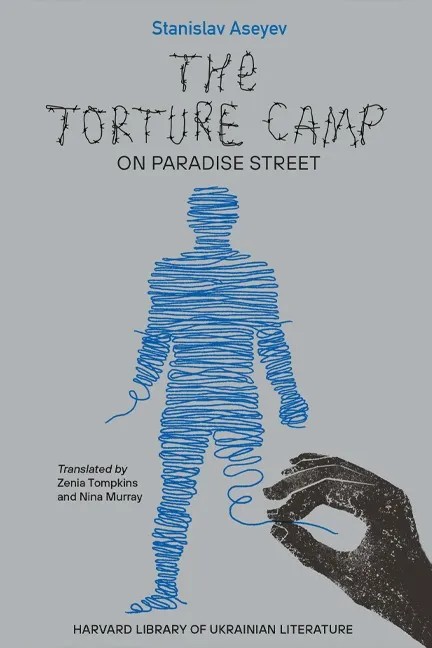
Stanislav Aseyev's memoir, which is prison literature of the highest order, is The Torture Camp on Paradise Street. Some of his journalism from Russian-occupied Ukraine, for which he was arrested and tortured, is collected in his book In Isolation. These books are available from the Harvard Ukrainian Research Institute, which also offers many other timely and excellent translations from Ukrainian.
This essay was translated from the Ukrainian by Amelia Glaser. She is the author of Songs in Dark Times: Yiddish Poetry of Struggle from Scottsboro to Palestine as well as Jews and Ukrainians in Russia's Literary Borderlands.
Source: substack.com