Whether this strategy is sustainable will largely depend on EU cohesion, U.S. foreign policy continuity, and internal resistance from Serbia.
By Timothy Snyder
Although Serbia has been an official candidate for EU membership since 2012, its leader found like-minded persons around the globe in the opposite camp in terms of European values. In addition to his best friend Viktor Orbán, he established cordial relations with the leaders of Turkey, Azerbaijan, the UAE, and Egypt. He never quit his “special” relations with Vladimir Putin which both leaders have used more for internal than any other reasons. To placate Western powers that were irritated by this, Mr. Vucic made a scheme, with the help of American diplomacy. The most influential European quality dailies claim that Serbia exported ammunition to neutral users who then re-exported it to Ukraine. At the same time many pro-government media in Serbia took an extremely pro-Russian stance during the Russian Aggression against Ukraine.
At the end of 2024, after the victory of Donald Trump in the USA, it looked like that this sort of policy could actually give results. Russia was ready to use its veto against the recognition of Kosovo’s independence in the UN, and many Western countries were satisfied with Serbia’s practical contribution in combating Russia. The issue of democracy in Serbia, although not totally forgotten, was put aside.
Meanwhile, the appeals and warnings of organizations monitoring democracy and related scores became increasingly alarming. Serbia left the club of free countries in 2018 and has been considered a partly free country by Freedom House since then. With 56 points Serbia is now the second worst ranked country in the Western Balkans with the ruling party that “has steadily eroded political rights and civil liberties, putting legal and extralegal pressure on independent media, the political opposition, and civil society organizations.” Nations in Transit, FH’s major publication for the countries of Eastern Europe and ex-USSR, sees Serbia as a hybrid or transitional state slowly but persistently sinking towards the status of semi-consolidated autocracy. In December 2024, Amnesty International called Serbia “a digital prison” and accused Serbian authorities of deploying “surveillance technology and digital repression tactics as instruments of wider state control and repression directed against civil society.” Finally, the latest report of “Reporters without borders” ranks Serbia’s situation with the media as “difficult” which is the second worst category, to which are assigned only Serbia and Kosovo in Europe.
The biggest student-led protest since 1968 and its transformation into a student and civic protest
The Student Protest emerged in Serbia after a train station canopy collapsed in Novi Sad, on November 1, 2024. Fourteen bystanders were killed at the spot, and two persons died of injuries later. The canopy was recently renovated, and, in March 2022, the train station was opened with great pomp by Serbia’s president accompanied by Hungarian PM Viktor Orbán. The 33-minute line Belgrade-Novi Sad was hailed by the president of Serbia as “the most modern European railway section with the best accompanying equipment and security systems.” In July 2024, the station was opened again, albeit with a less pomp, but again with the confirmation of the regional Prime Minister of Voivodina that passengers would be able to buy tickets in the renovated station “in the most modern, the safest, and the most efficient way.”. Only four months later, the tragedy of Novi Sad took place.
From subsequent revelations it turned out that corruption was to be blamed for the fall of the canopy, and also that the government was interested that the works of construction companies should be done as promptly as possible. After the tragedy the government tried to minimize its own responsibility.
Then the students suddenly began their protest without any sign that it would happen. They organized themselves in plenums (plenary sessions) and took over buildings of faculties around Serbia. By the end of 2024 all 85 state faculties joined the protest, and students of some private faculties also supported the protest. On December 22, the protest reached the first climax with around 102,000 protestors who came to the Belgrade Slavia Square.
By the beginning of 2025, it was clear that the Student Protest was transformed into the Student and Civic Protest. The situation at the beginning of February was that more than 300 towns and cities organized various protests that supported students and that voiced various forms of dissatisfaction with the Serbian authorities. The Student Protest in Serbia, in the late winter of 2025, became probably the biggest student-led movement in Europe since 1968. One of the major characteristics of the Student Protest is their non-violent approach, and avoidance to identify with specific political goals or with any of political parties. Another special aspect is students’ inclusiveness and ability to bridge political, cultural, and ethnic divisions. Spectacles of unity of Christian and Muslim students in Novi Pazar have demonstrated that the Student Protest also has a potential to overcome dark legacies of the 1990s.
A survey conducted in January 2025 by the Faculty of Philosophy in Belgrade showed that 85% of the students of Serbia’s five state universities supported student blockades and their four demands, but a mere 2.5% of them have participated in any activity of any political party or political organization. This is why students’ demands had to be conceptualized very widely. In their essence, these call for ending state capture and for institutions becoming independent and functional. The Student Protest turned out to be the mutiny of the Zomers since high school students also joined. Some ten generations of the age 15-25 found themselves in a joint protest.
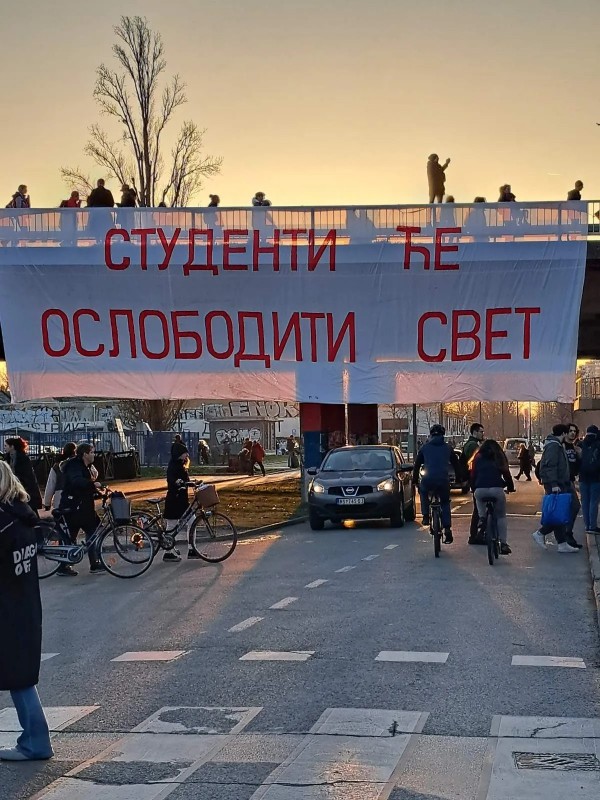
On January 27, 2025, the students blocked, but also symbolically liberated for one day, the Autokomanda Junction in Belgrade. After that they began something that could be called “mapping of freedom”, or “routes of liberation”. Students organized walks through Serbia in which they marched on foot between university centers. On January 31, the students who marched reached Novi Sad, the site of the tragedy, and by their own testimonies and recorded videos were seen as “liberators” by tens of thousands of citizens who greeted them along their routes. In this way, students mobilized very wide strata of society and were able to reach small places that are traditional strongholds of the ruling party. Students’ demands for the rule of law, accountable institutions, and that no individual should be above the law, became a nationwide cry. A very important aspect of the Student Protest is the demand that direct democracy, in the form of local gatherings, should be implemented wherever it is possible.
The spread of the movement led to the spectacular rally of March 15 in Belgrade that gathered unprecedented 300,000 persons, the figure almost twice higher than the number of citizens who had ousted Milosevic in October 2000. The Serbian regime reacted to the Student Protest by organizing its own rallies, but their main rally of April 12 in Belgrade was attended by only around 55,000 people. Many independent journalists were able to show that participants of this rally received various incentives to come or were warned that as state employees they had to come. In spite of all such forms of pressure many participants left the rally while the President was delivering his speech. In turned out to be a fiasco, and it confirmed the difference between party voters and party supporters. While the SNS is clearly capable of using clientelist and state-related networks to mobilize their voters, they seem to be mere dragged spectators at SNS rallies who are increasingly disinterested in political speeches of the Serbian regime.
A byproduct of the Student and Civic Protest is the sense of total delegitimization of authorities in Serbia at all levels. This, however, did not bring significant gains to the political opposition. Years of SNS campaigns against the political opposition in Serbia were successful. The result is that it is very fragmented. Under given circumstances there is a nation-wide debate on what is to be done. Many believe that a student-led, or a student-endorsed list, or a combination of them, is the way out. Political articulation seems to be crystalizing and is focused on one demand: snap elections. The regime’s response so far were President’s repeated claims that he prevented the Color revolution financed by the West, although not a single proof could ever be given about that, and, in spite of the fact, that EU officials have repeatedly warned their Serbian colleagues not to use statements that cannot be verified by any fact.
The regime has put all possible pressure on the universities, high schools, professors and teachers. The rector of the University of Belgrade and some deans were interrogated by the police, salaries of university professors were reduced by the government’s order by 87.5%. All of this came because the deans and the rector refused to call the police to intervene against the students which, by the Serbian university law, only the deans can request. State officials now go so far to threaten that faculties, and even high schools, could be privatized, and that all state faculties could lose their accreditations. Several activists were also interrogated by the police, and the offices of prosecutors tended to charge people for posts in social networks that they considered as incitement to violence. However, many pro-government posts with very similar messages, but directed against students and their supporters, have not been prosecuted so far. Some foreign residents who lived in Serbia for years have been expelled as “security threats” merely for expressing their support for the Student Protest.
In addition, the President of Serbia repeatedly voiced his dissatisfaction with the police that is too mild in his opinion, and with the prosecutors and judges. This produced the first wide protest and petitions of Serbian prosecutors and judges against this kind of pressure by the President of Serbia.
Under such conditions a group of students is at this moment performing a mega-marathon, running to Brussels to inform the EU institutions on what has been happening in Serbia. Previously 80 student cyclists made a 1,470 km tour to Strasbourg and brought their letters to the European institutions there. The EU does not seem to be silent anymore. Three leading parliamentary groups in the EU’s parliament openly sided with Serbian students. The EU Enlargement Commissioner repeated three times that students’ demands in Serbia were actually EU’s demands as well, and Austrian FM, on April 30, greeted student runners in Vienna. Selling the narrative of stabilitocracy to Brussels does not seem to be an option for the Serbian regime anymore. The President of Serbia has found himself torn between his publicly pronounced goal of Serbia’s EU membership and his special relations with Moscow. An increasing number of EU states seems to be more than ever irritated by this kind of policy.
Obviously the first half-time of the match between the SNS regime and the Serbian Students supported by rebelling citizens has ended with delegitimization of the regime, which is, however, still firmly in power. The second half-time is soon to begin and both sides believe that time could be their greatest ally. It could be a greater ally to the Civic Protest, though, since many SNS voters have turned into mere spectators, and surveys suggest that many of them have already opted for students. This erosion of the popularity of SNS is the greatest threat that this party has faced since 2012 when it came to power. The Student Protest in Serbia has made prospects of democratization of Serbia and the region more realistic.
Source: substack.com
English Edition