
Rodolfo Soriano-Núñez Miércoles, 12 de Febrero del 2025
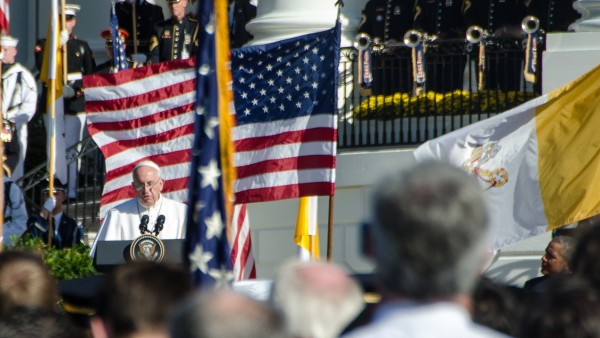
The Pontiff’s message regarding migration addresses a deeply divided conference of Catholic Bishops in the United States.
Pope Francis's letter dealing with migration reminds of an encyclical issued in 1937 by Pius XI dealing with the emergence of the Nazi regime in Germany.
By Rodolfo Soriano-Núñez
With a brief, ten-paragraph letter, Pope Francis called the Roman Catholic bishops of the United States to acknowledge that “worrying about personal, community or national identity (…) easily introduces an ideological criterion that distorts social life and imposes the will of the strongest as the criterion of truth.”
The letter, issued originally in English, Spanish, and Italian reminds of similar communications issued by previous pontiffs when dealing with social upheaval in the 1930s in Europe.
Francis’s message comes a few days after sitting U.S. Vice President, J.D. Vance, argued for a “Catholic” take to understand Trump’s migration policy pursuing massive deportations in his country.
Vance’s take faced immediate reactions in legacy and social media from other U.S. Roman Catholics and Christians affiliated with other religious traditions who rejected the VP’s understanding of what Catholic theology calls “the order of love.”
According to Vance, who now claims to be a Catholic, there is an “order of love” that forces humans to first pay attention to their own families and only after addressing their needs allows for the exercise of charity, compassion, and other values.
Sites associated with the Roman Catholic far-right have been running pieces to support Vance’s take on the so-called “order of love.”
One has been Word on Fire, managed by the bishop of Winona-Rochester, Minnesota, and former auxiliary bishop of Los Angeles, Robert Barron, available here.
Crisis Magazine, an outlet associated with conservative ideology in the English-speaking world, ran their own piece, available here. As to emphasize their adherence to that take, they even call Vance’s take “sacred order of love”.
However, other bishops in the United States decried Vance’s dismissal of long-established Catholic doctrine, as in the case of the Good Samaritan and other passages in the Bible, where people in need are willing to support others despite their own needs.
The story published yesterday by Los Angeles Press, linked after, about a joint activity in downtown San Diego by the Catholic and Episcopal dioceses there, where Cardinal Robert McElroy decried Trump’s policy offers a glimpse into that other way to understand Catholic and Christian teachings.
Vance’s controversial take led The Associated Press to publish an explainer of the so-called “Ordo Amoris” or order of love in Latin, available here.
Francis’s letter does not reject the idea of punishing criminals with jail sentences or, if required, with deportation, but he talks in the fourth paragraph about how he has been following “the major crisis that is taking place in the United States with the initiation of a program of mass deportations”.
He openly criticizes and expresses his “disagreement with any measure that tacitly or explicitly identifies the illegal status of some migrants with criminality” while talking about the need to acknowledge that “the act of deporting people who in many cases have left their own land for reasons of extreme poverty, insecurity, exploitation, persecution or serious deterioration of the environment, damages the dignity of many men and women, and of entire families, and places them in a state of particular vulnerability and defenselessness.”
Pope Francis explicitly offers his take of the “order of love” or “ordo amoris” at paragraph six:
The true ordo amoris that must be promoted is that which we discover by meditating constantly on the parable of the “Good Samaritan” (cf. Lk 10:25-37), that is, by meditating on the love that builds a fraternity open to all, without exception.
Francis then, on the ninth paragraph calls “not to give in to narratives that discriminate against and cause unnecessary suffering to our migrant and refugee brothers and sisters. With charity and clarity we are all called to live in solidarity and fraternity, to build bridges that bring us ever closer together, to avoid walls of ignominy and to learn to give our lives as Jesus Christ gave his for the salvation of all”.
Doubts and schisms
It is not clear whether the Pope’s words will have the intended effect as there is a deep divide in the United States Conference of Catholic Bishops, reflecting of the divisions among Catholics and other religious groups, and the overall public in the United States.
The conference of Catholic Bishops has at least two wings, with the now archbishop of Washington, DC, Cardinal Robert McElroy and his colleague in Chicago, Cardinal Blase Cupich, as the leaders of the wing closest to Pope Francis and the archbishop of New York, Cardinal Timothy Dolan, as one of the visible heads of the “MAGA wing” in the USCCB.
Despite those differences, by early afternoon the conference's website already had a link to the letter at the Holy See's website.
Pope Francis is the frequent target of attacks from websites that would have been unwilling to run a story with any criticism of his predecessors, John Paul II or Benedict XVI.
One example of the attacks on Francis and his allies was the subject of a piece dealing with a case of clergy sexual abuse in Chiclayo, Peru, linked below.
Media outlets close to the U.S. Roman Catholic far right attacked Cardinal Robert Prevost’s handling of that case, despite the fact that Chiclayo is one of the few Peruvian dioceses addressing the clergy sexual abuse issue, while dismissing or challenging the Pope’s authority when dealing with the cases at the Sodalitium and at the Archdiocese of Lima, that have been the subject of other pieces in Los Angeles Press.
Reveries of Berlin, 1937
The Pope’s letter to the USCCB is available here in English and as a PDF below.
The letter is reminiscent of at least one document issued back in 1937 by Pope Pius XI. On March 14th, Pius XI, born Achille Ratti, published Mit Brennender Sorge, an encyclical originally available only in German, whose title means, literally, “With deep anxiety”.
The document, available now in English and other languages here, addresses the risks posed to the Catholic Church and other Christian churches in Germany out of nationalism and the exaltation of ethnic identity.
As it is the case of the United States nowadays, there were German bishops willing to dismiss the document, keeping a relation with the Nazi regime.
The Wikipedia entry devoted to the relationship between the Nazi regime and the Roman Catholic bishops in Germany stresses how:
The German bishops initially hoped for a quid pro quo that would protect Catholic schools, organisations, publications and religious observance. While head of the Bishop's Conference Adolf Bertram persisted in a policy of avoiding confrontation on broader issues of human rights, the activities of Bishops such as Konrad von Preysing, Joseph Frings, and Clemens August Graf von Galen came to form a coherent, systematic critique of many of the teachings of Nazism.
British historian Ian Kershaw wrote that, while the "detestation of Nazism was overwhelming within the Catholic Church", it did not preclude church leaders approving of areas of the regime's policies, particularly where Nazism "blended into 'mainstream' national aspirations"—like support for "patriotic" foreign policy or war aims, obedience to State authority (where this did not contravene divine law); and destruction of atheistic Marxism and Soviet Bolshevism - and traditional Christian anti-Judaism was "no bulwark" against Nazi biological antisemitism.
Such protests as the bishops did make about the mistreatment of the Jews tended to be by way of private letters to government ministers, rather than explicit public pronouncements. From the outset, Pope Pius XI, had ordered the papal nuncio in Berlin, Cesare Orsenigo, to "look into whether and how it may be possible to become involved" in the aid of Jews, but Orsenigo proved a poor instrument in this regard, concerned more with the anti-church policies of the Nazis and how these might affect German Catholics, than with taking action to help German Jews.
Pius XI himself acknowledges in Mit Brenender Sorge the mistake he made when agreeing to the 1933 Concordat with the Reich.
Paragraph eight of that 1937 encyclical states:
8. Whoever exalts race, or the people, or the State, or a particular form of State, or the depositories of power, or any other fundamental value of the human community—however necessary and honorable be their function in worldly things—whoever raises these notions above their standard value and divinizes them to an idolatrous level, distorts and perverts an order of the world planned and created by God; he is far from the true faith in God and from the concept of life which that faith upholds.
Mutatis mutanda, both documents are warnings to the Catholic flock in their countries about the use of Catholic and Christian theology and symbols in legitimizing political decisions.
Pope Francis relation with the U.S. has been difficult even before the first Trump’s Presidency. Among the most active critics of his style, theology, and even his way of talking are the leaders of the Catholic far-right.
At Los Angeles Press we have published stories going into the details of the rift, an informal schism in the U.S. Roman Catholic Church. The story linked above deals with the kidnapping, the exploitation of the image and tradition of Our Lady of Guadalupe, for the political purposes of the U.S. far-right, while the story linked after, about the forced resignation of Joseph Strickland, the former bishop of Tyler, Texas offers more insights about the rift.
A symptom of the rift is noticeable in the substantial number of bishops who are over the 75-years-old age of retirement. At least 23 active bishops are above 75 and are still in charge of a diocese or other similar entity in the United States, while one is above that age and still active in the Roman Curia.
Spain has ten bishops in a similar circumstance. Canada and Mexico have six each. Same number as Brazil, while Argentina only has three active bishops who are older than 75.
It must be stressed that while the United States and Brazil have similar total number of bishops (450 as compared to 491), the U.S. only has 195 dioceses or similar jurisdictions as compared to the 280 that exist in Brazil.
In that regard, if one goes with the criteria of the number of jurisdictions, a 11.79 percent of the U.S. Catholic bishops remain in the positions beyond the age of retirement, as compared with 2.14 of Brazilian bishops in an analogous situation or the six percent of the Mexican bishops in a comparable situation.