
Rodolfo Soriano-Núñez Jueves, 23 de Enero del 2025
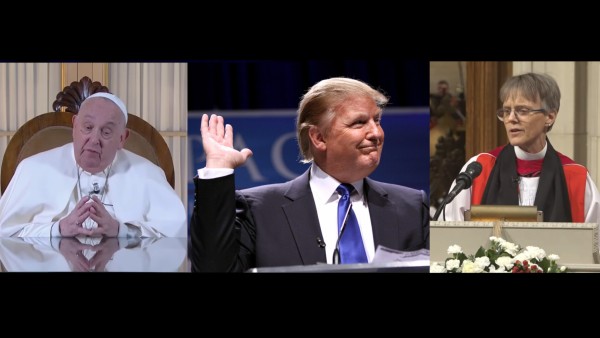
Mariann Budde, the Episcopal bishop of Washington, D.C., asked Trump to “have mercy” of LGTBQ and migrants.
In Mexico City, the archbishop of Chicago, Cardinal Cupich blasted Trump’s plans to conduct raids at places of worship in the United States.
By Rodolfo Soriano-Núñez
Following Donald Trump’s second inauguration as President of the United States, there has been a constant chain of reactions to his speeches and first group of Executive Orders from leaders of different religious organizations active in the United States.
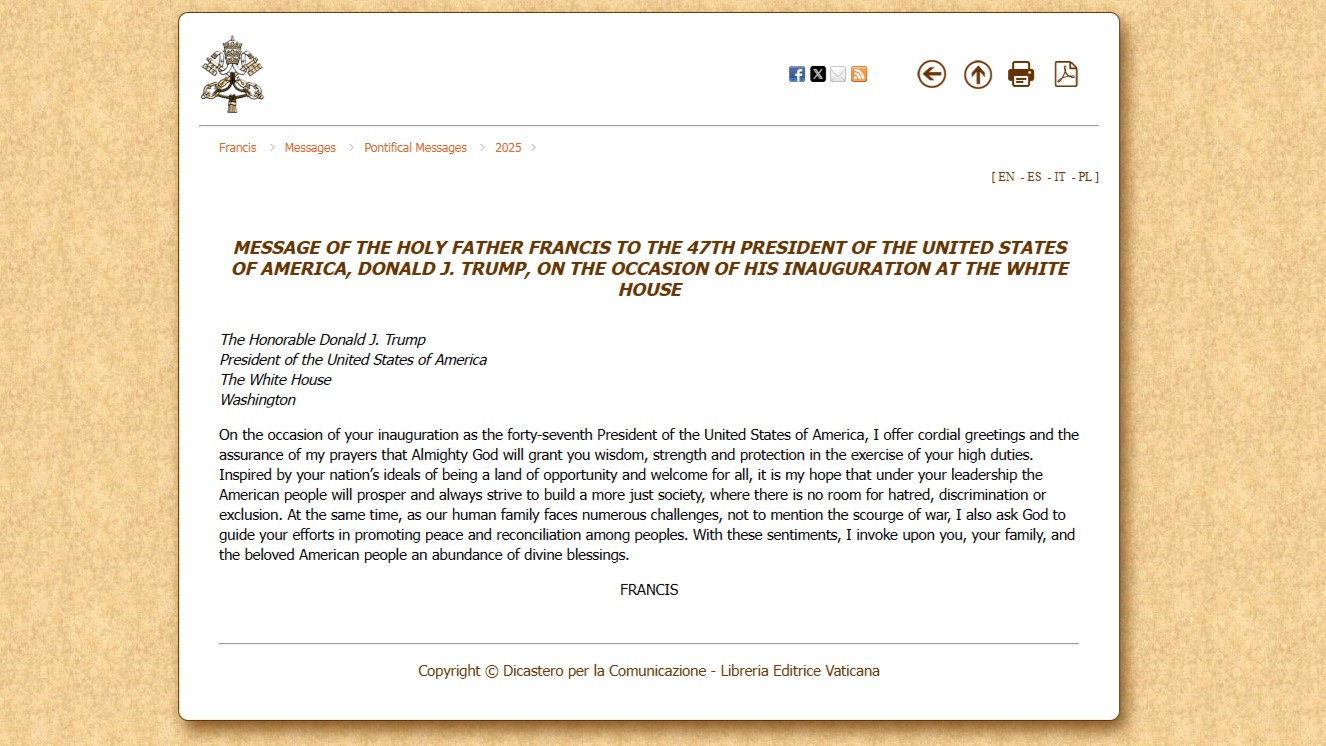
Besides Pope Francis’s official and circumspect congratulatory message, the head of the Roman Catholic Church voiced a clear critique of Trump’s migratory policies when interviewed by an Italian Sunday evening show where he has been frequently a guest.
The Pope’s official message, available here at the Vatican’s website, and as an image after this paragraph, follows the diplomatic standards of the Holy See and there is little or nothing new there. It could have been issued for any President or Prime Minister worldwide.
The message at NOVE, an Italian private broadcaster was issued as a cautious warning, still as a hypothetical, as Pope Jorge Mario Bergoglio spoke a few hours before the official inauguration and there was no clarity at that time of the extent of the actual changes to the U.S. migration and refugee policies.
Francis, the son of migrant Italians who reached Argentina in the early years of the 20th century, avoided any clear-cut condemnation of Trump’s policy choices, but was clear to stress the absurdity of measures aimed at making the poorest to pay for the “imbalances”. The Pope described such a policy as “a disgrace.”
His full interview at Che Tempo che fa is available with audio available only in Italian at NOVE’s YouTube channel at the video linked above and a short excerpt of the interview, where the Pontiff shares his sorrow regarding Trump’s decisions appears after this paragraph.
Over the same interview, Bergoglio called Italy and other European countries to soften their migration policies. When talking about the Italian case, he stressed how that country has reached an all-time high average age of 46 years, similar to other European countries, unable to achieve even the replacement rate of demographic growth, the bare minimum to keep their current population, and yet unwilling to change their policies as to allow people from other, so-called races, to enter their territories.
Vatican News, the Holy See's information service, published a summary of the Pope’s remarks during the Italian TV show, available here.
Have mercy
On Tuesday, during the Inaugural Service Prayer at Washington National Cathedral, the Episcopal bishop of Washington, D.C., the right reverend Mariann Edgar Budde grabbed the world’s attention after making a respectful plea to Trump and his team to spare the lives and futures of LGTBQ teens and adults, and of migrant families living in fear of Trump’s policies.
An excerpt of bishop Budde’s plea at the National Cathedral in Washington D.C. appears as a video before this paragraph. His full sermon is available at the National Cathedral’s YouTube channel, as linked below.
True to his nature, Trump dismissed bishop Budde’s message, as the posting of CSPAN at what used to be Twitter, linked below, shows. There Trump dismissed the service to honor the start of his second term as U.S. president saying he “didn’t think it was a good service”.
CSPAN’s broadcast of the service at the National Cathedral was able to catch Trump’s and Vice President J.D. Vance’s dismissive reaction to bishop Budde’s plea, as depicted in the screenshot after this paragraph.
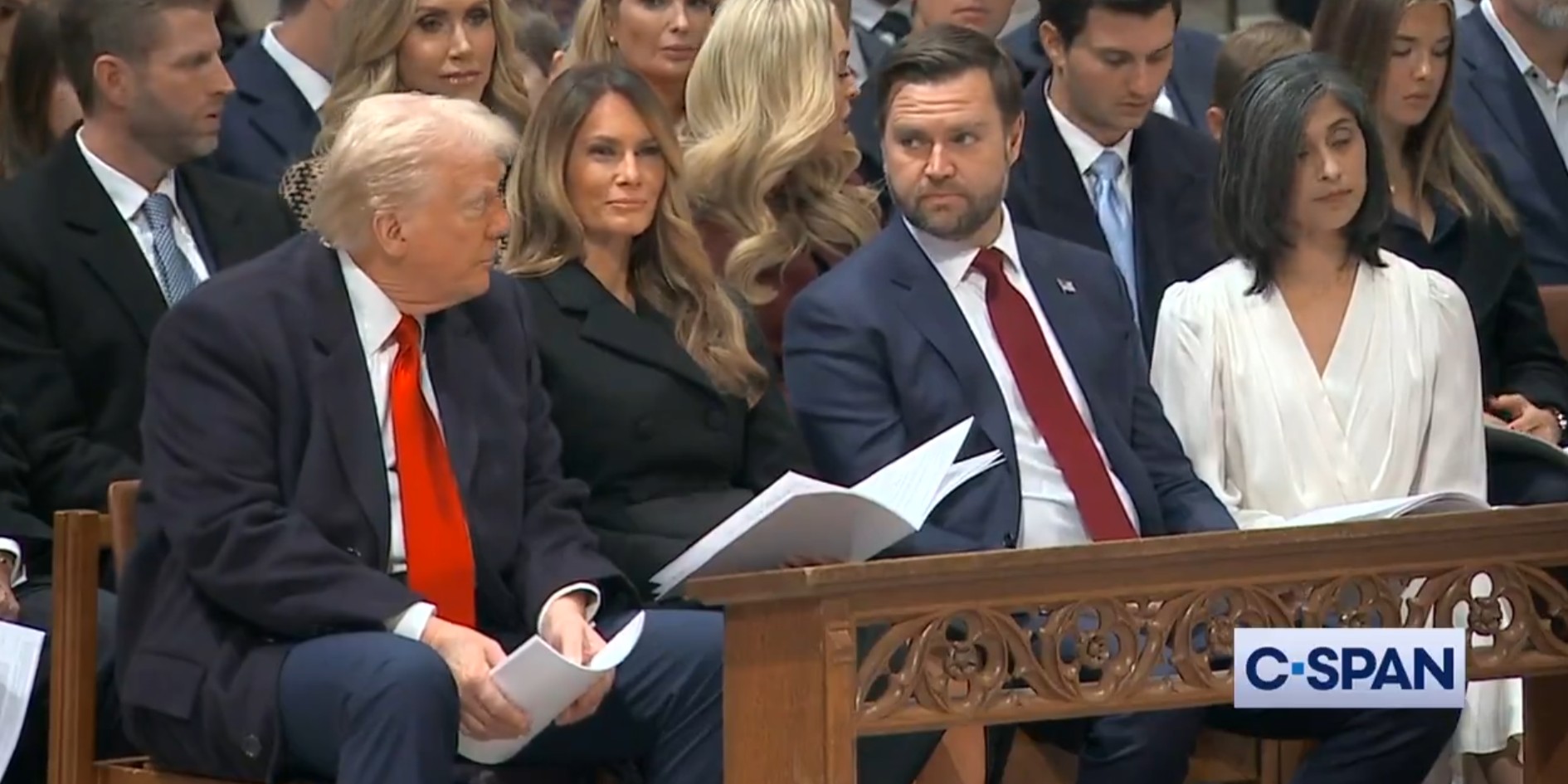
That screenshot comes from CSPAN’s social media message linked after.
The next day, on Wednesday January 22nd, Trump demanded “an apology” from bishop Budde. According to the newly inaugurated president, the Episcopal prelate’s plea was “nasty in tone”, despite the extremely careful language used by the bishop.
The core of her message stated:
I ask you to have mercy, mister President, on those in our communities whose children fear that their parents will be taken away, and that you help those who are fleeing war zones and persecution in their own lands to find compassion and welcome here…
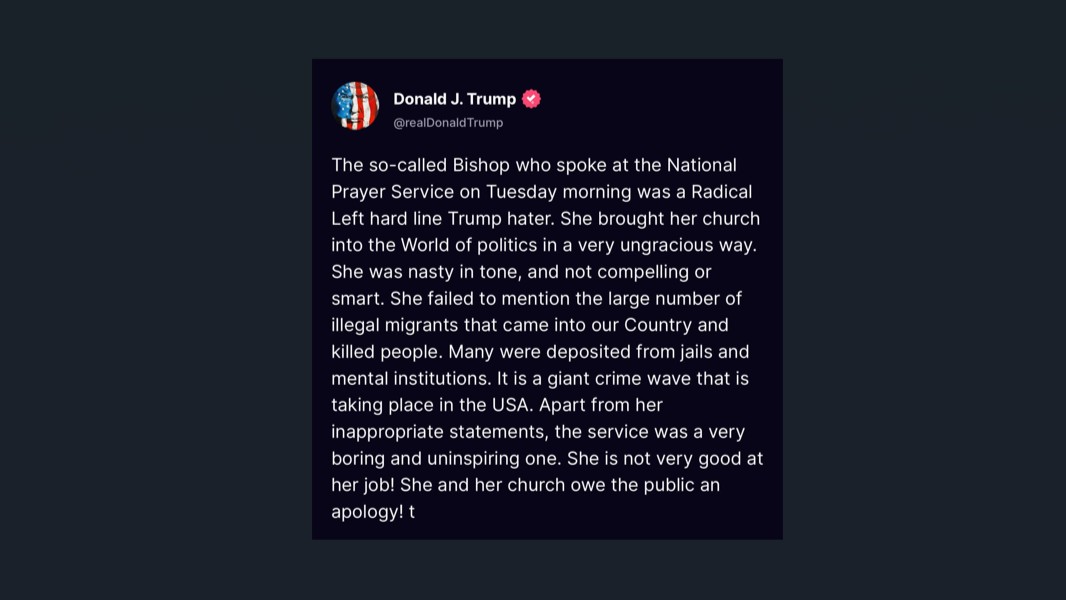
Several hours after the ceremony, Trump blasted the Episcopal bishop over his many social media accounts as “Radical Left hard line Trump hater”, as the image after this paragraph, from one of his social media accounts proves.
Republican representative Mike Collins of Georgia called for the deportation of bishop Budde, despite the fact she was born in New Jersey in 1959 to a couple of U.S. citizens.
Other conservative leaders, as GOP conference chair Lisa McClain, chastised Budde as “extreme in her views, extremely out of line and out of touch”. McClain went as far as to say that what Budde “did was uncalled for.”
A Catholic Church divided
The United States Conference of Catholic Bishops published a short message at their website. The brevity of the message and its content reflects the divisive effects of Trump’s policies on a Church whose growth has been closely connected to the waves of migration, first of Irish, later of Italian and other European minorities during the 19th century, and to Mexican and other Latin American minorities throughout the 20th century.
The bishops’ conference will be carefully reviewing the executive orders that are expected to be signed today by President Trump. The Catholic Church’s foundational teaching calls us to uphold the sacredness of human life and the God-given dignity of the human person. This means that the care for immigrants, refugees, and the poor is part of the same teaching of the Church that requires us to protect the most vulnerable among us, especially unborn children, the elderly and the infirm. The bishops’ conference will work with the Trump Administration as well as the U.S. Congress to advance the common good for all, which will include instances of agreement, as well as disagreement.
The deep divide in the U.S. Roman Catholic Church is clear in the statement’s last sentence, where the message talks about “instances of agreement, as well as disagreement”. And that is what has been happening at the Roman Catholic Church over the last few days.
On Sunday 19th, a few hours before Pope Francis’s interview, Cardinal Blase Cupich, head of the archdiocese of Chicago, Illinois, presided mass at the Basilica of Our Lady of Guadalupe in Mexico City.
Although Cardinal Carlos Aguiar Retes, head of the local Church and Cupich’s host for the day, delivered the mass’ homily, the Archbishop of Chicago made remarks in both Spanish and English at the end of the service.
In doing so, he offered another view into the deep divide in his Church in the United States. On his remarks at Mexico City’s largest Church, he stressed how…
While we wish the new administration success in promoting the common good, the reports being circulated of planned mass deportations targeting the Chicago area are not only profoundly disturbing but also wound us deeply.
He went to talk about Chicago’s “legacy of immigration”, not limited to Mexican communities, but encompassing large neighborhoods of Roman Catholics of Polish, German, Italian, and other European ancestries, on top of large communities of Puerto Rican, Dominican, and Vietnamese families.
Cardinal Cupich, born in Nebraska back in 1949, to a family from Croatia spoke at Mexico City of a “moment to be honest about who we are: There is not a person in Chicago, save the Indigenous people, who has not benefited from this legacy”.
Talking as head of the Archdiocese of Chicago he emphasized the need to speak out “in defense of the rights of immigrants and asylum seekers,” while rallying his faithful to “oppose any plan that includes a mass deportation of U.S. citizens born of undocumented parents.”
Responsibilities
Archbishop Cupich went on to remember the government’s “responsibility to secure our borders and keep us safe” and even if he was willing to “support the legitimate efforts of law enforcement to protect the safety and security of our communities” he also highlighted his commitment to “defending the rights of all people and protecting their human dignity.”
As other leaders of his faith have been doing over the last few days, Cupich decried “all efforts by Immigration and Customs Enforcement and other government agencies to enter places of worship for any enforcement activities.”
For the archbishop of Chicago “the choice is not simply between strict enforcement and open borders, as some commentators would have us believe.”
His message, delivered in Mexico City in English is available at the archdiocese’s website here.
The core of that message appears as a video after this paragraph. The full video of the mass at the Basilica of Our Lady of Guadalupe is available here, with most of the audio available only in Spanish.
Despite Cupich’s call, as early as Wednesday 22nd, NPR informed about changes in the policies preventing raids at places of worship as defended by Cardinal Cupich, as the video after this paragraph shows.
Besides Cardinal Cupich, the archbishop of Santa Fe, New Mexico, John C. Wester and the bishop of El Paso, Texas, Mark Seitz issued statements highlighting their concerns with the changes in policy guiding the actions of U.S. federal law enforcement.
Archbishop Wester talked about the need to not treat migrants as “mere pawns in a game of chess nor politicize them. Instead, we must place their needs and concerns at the forefront of our debates, considering both the citizens of our nation and those seeking refuge at our borders. Our Christian faith urges us to care for the resident and the stranger”.
His statement, available as a PDF, in full here is similar to the one issued at El Paso by bishop Seitz over his social media accounts, as the message posted at X after this paragraph shows.
His diocese has been preparing for potential changes in U.S. migration policy for the last year or so, as proven by the launching of The Border Refugee Assistance Fund, whose Go Fund Me page is available here.
More recently, in October 2024, Seitz launched the Migrant with Dignity initiative, whose Webpage is available here.
A statement issued on January 21st, after Trump's new policies to conduct raids, stresses bishop Seitz's discomfort. Its main paragraph says:
The end of the Department of Homeland Security’s sensitive locations policy strikes fear into the heart of our community, cynically layering a blanket of anxiety on families when they are worshiping God, seeking health care and dropping off and picking up children at school.
However, as was evident during Trump’s inauguration he asked the archbishop of New York, Cardinal Timothy Dolan, to lead the so-called Invocation, as the video from PBS displayed after this paragraph shows.
Although Dolan’s prayer was extremely careful as to avoid blessing of the kind of policies Trump is about to unleash in the United States, he has been willing to participate in this and other public functions with Trump and his closest allies.
The full text of Dolan’s invocation is available at his archdiocese’s website here. Its key paragraphs calls for...
We, blessed citizens of this one nation under God, humbled by our claim that ‘in God we trust,’ gather on this Inauguration Day to pray. For our President Donald J. Trump, his family, his advisors, his cabinet, his aspirations, his vice president. For the Lord’s blessings upon Joseph Biden. For our men and women in uniform. For each other, whose hopes are stoked this new year, this Inauguration Day.
Also, when trying to grasp the complexity of the Roman Catholic Church’s role in Trump’s second term it is necessary to acknowledge the role of J.D. Vance, his Vice President, who claims to be a convert to Catholicism, although closely aligned with the wings in that Church more vocal in their relentless opposition and attack on Pope Francis’s teachings, theology, and pastoral approaches.
Roman Catholic conservatives justify their loyalty for Trump in the sweeping overturn of Roe vs. Wade, since abortion is still the key priority for USCCB, despite Cupich’s and other high ranking Catholic officials to revamp the priorities of the Conference.
Something similar happens in the Roman Catholic world outside of the United States despite the bitter experience of that Church in Nicaragua, where Cardinal Miguel Obando y Bravo repeatedly dismissed warnings from the local Province of the Jesuits back in the first decade of this century.

English Edition
The Catholic Church in Nicaragua: a new twist in the plot
Daniel Ortega, Nicaraguan strongman pocketed Obando’s support after he delivered one of the most restrictive laws prohibiting almost any kind of abortion in the Central American nation.
And despite Budde’s brave plea for mercy at the Washington National Cathedral, the non-Catholic Christian leaders are at least as divided and confronted by Trump’s policies as the United States Conference of Catholic Bishops.
On their February issue, The Atlantic Magazine goes deep into the sources of political support for Trump in the other-than-Catholic Christian political sphere in the United States.
Back in 2023, Los Angeles Press published a series describing the links between the Mexican and the U.S. far-right. A link to the last installment of that series appears below.

English Edition
The Verástegui Network, a dystopian and authoritarian world