
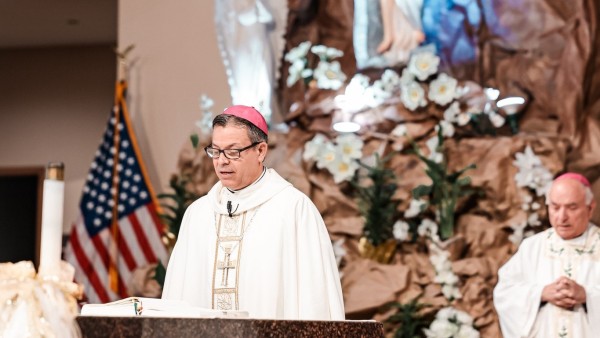
Rodolfo Soriano-Núñez Viernes, 11 de Julio del 2025
San Bernardino’s statement mirrors similar messages of Popes Francis and Leo XIV, and other Catholic Bishops in the United States.
However, the USCCB remains unable to support San Bernardino's bishop Rojas and others in similar situation and to confront Trump’s antimigrant policies.
By Rodolfo Soriano-Núñez
The Catholic diocese of San Bernardino, located East of Los Angeles and all the way to the border with Arizona and Nevada issued, as other dioceses in the United States have done since Donald Trump’s inauguration, a message to its flock dispensing them from the weekly obligation to attend Mass.
Bishop Alberto Rojas acknowledged the deep fear his faithful confront when attending Mass and other religious services at the 92 parishes and 30 schools spread over 28 thousand square miles or 71 thousand square kilometers encompassing the San Bernardino and Presidio counties in Southeastern California.
Mostly rural, the diocese serves a population of roughly 1.8 million Catholics, who represent roughly 40 percent of the total population of those two counties. According to Census data, roughly 55 percent of the population identify as Latino or Hispanic. The diocese’s flock has a large share of its population working in low-wage and relatively low qualification jobs in the primary sector of the economy.
Bishop Rojas, a native of Aguascalientes, Mexico, is the very epitome of half the inhabitants of those counties and the diocese at large, who are under great fear of being arrested by Immigration and Customs Enforcement, even if they are legal residents or citizens.
Bishop Rojas's message to his flock is presented in full, in both English and Spanish, directly below this paragraph.
Bishop Rojas's message to his flock in both English and Spanish.
The message by bishop Rojas mirrors the one issued back in May 13 by the Catholic diocese of Nashville, Tennessee (available here in both English and Spanish).
It also echoes statements and stern criticism of the Trump administration’s migration policies made over the last six months by the now archbishop of Washington, DC, former bishop of San Diego, Robert McElroy, as the story linked after this paragraph told.
The recently appointed new bishop of San Diego, former auxiliary there, Vietnam born Michael (Micae) Phạm Minh Cường, maintains all the programs to support migrant communities in San Diego left by McElroy before taking over the country’s capital see.
The bishop of El Paso, Texas, Mark Joseph Seitz, who leads a group of Catholic bishops actively working for the migrants in the United States, has also been active in keeping the ministries at his diocese up and running and supporting communities under threat of discriminatory policies there.
However, at the same time he has become the target of a baseless campaign portraying him as involved in child trafficking supported by the most radical factions of the MAGA movement.
Also active in the denunciation of Trump policies, on migration and other issues, is the archbishop of San Antonio, Gustavo García-Siller. He closed his Twitter account recently after facing criticism for his outspoken views, including his critique of Israel’s indiscriminate attacks on civil populations, a move that some see as part of the broader anti-migration wave.
Another leading voice has been the archbishop of Chicago, Cardinal Blaise Cupich, who went as far as going to Mexico City to issue, at the Basilica of Our Lady of Guadalupe, a stern condemnation of Donald Trump’s migration policies (see the story linked above).
Cupich has made unequivocal critiques of current U.S. migration policies and more so of the way such policies have been enforced, as this story from Newsweek tells.
Before dying, Pope Francis issued a severe critique of Trump’s migration policies and J.D. Vance’s misappropriation of Catholic doctrine to endorse said policies on a letter addressing the USCCB.
As the story linked after this paragraph tells, Jorge Mario Bergoglio’s letter, his very last to a national conference of bishops, is reminiscent of a similar condemnation of the German Nazi regime issued by Pius XI in 1937.
As soon as he was elected as bishop of Rome, Leo XIV has made repeated statements endorsing his predecessor criticism of Trump’s policies and calling the U.S. government to acknowledge the value of migration and its own history of supporting migrants going in difficult circumstances to the United States.
Even as a local bishop in a rather small diocese in Peru, Robert Prevost fully embraced Pope Francis’s and the Catholic social doctrine on migration. He did so by actively supporting the integration of migrants arriving to Chiclayo and other cities in Peru from Venezuela, fleeing the political crisis there.
An unofficial translation to English of an homily at a Mass for the World Day of Migrants and Refugees in Chiclayo, back in 2020 is available here. A video, available only in Spanish, with Prevost addressing his then diocese on the issue is available after this paragraph at YouTube.
Robert Prevost, bishop of Chiclayo. Social media of the diocese of Chiclayo, Peru, 2020. Audio in Spanish.
As pontiff, Leo XIV has used any opportunity at hand to endorse the embrace of migrants and to criticize the racist undertones of migratory policies in the United States and elsewhere.
Over his May 16 message to the diplomatic corps accredited in the Holy See, available here, Leo XIV portrayed himself as a product of migration. He said:
- My own story is that of a citizen, the descendant of immigrants, who in turn chose to emigrate. All of us, in the course of our lives, can find ourselves healthy or sick, employed or unemployed, living in our native land or in a foreign country, yet our dignity always remains unchanged: it is the dignity of a creature willed and loved by God.
Other religious leaders in the United States have criticized the policies and how said policies have been enforced. The Episcopal Church, the U.S. branch of the Church of England, declined to offer relocation services to a group of South Africans portrayed without evidence by the Trump administration as refugees fleeing their country, as this story from May at that Church’s newspaper tells.
Closer to Caesar…
Despite the support of Cardinals such as Cupich and McElroy, or the programs that dioceses such as San Diego or El Paso keep running despite the many threats, the reaction of the United States Conference of Catholic Bishops is far from solid on the issue.
Archbishop Timothy P. Broglio, the head of the U.S. military diocese and current chair of the USCCB, acknowledged receiving the letter from Pope Francis, but made no specific comment about its contents or the critique of U.S. policy and practice on migration there.
And the same goes for the Catholic bishops of California. Even if Rojas and Phạm support the migrant communities in the territories under their care, other bishops are less willing to express any explicit support.
During the recent episodes of violence in Los Angeles, the Catholic archbishop there, Mexican-born José Horacio Gómez Velasco was in Mexico City, with a small group of his flock during the yearly pilgrimage to the Basilica of Our Lady of Guadalupe.
While there, Gómez, a full member of the Opus Dei, issued a rather timid statement, short of calling out the violence in full display in Los Angeles and elsewhere in California, as Mayor Karen Bass said yesterday.
The other head of an archdiocese in California, archbishop Salvatore Cordileone of San Francisco, dismissed the violence and was more concerned with issuing calls over his social media to non-Catholics in Texas to support a join activity there to protest the “profanation” of a Catholic procession there.
The attitudes of both archbishops of California during the violence in Los Angeles were considered in the story linked after this paragraph.
Besides those two cases, there is the frequent endorsement of Trump’s policies by the archbishop of New York, Cardinal Timothy Dolan, and more so by Winona-Rochester’s bishop Robert Barron, among other U.S. bishops close to the MAGA wing of the Republican Party.
South of the border, the Mexican bishops have issued statements supporting the migrants living in the United States and their families back in Mexico, as the story linked at the end of this story shows.
Despite the close relation of Ramón Castro, bishop of Cuernavaca and chair of the Mexican Conference of Catholic bishops has with the far-right wing of the USCCB, with whom he shares their understanding of antiabortion policies as the main priority of the Catholic Church’s involvement in public life, there have been no joint statement on the issue from him and archbishop Broglio.