
Rodolfo Soriano-Núñez Lunes, 21 de Julio del 2025
The Epstein scandal offers lessons to religious organizations willing to learn something from it.
The Epstein scandal offers a cautionary tale for religious organizations fueling conspiracy theories, thereby turning their flocks and themselves into pawns.
By Rodolfo Soriano-Núñez
Over the last two weeks, starting on Monday, July 7, it has been impossible to engage with any newscast, late-night show, or podcast without encountering commentary on Donald Trump’s decision to betray his promises to release the so-called “Epstein files.”
Whether one watches U.S.-, Canada-, France-, or Germany-based news, or goes to Spanish-language newscasts, the references are hard to miss.
Trump's goal, it seems, has not been to actually address the issue but to shift public attention to topics closer to his interests. Trump launched, on Wednesday, July 16, stern criticism of the Mexican government’s handling of criminal organizations. He announced, as if to inject another issue into the news cycle, a Bill to “Halt Fentanyl.”
Despite the attempt to divert, one of many over the last week, during a press conference of sorts at the now “golden” Oval Office, on the very same Wednesday Trump went as far as to say he does not need the support of those asking for full disclosure of Epstein’s crimes. However, late on Thursday he offered a partial release of the Grand Jury testimony on that case.
Jeffrey Edward Epstein, a New York-based financier, has been the main character of a drama spanning almost two decades, whose many crimes were a main weapon of Trump’s presidential campaigns in 2016, 2020, and 2024.
He was the visible head of a ring preying on females, both minors and adults, with Ghislaine Maxwell's help. She is a relatively affluent member of the British elites, who recruited victims for Epstein. Although it is impossible to set a final number, by 2021, a total of 225 applications for compensation had been submitted to a fund, the Epstein Victims' Compensation Program. However, back on July 10, a new estimate of at least one thousand victims emerged.
Epstein allegedly committed suicide on August 10, 2019, at the Metropolitan Corrections Center in New York City during Trump’s first term of office (2017-21), a facility under the U.S. federal government purview. Maxwell is in jail still after going through a trial, serving a 20-year sentence.
On July 16, Mike Pence, Trump’s Vice President during his first term of office, called Trump to release the full Epstein files: “give the facts to the American people,” said Pence to CBS.
Given Trump’s refusal to follow the usual path of an independent probe, some of the most radical factions of MAGA claim he has become the “Deep State,” one of a family of conspiracy theories common nowadays in populist political narratives.
MAGA and other organizations use them to drive an oversimplified narrative to explain any and all grievances. Whatever issue they dislike, it can fit the idea that there is an elite making key decisions, able to ruin the world.
More significantly, the narrative “explains” the concrete grievance they are addressing at that point. In these simplified narratives, one finds echoes of old all-encompassing conspiracy theories such as that behind the so-called Protocols of the Elders of Zion.
Malevolent elites
Instead of following the path of the spies working for the Russian czar, back in the 19th century, the modern “Deep State” narrative talks about a vast global cabal, not necessarily led by Jewish potentates, but as damaging as that in the Protocols.
Both the Protocols and the “Deep State” narrative posit the existence of a hidden, powerful, and malevolent elite, secretly manipulating world events for their own nefarious ends. Both narratives aim to explain complex societal problems through simplistic, all-encompassing, and often demonizing frameworks.
They provide good talking points to further a narrative about a strong government actually addressing pressing issues of the day, even if it comes at the expense of the rights of minorities conveniently dehumanized.
Both the Protocols and the “Deep State” narrative thrive on creating an “us vs. them” dichotomy, identifying a common enemy, some “other” group or entity (Jewish people in the Protocols, globalists/woke opponents in the "Deep State" narrative) as the drivers of societal decline and the source of all grievances.
Both narratives foster deep-seated paranoia, encouraging distrust of established institutions, including the judiciary, media, and often, democratic processes. They suggest that visible leaders are mere puppets, and the real power lies in the leaders of cabals.
A common strain of the “Deep State” narrative has at its core a conspiracy theory involving global organizations such as the United Nations. That and other global bodies emerged after the second World War are blamed as puppets of forces driving vast changes destroying national, religious, or “sexual identities.”
They do so even at the expense of pulling elements of their narrative from fiction works such as how the Da Vinci code series of novels depicts the World Health Organization as having some sort of “striking force” able to prevent pandemics on its own. There is no evidence of WHO having such powers. As the responses to the pandemic of coronavirus prove, the power lies in the national governments.
Other strains focus on the idea of minorities as the driving force behind unspeakable crimes, ranging from pedophilia to attacks on pets. A prime example of pedophilia as a driving force is the movie Sound of Freedom, produced by Mexican soap opera actor and aspiring politician Eduardo Verástegui.
Back in 2023, Los Angeles Press published a series mapping Verástegui’s relationship with MAGA. The last of the articles in that series appears after this paragraph.
Sound of Freedom pretends to portray the modus operandi of one of these cabals, a ring of powerful financiers and politicians committed to trafficking underaged victims for the benefit of public figures accused of pedophilia such as Epstein himself. Sound of Freedom pretends to be a realistic account of the efforts by heroic U.S. law enforcement agents working against the wishes of their superiors to uncover the cabal and ultimately rescue the victims.
An example of the pets variation of this strain was launched by Donald Trump himself when he attacked Haitian immigrants in Springfield, Ohio, claiming they were eating their neighbors’ pets during a 2024 presidential debate, despite the lack of any evidence of such attacks on pets. And even worse, when fact-checked, he claimed to be the victim of the media.
Lessons for the Church
Even as this series focuses on clergy sexual abuse, the Epstein debacle offers a compelling opportunity to examine the potential lessons for the Catholic Church and other religious institutions, stemming from the ongoing rebellion within the “soft belly” of the Make America Great Again (MAGA) movement.
Already in January, this series delved into the potential implications for the Catholic Church in the U. S. of the apparent interest of a wing of the MAGA movement to politicize the sexual abuse issue.
You can see in the story linked after this paragraph how, early in Trump’s second term, there was a baseless attack on bishops such as El Paso’s Mark Seitz, naming him as a boss of sorts of a child trafficking ring.
As baseless as the accusation was, there were people who, at least on social media, identify themselves as Catholics and are, up until now, willing to share the postings where Seitz and other U.S. bishops are the target of attacks.
They follow the template of the so-called Rad-Trad movement, after Radical Traditionalist. They attack with arguments borrowed from the Protocols, Pope Paul VI’s reform of Catholic liturgy, a Pope whom they portray as a heretic for changing how the Church celebrates Mass. Since bishops such as Seitz accept this reform and celebrate Mass in languages other than Latin, they are portrayed as heretics, unworthy of trust.
For a deeper dive on the reasons for some factions of the Catholic flock to attack their own and the pervasive role conspiracy theories play within the Catholic Church itself, you can read the story, linked above, about bishop Strickland, a darling of Catholics close to MAGA.
Rome forced Strickland’s resignation after the former bishop of Tyler, Texas, repeatedly insinuating Pope Francis’s teachings or rulings broke with Catholic teaching, as to imply heresy. While portraying himself as the herald of resistance and fidelity to a “pure” Catholic identity.
This narrative of betrayal resonates with a Catholic base in the U.S. incensed by a claim to doctrinal purity, boasted by their preference for the so-called “Traditional Latin Mass,” and coupled with repeated attacks on migrants, portrayed as criminals, and as existential threats, as Trump did when baselessly talking about Haitians stealing pets in Ohio to eat them. Such attacks follow the lines of the so-called “Great Replacement” theory,.
Even Elon Musk, then widely considered the de facto head of the Department of Government Efficiency (DOGE), and now going through a bitter “divorce” of sorts with Trump, was willing to attack the churches for getting money from the U.S. federal government to help resettle any refugees.
Gambit ahead
Refugees used to be individuals acknowledged by the U.S. government as victims in their country of origin. Asking churches to help settle them in the U.S. used to be a lawful practice. For instance, back on May 12, the Trump administration asked the Episcopal Church, the U.S. branch of the Anglican Church, to help resettle South African nationals accepted by Trump as refugees.
Aware of the gambit they were facing, the Episcopal Church immediately, the same day, declined the contract and later ended their work for the U.S. government.
A more recent installment of the series, linked after this paragraph, warned about the contradictory nature of MAGA’s interest in the sexual abuse issue. It was about weaponizing abuse while blasting long-standing commitments of the U.S. Catholic Church, going back as far as the 19th century, to help immigrants settle.
As noted there, despite the many claims Trump made during his 2024 presidential campaign about “releasing” the Epstein files, there was a more enthusiastic and concrete effort, for example, to support people with standing accusations of sexual abuse such as the British Romanian influencers Andrew and Tristan Tate.
The Tates would merit a book on their own; suffice to say at this point that the brothers, darlings of the MAGA crowd, at one point were controversially able to leave Romania and travel to the United States.
This temporary freedom has been, for now, widely celebrated by their supporters as a de facto “get-out-of-jail” card, a perceived triumph often attributed directly to President Trump’s influence. So much, that the narrative surrounding Trump's relationship with the Tates often bordered on a marketing campaign, with some characters, Donald Trump Jr. included, framing his dad’s intervention as a “rescue,” a social media remake of Saving Private Ryan.
This outcome solidified the Tates’ narrative as “virtuous heroes” or “victims of a corrupt woke system,” allowing them to sell themselves as MAGA’s ultimate poster boys. They have been able to do so, despite still facing severe charges for human trafficking and rape in Romania, the U.K., and the U.S.
Andrew Tate himself is a convert to Islam who publicly criticizes Christianity for its alleged softness or femininity. The way he preaches about “masculinity,” or about the betrayal of Western “traditions” of masculinity is a rejection of modern liberalism, in ways all too similar to other influencers in the MAGA camp, from Canadian former professor Jordan Peterson to none other than Trump’s vice president, J. D. Vance.
MAGA’s order of love
The current second man at the White House calls himself a Catholic but was far too eager to side with Trump while dismissing Pope Francis’s take on the so-called Ordo Amoris or Order of Love, a fixture of Catholic doctrine as derived from Saint Augustine. Another story, from February, a few weeks before the Argentine pontiff’s death, available after this paragraph, deals with the confrontation between Francis and the allegedly Catholic Vance.
The Tates, as other opinion leaders in MAGA, promote what some observers see as “muscular” forms of faith, including elements within Christian Orthodoxy, and “traditional” Catholicism, but also from some branches of Islam, which criticize the West for its “effeminate” or “woke” understanding of human rights, access to opportunities, the role of the law and the State.
The Tates’ popularity stems from their endorsement of ideals of traditional gender roles. For them, the only valid differentiation is that of biological sex (male vs female), leading to vocal rejection of gay marriage, among other novelties.
Moreover, the helping hand Trump offered the Tates aligns with a consistent pattern of undermining independent judicial processes both in the United States and globally, as Trump is known for his determined interference when justice systems target his allies or perceived enemies.
For instance, he issued Executive Orders sanctioning the International Criminal Court (ICC) and its officials, denouncing their investigations—particularly those concerning Israel—as “illegitimate” and “baseless.”
Trump’s attitude is more troubling because the ICC offered detailed justifications for its actions, including its decision to seek warrants for the current Prime Minister of Israel, Benjamin Netanyahu. More recently, Trump has aggressively denounced Brazil’s ongoing trial of former President Jair Bolsonaro on coup-related charges, labeling it a “witch hunt,” threatening Brazil with tariffs unless they drop the case.
This contradicts the recent judiciary history of the U.S., as it is clear that country was at the forefront of addressing sexual abuse at large, whether clergy or otherwise. The nature of Common Law, and features of the U.S. system of justice, such as the way district and/or state attorneys, and most of the judiciary positions are elective offices, allow more flexibility to deal with relatively new or obscure issues.
Both sides of the fence
Those features gave the U.S. a clear advantage over countries following the Roman and French traditions of highly codified written law. One installment of this series has compared, the differences in how clergy sexual abuse cases are managed by the diocese of El Paso, Texas, and how the same issue is systematically dismissed and ignored by the Mexican diocese of Ciudad Juárez, Chihuahua. That story appears linked after this paragraph.
Later, over two separate installments this series offered a similar comparison between the response from the U.S. Catholic dioceses in the state of California, and the dismissive, unaccountable attitude one finds in the Mexican Catholic dioceses in the states of Baja California and Baja California Sur.
That kind of flexibility of the U.S. system of justice, verifiable in innovations, such as the “look-back windows,” made credible and even plausible, at least in the eyes of the most radical factions of MAGA, the idea of some sort of actual, official, probe to explain who was behind Epstein’s sexual abuse ring.
The look-back windows and how California used them, were key elements of the story about the Catholic dioceses in that state, linked after this paragraph.
Mutatis mutandis, the Mexican dioceses of Baja California and Baja California Sur follow, for the most part, the same template as that of Ciudad Juárez. Suffice to say that neither Ciudad Juárez nor Tijuana, the metropolis of the Catholic dioceses in the Baja Californias, has a commission to at least prevent clergy sexual abuse.
As told in the piece about California, New York used a similar mechanism, and now dioceses such as Buffalo are raising money from their dwindling flocks to pay for the many cover-ups perpetrated there in the Empire State.
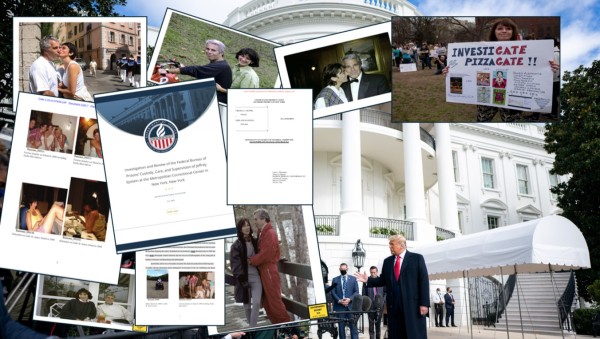
MAGA trust in Trump on this issue was not primarily about sexual abuse, but about uncovering the inner workings, the nuts and bolts, of the so-called “Deep State,” a recurrent theme in MAGA parlance, which went as far as to talk about Pizzagate. This “scandal” of sorts claimed that pizza joints in the Washington, D.C. area were used to abuse minors by top figures of the Clinton and Obama administrations.
And even if the 2016 Pizzagate has been largely debunked, it tapped into a long history of similar conspiracy theories and moral panics about child abuse by hidden elites. Many of those scandals, in the pre-Internet era, had real-world consequences in Europe well before 2016, going back all the way to the 1980s, when the “Satanic Ritual Abuse (SRA) moral panic” swept Western Europe.
That it was not about Trump's record can be seen in the fact that he was found guilty of attacking E. Jean Carroll and in his own bragging about molesting females in the so-called Access Hollywood Tape. Despite that, he and his team repeatedly claimed he would ‘go deep’ into the Epstein case, raising expectations on the issue.
The tale of the tape
There are potential political consequences for Trump, even if there is still little more than a year before the U. S. midterms. Putting that issue aside, Trump’s decision to kill the plan to release the Epstein files has turned into a major kerfuffle.
To fully grasp the scope of this fallout, we turn to the hard data: the tale of the tape. And unlike other topics, where he seems to have a firm grip on his base, now there is evidence about damage to his popularity. Back on Tuesday, July 15, CNN released data of a poll conducted for them by SSRS between July 10-13.
There one can find that 50 percent of U.S. adults, regardless of the political preference, are dissatisfied with the way the Trump administration has handled, so far, the issue. The full SRSS poll is available here.
Unlike polling on other issues where most of the dissatisfaction follows party preference, in this issue, 43 percent of those adults self-identified as Republicans say they are dissatisfied, and the share for Democrats balloons to 60 percent, with only four and three percent, respectively, calling themselves satisfied with how the Epstein files are handled by Trump.
This is even more damaging as Congressional Democrats have been putting pressure on their Republican colleagues in the majority to address the issue. Some Republicans seem to be already concerned about their political future, as late on Thursday, July 17, news about a drive to force the White House to act on this issue emerged. This happened little over 24 hours after the Department of Justice decision to fire Maurene Comey, with no reason provided.
She is the daughter of former FBI director James Comey, but more significantly, she was up until that day the federal prosecutor in New York, and as such, she dealt at some point in her career with the Epstein case. Maurene Comey was, as far as NBC News was concerned, the “preeminent sex-trafficking prosecutor in the United States.” Firing her without any explanation further complicates the handling of the Epstein case.
Gaslighting atmosphere
Overall, we are witnessing the many failures of the systems of justice, even in countries following the more flexible Common Law tradition, such as the U.S. or the U.K., which continue to hurt victims and their families, thereby nurturing a gaslighting atmosphere.
As such, it reinforces patterns turning sexual abuse victims into pawns of complex power dynamics while their actual needs remain unaddressed, forcing them into the kind of dark places that often lead to suicide and other forms of self-harm.
The most recent of such cases happened less than three months ago. Back on April 25, several news outlets reported Virginia Giuffre’s suicide. She gained notoriety because on top of accusing Epstein, she provided details of the way the New York-based financier wove intricate complicities with members of the world elites, including Prince Andrew, brother of King Charles III.
Up until now, the sole “penalty” on Andrew Windsor for being part of what seems to be a wide network of powerful sex predators was to be forced into some kind of private life, and a private settlement with Giuffre back in 2022.
Even there the parallels, the similarities with the clergy sexual abuse crisis in the Catholic, other Christian churches and other religious organizations are way too many to be dismissed as anecdotal or the outcome of random forces at play.
There lies one of the main problems the Catholic Church faces when dealing with these issues. Mostly because some of its top leaders, Cardinals, bishops, and laypersons with some influence or reach, love to naturalize sexual abuse. There is a drive to turn it into an issue inherent to human interaction as such, and not to some aspects of how sacred texts of different traditions are interpreted.
In the rare occasions when sexual abuse was actually addressed in Latin American Catholic groups back in the 1990s and 2000s, the predominant idea, often rendered as a suggestion of sorts by the bishops was to never talk loudly about the issue, as the Church’s prestige would be affected. More importantly, the explanation was almost always either an unwanted but ultimately unavoidable byproduct of the celibacy rule or the outcome of the very existence of gay people.
In both cases, the then preferred, but rather private “explanations,” were easy get-out-of-jail cards. Bishops would ask Catholic faithful to be “charitable” with either lone priests, longing for the kind of life families theoretically have or, alternatively, to see them as victims of an assault on the Church from “the gays,” often described—up until today in far-right Catholic circles—as forming a “pink” or “lavender” mafia of sorts.
Those ideas, by the way, came to the fore only in very private conversations, with the selected few, perceived as loyal enough by the bishops. Publicly, the “line” was full, absolute, recalcitrant denial of any issue at all. It was always a matter of keeping the “bad dudes,” i.e., the communists, the leftists, “others” from damaging an otherwise watchful leadership committed to protect its flock.
Blame the gay, really?
That was Benedict XVI’s 2005 solution: expel the gay people from the seminaries. Two decades later, graduates of that model, however, show similar problems to those educated under “liberal” standards, the allegedly pervasive influence of Second Vatican Council, the misguided few loyal to Paul VI and his legacy.
Here at Los Angeles Press we have provided at least one example of young priests who followed the Ratzingerian seminary curriculum, with strong anti-gay and masculinity affirmation undertones, to no avail. It was the case of Brazilian priest Paulo Araújo, whose story is linked after this paragraph.
However, despite those reforms, there are still new cases of relatively young new priests, attacking underaged males.
Back in 2021, Los Angeles Press published about two cases from two different dioceses. The first one involves the Archdiocese of Mexico City, and a Spanish-language story is available here.
The other case involves the diocese of Izcalli, in the State of Mexico, near Mexico City, and the archdiocese of Acapulco. That story is available here, but only in Spanish.
Ratzinger’s ideas, heavily influenced by French priest Tony Anatrella’s “scholarship” were already misguided, as the John Jay Report, back in the first decade of this century, was providing evidence of how abuse was more prevalent among the U.S. priests cohorts ordained before Paul VI’s reforms.
However, sexual abuse is not restricted to clergy of religious organizations requesting total or some degree of celibacy (Catholics, some Buddhist traditions). It happens in the Anglican Church, even with lay leaders, not to mention Bev Mason, a female Anglican bishop who came forward talking about assault from male clergy. It happens also in the Southern Baptist Convention, or in the Latter-day Saint Church, in the United States, and in Canada.
In that regard, looking at Epstein’s and many other cases of sexual abuse in other-than-Catholic settings, it is necessary to acknowledge what many of the most entrenched foes of gender studies, Catholic or not, reject.
They have come to actively reject as “gender ideology,” the notion that power structures and more specifically, power structures legitimized by certain notions of the expected roles of gender are a key component of sexual abuse. They do so, despite the fact that the issue is not restricted to religious settings.
The insistence by the most radical conservative wings of the Catholic Church on the blame-the-gay riff is discredited by cases such as Epstein. Despite the many victims that have come forward so far, there is not one male who claims to be a victim of Epstein. All are female, so no way to blame-the-gay there.
In that regard, a key lesson the Catholic Church should distill from the Epstein case is that, despite Ratzinger’s/Benedict XVI’s claim of doctrinal orthodoxy, his understanding of the dynamics behind sexual abuse was—to put it bluntly—clueless, as a recent installment from this series, linked after this paragraph, proved.
Nurturing the beast
In that same light, acknowledging that this piece has not delved into the depths of the Epstein case, it aims to highlight, as one of many possible examples, the dismissive, irresponsible attitude of top law enforcement officers in the states of Florida and New York and the U.S. federal government at large.
In the case of Florida, there was evidence, as concrete as possible, of how dangerous Epstein was. Despite that evidence, law enforcement there allowed him a special status. Although “convicted,” he enjoyed almost unrestricted freedom to literally do as he pleased, even engaging in the sexual trafficking of minors.
The key example comes from his 2008 plea deal. Alexander Acosta, the federal prosecutor in Florida, allowed Epstein to plead guilty to state prostitution charges. In doing so, the case rendered the lightest possible “sentence”: 13 months (or 18 months in some reports) in a county jail.
Acosta had conducted a federal investigation, and, in June 2007, an FBI investigation resulted in a 53-page federal indictment outlining federal sex trafficking charges against Epstein.
Instead of pursuing federal charges, Acosta's office negotiated the highly controversial Non-Prosecution Agreement (NPA). This agreement allowed Epstein to plead guilty to two state charges of prostitution (soliciting prostitution and procurement of minors to engage in prostitution) in Florida, effectively avoiding federal prosecution.
The NPA also controversially granted immunity from federal charges to four named co-conspirators and any unnamed “potential co-conspirators,” which is one of the many drivers of the conspiracy theories around the Epstein files, the so-called Pizzagate, and other associated conspiracy narratives.
Acosta's decision to solve the case through a state plea deal coupled with a federal NPA was perhaps standard procedure to avoid the drag of a federal trial. However, it backfired, as the decision was later heavily scrutinized and criticized, with a federal judge ruling in 2019 that the deal violated the Crime Victims' Rights Act because victims were not notified.
If that was not enough mockery of the law, Epstein was granted “work release privileges” for up to 12 hours a day, six days a week. He served this time in a private wing of the jail. The “work release” status essentially granted him unrestricted freedom during most of his waking hours.
Andean beasts
One finds in Epstein’s “penalty” aromas of the kind of “punishments” Fernando Karadima and many other sexual predators got from the Catholic Church. More importantly, one can find there, in Alexander Acosta’s prosecution, going for the easy slam dunk of the state charges adorned with the NPA, the roots of the “Deep State” narrative.
He got the easy conviction at the expense of vulnerable victims. In doing so, perhaps unwillingly, he nurtured the beast of the “Deep State” narrative.
Mutatis mutandis, the Vatican itself acknowledged back in April, one week before Pope Francis’s death that since it was impossible to prosecute the Sodalitium cases in Peru, they would do it in U.S. courts.
In Peru with its adherence to the Roman and French traditions of highly codified written law, the antipodes of the more flexible Common Law, it is far easier to find hints and flavors of the kind of elite behavior nurturing the “Deep State” narrative.
However, in that regard, the “Deep State” MAGA narrative misses a crucial point: ultimately, despite all its possible failures, Epstein included, the U.S. was, at least up until January of this year, the best place possible to pursue a measure of justice, even if partial, for victims of sexual abuse.
The narrative is also flawed as it assumed that Donald Trump was exempt from the kind of commitments with the “Deep State” any politician would have, when it is clear that he is a politician. Sadly, the most loyal in MAGA still perceive him as some kind of Herculean figure, able to overcome his many contradictions and even potentially his own role in the “Epstein files”, which has been one of Elon Musk’s contentions over the last couple of months.
Such ideas were confirmed by The Wall Street Journal which published (behind a paywall), on July 17 details about the things Epstein and Trump shared, as far as bad behavior was concerned, back in 2003.
In this light, the unfolding Epstein snafu and the public's visceral reaction to perceived cover-ups, serve as a stark and urgent reminder to the Catholic Church and other religious organizations about the limits of their grip over their flocks.
It underscores that trust, once shattered, cannot be easily rebuilt. Less so when there are repeated attempts at prioritizing institutional prestige over the wellbeing of survivors. The Church's challenge, much like that now facing political figures, is to move beyond self-serving narratives and confront the systemic abuse that enables such crimes, for only then can it begin healing.
This lesson is particularly critical given the Catholic Church's increasingly visible, and at times dangerous, flirtation with the global far-right. The very narratives propagated by figures like Andrew and Tristan Tate, championed by elements within the MAGA movement and even embraced by some self-professed Catholic political leaders such as J.D. Vance.
Frequently, it is possible to find in said narratives echoes of the tendencies in the Catholic Church and other religious institutions to “naturalize” abuse, dismiss human rights advancements as “effeminate,” or “woke,” and also to demonize “others,” be they LGBTQ+ individuals or perceived ideological foes.
One just needs to look at the history of race or polygamy in the Latter-Days Saints to find examples of that kind of tendencies to naturalize different forms of abuse from religious institutions other than the Catholic Church. Suffice to remember that African American males were barred from LDS priesthood until 1978.
The Epstein scandal also offers a stark warning for the Catholic Church and other religious institutions of the limits of patience with claims about ending abuse. And even more so, as frequently, religious leaders gaslight and even attack the survivors and their families, labeling them as their enemies.
It is hard to bet on the actual outcome of the Epstein scandal at this point. However, what Pope Francis said back in 2023 to the then members of Tutela Minorum, the commission to prevent sexual abuse in the Catholic Church, about the so-called “Spirituality of reparation” should remain meaningful for that Church.
He offered then the priorities for his Church and a critique of the attacks on survivors and their relatives, leading, in the most extreme cases to suicide.
Betting on the survivors’ and their relatives’ inability to organize and challenge them, more so in countries such as Mexico, Peru, and many others in Latin America with low stocks of social capital amounts to place a bet on a losing pony. One that will come back to bite them.
The Sound of Freedom?
And the same happens when Catholic Cardinals and bishops lend credibility to a movement that simultaneously rails against alleged “Deep State” pedophilia narratives, as the Latin American bishops did when endorsing Verástegui’s Sound of Freedom, while overlooking real accusations against their own priests, risks both their moral authority and commitment to zero-tolerance.
It makes a mockery of their alleged commitment with justice, as they deny such value for actual victims, while praising the plight of fictional victims straight out of a Mexican telenovela script, barely legitimized by the production standards of a Hollywood movie.
That aspect of the Catholic Church’s public performance on issues of abuse is more troubling when one looks at the Church’s own record on sexual abuse, and more so now, with a rebellion of sorts among U.S. Catholic clergy, angry at bishops setting restrictions on their ministry for accusations of some impropriety, as this story from National Catholic Reporter tells.
This is more relevant as the liturgy of a weeping Pontiff, lamenting abuses while offering no actual punishment to the predators and no actual relief to the victims, stresses a deep cognitive dissonance.
And the dissonance runs deeper as there is far less interest outside the U.S. among Catholic bishops to set such restrictions on priests facing accusations ranging from sexual impropriety to full-scale sexual abuse.
There lies a profound contradiction, a paradox of sorts, undermining alleged efforts toward zero-tolerance, and accountability while perpetuating the environment where abuse thrives, protected by silence and misdirection. As the Epstein case proves, the public is increasingly unwilling to tolerate institutional stonewalling, regardless of who perpetrates it.
The risk for the Catholic Church runs deeper when it endorses political factions that traffic in conspiracy theories while undermining judicial processes seeking reparation for the survivors of clergy sexual abuse. To do so damages its internal reform efforts and stresses its own contradictions.
That is the risky bet behind Eduardo Verástegui’s wish to build an identity-based Catholic political party in Mexico. Similar risks exist in the performance of factions of the Catholic Church closer to Javier Milei’s ruling coalition in Argentina.
And the same risk emerged in the August 2024 attacks on Robert Prevost as bishop of Chiclayo, Peru. Before he was elected Pope, he endured such attacks when he was the prefect of the Dicastery of the Bishops, as he was perceived as a proxy to attack Pope Francis, as the story linked after this paragraph proves.
Acting that way forces the Catholic Church to treat its own victims as pawns of their intrachurch conflicts, while turning that religious organization itself into a larger pawn in political games.
Instead of the bishops being so while performing their duties to protect the vulnerable and ensure genuine spiritual and physical safety for their flock, they are pawned when seeking political favor to protect predatory clergymen.
A path to redemption for the Catholic Church lies not in political alliances of convenience, the endless pursuit of the next Constantine, that is to say, the next wedding of Church and State, as told by the legend of the Roman emperor who embraced Christianity only because it helped him seize political power.
It lies in a commitment to truth, justice, to actual, enforceable zero-tolerance to abuse, and the acknowledgment of the profound dignity of every victim.