
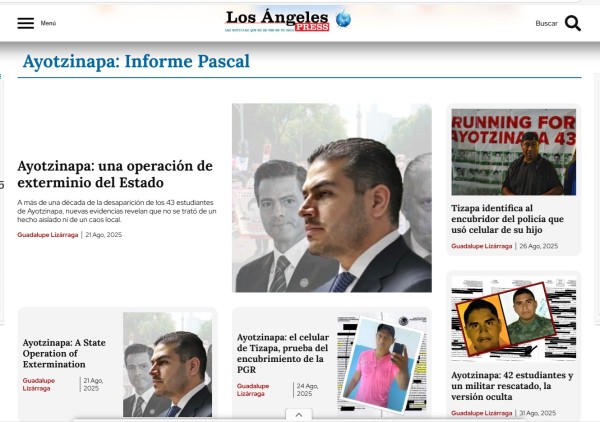
The Pascal Report is an independent investigation, free from official funding, that questions the accounts of the FGR, CNDH, and GIEI.
By Guadalupe Parral
On September 26, it will mark eleven years since the disappearance of 42 students and an undercover soldier from the “Raúl Isidro Burgos” Rural Normal School in Ayotzinapa, Guerrero.
This historic event has led to more than a decade of conflicting official versions and leaks, often far from the truth, according to the Pascal Report, delivered exclusively to Los Ángeles Press.
The Pascal Report is the result of an independent investigation into the Ayotzinapa case conducted by a citizen-led intelligence group composed of professionals and activists, with no institutional backing or government funding. Based on open-source information, their investigation meticulously reconstructed the state operation that led to the disappearance of 42 teacher-training students and, later, the undercover soldier at the Rural Normal School.
Spanning over 1,200 pages, the report focuses on two main aspects: the cover-up of evidence and accountability, and the police and military chain of command that orchestrated the operation.
The research team highlights the omissions in the investigation carried out by the Interdisciplinary Group of Independent Experts (GIEI), as well as by the National Human Rights Commission (CNDH) and the Attorney General’s Office (FGR).
Methodology
Operating under the pseudonym Pascal Bourne, the investigators have maintained complete anonymity, while providing a thorough review that contradicts both institutional and media narratives.
This group meticulously reviewed every file and video, as well as expert reports and testimonies from open sources. Their methodology involved contrasting the official narrative and the conclusions of previous reports with the documentary evidence available online.
Among the findings highlighted in the first sections of the Pascal Report are the hidden videos from the Palace of Justice and the clandestine SEIDO operation in Iguala, Guerrero, which began on September 29, 2014—three days after the disappearances. The report also presents evidence that Omar García Harfuch, Mexico’s current Secretary of Security and Citizen Protection, who at the time served as the state coordinator of the Federal Police in Guerrero, led command meetings in Acapulco following directives from then-President Enrique Peña Nieto and Defense Secretary Salvador Cienfuegos to ambush the students.
The report sharply contrasts with what the GIEI presented. It points out omissions and identifies operational actors, including García Harfuch and José Rodríguez Pérez, commander of the 27th Infantry Battalion, as well as a military intelligence structure that monitored, infiltrated, and directed the movement of the teacher-training students.
Focus
The Pascal Report does not seek to replace official investigations but aims to reveal what they concealed. Its central contribution is to provide verifiable evidence showing that the disappearance of the Ayotzinapa students resulted from a state operation, not an isolated crime.
The document exposes how federal and state authorities manipulated case files, hid key videos, and rewrote testimonies to cover up the involvement of police, military personnel, and high-ranking officials.
Through this work, the independent group behind the Pascal Report opens a new path toward memory and truth, offering victims, society, and history a well-documented account free from political interests.
---
Parral reported from Mexico City. Los Ángeles Press journalist Guadalupe Lizárraga, in Southern California, contributed to this dispatch.