Guadalupe Lizárraga Jueves, 21 de Agosto del 2025, 01:15
The Pascal Report, produced by an independent intelligence group, delivers a thorough investigation and meticulously reconstructs—with evidence—the state-led operation that resulted in the disappearance of the 43 Ayotzinapa students.
By Guadalupe Lizárraga
PART ONE
The Hidden Videos from the Palace of Justice and SEIDO’s Clandestine Operation
When it comes to the Ayotzinapa case, it seems as if everything is already known. On the night of September 26, 2014, 43 students from the Isidro Burgos Rural Teachers’ College were disappeared in Iguala, Guerrero, and ever since, the country has been flooded with official accounts, reports, and leaks. Yet, an unpublished document—identified as the Pascal Report—shows that what happened was not local chaos, but rather a meticulously planned and concealed state operation.
Even the general public is familiar with the video from the Iguala Palace of Justice, allegedly destroyed—a case for which former president of the Guerrero Superior Court, Lambertina Galeana Marín, was arrested just months ago. But what very few know is that, three days after the disappearance, a clandestine operation began in Iguala, led by the Special Prosecutor’s Office for Organized Crime Investigation (SEIDO).
The operation unfolded on September 29, 2014, with the arrival of a special unit headed by federal prosecutor Ernesto Óscar Francisco Ornelas Delgado, accompanied by forensic experts in computer science and other technical fields. The prosecutor stormed the Palace of Justice in Iguala to extract directly from the server the first copy of the videos recorded on the night of September 26 and the early hours of September 27. According to official documents, that copy was followed by four more, made on October 6, covering a broader period of footage.
These actions were never incorporated into the judicial case file, because they were part of a parallel operation, off the legal record, whose purpose was to seize and conceal key evidence of the crime. Yet the maneuver was nonetheless documented in folios 0045 to 0068, in volume 123, of the digital archives of the Attorney General’s Office (FGR).

According to forensic IT reports 2083/2015 and 2038/2015—both identical—five copies of the Iguala Palace of Justice videos were confirmed: one on September 29 and four more on October 6, 2014. The latter were made through remote network connections to extract the recordings from cameras numbered 12 to 18, corresponding to September 26 and 27, 2014. These actions took place before the material was officially incorporated into the investigation, demonstrating a break in the chain of custody and clear manipulation of evidence.
During this process, the presiding magistrate of the Regional Court in Iguala was forced to hand over the video material to his superior, Lambertina Galeana, then president of the Guerrero Superior Court of Justice. From that order, the extraction route was opened: the material was delivered to SEIDO through prosecutor Ornelas Delgado, who in 2020 attempted to file for an injunction that was rejected by a federal court.
Two judicial technicians also took part in the extraction: Javier Uribe Iturbe, a programmer at the Superior Court, and Luis Europa Solís Jiménez, a systems specialist. They carried out the physical and digital delivery of the files, confirming that the order came from the Court’s presidency and that the execution was carried out with the collaboration of IT personnel.
Lambertina Galeana was arrested on May 14, 2025, accused of destroying the security camera videos from the Palace of Justice. Those recordings captured the exact moment when a bus carrying the students passed in front of the building—just before it was intercepted.
The official version described the footage as “blurry” or “useless.” Even the officials responsible for the CCTV system, Solís Jiménez and Uribe Iturbe, lied by claiming that the material’s quality made it impossible to identify people or vehicles. In reality, the images were clear, and copies were sent to the highest levels of government.
According to this reconstruction, Ornelas received the recordings that documented the attacks on the students but withheld the full video captured by the Palace of Justice cameras on September 26, 2014. According to the Interdisciplinary Group of Independent Experts (GIEI), Ornelas Delgado’s intervention coincided with a crucial moment in the timeline of the attacks: at 9:34:29 p.m. on September 26, precisely when the Estrella de Oro 1531 bus was stopped under the Chipote bridge, SEIDO marked that instant as the starting point for the copied footage from the Palace of Justice, extending it until 2:00 a.m. the following day.
The Pascal Report states:
"The Estrella de Oro 1531 bus never headed toward the South Periférico, as speculated by the GIEI. That never happened.
If we take into account that the Estrella de Oro 1531 bus left the terminal at 9:15 p.m. and then add, first, the 5 or 6 minutes mentioned by police officer Emilio Torres Quezada, then the 10 minutes he later referred to, and finally the 15 minutes he mentioned at the end of his statement, this allows us to establish that at 9:34:29 p.m. the Estrella de Oro 1531 bus was stopped exactly beneath the Chipote Bridge by the Iguala Municipal Police.Our investigative team is absolutely certain that this bus was stopped under the Chipote Bridge at 9:34:29 p.m."
Image Translation:
"Because on September 29, 2014, at 15:03:37 hours (64 hours after the students had been disappeared), Federal Prosecutor Ernesto Óscar Francisco Ornelas Delgado and four forensic IT experts from SEIDO accessed the computer system of the CCTV at the Palace of Justice in Iguala and COPIED the video files (Forensic IT Report 2083/2015, Volume 123, folio 50) covering the period from 21:34:29 hours on September 26 until 02:00:29 hours on September 27, 2014.
In other words, at 15:03:37 on September 29, 2014, SEIDO copied 266 minutes of video footage from this crime scene; videos that were deliberately concealed in the investigation of the Iguala Case and are still in the possession of Ernesto Óscar Francisco Ornelas Delgado and his superiors at SEIDO.
Clandestinely, SEIDO arrived in Iguala on the evening of Sunday, September 28, 2014, and the following day carried out a series of operations to destroy evidence that implicated the Guerrero State Police, the Ministerial Police of Guerrero, the Federal Police, and above all, SEDENA, in the disappearance of the Ayotzinapa students."
The September 29 operation, carried out 56 hours after the students’ disappearance, was clandestine and illegal: neither then–Attorney General Jesús Murillo Karam, nor Tomás Zerón, nor SEIDO itself ever publicly acknowledged that they had already been operating on the ground in Iguala since that date. “Legally, and as documented, it was not until October 25, 2014, at 3:01 p.m., that SEIDO opened the preliminary inquiry AP/PGR/SEIDO/UEIDMS/871/2014 into the Iguala Case,” the report specifies, adding: “What SEIDO did was a flagrant violation of the sovereignty of Guerrero’s Judicial Branch, storming into its premises, examining computer equipment and security cameras, and interrogating judicial staff without a court order—an order that should have been included in the same preliminary inquiry.”
On July 24, 2015, according to Guerrero Superior Court president Robespierre Robles Hurtado, the recordings were officially delivered to SEIDO. By then, however, the material had already been edited and mutilated: the images that clearly showed the bus’s route in front of the Palace of Justice, at the moment it was intercepted, had been erased.
SEIDO withheld key material for more than a year, based on the following sequence:
- The early date of material seizure (09/29/2014).
- The date additional copies were made (10/06/2014).
- The date the preliminary inquiry was opened (10/25/2014).
- The date of formal incorporation into the case file (07/24/2015).
- The fact that what was officially delivered had already been mutilated, confirming that the complete version was never included and that the withheld material contained the most compromising images.
This cover-up is one of the findings concealed for more than a decade to distort the truth about the forced disappearance of the 43 Ayotzinapa students. Its revelation shows that the so-called historic truth was never incomplete for lack of evidence, but was deliberately mutilated by the very institutions charged with uncovering it.
GIEI’s Gaps: Silences That Weigh Heavily
The five reports of the Interdisciplinary Group of Independent Experts (GIEI), presented between 2015 and 2023, dismantled official myths and documented proof of a state crime. They revealed military surveillance of the students, exposed the destruction of documents by SEDENA, and debunked the “historic truth.” Yet they left crucial gaps: as demonstrated here, the break in the chain of custody and manipulation of key evidence such as the Palace of Justice videos. They also remained silent on the operational meeting in Acapulco convened by Omar García Harfuch, the tactical role of the Federal Police and the Army in ambushing the students, and the manipulation of information at the Epifanio Rodríguez bus terminal.
These silences are far from minor: they show that, even with the GIEI’s critical work, key pieces of the puzzle were left outside the public narrative.
It is into this silence that the Pascal Report emerges, delivered exclusively to Los Ángeles Press, as an inconvenient document. It not only names the commanders involved and describes the logistics of the operation—including the revelation of the manipulated videos—but also traces a chain of command that reaches the highest authorities: then-President Enrique Peña Nieto and Defense Secretary Salvador Cienfuegos.
Signed under the pseudonym Pascal Borne, the report—its first installment consisting of 97 pages, which according to its authors represents 10 percent of the full investigation—contrasts what the GIEI presented with what it chose not to address. But the report goes beyond pointing out omissions: it identifies the operational actors, among them Omar García Harfuch, state coordinator of the Federal Police, and José Rodríguez Pérez, commander of the 27th Infantry Battalion, as well as a military intelligence structure that monitored, infiltrated, and directed the students’ movements.
The Pascal Report: A Citizen Intelligence Think Tank
The Pascal Report is the result of the work of an independent citizen intelligence group, made up of professionals and activists without institutional backing or government funding. This group rigorously reviewed every file, every video, forensic analysis, and testimony from open sources with absolute discretion. Their methodology was to contrast the official narrative, media accounts—including those presented as critical voices, such as Anabel Hernández—and the conclusions of the GIEI, against the documentary evidence available online.
The Acapulco Meeting: The Beginning of the Operation
Following the documentary evidence of September 26, 2014, the Pascal Report establishes that at 9:00 a.m. a meeting was held at the Base Vértice in Acapulco, convened by Omar García Harfuch, then the state coordinator of the Federal Police. Only commanders of the federal corporation participated in this meeting, without the presence of the Attorney General’s Office (PGR), SEDENA, the State Police, or the Ministerial Police. It was there that the orders were issued to reorganize the buses and set the trap for the students in Iguala.
The CNDH Recommendation VG/015/2018 confirms this meeting and makes clear that García Harfuch was present. Official documents such as information card no. 1358/2014, signed by Luis Antonio Dorantes Macías, head of the Iguala Station, and addressed to Commissioner General Antonio Garza García, not only mention his participation but explicitly recognize him as the authority who issued direct operational orders. This document disproves his public version, in which he claimed to have been commissioned in Michoacán that day.

Image Translation:
"On the morning of September 26, 2014, the top commanders of the Federal Police in Guerrero were urgently summoned by Commissioner Omar Hamid García Harfuch to the Base Vértice of the Federal Police in Acapulco, as documented in CNDH Recommendation VG 015/2018, Folio 700:
"Particularly noteworthy is the third information card, no. 1358/2014, issued on September 26, 2014, signed by Luis Antonio Dorantes Macías, head of the 'Iguala Station,' which was addressed to Commissioner General Antonio Garza García, head of the Regional Security Division of the Federal Police, and which reads: ‘On that day I complied with the urgent summons made by Commissioner Omar Hamid García Harfuch, State Coordinator in Guerrero of the Federal Police, presided over by Inspector General, Operational Supervisor of the Coordination (of the Federal Police Security Division), which took place at the Base Vértice in Acapulco, Gro.…’"
From the content of this information card, several revealing aspects stand out. First, there is no doubt: the person convening the meeting was Commissioner Omar Hamid García Harfuch. Second, at no point is it indicated that García Harfuch was absent from Guerrero that day. Third, perhaps most importantly, the meeting held on September 26, 2014, took place in Acapulco, Guerrero, which makes it clear that Commissioner Omar Hamid García Harfuch was indeed in Guerrero. And finally, in the same information card, signed by Sub-inspector Luis Antonio Dorantes Macías, García Harfuch is identified once again as “State Coordinator in Guerrero of the Federal Police.”
The evidence provided by the CNDH disproves the version of Commissioner Omar Hamid García Harfuch, who has claimed that on September 26, 2014, he was commissioned by himself in the state of Michoacán. For this reason, the FGR must summon to testify all Federal Police commanders who attended the meeting convened by Commissioner Omar Hamid García Harfuch and obtain his georeferencing for September 26 and 27, 2014.
The operation, however, was not defined solely at the Base Vértice. Hours later, on that same September 26, a second and much larger meeting took place: an emergency session of the Guerrero State Security Cabinet, held at the C4 in Acapulco. Representatives from all three levels of government attended: SEDENA, the Ministerial Police, the State Public Security Secretariat, and the Federal Police. According to testimonies cited in the Pascal Report, the only item on the agenda was categorical: “to put an end once and for all to the Ayotzinapa students.”
What the GIEI said (p. 30, folio 28):
"According to the testimonies of the students traveling on the two Estrella de Oro buses, Federal Police patrols were present at the two collection points, aware of their activities and attempting to prevent the commandeering of buses. Official C-4 reports and statements from state agents before the PGJ also acknowledge this monitoring of the students’ activities. At 5:59 p.m., the State Police Control Center, or C-4 in Chilpancingo, reported by phone to the State Police based in Iguala that two Estrella de Oro buses carrying students from the Ayotzinapa Rural Teachers’ College had departed for Iguala, and they were monitored by the C-4 in Iguala."
What the Pascal Report reveals (p. 27):
"Observation: THE GIEI IS LYING. The GIEI omits that, on the afternoon of September 26, 2014, there was an urgent meeting of the entire Guerrero Security Cabinet at the C4 in Acapulco. Present were the director of the Ministerial Police, Admiral Alejandro Salomón Belmar; the director of State Public Security, Lieutenant and lawyer Leonardo Octavio Vázquez Pérez; and Commissioner Omar Hamid García Harfuch, state coordinator of the Federal Police in Guerrero."
The following document is an excerpt from the testimony of Lieutenant Vázquez Pérez.
The Pascal Report thus reveals the coordination of civilian and military commanders from Acapulco to Iguala on the night of September 26, 2014. At nine in the morning, Harfuch led the first meeting at the Base Vértice, restricted only to the Federal Police. Hours later, at seven in the evening, a second meeting at the C4 or at the IX Military Region already included SEDENA, the State Police, and the Ministerial Police, with one explicit objective: “the Ayotzinapa students.” Meanwhile, at eleven o’clock that night, testimonies converge on the arrival of ministerial convoys in Iguala and the presence of senior commanders at the Regional Prosecutor’s Office. The Tomatal checkpoint witnessed the passage of these caravans—first the Ministerial Police and the GERI Group, and later, close to midnight, the entourage led by Prosecutor Iñaki Blanco. The sequence, supported by multiple testimonies, shows how the decisions made in Acapulco translated into a rapid operational deployment in Iguala that same night.
The following chronology, prepared by Los Ángeles Press, reconstructs the movements of then–Guerrero Secretary of Public Security Leonardo Octavio Vázquez Pérez, based on his own ministerial statement. His testimony about the night of September 26 precisely traces how, from the first alert call around ten p.m., a chain of orders and transfers was activated that took him from Chilpancingo to Iguala. Between roadblocks, ambulances being mobilized, and his arrival at the Regional Prosecutor’s Office, his account offers a window into the first official reactions to the attacks against the Ayotzinapa students.
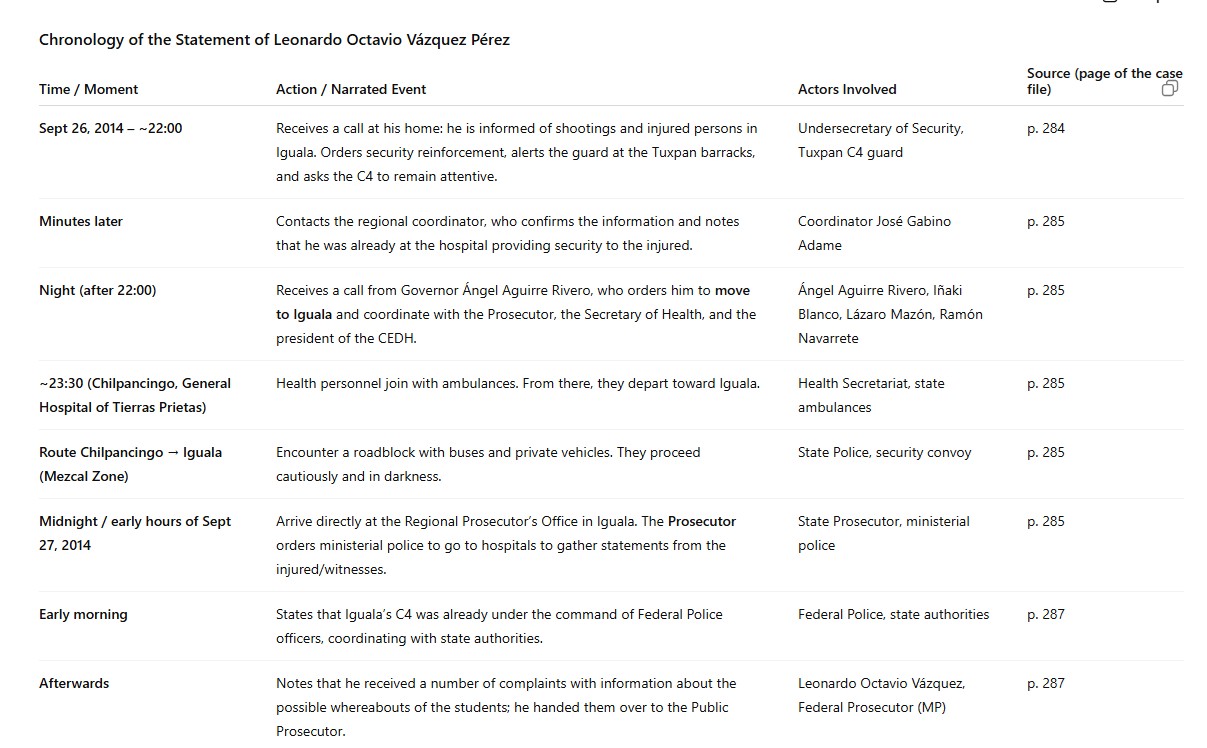
The testimony of Vázquez Pérez, on the one hand, outlines the sequence of orders and movements that night in Iguala, but it also reveals the gaps and contradictions in the institutional response. While he insists that he received reports pointing to the whereabouts of the students, which he says were handed over to the Public Prosecutor, his statement avoids clarifying what follow-up was given to that information.
In an interview with Los Ángeles Press, one member of the Pascal Borne group emphasized the need to pinpoint the geolocation of Omar García Harfuch on September 26, 2014, through his two official cell phones as well as the armored vehicle equipped with GPS in which he traveled with his driver. “The calls with georeferencing will disprove what he has said—that he was in Michoacán, when in fact he was in Acapulco. That is why his phone geolocation, his credit card spending, and his travel expenses submitted to the institution he worked for are crucial.”
The Pascal Report highlights the GIEI’s silence regarding the crucial meetings in Acapulco attended by Harfuch and argues that the attack in Iguala was not an isolated event, but a coordinated operation planned at the highest levels of the security apparatus. It also politically links the commissioner to the Ministry of Defense, noting that his rise in public security was part of a military strategy of political control and even of anticipation of scenarios of insurrection or a coup d’état.
In other words, while the official narrative reduced the events to a local operation, the Pascal Report demonstrates that it was in Acapulco where the state decision was made that led to the disappearance of the 43 students.

Key Findings of the First Installment
The first part of this investigation demonstrates that the disappearance of the 43 Ayotzinapa students was not the result of local chaos but, according to the analyzed evidence, constitutes a state operation of extermination.
From the morning of September 26, 2014, at the Base Vértice in Acapulco, precise orders were issued to surround and ambush the students. Three days later, SEIDO carried out a clandestine operation to mutilate the videos that revealed the real route of the buses. The presence of military commanders, the infiltration of soldier Julio César López Patolzin into the school, and the chain of command that reached Los Pinos and the Ministry of Defense were all part of this strategy.
The Pascal Report identifies that this strategy had the political backing of then-President Enrique Peña Nieto and Defense Secretary Salvador Cienfuegos, who validated the operation from the beginning and covered up its concealment afterward. Official documents such as information card 1358/2014 also prove that Omar García Harfuch issued direct operational orders from Acapulco, showing that his role in the case was not marginal but central—and that his political career rests on the impunity of Ayotzinapa.
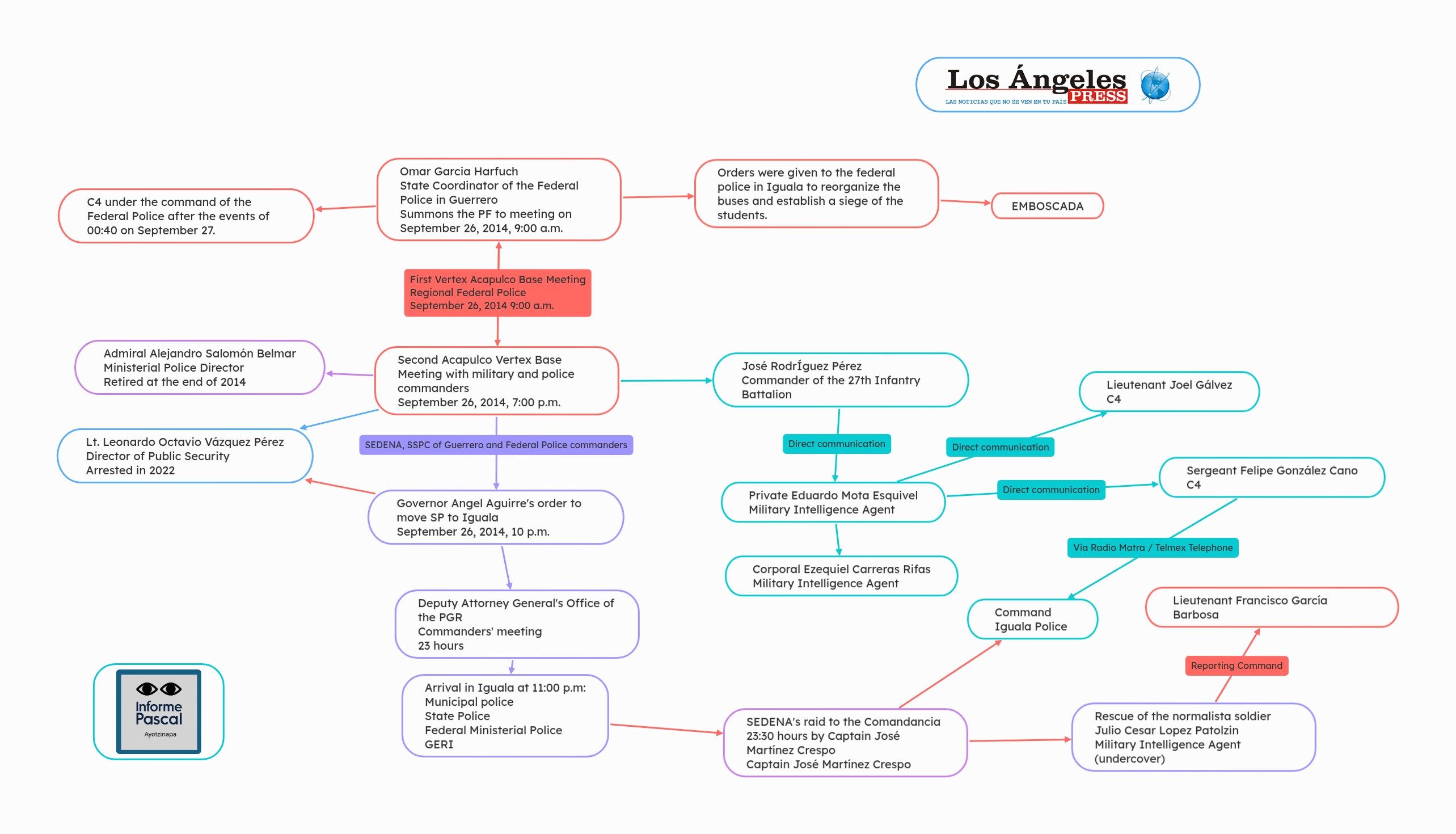 Map of actors and circumstances involved in the Ayotzinapa case on September 26, 2014. Compiled by Guadalupe Lizárraga