
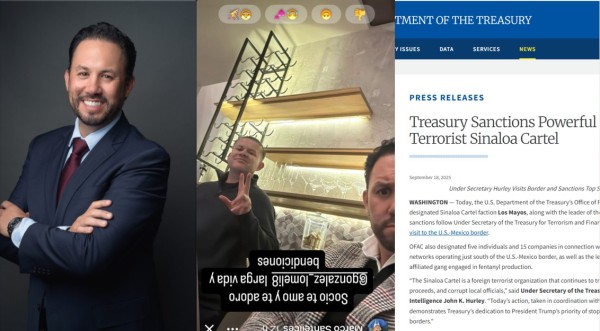
Guadalupe Lizárraga Lunes, 22 de Septiembre del 2025
Million-dollar contracts, entertainment, and real estate are part of the network Marco Santelices runs with operators of both the Sinaloa Cartel and the CJNG in Baja California.
By Guadalupe Lizárraga
SAN DIEGO / Rosarito, Baja California — Marco Antonio Moreno Gómez Santelices has emerged as a strategic player on Mexico’s northwest border, operating in the shadows of two criminal groups that the United States has designated as terrorist organizations. An entrepreneur in entertainment, real estate, and security technology, he also appears on the Baja California State Prosecutor’s Office’s institutional publicity list as a reporter with access to confidential information. In the first quarter of 2025, he secured contracts worth 3.7 million pesos from that same institution.
Moreno Gómez Santelices has become a hinge of power in the state: through his actions and documented ties, he connects operators of the Sinaloa Cartel (CDS) and the Jalisco New Generation Cartel (CJNG)—two rivals who, despite open confrontation, replicate the same corporate structures to move capital and extend their influence.
That double role—businessman and reporter, state contractor and entertainment promoter—makes Marco Antonio Moreno Gómez Santelices the key entry point into the circle of Fernando Rafael Salgado Chávez, an entrepreneur who has built a network of real estate developments and property ventures stretching from Ensenada to Rosarito, Baja California.
As of Grupo LAGSA and its Chardonnay development, Salgado follows a consistent pattern: luxury projects, aspirational marketing, and cross-border ties that extend into San Diego and Florida through the network of LLCs connected to the Fimbres network.
The CJNG Vector: Salgado’s Real Estate Network
From Ensenada, Fernando Rafael Salgado Chávez has built a network of real estate and marketing ventures that represent one side of a growing development axis. Despite having no ties to Grupo LAGSA, Salgado has been mistakenly associated with the company and its high-profile developments—such as Chardonnay, San Marino, Mar de Calafia, Mar de Popotla, and Baja Blue—all of which are solely operated by LAGSA from its offices at kilometer 19.5 on the Tijuana–Ensenada free highway. This misperception has, in part, helped bolster Salgado’s public image among local and cross-border audiences.
A similar case of mistaken association involves the “Chardonnay Masters Tournament,” a golf event organized by LAGSA in Bajamar. Though Salgado has no connection to the tournament or the Chardonnay brand, his name has surfaced in third-party reports—and even in some media coverage—wrongly linking him to the event. These erroneous associations have inadvertently supported a narrative of prestige around Salgado’s ventures, despite lacking any factual basis.
In parallel, the network expands into San Diego, where Salgado partners with Gustavo Fimbres through Fimbres Consulting Group Inc. and has placed capital in LLCs registered in Florida. These companies operate as financial vehicles to channel high-value resources into the U.S. real estate market, many of them tied to politicians, business leaders, and public officials.
The Salgado–Velazco Partnership in Jalisco
The business record of Álvaro Vidal Velazco Castro reveals a network that extends far beyond formal enterprises. In San Diego, California, he appears as the holder of the Pegaso Packing trademark, with offices in Los Angeles, Nogales, Arizona, and Medley, Florida. In Ensenada, his interests diversify into event halls, retail stores under the name Ópera, transportation, furniture rentals, and the Mare plaza, located just a few meters from the state government headquarters.
His partnership with Fernando Rafael Salgado Chávez was formalized in the Public Registry of Commerce of Jalisco through Grupo Xavkar, S.A. de C.V., with a corporate act approving the sale of all shares in their favor. The company operated a car and truck wash and lubrication business. The document recorded: “The sale of all owned shares is approved in favor of Mr. Álvaro Vidal Velazco Castro and Mr. Fernando Rafael Salgado Chávez.” In this partnership, Álvaro Vidal Velazco Castro was designated sole administrator, while Fernando Rafael Salgado Chávez was granted broad powers for litigation and collections.
This network also includes properties such as a luxury condominium in the Entremar tower in El Sauzal, along with family businesses long tied to merchandise trafficking—clothing, shoes of Chinese origin, costume jewelry, and contraband circulated across several Mexican states.
In 2020, the murder of Gil Alberto Velazco Castro, amid the struggle between the Sinaloa Cartel and CJNG for control of Ensenada, exposed the vulnerability of that structure. Nevertheless, the family continued expanding into craft breweries, restaurants, entertainment, and gyms, even after past incidents such as the historic 2008 seizure of 9.3 tons of marijuana at Hacienda San Carlos, on a property linked to the Velazco family.
The Role of Santelices
The position of Marco Antonio Moreno Gómez Santelices is central to this network. His dual role as an entertainment and real estate entrepreneur, combined with his business as a security technology provider, ties him directly to Salgado’s group. The multimillion-peso contracts from the Baja California State Prosecutor’s Office—already reported in a previous installment—reinforce his privileged access to security authorities, allowing him to act as a broker between Salgado and the political-institutional sphere.
Santelices has also promoted projects for the group La Familia Presenta and extended his influence into business organizations such as Coparmex Tijuana and the Tijuana Development Council (CDT). One of his main operational bases is located in the BH building in Tijuana’s Zona Río, from where he coordinates his activities in both the business world and the political arena.
Business Hub building, in Tijuana’s Zona Río, where Santelices maintains a business office.
The Sinaloa Vector: González Lomelí’s Network
On September 18, 2025, the U.S. Department of the Treasury’s Office of Foreign Assets Control (OFAC) added Jesús González Lomelí to its sanctions list as a financial operator for the Los Mayos faction in Rosarito. The designation linked him to a constellation of bars, restaurants, and entertainment companies—El Rey de los Cantaritos, Cavally Antro & Bar, Coco Beach Bar, Sunset Servicios Gastronómicos, and J&R Operadora de Espectáculos—identified as fronts for money laundering. In Washington’s files, he is profiled as a key figure in the Sinaloa Cartel’s flow of capital, responsible for channeling millions of dollars through businesses that appear legitimate.
In Jalisco, González Lomelí is legally represented by Martha Bibiana Martínez Barajas, attorney-in-fact for Gotoco Alimentos Procesados S. de R.L. de C.V., better known as El Rey de los Cantaritos. Her previous career in the State Attorney General’s Office and the National Intelligence Center reveals a bridge between criminal structures and institutional networks—a shield of relationships that guarantees both protection and room for maneuver.
Excerpt from the résumé of the legal representative of Gotoco Alimentos Procesados S. de R.L. de C.V.
Santelices’s ties to members of the Sinaloa Cartel are not limited to his current closeness with Jesús González Lomelí. Beyond that link, he is a business partner of Jorge Enrique Figueroa Barrozo, a former state official who became a contractor for PAN governments through various security and consulting firms.
Figueroa operated under corporate names such as Inteliproof S. de R.L. de C.V., dedicated to selling tactical equipment, armor, and signal jammers. With this company he even signed a contract in Baja California Sur worth more than $555,000 (MXN 10 million) disguised as the purchase of garbage trucks. He also participated in Corporativo TekSeg, which in 2017 obtained contracts in Rosarito and Ensenada for the acquisition of patrol cars and motorcycles, and in Innovatio Consultores, focused on managing government funds.
This is one of TekSeg’s current contracts with the Tecate municipal government.
It was precisely within TekSeg that Santelices appears as a partner, while at the same time receiving from the Tijuana municipal government a contract worth about $414,000 for the pre-screening of municipal police candidates. These records show that, before becoming a key figure in Fernando Salgado’s network, Santelices had already built business alliances with operators tied to the Sinaloa Cartel—confirming a trajectory of connections that positioned him as a hinge between both worlds.
The photograph posted by Santelices himself on Instagram, where he poses with González Lomelí, is a visible sign of that closeness. Both even share the same entertainment circuit in Rosarito and Tijuana. While OFAC documents how González Lomelí’s companies operate as money-laundering vehicles, Santelices presents himself as an organizer of local fairs, such as the Tijuana Fair, working with Fernando Salgado’s La Familia Presenta and benefiting from multimillion-peso contracts from the state prosecutor’s office.
Jesús González Lomelí and Marco Santelices on his Instagram account.
Instagram image from Santelices’s profile (left) and González Lomelí (right).
The Hinge: A Shared Pattern for Two Rival Cartels
The case of Marco Antonio Moreno Gómez Santelices reveals an unusual point of convergence on Mexico’s northwest border. On one side stands the real estate and marketing network of Fernando Salgado Chávez, tied to the CJNG, projecting from Rosarito into San Diego, California, as well as Jalisco and Florida. On the other side lies the financial apparatus of Jesús González Lomelí, sanctioned by the U.S. Treasury Department as a Sinaloa Cartel operator, with his constellation of bars and entertainment companies in Rosarito and the legal representation of Martha Bibiana Martínez Barajas in Jalisco.
Taken together, the cases of Fernando Salgado Chávez and Jesús González Lomelí show how two rival criminal organizations end up deploying nearly identical business schemes: housing subdivisions and real estate firms with shared addresses, bars and entertainment operators as cash vehicles, aspirational marketing campaigns, and shell companies in the United States.
At the center of these two groups stands Marco Antonio Moreno Gómez Santelices, legitimized by public contracts and with documented ties on both fronts. His business record, his earlier relationships with Sinaloa operators, and his current role within Salgado’s circle place him at the intersection of two networks that, while clashing in the criminal arena, rely on the same tools to move money and wield influence.
From left to right: Marco Santelices, Jesús González Lomelí, Edwin Caz, and Fernando Salgado Chávez.