
The operation in Venezuela combined air superiority, cyberspace control, and special-forces actions to neutralize defenses, preserve the element of surprise, and secure Maduro’s capture.
By Javier Biosca Azcoiti
“Good luck, and God be with you.” That was the signal, according to U.S. officials, that set in motion the clandestine operation to seize Venezuelan President Nicolás Maduro and fly him to the United States. It was 10:46 p.m. at Donald Trump’s Florida residence, and planners had agreed to wait for the darkest hour of the night before launching a mission months in the making. Drawing on counterterrorism tactics and battlefield experience, the operation lasted less than five hours. The full death toll inside Venezuela remains unknown.
For weeks, U.S. intelligence services had tracked Maduro around the clock to understand “how he moved, where he lived, where he traveled, what he ate, what he wore, and even what pets he kept,” said Gen. Dan Caine, Joint Chiefs of Staff director and a former senior CIA official.
According to CIA sources cited by Axios, a small agency team had been on the ground in Venezuela since August, mapping the president’s movements and daily routines. Trump later claimed that elite troops even built a full-scale replica of the residence where Maduro was ultimately apprehended in order to rehearse the raid. “They constructed an identical house, with all the steel-reinforced rooms,” he said.
By early December, the mission was on standby. “Our forces were waiting on a sequence of conditions that needed to align,” Caine explained. The priority was to choose a date that would minimize potential civilian harm, maximize surprise, and reduce risk to the accused personnel so they could, in the president’s words, “be brought to justice.” Maduro faces U.S. charges alleging his leadership of a narcotrafficking organization whose existence as a structured cartel remains disputed.
“The weather in Venezuela is always a factor at this time of year,” Caine said. “Through the weeks between Christmas and New Year’s, U.S. service members waited patiently for the right conditions and the president’s order to proceed.” That order came Friday night at 10:46 p.m., when skies cleared and pilots had sufficient visibility.
Roughly two hours later, Trump took his seat inside a secure room at Mar-a-Lago to monitor the mission in real time. A fleet of about 150 aircraft, each assigned to a specific task and operating from 20 separate bases, moved into action. U.S. forces first triggered a blackout in Caracas, then extraction teams lifted off by helicopter toward Maduro’s compound, shielded overhead by waves of fighter jets and drones.
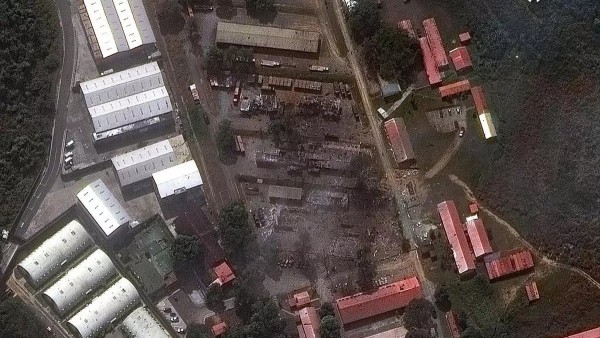
“As the force approached Caracas, the joint air command began dismantling and disabling Venezuela’s air-defense systems using precision munitions to ensure safe passage for the helicopters,” Caine said. The blasts and bombardments echoed across key points of the capital, jolting residents awake as plumes of smoke and fire lit the skyline.
Once ground units crossed the final ridgeline where they had been concealed in dense vegetation, commanders judged that the element of surprise still held. Helicopters skimmed in at low altitude while assault teams received real-time intelligence from assets on the ground and in the air.
At 1:01 a.m. in Mar-a-Lago — 2:01 a.m. in Caracas — the team fast-roped from helicopters and breached Maduro’s residence. Other units sealed off the surrounding compound to secure the perimeter. As they touched down, the aircraft came under sustained fire. “They responded with overwhelming force. One of our aircraft was hit, but remained airworthy,” Caine said.
Maduro and his wife awoke amid the chaos and, according to Trump’s account of the live feed, attempted to retreat into a secure room. They reached the doorway but were apprehended before locking themselves inside. “It wasn’t truly secure — we would have blown the door in 47 seconds regardless of how thick the steel was,” Trump said. Planners had anticipated the scenario and teams carried cutting torches to defeat reinforced barriers, according to accounts provided to CBS.
After the pair was detained, the operators summoned the helicopters for extraction while fighters and drones provided overhead cover and suppressive fire. “There were multiple engagements as the extraction force began to withdraw from Venezuela,” Caine said. On Sunday, Venezuelan Defense Minister Vladimir Padrino López accused U.S. troops of killing “a large part” of Maduro’s security detail “in cold blood.”
By 3:29 a.m., the helicopter carrying Maduro and his wife had cleared Venezuelan airspace and was flying over open water. They were transferred to the amphibious assault ship USS Iwo Jima before being transported to a detention facility in New York.
Maduro was seized inside his residence at Fuerte Tiuna, the sprawling Caracas military complex that also houses senior government officials and civilians, Nahum Fernández, a leader of the ruling party, told the Associated Press.
At 4:21 a.m., Trump went public. “The United States of America has successfully carried out a large-scale strike against Venezuela, and its leader, President Nicolás Maduro, has been captured along with his wife and removed from the country,” he announced.