
Rodolfo Soriano-Núñez Lunes, 29 de Junio del 2026
The lack of coherent criteria to attend to victims generates grievances, as it forces them to compete with one another.
The Catholic Church does not incorporate knowledge from social sciences into its reflection on the abuse of power and its effects on victims of sexual abuse.
By Rodolfo Soriano-Núñez
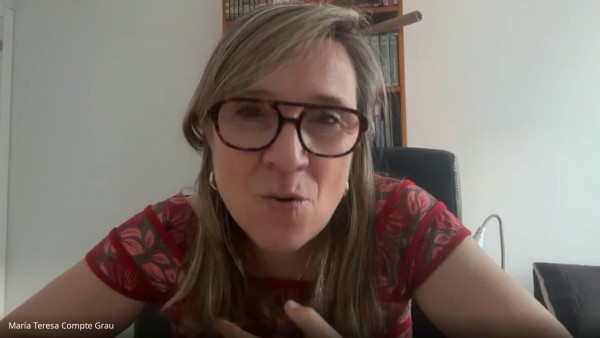
María Teresa Compte Grau is a social sciences professional who currently presides over a Spaniard NGO addressing clergy sexual abuse cases, focused mostly, though not exclusively, on the Catholic Church.
Catalan but residing most of her time in Madrid, María Teresa holds a PhD in Political Science and has extensive experience in Latin America, where she coordinated various programs for the University of Salamanca during the first and second decades of this century.
She now heads Acogida Betania which, in Compte Grau's own words, “aims to be a third-party facilitator, which means creating the conditions so that people who have been victimized can meet in an environment of safety and trust to share what happened to them and facilitate that the facts can be brought to the attention of the institutions in which the abuses were perpetrated.”
Acogida Betania is a reference to the passage in the Gospel of John (12:1-8) in which Mary of Bethany receives Jesus and anoints his feet six days before his crucifixion. It is an image frequently associated with an idea of charity and respect, as well as the recognition of Jesus’s dual nature, human and divine, and the duty to accept the stranger, the foreigner in home.
What follows is a conversation with María Teresa Compte Grau focused on the responses that the Catholic Church in Spain has recently given to the clergy sexual abuse crisis, focused on the methods followed by Acogida Betania or Bethany for short to achieve its goals.
Teresa, you are part of Bethany, which is an organization helping survivors of clergy sexual abusein the Catholic Church in Spain. What is your role in Bethany?
I am one of its founders, I coordinate the team, and I preside over Bethany.
Could you explain how Bethany came about?
Yes, of course. The initial core consists of conversations among friends who, through their professional work and vital commitments, had the opportunity to encounter people who had suffered sexual abuse in an ecclesial context, bringing together different experiences.
From the fields of journalism, accompaniment, psychological support, and even legal advocacy, we shared the conviction that we all knew of cases where people affected by this had nowhere to go; they lacked an institutional response, an organized response. For about a year, we met once a month in a group that grew to 17 people, and we finally decided to establish ourselves as a civil, independent, and fundamentally professional association.
That is the origin and fundamental raison d'être: to provide a professional response with a vocation for institutionalization, one that is viable over time, with a clear structure and clear objectives, backed by a solid theoretical foundation.
Because the reality is that, although there have been recent changes in the Conference of Catholic Bishops of Spain, five years ago there was no truly serious response from the Church hierarchy, if I am not mistaken.
When we were established in 2019—meaning our statutes were approved on December 10, 2018, which was the day the registry of associations notified us that we were recognized under the Spanish civil legal system—and we presented ourselves publicly in 2019, there was no organized, sustained, or institutionalized proposal at that moment.
In that moment, there was no organized, sustained, or institutionalized proposal. Therefore, in a way, we were among the first to do it in an organized manner from outside the Church, from a purely civil sphere, as a project aimed at carrying out social intervention on this issue, overcoming the limits of therapeutic care.
Then other proposals emerged. Thanks to or through Pope Francis’s motu proprio Vos estis Lux Mundi, in 2019, first as a tentative trial and later gaining universal and stable status, offices were created. It was mandated that all dioceses worldwide establish an office or a service for victim assistance.
A whole system of diocesan offices, safe environment frameworks, and safe spaces began to emerge from 2019 onward in both dioceses and religious orders, besides survivors’ organizations, which is a different type of process.
What went missing in Spain was an institutionalized response from the Church, especially as far as the reparation or financial compensation. This is what is achieved with PRIVA, regardless of the value judgment that each person may make regarding the Advisory Commission for the Comprehensive Plan for Reparation to Victims of Abuse (PRIVA after its Spanish-language acronym).
That is an institutionalized, formal, and stable response, which is fundamentally oriented toward financial reparation. And recently, in April 2026, another commission was established—the commission called that of the Ombudsman (Defensor del Pueblo), which had already appeared outlined in the report that this same Ombudsman's office presented in 2023. This is the landscape now.
One key issue is the nature of the different initiatives, what each one pursues, what coherence exists between them, and how each of us sees them, because here each of us evaluates things very differently as well. I mean, if I have to make an overall assessment, it seems to me that the plurality of initiatives is something positive.
Insofar as they respond to the interests, rights, and needs of the victims—who are all different and do not all want the same thing—we in Bethany have always insisted on the same thing, from the day we were established until today. Let there exist as many initiatives as may be opportune, just, and necessary; what must exist are coherent criteria, because the lack of coherent criteria generates grievances, and grievances generate victim competition, and victim competition is perverse.
It generates what many of us often say, and I am sure you say it too: that in the end, when grievances exist, there are first, second, third, and fourth-class victims.
Right, which is a position defended in the series due to the problem of distinguishing between minor and adult victims, as if that were the substantive problem, when the reality is that this type of criterion cannot be used. That is one problem, that is one of the problems.
In the Catholic Church, there is a significant number—we do not know exactly how many, because measuring the magnitude is very difficult—of adult people who have suffered abuse.
I mean, these are very respectable reports affecting individuals who either were adults at the time of the events or are adults now reporting what happened. This is an important segment that often falls into a legal or institutional limbo because attention is heavily focused on minors. But that which you point out is one of the first grievances, because in the Catholic Church there exists a number, let's say significant, of people who in technical language are victims without identity, which are adult victims, who are not recognized as victims.
That is a first grievance, but then among the victims themselves, there are many discrepancies. Because over time, there has been an absolute asymmetry in how different dioceses or religious congregations have responded.
Due to the absence of clear guidelines, there have been congregations and religious orders that have been very sensitive to a committed listening and reparation, while there have been others that have not been. There have been people who have had the possibility to escalate their complaints very high, while others do not have those possibilities, and all of that generates grievances. There are victims in Spain who have had a very significant role in victim politics. I do not question it, but not all of them have had the same role in victim politics.
I do not like this idea of there being tame victims and subversive victims, nor do I like there being good victims or bad victims, nor do I like there being constructive and destructive victims."
Unfortunately, victims are victims because they have suffered either an abuse of power or a serious crime. So that is what defines them as victims. Everything else, whether they are more or less defiant, whether they were 15 years old, 16 and a half, or 18 and fifty days—all of those are aggravating factors or specificities that will have to be taken into account depending on the facts, the damages, the circumstances. But what cannot be is that we use such selective and aprioristic notions of victims. And I believe the Church has a very selective and very aprioristic notion of a victim that ends up being exclusive: "you either are one or you are not."
To me, this seems like one thing—I think with you we can discuss this calmly, with many other people too—but to me it seems, let's see how I say it, it still questions me deeply that for the Catholic Church one is a victim based on belonging to a group that has been previously defined as such.
In other words, one is not a victim due to having suffered a process of victimization or, as international standards say, for having suffered serious crimes or abuses of power. No, one is a victim for belonging to a group previously defined as such.
In other words, excuse me, that aprioristic image aims at excluding some victims.
Which comes from the very title of the institution created by Francis—and how good it is that he created it—but by giving it the title of Tutela Minorum and then he adds that about "vulnerable persons," and what does vulnerability depend on? Instead of calling it simply Tutela Fidelium, which I believe was the appropriate choice in any case, because we are all susceptible.
That is something that for many still, even in the press, especially in the Spanish media, is very difficult for them to understand that it is not just pedophilia, that it is a much more complex, much more elaborate problem, but they continue to adhere—I do not know if due to editorial criteria or to protect themselves legally or for some other reason—they continue to adhere to the idea of pedophilia as the criterion on which, paradoxically, they end up agreeing with what the hierarchy of the Catholic Church wants to happen.
The thing is, it is not just pedophilia. I mean, let's see, I think we have been able to discuss this at other times—in other words, the Church does not possess its own language to define the phenomenon of sexual abuse or the abuse of power; it does not have its own language. That is a language that, as in so many other fields, the Church has to appropriate from other areas.
And it incorporates it fundamentally from the social sciences, something that you and I know well, which is the social doctrine of the Church; its nature is interdisciplinary and it is based fundamentally on the autonomy of the sciences. Second Vatican Council, pure and hard—in other words, I mean, the Church values, and the Council says it very clearly, the autonomy of temporal realities and the autonomy of the sciences, right? And it seeks that interdisciplinary dialogue.
Curiously, on this topic, what strikes me powerfully is not that at this moment there is no good research within the Catholic sphere—in a university sphere, for example, a scientific one—or that there is no good theology on the matter that dialogues with the human and social sciences; what strikes my attention powerfully is that the magisterium on these topics does not dialogue with the human and social sciences.
In Spain right now, good theology is being written on this. There is a Spanish Jesuit—not only in Spain, also in the United States, good theology is being written on this and very interesting things are being entered into, right? The topic of evil, interesting things that have to do from the sphere of theology; of course, what to say of all the studies being done on topics of transparency, accountability, safeguarding—of course, there is good research in Catholic universities on this topic.
But, I insist, Rodolfo, I insist, the magisterium has not incorporated the social sciences into its discourse, into its reflection, into its doctrine on the topic of the abuse of power, which in the end is what it is: abuse of power.
In other words, here there is a problem that is of abuse of power manifested in different ways, in terms of abuse of conscience, spiritual abuse, sexual abuse, which in the end is abuse of power. That is to say, there is an object that should be an object of study, and also an object of study for theology, which is power—the conception of power in the Catholic Church.
Sure, which is one of the contributions, with all the limitations it had, of the pontificate of Francis, which is identifying clericalism as one of the key nodes—which people do not always want to recognize, that clericalism is above all a problem of power.
And of the legitimization of power and the very understanding of power. In other words, I believe that one of the questions that we also have not addressed sufficiently, which is surpassed in sociology and political science—you know it very well—is the notion of power as an object; power is a relationship, not an object. And unfortunately, in the internal life of the Catholic Church and of other denominations, power continues to be conceived as an object—as an object that is possessed, not as a relationship that is generated. And well, for example, that political science and political theorists who have studied power could, through their theoretical contributions, help in a reflection on the notion of power within the Church is important.
The topic of charismatic legitimization, for example—power is legitimized charismatically; well, within the Catholic Church it is still legitimized charismatically. We already know that the Catholic Church is not a democracy, but we are not saying that.
Then there is a topic that, to me, who am not a theologian, but which also questions me, which is to say: there are certain ministries in the Catholic Church that can only be exercised by reason of the presbyteral ministry.
For example, that the prefect of the Dicastery for the Laity must be a cardinal, because he is a priest. In other words, he then exercises that ministry as prefect of a dicastery—prefect of the laity or family, life, and laity, as it is called now—has to be a cardinal, because he is a priest.
So there are even those who believe that the ministry can be developed by a prefect in the Dicastery for Promoting Integral Human Development. They depend on the presbyteral ministry. That is the source of legitimacy for the exercise of a service or a ministry such as directing dicasteries of this nature.
I ask myself: is the presbyteral ministry the one that legitimizes the exercise of power? These are things that clash with me and that I ask myself without being a theologian, which I am not. And I believe that this would not tear down any fundamental pillar either, right?
The Pope recently appointed a religious sister as prefect of the Dicastery for Religious Life...
Sister Simona Brambilla...
Why? Because we are talking about a reality where, of course, we understand that whoever has been appointed is competent—that competence derives from knowledge, well, from knowledge and, furthermore, not just from intellectual, theoretical, or theological knowledge, but also from an experience that allows bringing greater knowledge to that task, right?
These are things that will have to be gradually thought through. I do not know if synodality addresses them completely or not, but these are topics that must be thought through, right? And which, without a doubt, would contribute. But, in any case, I believe what is urgent is for the magisterium of the Catholic Church on these topics to seek dialogue with the social sciences.
Why? Because, I insist, because the magisterium does not have a specific and proper language to name and comprehend these realities.
Which would be one of Bethany's work feaures, right? That you have precisely an interdisciplinary team...
Yes. In Bethany there are psychologists; there are people who are, let's call them, experts in accompaniment, which implies accompanying a process of recovery, of gaining awareness, of confrontation with reality. It is sustaining.
There are people who come from the field of social intervention, well, in social intervention in the third sector or even in work with minors—with minors who have been in institutionalized contexts.
Then there are jurists, experts in criminal law, criminal defense attorneys—female attorneys, in this case—who work in the practice of law fundamentally in the field of criminal law, and then people who, well, who are also in the field of teaching or research on these topics with a special interest in everything related to victimology.
And well, that is the conglomerate we are in, right? And then, well, we also count on the advice of canonists, of some moral theologian, because here many problems arise that need very different viewpoints.
So, we have a good team that works fundamentally pro bono, which is one of the big problems, because this work is hard and demands a lot of dedication, and so the pro bono thing is not the best way, but well, there we go.
But it interests me a lot that you emphasize that, because there is this myth that organizations of victims, of survivors like you, do it because they want to enrich themselves.
One of the traits of our work is professionalism. I believe that professionalism is a virtue, because professionalism implies excellence, because professionalism implies rigor, because professionalism implies a deontology, a responsibility in the performance of tasks, because it also implies a knowledge of prudence—that is to say, many judgments of prudence, practical wisdom, knowledge of reality—and it demands a technical knowledge of things.
Therefore, a professional work must be a remunerated work.
But you do not have those resources and that is why it is pro bono, right?
Fundamentally, yes, but not everything we do is done pro bono. But there is a significant percentage of pro bono work.
We provide services, and those services, when we can and it is possible, are charged for. Why are they charged for? Because those services are provided as a concept of reparation for damages caused, whether for moral damage or for material damage.
When a person comes to Bethany, knocks on the door and says, "I need help, this happened to me, how can you help me?" What we do, first of all, is listen—not to listen just to take stock, but to listen in a committed way.
We do not listen just to find out; nor do we listen to accumulate knowledge, nor do we listen in an empathetic way, which is a term used a lot now. We listen in a committed way—that is to say, here there is a project that attempts to be a project that generates safety and trust, which understands that abuse generates damage and that this damage must be repaired.
There are people who need psychological care; there are those who do not want it. There are people who only need a listening ear or who need a legal clarification. When that process takes shape and the person gains full awareness and is capable of narrating in a linear way—not in a disconnected way, but in a linear way—a life testimony, a life history, we contact the institutions.
“Listen, there is someone here alleging this, we have been working for a certain number of sessions.” There are institutions with which we have agreements, with others we do not have agreements. At this moment in Spain, it must be said that, when one enters a process of reparation, therapies are paid for.
Therefore, the institutions pay for them and the professional who performs that service of psychological care is going to collect for their sessions. But ours is a project that needs money to function, so that coherence exists, so that it is a sustainable project over time, because it also requires tasks of management, of systematizing information.
So we scrape by, we scrape by from here and from there and we subsist; we have had some institutional aid, but we do not count on financial resources beyond this. Let's say that we exist, that we try to do our job well, but we do not do it with the comfort of counting on a budget that helps sustain it.
Here the question is not that the professionals who work in Bethany enrich themselves, but that there is a financially sustained project that allows the services we provide to be the best possible services, which is different.
But you are not in this because you are pirates; you are not in this to enrich yourselves.
No, sometimes we have been told that—that we go around looking for victims like someone looking for investors, but Bethany does not look for victims. And this is a thing that is also good for us to explain.
We only initiate processes of listening, accompaniment, orientation, and intervention when, in writing, a victim requests it. In other words, we do not even accept that institutions refer people to us. No one is referred here.
An institution might say: "Look, here you have a proposal, maybe it interests you, maybe they could help you," but a process is not initiated because an institution calls us. No, this does not happen. The decision here is autonomous.
Right now—this is a simple example—but right now we have just signed a letter to a person who has asked us for accompaniment of a psychological nature; a letter is made for them to explain how we are going to proceed. They have been given the address of a psychologist; it is a psychologist from this project, and the person is told: "You are the one who must write to them, I am not going to write."
And any other of the people who are in Bethany, well, in the same way. People do not come to Bethany referred, as if it were the outsourcing of a service. The people who want to and who have freely decided it come. We are not going to look for anyone, and it is true that there have been those who have tried to say it. But it does not hold up, because it is not true.
Another thing is that when one calls, they are listened to; we always sign a confidentiality document, because it is a protection document that obligates us and protects the identity of the person.
A confidentiality document is not a silence clause; the person comes to Bethany and can tell whatever they want, we cannot, and when the person decides to leave, they sign a revocation document. Today there was a person who signed a document of revocation of consent.
Why? Well, because there is a process that got stuck. When a process gets stuck, you cannot generate a greater harm to the victim. So let's cut it and another way out is sought, but not with us. That is why a revocation of consent must exist, because this is an exercise of autonomy and of freedom; it cannot be any other way.
We do not enrich ourselves. Although there are people who are enriching themselves with this, this is true. Especially in the field, for example, of drafting protocols, guidelines, standards, codes of conduct. It is true that I am aware that there are those who are making money with that, right? But no, it is not our case. We work with victims and working with victims is something else. That is a work—it is a work that is subjected by its very nature to critical standards that are demanding, right? Fundamentally because when one works with victims, the main risk, the first risk is revictimization, and that is what must be avoided at all costs.
Teresa, Pope Leo XIV has just been to Spain; he had a visit that seems very positive to me in the field of migration, very positive even in the field of Spain's reconciliation with itself, but there are those of us who believe that this meeting in Madrid with that group of victims was not the greatest success of the visit. What do you think of that visit, of that aspect of the visit?
Now I am going to answer like a Galician. No, but the Galician answer is true: I have not been in Spain. During the last two and a half months I have been outside of Spain; therefore, geographically the visit caught me far away and I have not lived it up close, therefore, I cannot make an assessment either because for work reasons I have not had much opportunity to follow the visit—that as a first measure.
In relation to the encounter, I do not possess privileged information of any kind; I possess the same information possessed by the rest of mortals—what has been published and what has been said. Therefore, I do not know how that interview was gestated either; who gestated it and much less do I know who was there.
I know it took place and I firmly believe: if the people who were in that interview and in that meeting came out pacified, satisfied, justified, that is fundamental.
Second question: even if there had been 100 victims in that meeting, those 100 victims would not have represented all victims. Third, it will not be me who says that the victims who attended that meeting are tame victims. They are people who have suffered sexual abuse and therefore I will not say whether they are tame or not. What I do ask myself is if those encounters are really necessary, and in this I go against the current.
Are those encounters necessary? For whom? For what? And why? Why is it necessary for the Pope to meet with victims? As a symbol? I ask the question: is a symbol a way of testifying to a commitment? Well, perhaps. What is said in those meetings? How long do those meetings last? What is conveyed in those meetings? What effectiveness do they have?
Because if those meetings are a simple listening, a non-committed listening, it is a revictimizing listening. I am not going to say that the Pope is not committed, I am not saying that. But I am among those who ask themselves if those meetings are really useful. Look, I am going to tell you something that might sound provocative. But I do not know if you saw the act in Montjuïc, the act of the Pope in Montjuïc.
In the testimonies of Montjuïc, three people spoke, I think it was. I remember two. I remember a girl who had suffered a severe depression. I remember a girl whose father had tried to murder the mother, she had been a witness to that, someone intervened. And I do not remember the third testimony. When I saw those testimonies on delay, I asked myself a question internally, but now I ask it in public.
Would it have been possible that, before forty thousand people, in the same way that a woman spoke who had suffered a severe depression and had been on the verge of suicide, or a woman spoke who had suffered and lived in her own flesh, or at least in her family, gender violence—would it have been possible that before forty thousand people and before the Pope there had been a testimony of a woman, of a man, who had suffered sexual abuse within the Catholic Church?
Would the forty thousand people who listened to those testimonies have listened with their eyes fixed on those people or would they have lowered their gaze?
I do not take an ounce of value away from this encounter, from those that have been, which have been many before—Benedict met with victims, Francis met with victims, therefore, Leo XIV will have to meet with victims; I mean, that has already happened.
And it is fine for the encounters to be reserved if people do not want to show their faces, right? But for me the big question is the other thing—in other words, would that same testimony have been possible in front of forty thousand people? The woman who, I say, and I do not want to center it on that woman, but others—look, for example, something that impacted me a lot and surely you too.
When Pope Francis was in Colombia and encounters were held with a restorative perspective, they impressed me immensely; for example, let's think about those encounters, let's think just about what happened in Barcelona and in Colombia, which to me seemed very important.
Would it be possible for victims who have been in the Catholic Church to have encounters like that? Maybe the challenge is that, right? But the challenge is also not to normalize, because this cannot be normalized. To accept with greater transparency that this happens in our house, sure.
That is also the problem of distinguishing in that manner between violences. And to recognize that effectively it continues to happen, which is what it seems to me that we do not know what is going to happen here. Well, it keeps happening because, we know that, well, violence continues to be a resource for many people. That is why aggressiveness is adaptive, but violence has a rationale that is more cultural. Well, that has to be stopped. And to stop it, what exists and what has existed must be made visible, always respecting, of course, the victims. In other words, here people do not have to be exposed as if they were carnival dolls.
But things must be allowed to happen, to pass, to be seen. And then, especially because it seems to me that in Spain a few years ago—I remember, about ten—at the University of the Basque Country, at the Institute of Criminology of the University of the Basque Country, a small victimization survey was done.
And one of the things asked about was the topic of stolen babies, right? More than about abuse within the Church, they were asked about the topic of stolen babies. And what differences, similarities, and such they perceived. Then, well, the victims who were, who were stolen, have, let's say with a certain pride, reclaimed their rights.
It is true that sexual violence always generates much more shame. And it is a taboo and it is a stigma outside and inside the Church. But it is not addressed with the same—I am not going to say natural way, because it is not something natural—but we have not managed to dignify it in the same way. That shame continues to exist.
Although well, the victims of Bétharram in France openly want to be present and for what happened to them to be known and for their testimonies to be heard. It is what they are fighting for now as they negotiate, and they do not want the Madrid situation.
Sure, although I ask myself, is it necessary for that to happen with the Pope as a witness? That is what I ask myself. Because in the end, in this type of trip, I think it is very good for popes to listen to victims, it is very good. And probably there are other ways to do it, I do not know.
Likewise, it is very good for popes to listen to victims, it is very good for bishops to do it, major superiors, cardinals to do it, archbishops to do it, laity to do it. I mean, one must know what has happened.
Because as long as we do not know what has happened, we will not be able to prevent it. And the only ones who can tell it are those who have suffered it. So, here we are always in the scenario of the fish biting its own tail.
I mean, I have many questions in relation to this type of, in relation to this type of encounters. I am not clear. I believe they have a very important symbolic power. Precisely because they have an important symbolic power, it must be done well. There is always going to be someone who feels discriminated against, that is also true. But perhaps other mechanisms must also be generated—of encounter, of listening.
And then, well, look—the meeting of the year 2019 or, for example, some testimonies collected from victims during one of the sessions of the synod; well, I am aware through the sessions that they have been relevant.
Perhaps more acts like that can be done. It is something that brings about too many questions for me. I do not have answers about this. I have questions, many. So, I cannot clarify much more for you either nor tell you much more.
Sure, and there furthermore is the problem of the legal context of each country. You in Europe have a very solid common framework of human rights; the differences between Spain and France or Germany, though notable, are of tone. In Latin America, where a framework of human rights of that nature does not exist, it is much more difficult.
What have these years of work left you with, Teresa?
We have already been at it for seven years, we have attended to many people—in general terms, in these years about 200, an average of three people a month.
And it is not a production line where you can program and this is going to be resolved in so much time, because each person is going to have a different experience.
Well, we are present. I am going to give you an example. Since last week, a person gets in touch and writes an email, and a conversation is struck up. the conversation generates a certain trust and a certain safety, so there is a response, an additional email, an invitation to speak, a telephone call, a possible conference or videoconference. There may be an acceptance or not, or the person might say, "Hey, well, if it cannot be now, could we see each other in three weeks?"
If there is the possibility of a personal encounter, the person makes a series of demands, the demands are set in motion, and when the person sees that it is going to materialize, they say, no. Always no.
That can last a month. And then there are the processes that start and finish—that is to say, the person who comes, who establishes a relationship of trust, enters into a process of confrontation, of recovery of memory, of elaboration of the trauma, who at a certain moment, that person who at the beginning said, "No, I don't want to see a psychologist," when they have been at it for two and a half months or more says, "I think I need to go to therapy."
Then, a psychologist is found, the therapeutic process begins, the process of accompaniment. It becomes something very specific, the testimony is drafted, the psychologist makes her report, an analysis of the dynamics of the abuse is done, the most simultaneous elements are identified, trust is built—which is fundamental for trauma in this context, as well as the value of silence, the recognition of oneself as a victim, the subjective notion of a victim, and all of that is gradually elaborated, and the door of the institution is knocked on.
It is possible that a year has already passed—a year has already passed, at least—and when the door of the institution is knocked on, after finding an institution that says, "Let's dialogue about it and let's arrive at a dialogued proposal of reparation," or at this moment there may be an institution that says, "Very well, this is the information, let's go to the PRIVA commission," and then a process begins that is going to last, how much time? Three months more?
Three months more, and then there is an opinion, and then the opinion is complied with, and then an agreement is signed, and then there may be a personal encounter with a certain restorative perspective between the person and the institution. How much time has that lasted? A year and a half? Two years and a half? In Bethany there are people who have been in therapy for four years.
Sure, it is not a production line. One cannot predict so much time to achieve X. It is a process that initiates and hopefully concludes.
And then here people encounter institutional responses that are authentically reparative, not only economically—not only economically, because this is a thing that must be said: the Catholic Church in Spain has been offering economic reparations for a few years now. Whether the economic reparation or the economic dimension of the reparation is sufficient, that is up for debate.
And this is an interesting topic for research as well, because as of today, the impact of what happened with the hefty compensations in the United States could be measured. The victims, 15 years after having received millionaire figures—if a survey were conducted among them, the impact of the compensation on their lives could be assessed; would they say it has been reparative or do they need something more?
Because here it is also necessary to examine those processes. The millions that the US Catholic Church has paid would be unthinkable in Europe. But this topic is very important, because this likewise within five years might generate significant emotional gaps and vacuums.
Although likewise in the United States perhaps if they hadn't litigated the cases so much and denied the cases so much, it wouldn't have been necessary for them to spend so much...
That, that, that, that is pointed out in the famous report presented in the year '85, which you know perfectly well, the one published as a result of or made as a result of the Gilbert Gauthe case, right? That report on which the former canonist of the nunciature in Washington, D.C., Thomas P. Doyle, worked. He already pointed out in the eighties the impact that the sexual abuse crisis was going to have. Doyle warned, "If there is no immediate response, this is going to turn into a brutal crisis."
Of course, because lawyer hours accumulate, and lawyers in the United States are not going to charge a dollar per hour.
Yes, but how does that impact the life of the victims? This is a very important piece of work. Clarifying whether that has served and for what. For post-traumatic growth? For the forging of character? For full recovery? For people to stop being victims? That is the final objective, because one cannot live forever being a victim; it's impossible.
And what the institutions learn as well, because it's terrible that the first diocese—the only diocese in the United States that has lost two bishops due to sexual abuse, Palm Beach—has just reported another case of abuse and, 30 years later, it still hasn't developed an institutional memory of what needs to be done to avoid cases of abuse.
And that also raises questions about Seán O'Malley's work, because he was bishop there in Palm Beach, he was sent to resolve those problems, and 30 years later the problem returns—now with another bishop and another priest accused—but the problem returns.
Of course, you are framing it from the institutional perspective; that is a fundamental dimension. I frame it from the victim dimension: financial compensations serve reparation, and I am not saying they are not necessary—they are, they are an element of justice, they are an element of justice.
And other problems, such as whether the crime has prescribed, whether criminal action can be exercised or not. That is to say, there I am very clear: the standards within the Catholic Church are different, so whether the crime has prescribed or not, you do not have a legal duty, but you have a moral duty.
Of course, sin does not prescribe.
Neither does injustice. Injustice does not prescribe. And where there is justice, if justice is not done, order is not restored. It is not restored. And here I am going to tell you one thing and I am going to cite Ratzinger: amnesty is not possible; in his Introduction to Christianity, speaking about the question of reparation—which probably Joseph Ratzinger was not thinking about abuses, but he clearly says—amnesty is not possible without recognition of guilt; there is no possible amnesty.
And that is also said by liberation theology. There is a very interesting reflection in Jon Sobrino's book, the one on La fe en Jesucristo [Christ the Liberator], essays on the victims. When Sobrino, speaking of the victims of the world, says that about when cover-up does not work, when cover-up does not work, they appeal to amnesty. Amnesty is not possible.
And when I say this, I always cite Ratzinger, because if you cite Ellacuría or Sobrino they can answer you. If you cite Ratzinger, nobody answers you; those who would dare to refute Ratzinger do not do it because they do not dare. I mean, without forgiveness, without forgiveness and without recognition of guilt, amnesty is not possible here. And here one must read Spes Salvi on reparation.
In other words, this is another very important theme. The banalization of forgiveness, what Dietrich Bonhoeffer called: cheap grace. That is a heavy topic, we know it, you and I share it, it's a heavy topic, it's a heavy topic. What happens?
That we have found a formula that is useful, which is the formula of financial compensation, which is a way of doing justice—it is not all of justice.
What is it that enables a health professional to dedicate time to another person? It's not a problem of money as such; it's what makes it possible for a health professional trained for that to dedicate time to a person who has been affected. But of course, they want to present you as if you were privateers.
And not only that, because in Spain at this moment compensation is being paid for moral damage. Not only is compensation paid for material damage, it is paid for moral damage. But of course, this is a debate. How much does it cost? How much does it cost? Of course, there we are in the question of economic criteria, sure, but there have to be objective standards, right? What do the ordinary courts of justice say?
I mean, here much remains to be done and one must think a lot about moral damage too. I am not a jurist, but one must think and one must think about the issue of moral damage from the criminal perspective, one must think about moral damage from the theological perspective, and one must think about moral damage from the ethical and psychological perspective. Which is suffering.
Well, the truth is that in the United States there is a good bibliography about all this, very good. The whole theme of the survivors of the Vietnam War, all the work of the civil rights movements, the feminist approaches, the whole ethics of care—that is to say, there are very interesting things, very interesting about this topic that help to think about it and one must keep thinking about it, one must keep thinking about it.
And that unfortunately is easier to do from the perspective of Common Law, than to do it from the perspective of French and Hispano-American law that ties itself to a formalistic vision that does not allow incorporating those elements.
Furthermore, because it also has very different procedures, well in the end establishing much lower amounts.
And the cost is clear, which is the worst part, because since it is not recognized, then the rejection of the survivors themselves is incentivized, and it makes it harder for them to survive the process.
That is an issue, what you have just pointed out is a very important issue: probably the hardest phase, the phase with the highest risk of secondary victimization, the phase that generates the most stress, is the phase in which the victim takes full awareness that they are in a process of reparation. That is the worst phase, Rodolfo, the worst, the worst, the worst. At least the most difficult. The worst in terms of intensity of pain and suffering, because uncertainty skyrockets.
Because in those moments, in the moments in which—look, this afternoon we spoke with a gentleman, we have delivered a part of the testimony, that is to say, we have delivered a part of the information. Well, so that the institution knows and has the basic data and can start to investigate, because it has to investigate.
But then comes the life testimony. Which takes longer to develop, well it must be reviewed. Because one thing is that we work on it or that people record and tell you, “I'm going to go along sending you scraps.” And they record it because it is easier for them than writing it, although we believe very much in narrative, in this value of the therapeutic and healing power of narrative. Of writing in the first person.
But there are people who cannot, so they record it. And then we transcribe it and then we talk about it and then they review it. Well, this afternoon we finished in a meeting of Bethany, we finished a life testimony. And we told the person: Read it carefully, review it.
At the end of the testimony, the demands for reparation are always included, it is what the person asks of the institution in terms of reparation and you sign it and date it. And he says to us, tells us, "As soon as you send it to me, I'll read it and sign it."
It is not going to be that way. Why? Because the person knows that they have transferred basic information, but now comes the fundamental part, putting that information into the hands of the institution is a brutal exercise of trust. I hand over to the institution in which I suffered damages, my life. What are they going to do with it? And why don't they answer? And how long are they going to take? And are they going to believe me? And am I going to be accused? I prefer not to expect anything.
So, there even the most structured, most integrated person faces problems at that point. We have accompanied processes that have been a delight in the sense that we have been witnesses to how the person has reconstructed the narrative about their own life with a depth and with a delicacy toward themselves that is impressive.
And suddenly, when all that has been transferred to the institution, we have seen another person. “But this wasn't the one who seemed,” or “this is another one.” Because, of course, it skyrockets absolutely. That process, clear, is that, look, that is the true process of empowerment in the English sense of the term, which to me—that is to say, in the English meaning I love the term—that is to say, acquiring the power, recovering the power of decision, recovering autonomy.
The step from being a victim to being a survivor, right?
Yes, in English there is much talk of survivor. What I say is the step from being a victim to ceasing to be one. Okay, that is, to ceasing to be one. It is the person who thinks as a subject of rights. I mean, I don't know, do you know a small book by Marie M. Fortune with five or six pages dedicated to moral agency?
And for me they are a jewel because it is explaining abuses as incapacitating, but the victim is not incapable. So, the process of empowerment, which sometimes the term is ridiculed a lot, especially in the Spanish translation the term and meaning are ridiculed a lot. And to me it seems, it seems brutal—I know this is a non-academic and non-formal expression, but it seems brutal to me. That is, to empower oneself is to take awareness that you are a subject of rights who acts autonomously. You are capable of making decisions for yourself. So, it is passing from being a victim, from living tutored, from living incapacitated by the action of someone, passing from living isolated, disconnected from the community, to reconnecting yourself, it is building yourself and thinking in the first person. And acting in the first person.
So, for me the problem is: why does the Catholic Church want to consciously lose that process? Why does it want to lose it? That is to say, why instead of actively committing to that process does it take a step back and that scares it?
Rodolfo, lately I have been reading a lot of Ignacio Ellacuría, José María Castillo, and Jon Sobrino. While there are elements of their broader discourse that don't entirely convince me, their notion of liberation is absolutely key to this entire process.
It is key because it means liberating oneself from the crushing weight of the abuse, liberating oneself from oppression, from synthetic incapacity, and from institutional subjugation.
So I say, for freedom Christ set us free, but the Catholic Church wants to take a step back in that sense. Not to be present in that process, not to favor it, why? If that is where it should give its all, that is where it should give it.
In class, I repeat many times a phrase by Jacques Maritain that captivated me: From the womb to the grave, man must be able to exist free.
But in the Catholic Church, coercive, manipulative institutions are permitted, institutions that end the moral agency of people, trapped in sectarian drifts—that is to say, and we are not going to talk about the Legionaries because we'll finish, we'll never finish, but, please, the aberrations that we see of people who have suffered, and that is permitted.
You can follow Bethany, Acogida Betania in Spanish, on their social media here in what used to be Twitter and Instagram here.
* * *
A summary of this piece is available as audio after this paragraph.
Your browser doesn't support HTML5 audio. Here is a link to the audio instead.
Note on production: The text of this summary was written and edited solely by the author. The delivery of the audio summary was achieved using a high-quality, text-to-speech engine Microsoft Word for Web. The AI was used for voice generation only, not content creation.