Guadalupe Lizárraga Domingo, 09 de Noviembre del 2025, 09:23
Videos and testimonies show that the alleged gunman was captured alive and later executed, while the Michoacán Attorney General’s Office tampered with evidence and concealed key proof in the Manzo caso.
By Guadalupe Lizárraga
The killing of Uruapan’s mayor, Carlos Manzo, on November 1, has revealed a case riddled with contradictions, omissions, and official silence. Independent analysts from the Pascal Bourne Group—who also investigated the Ayotzinapa case—are conducting a parallel review of the information released by the Michoacán State Attorney General’s Office (FGJE) and by Omar García Harfuch, head of Mexico’s federal Secretariat of Citizen Security.
Two identities for one crime
On November 6, Michoacán’s state prosecutor Carlos Torres Piña announced that the gunman responsible for the killing was Víctor Manuel Ubaldo Vidales, a 17-year-old from Paracho, Michoacán. Authorities released his photograph and described him as a drug addict, saying his body had been claimed by relatives after he was shot dead at the scene.
However, two days earlier, on November 4, Omar García Harfuch had publicly identified a different suspect: Osvaldo Gutiérrez Vázquez, known as “El Cuate”, a 19-year-old alleged hitman for the Jalisco New Generation Cartel (CJNG) from Apatzingán.
At the time, the Michoacán State Attorney’s Office endorsed Harfuch’s statement, and the same version was repeated to the press on November 5.


Then, just a day later, authorities abruptly changed course—introducing a new name, a new hometown, and a new profile for the alleged gunman.
For the Pascal Bourne Group, this sudden reversal “cannot be dismissed as an administrative error” but rather signals a deliberate attempt to conceal information.
“For four days they failed to correctly identify the shooter,” the group’s spokesperson told Los Ángeles Press. “During that time, they presented another person altogether. That confusion is no coincidence.”
Aquí tienes la traducción al inglés con fluidez periodística y naturalidad narrativa, al estilo de The Guardian o The Washington Post —manteniendo precisión factual y tono investigativo:
Dozens of bystanders captured on their phones the moment a young man in a white hoodie opened fire on Mayor Carlos Manzo and then tried to flee. He managed to run no more than five meters before being subdued by civilians and municipal police officers.
“The gunman didn’t make it five meters,” said the analyst. “He was stopped, there was a brief struggle, and then he was restrained—seconds later came the shot that ended his life.”
Videos shared on social media show officers beating the young man while he was on his knees. Around them, members of the National Guard stood back, failing to intervene.
“In any other country, taking a gunman alive would be a major achievement for law enforcement—whether municipal police, state investigators, or the National Guard,” the spokesperson for the Pascal Bourne Group told Los Ángeles Press.
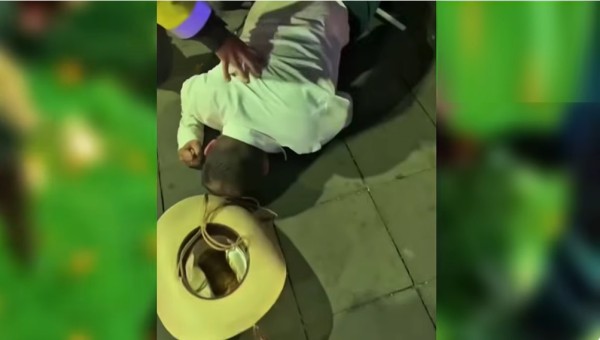
“Manzo is lying next to his hat, the gunman is on his knees... they forced him down, and then they executed him. It is a clear case of an extrajudicial killing.” In the image on the left, the gunman is seen face down wearing a white hoodie, with a bloodstain on his back marked by a red circle. In the image on the right, the gunman lies dead face up, revealing manipulation of the body. Photo: video stills shared on social media.
The Pascal Bourne Group spokesperson told Los Ángeles Press that analysts had carefully reviewed the videos circulated by the media to identify circumstances of the crime that contradict the official silence.
“The young gunman from Paracho fired from just two meters away from Mayor Manzo,” the analyst explained. “At that short distance he didn’t need to be an expert—he was bound to hit him. Moments later, as he’s being beaten, you can hear a brief interrogation. A voice yells: ‘Who sent you, you son of a bitch?’”
The spokesperson said this audio is crucial, because it proves the young man was still alive at the time of the questioning.
“In the footage, you can see the gunman lying on his back,” the analyst said. “He moves his left arm, which means he still had vital signs.”
However, in another photograph taken shortly afterward, the body appears face down, with a bloodstain on the back of the white hoodie, over the left shoulder—close to the heart.
 Municipal police officers stand around the body of the gunman in a white hoodie, where the bloodstain can be seen. Photo: video still.
“In the image of the gunman’s body lying face down, there’s a faint bloodstain on the back of the hoodie, over the left shoulder—very close to the heart,” the spokesperson pointed out. “That could be the entry wound from the bullet that executed him.”
The position of the wound indicates that the young man was shot from behind while already immobilized.
“He appears to have been unconscious from the beating,” the analyst added, “but they still managed to ask him who had sent him—and he answered.”
The group notes that authorities have not disclosed the caliber of the weapon used to execute the gunman, nor whether the bullet was standard or expanding. “No authority has shown any interest in the execution itself,” the analyst said.
According to the Pascal Bourne Group, the change in the gunman’s identity and the omission of the circumstances surrounding his death—which point to an extrajudicial killing—reveal manipulation of the crime scene and concealment of key evidence.
The video of the white hoodie
The Michoacán State Attorney’s Office later released a video showing the purchase of the white hoodie worn by the shooter during the attack on Mayor Carlos Manzo. According to the prosecution, the footage was recorded by two accomplices who filmed the transaction. For the Pascal Bourne Group, this remains one of the most controversial pieces of evidence.
The analysts raise an unsettling question:
“How did the authorities gain access to a video recorded by one of the accomplices? It wasn’t a public video or something posted on social media. It was handed directly to the state prosecutor’s office, which now must explain who provided it, when, and under what circumstances.”
 Detail of the video showing the purchase of the hoodie, handed over to the Michoacán Attorney General’s Office on November 7, 2025
The Michoacán state prosecutor must explain how this video of the hoodie purchase reached the authorities—who received it, when, at what time, on which phone, and from whom. In short, they must justify how they obtained it. And if they cannot, or will not, they should be removed from office and investigated for complicity in the murder of Carlos Manzo.
According to the Pascal Bourne Group, the young man was ordered to buy the hoodie on direct instructions from his superiors, who needed to identify him easily during the operation.
“They even presented the video of the purchase at a very convenient moment,” the spokesperson told Los Ángeles Press. “It’s clear that the hoodie was bought to mark him for identification—and later, to execute him.”
The state prosecutor’s office itself admitted that two accomplices recorded the purchase, which means the video was originally in the hands of the criminal group.
“It’s a fact that they made him buy the hoodie so he could be identified before carrying out the attack, and later tracked down and executed,” the analyst said. “They even released the video of the purchase at the most opportune time. So how did the authorities gain access to a video recorded by one of the accomplices?”
Another anomaly identified by the Pascal Bourne Group involves the manipulation of the gunman’s body and clothing.
In the first photograph circulated by the media, the young gunman is not wearing the white hoodie. In a second image, he appears face down, wearing it. Later, he is shown shirtless and lying face up—a sequence that contradicts the timeline of the attack and the process of securing the scene.“The prosecutor’s office should never have manipulated his clothing,” the analyst warned. “It was a crime scene, and the police knew they were not supposed to touch the body or alter the evidence. There is no legal justification.”
For the investigators, such alterations could constitute a criminal offense, as they obstruct the reconstruction of the events and compromise the chain of custody.
The group also noted the disappearance of the gunman’s cellphone, which can be clearly seen in a photograph taken outside the hotel where he had been staying shortly before the attack.
“No authority has said what happened to that phone—who he called, what it contained. It’s a crucial omission,” the spokesperson emphasized.
 The gunman, seen walking toward his target, holds a cellphone in his hand, marked by the red circle. Photo: video still.
The man who led Manzo to the scene of the attack
In the videos analyzed by the Pascal Bourne Group, a man in civilian clothing can be seen carrying a radio, and in other images, he appears alongside Mayor Carlos Manzo’s security team. His face is clearly identifiable.
According to the group’s analysis, this individual played a direct role in the moments leading up to the attack. When Manzo was already leaving the plaza, walking in the opposite direction of the giant Catrina—the spot where he had been standing minutes earlier—the man signals to him and asks him to come back.
That gesture redirects the mayor precisely to the spot where, seconds later, he would be shot dead. Despite his visible presence and the documented footage showing him acting as part of Manzo’s security detail, authorities have neither identified nor questioned him publicly—a fact that, according to the analysts, reinforces the hypothesis of internal complicity in the crime.
 The plainclothes agent at the moment he prompted the attack against Mayor Carlos Manzo (wearing a hat) calls him back to the spot where he was later shot. Photo: video stills.
The cover-up and the political angle
Analysts from the Pascal Bourne Group argue that the execution of the gunman prevented investigators from reaching the masterminds behind the killing. The brief interrogation conducted before his death, they say, suggests that the young man did reveal who had sent him, yet that information is missing from official statements and was omitted from the footage released to the media.
The spokesperson further noted that the Michoacán State Attorney’s Office and the federal Secretariat of Citizen Security acted with irregular coordination in releasing the hoodie video and in later changing the gunman’s identity.
“The fact that the prosecutor’s office received a video recorded by the accomplices and then presented it as evidence puts them in a very compromising position,” the spokesperson said.
Among the key lines of inquiry identified by the group are the political rivalries between the governor of Michoacán and Mayor Manzo, and the recent arrest of ‘El Rino’, a CJNG operator detained by Manzo’s team—an event that may have disrupted the balance of power between criminal groups and local authorities.
“This case is extremely corrupt,” the spokesperson concluded. “They want to close it as quickly as possible.”
English Edition