
Guadalupe Lizárraga Viernes, 21 de Noviembre del 2025, 15:56
False Identity, Manipulated Images and a Silenced Investigation: How Mexico’s Security Chief Misled the Country Over the Murder of Uruapan’s Mayor, Carlos Manzo.
By Guadalupe Lizárraga
Special InvestigationThe inconsistencies uncovered by Los Ángeles Press cast serious doubt on the official narrative surrounding the assassination of Mayor Carlos Manzo — and expose grave failures in the chain of information disseminated by Secretary of Security Omar García Harfuch.
A familiar pattern of deception
It is not the first time that Omar García Harfuch, head of Mexico’s Secretariat of Citizen Security, has lied in a major criminal case. During the Iguala investigation, he claimed he had been in Michoacán on 26 September 2014, the night 42 students — and an infiltrated soldier — from Ayotzinapa were forcibly disappeared. Independent investigators from the Pascal Bourne Group later demonstrated that not only had García Harfuch been in Guerrero that day, but that he had issued the orders for security forces to ambush the students.
Now, in the investigation into the murder of Uruapan mayor Carlos Manzo Rodríguez — a mayor openly at odds with Governor Alfredo Ramírez Bedolla — García Harfuch has again provided false information. Within the first three days, he supplied a non-existent identity for one alleged hitman, confused public opinion, and promoted the claim across his own social-media accounts, never correcting the falsehood.
A political operation disguised as a criminal attack
A spokesperson for the Pascal Bourne Group, which is conducting a parallel investigation, says there is no doubt the killing was the result of a politically coordinated operation between the Jalisco New Generation Cartel (CJNG) and government officials in Michoacán under Ramírez Bedolla.
“A high-impact assassination of this nature, targeting the mayor of Uruapan — a man surrounded by a security apparatus of roughly twenty escorts, including National Guard agents, state police and his own team — could not have been carried out by three or four youths evading every layer of protection,” the researcher said, in contradiction to García Harfuch’s public statements.
Their conclusions, based on a chronological analysis of the longest uninterrupted video available from the night of the attack, directly challenge the version disseminated by the Michoacán State Prosecutor’s Office and echoed by Mexico’s federal security cabinet. They also reveal that video material was manipulated to support the first false identity publicised by García Harfuch on 3 November — presented as apparent investigative “efficiency.”
A six-second clip that became a national accusation
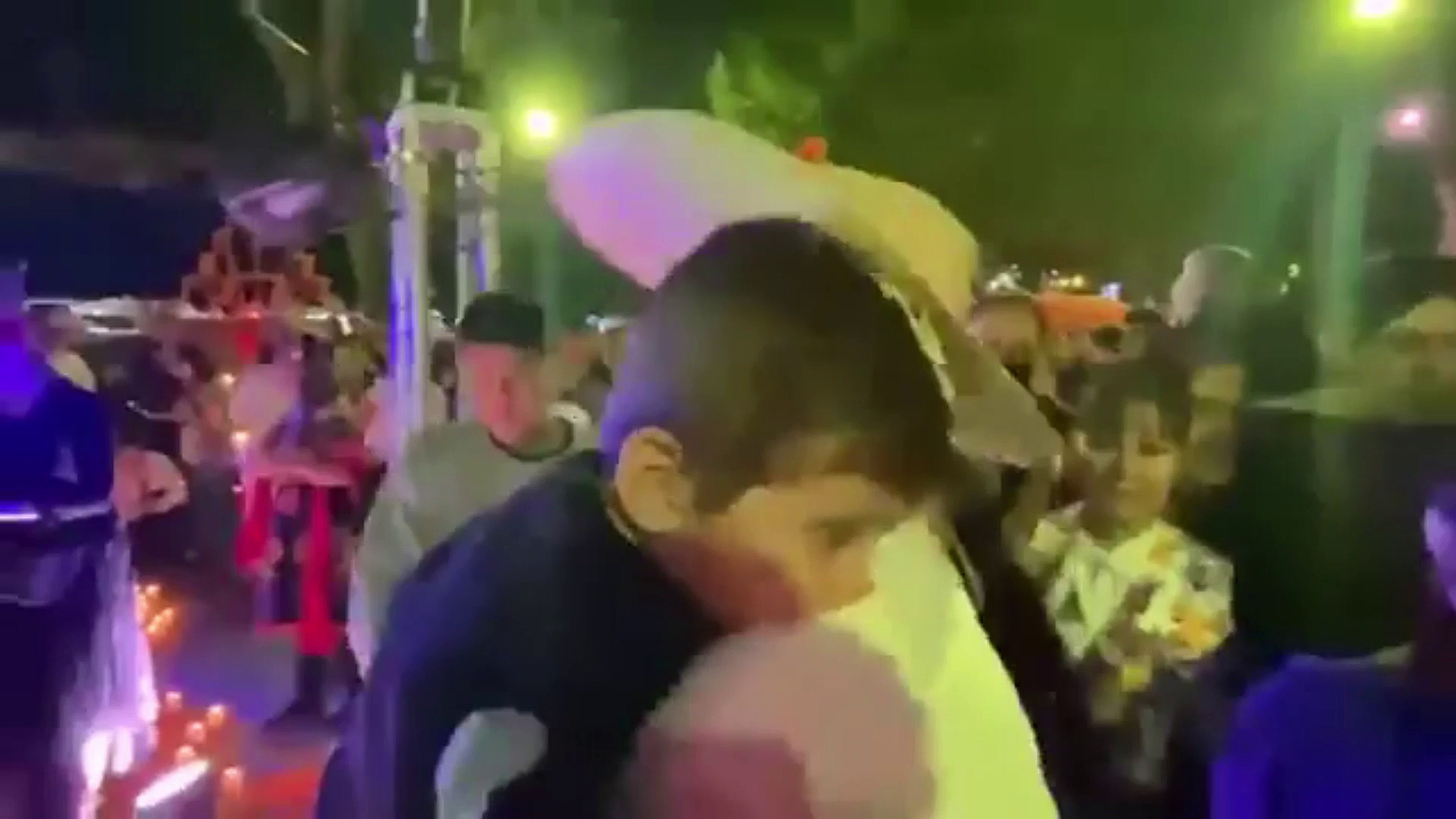
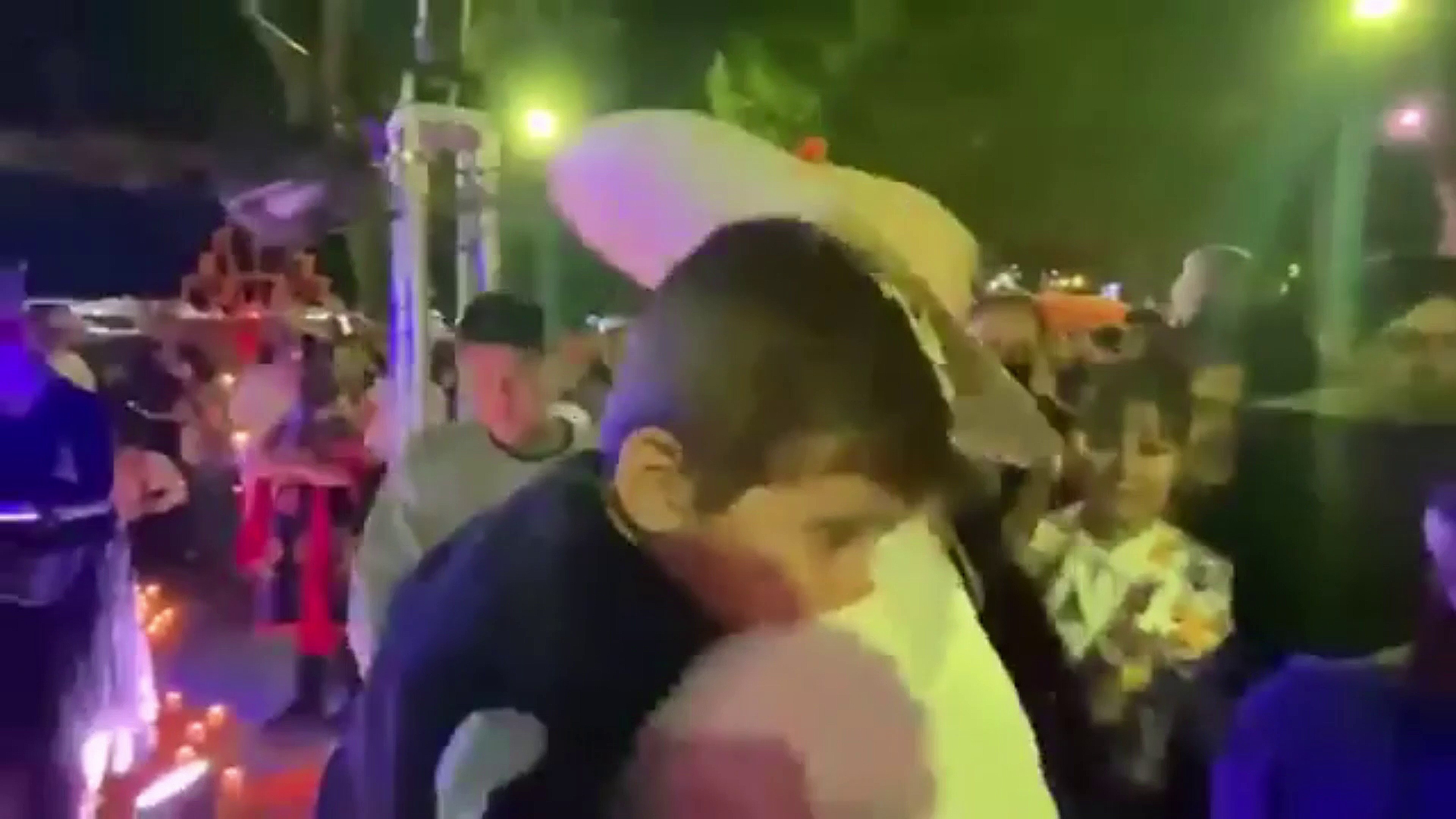
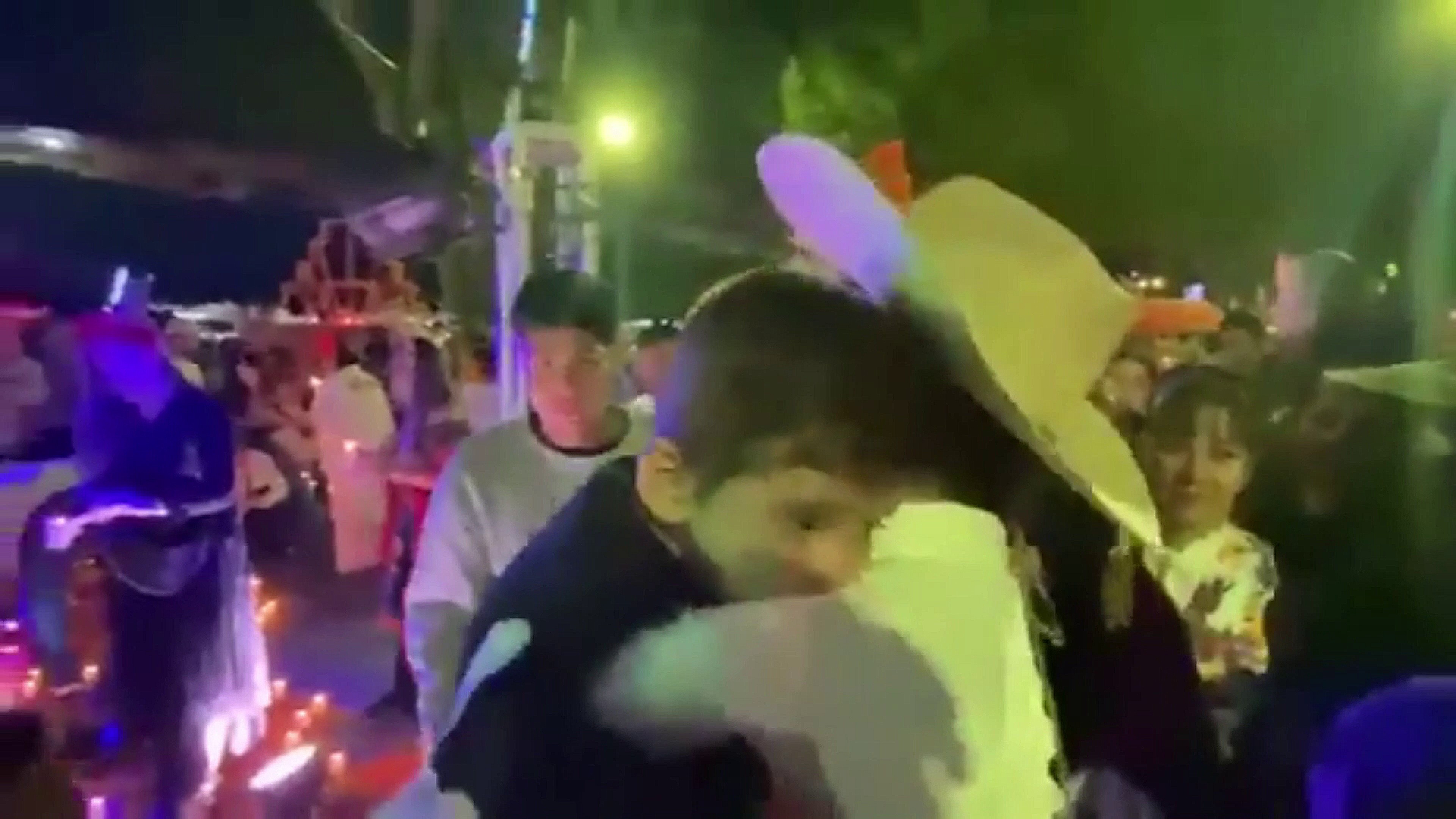
On the evening of 1 November 2025, Mayor Manzo toured the Feria de las Velas, surrounded by families. As he greeted attendees while a cameraman livestreamed the event, Manzo embraced his young son and continued forward carrying him. Just a few feet away, the livestream captured a young man in a grey hoodie walking through the crowd and looking toward the stage. The clip lasted barely six seconds.
Those seconds were later weaponised.
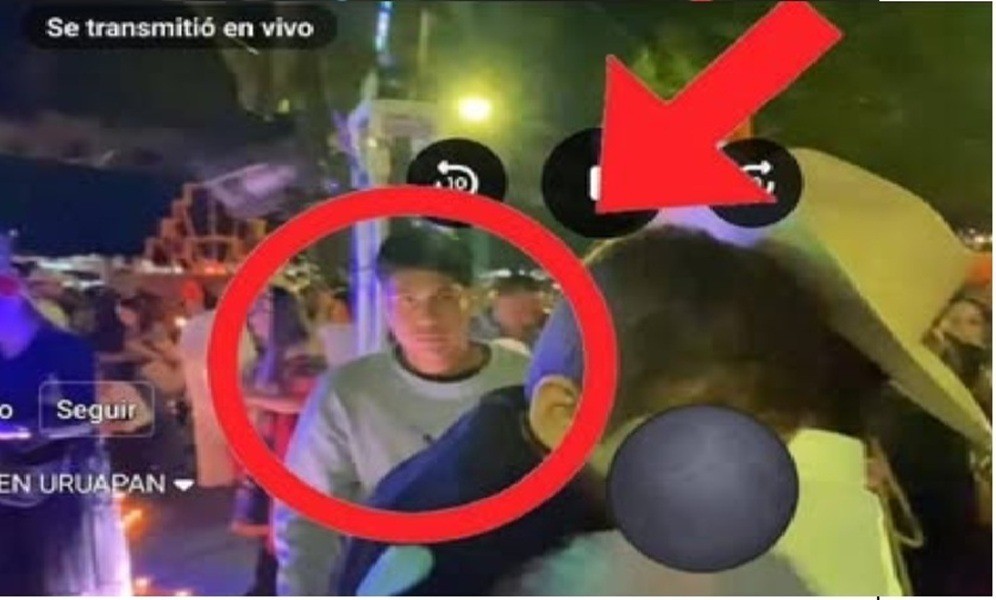
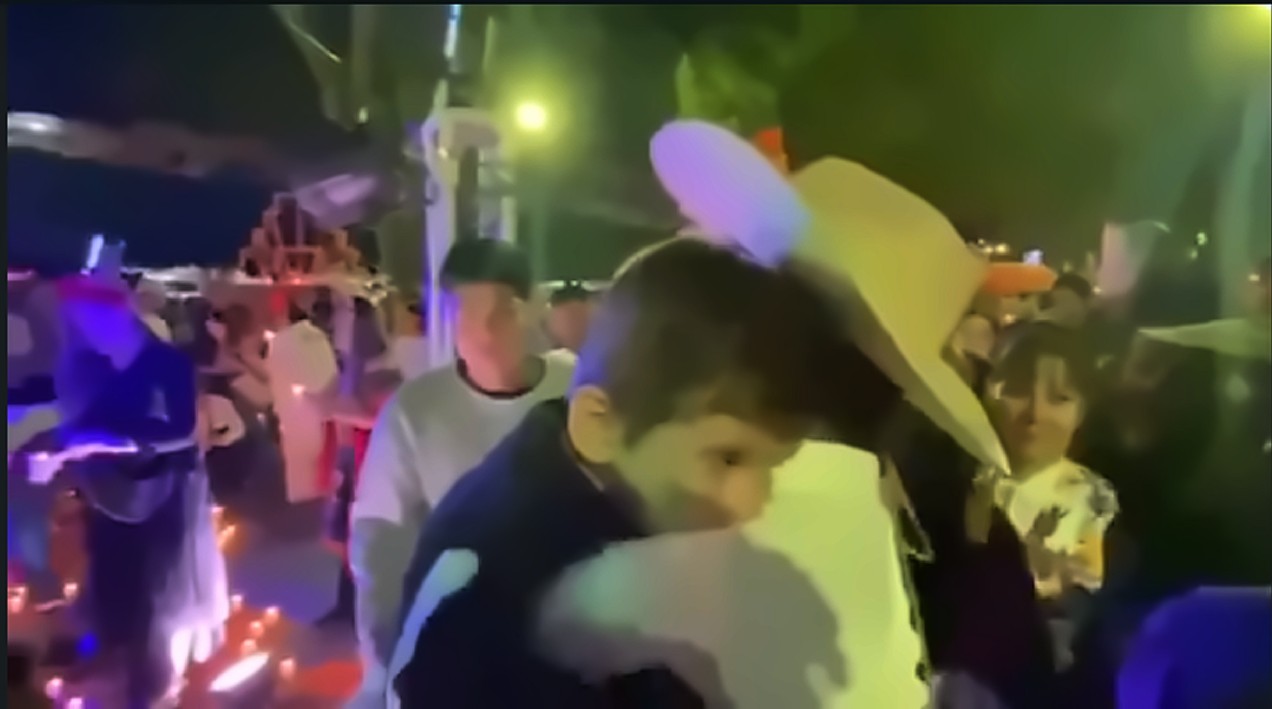
The image — 152 frames illuminated by fairground lights, blown up, and marked with a red circle — became the centrepiece of the official accusation. Shared across social media and broadcast outlets, it never originated from the official investigation and had not been extracted through any forensic protocol. It was a silhouette, not a suspect. And crucially, it was not the individual who shot Manzo.
What followed was a cascade of rushed, contradictory institutional claims.
This was not a harmless “imprecision.” It was the trigger of a disinformation chain that misled the public and diverted scrutiny from the real evidence.
The creation of a suspect: the myth of “El Cuate”
The face of the young man in the video — hoodie, posture, proximity to Manzo — was digitally manipulated. Media outlets, guided by official messaging, attached to it the name Osvaldo “El Cuate” Gutiérrez Vázquez, despite no authority having confirmed his identity.
On 4 November, two days after the killing, García Harfuch announced that the mayor’s attacker was “Osvaldo Gutiérrez Vázquez, alias El Cuate,” a 19-year-old relative of a man known as El Prángana, themselves allegedly linked to CJNG figures Ramón and Rafael Álvarez Ayala. He presented no evidence. No case file. No arrest. No body. No proof of the supposed family ties. No address. No digital trace.
He delivered only a name and an alias — dutifully repeated by the press without examining the claim’s origin.
The single image used to portray this supposed identity was a screenshot circulating on social networks: the grey-hooded man near the mayor, encircled in red. No one explained who captured it, its timestamp, or why it should count as evidence. It did not match any frame of the official video. Its origin was as dubious as the identity García Harfuch had proclaimed and continued amplifying through his AI-fed channel “México Ataca.”
Forensic analysis confirms manipulation and absence of original data
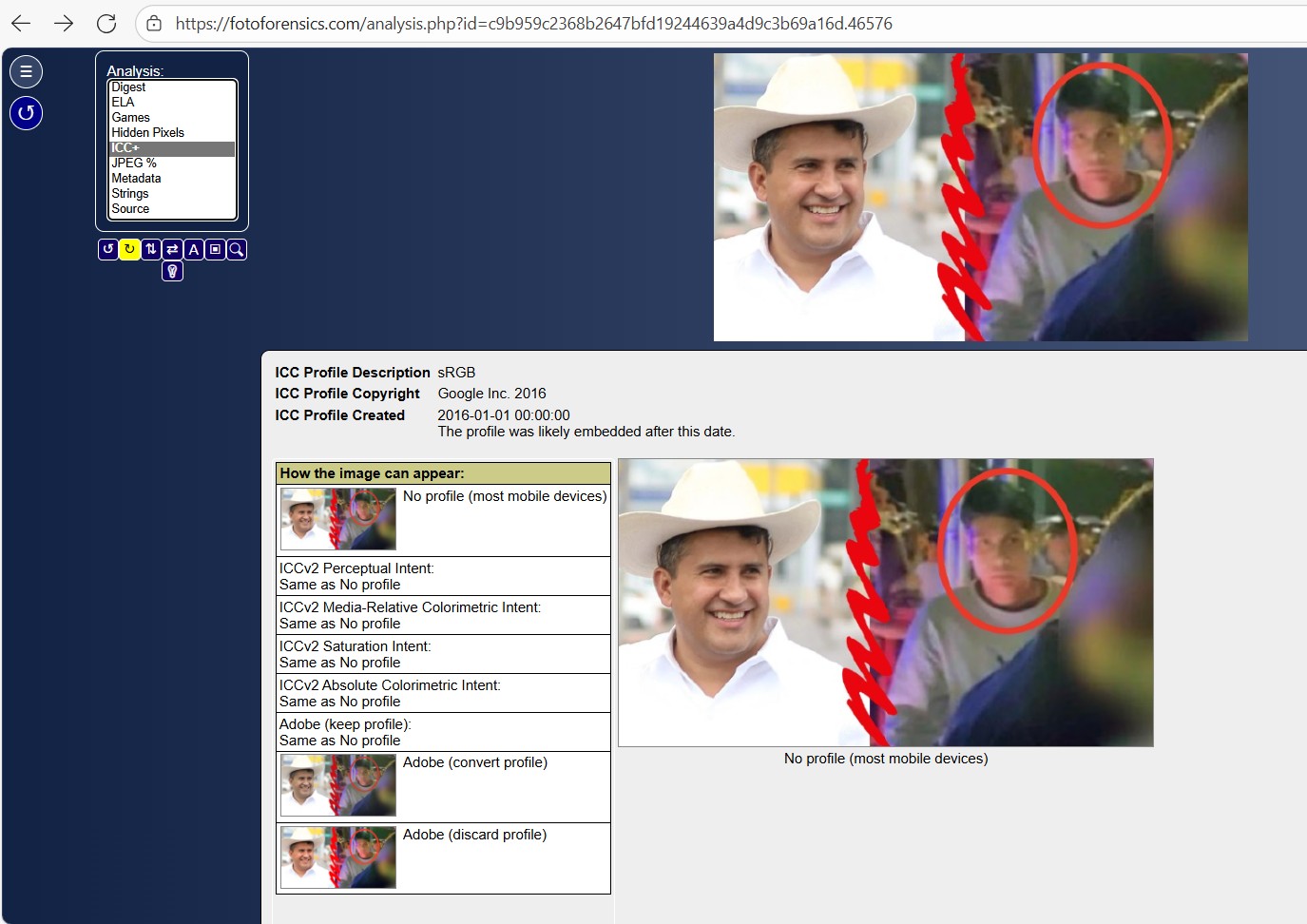
A FotoForensics evaluation found the image had been processed through a Google service (likely Chrome, Google Photos, Android WebView) and was not original to any camera. The JPEG was recompressed and resized. All EXIF data — camera model, timestamp, GPS, software — had been stripped, typical of screenshots or downloaded images circulated online.
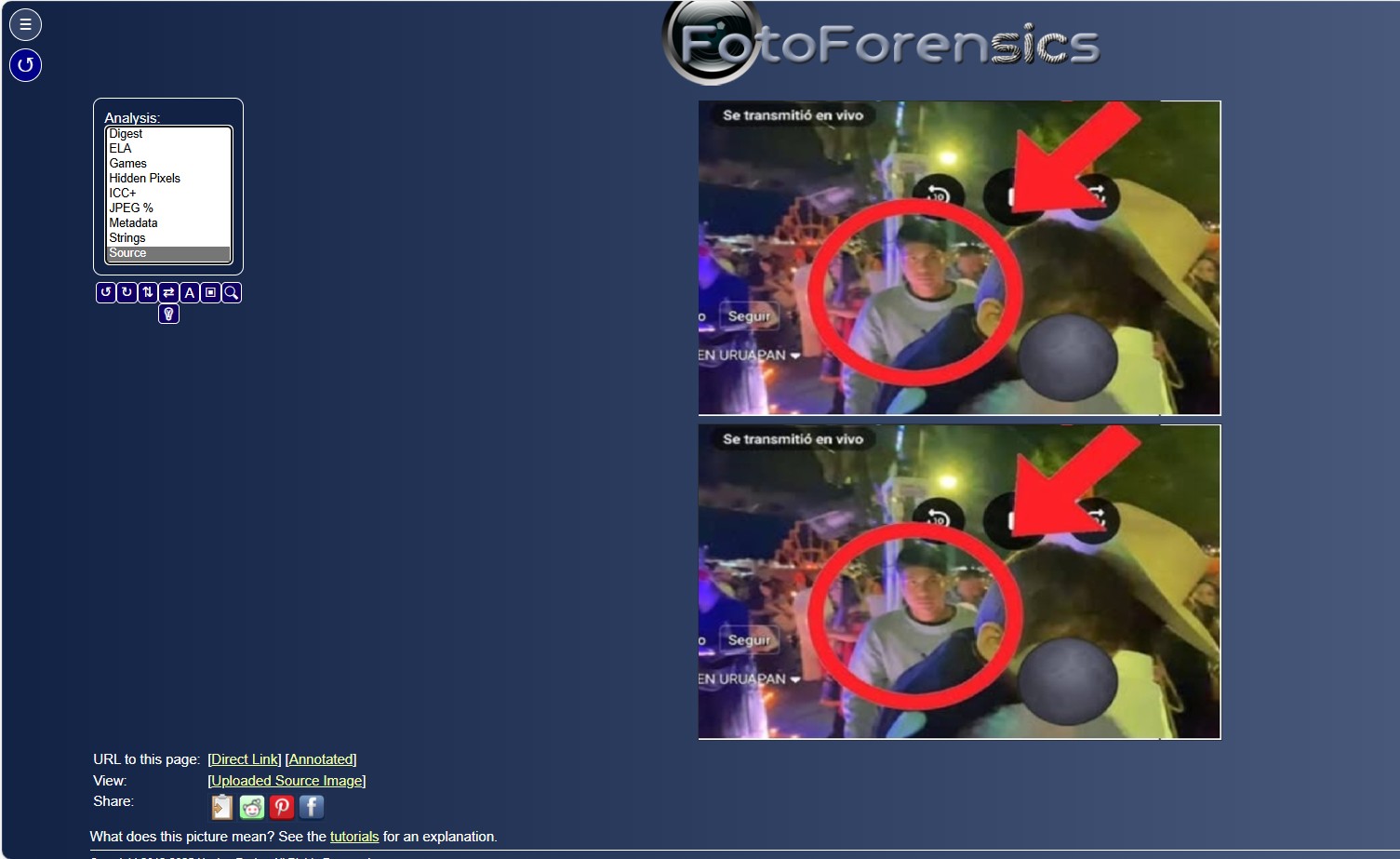
Visual analysis
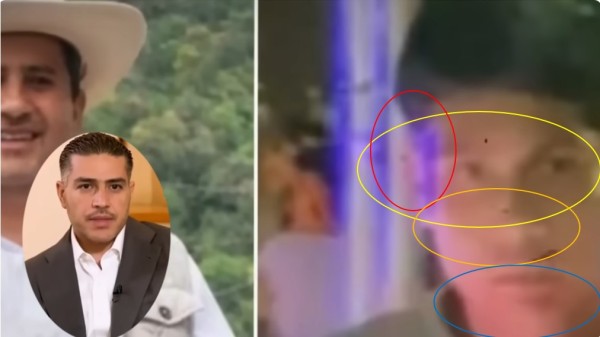
The right-side image — the supposed “Cuate” — appears blurry, taken at night, with police lights and heavy digital noise. Its quality sharply contrasts with the left-side image. The two halves were not captured at the same moment or with the same device. The red circle is a graphic overlay, not a tool used in police or surveillance systems. The composition is editorial, designed to contrast a “victim” against an “aggressor.”
Forensic analysis
The ICC profile corresponds to Google Inc. 2016 — a generic software profile, not one generated by a camera. The absence of EXIF data confirms the image’s original capture information was removed, a hallmark of edited compositions or re-posted assets.
Identification analysis
This was the first photograph in which the alleged “Cuate” appeared — already distorted, cropped and stripped of metadata. Presented as “proof,” it lacked any verifiable source. The face is overexposed, without defined contours, filled with artefacts and chromatic distortion, preventing reliable identification. No social-media profile or official photograph corresponds to it.
The real gunman: detained alive, then executed
Documentary verification demonstrates that the supposed identity of “El Cuate” was a fabrication. The widely circulated photograph does not appear in the event video, does not match the person visible in the scene, and does not correspond to the young man the prosecutor’s office presented as the material perpetrator.
The real gunman, Víctor Manuel Ubaldo Vidales, 17, was detained alive and executed minutes later by a police officer on 6 November. Authorities attempted to close the case abruptly — an approach consistent with earlier manipulation and the absence of a truthful investigation. Even the identity of the officer who shot Ubaldo was obscured: first it was attributed to the National Guard; later, García Harfuch claimed it was one of Manzo’s own municipal escorts.
His precise statement:
- “There is no evidence that the Municipal Police officers assigned to protect the mayor have links to organised crime. In fact, it was one of his own escorts who neutralised the aggressor.”
The lie of “El Cuate,” sustained by García Harfuch, not only misdirected public attention but helped conceal an extrajudicial execution and obstructed scrutiny of the political forces behind the mayor’s killing.
Governor vs prosecutor: contradictions deepen
After ten days of silence, Michoacán’s prosecutor Carlos Torres Piña addressed the press on 14 November, when asked if two bodies found on an Uruapan road on 10 November were tied to the assassination. His answer was cautious:
“This is what we are verifying. We hope to have more data and to share details about this matter, particularly regarding Carlos Manzo.”
The Pascal Bourne spokesperson emphasised to Los Ángeles Press that the prosecutor did not confirm anything. The investigation was still active.
However, this statement came after Governor Ramírez Bedolla had already declared — and media had reported — that the two deceased individuals were indeed linked to the murder. As of 14 November, the prosecutor had not endorsed the governor’s claim, while the governor had presented it as fact.
“The person leading the investigation is the state prosecutor, not the governor,” the spokesperson said. “To this hour, the FGE has no evidence it can present. No videos. No indications. Nothing to support that these two murdered people were linked to the Paracho hitman.”
One of the bodies was labelled only as “Josué, 16 years old.” The second had no identifying data. Despite this, the governor insisted both were connected to the crime and had been found along the Uruapan–Paracho highway.
A shifting narrative grows stranger
García Harfuch reappeared on 19 November, announcing that the two dead youths were not merely linked to the case but were its intellectual authors. He said they collaborated with a man he identified as “Jorge Armando,” alias “El Licenciado,” who allegedly issued instructions through WhatsApp and had been located in central Morelia.
Delivered with dramatic flair — though accompanied by verbal missteps — this new account relied heavily on unspecified “intelligence work” and claimed major security operations had been conducted to detain those responsible.
The Secretariat of Citizen Security concluded:
“The arrest of ‘El Licenciado’ is a key step in dismantling the criminal structure responsible for this attack.”
Prosecutor Carlos Piña has not appeared in public since.
