Guadalupe Lizárraga Viernes, 17 de Octubre del 2025, 04:42
Fernando Salgado turned to the Virginia-based law firm Clare Locke LLP to demand a retraction, apology, source disclosure, and prior review of future publications.
By Guadalupe Lizárraga
On October 12, 2025, the U.S. law firm Clare Locke LLP sent a threatening letter to Los Ángeles Press demanding "an immediate retraction, public apology, and cessation of all publications" related to my investigations into Fernando Rafael Salgado Chávez. The firm also demanded the disclosure of sources, prior review of future publications, and warned of potential litigation if these demands were not met.
Minutes after we responded to their October 12 letter addressing two specific reports, Clare Locke sent a second letter dated October 16, 2025, reiterating substantially the same demands—full retraction, public apology, and cessation of publications—while citing additional reports. This follow-up letter insists that “everything is false,” demands editorial pre-approval, and again strongly calls for the disclosure of sources. However, it fails to provide any documentary evidence to refute the specific facts published. The letter also claims that the right of reply was “denied,” despite never having been requested prior to these communications, and even though Los Ángeles Press offered a written and documented right of reply consistent with editorial standards.
The letters—unilaterally marked as “Confidential – Not For Publication Or Attribution”—are signed by attorneys Thomas A. Clare and Kathryn G. Humphrey, who claim experience representing “high-profile” clients. The correspondence accuses me of acting “with actual malice” and violating “the principles of professional journalism.”
The Virginia-based law firm asserts in its first letter that two recent reports contain “false and defamatory statements” about Fernando Salgado and demands “full and unequivocal retractions.” The targeted articles are titled: “Between Sinaloa and CJNG: The Business of ‘Marco Santelices’” (September 22, 2025) and “Grupo LAGSA Distances Itself from Ties to Fernando Salgado Chávez” (September 23, 2025). The second letter references three additional reports, making the same demands.
Extrajudicial Demands and Intimidation
The law firm Clare Locke, acting as legal representatives of Fernando Salgado, portrays the businessman as “a victim of drug trafficking violence” and “a respectable man” whose real estate and financial dealings are “legitimate and transparent.” In stark contrast, the letters label as “false” the journalistic references to his alleged ties to criminal organizations, despite Los Ángeles Press reports documenting business, corporate, and public proximity links with individuals sanctioned by the U.S. Treasury Department for drug trafficking and money laundering.
Salgado’s circle also includes officials close to Governor Marina del Pilar Ávila Olmeda, customs agents, doctors, event promoters, and political operatives affiliated with the Morena party. These figures have appeared as partners, intermediaries, or beneficiaries in real estate projects spanning Ensenada, San Diego, and Florida. Salgado has even shared or currently shares residences and offices with some of them in Tijuana and San Diego.
These connections are not mere speculation—they are supported by official records and visual evidence documenting personal and business relationships within a cross-border network of real estate operations, including LLCs registered in California and Florida.
Editorial Response
Los Ángeles Press will neither accept broad retractions nor submit to prior editorial control, will protect confidential sources, and will continue its coverage adhering to rigorous verification standards. In response to the initial letter, the outlet offered a documented rebuttal of up to 700 words, subject to editorial review, which was ignored.
The letters contain generic denials without providing specific evidence to refute the published facts, making this a clear attempt at private censorship of matters in the public interest.
SLAPP Suits: A Legal Intimidation Tactic
These types of letters are a form of private censorship aimed at shutting down public interest investigations through legal harassment. Although Los Ángeles Press operates transnationally, its legal base and protections are in the United States, making this not a local threat, but an international intimidation effort.
The engagement of Clare Locke LLP fits the SLAPP (Strategic Lawsuits Against Public Participation) pattern—tactics used to intimidate journalists and discourage investigations through costly legal threats or litigation.
The letters sent to Los Ángeles Press follow this pattern precisely: they do not contest the documented facts but seek to discredit them using legal and reputational arguments, portraying the businessman as a “victim” rather than a player in a visible network of interests operating simultaneously in Mexico and the United States.
Defense of Press Freedom
Since its founding, Los Ángeles Press has investigated corruption, human rights abuses, and money laundering networks on both sides of the border, protected by the legal safeguards of American journalism.
We will neither remove verified information nor reveal our sources. We will defend journalism using the same legal tools that are being wielded in an attempt to silence it.
Documented Facts
Within the business and political network operating in Baja California, Marco Antonio Moreno Gómez Santelices emerges as a key link: on one side, the business network tied by the U.S. Treasury Department to Jesús González Lomelí, part of the “Los Mayos” faction of the Sinaloa Cartel; on the other, the ecosystem of businesses and associates connected to Fernando Salgado, with ties to profiles linked by local media to the CJNG. Yet, figures from both groups are seen together in photos and share social circles.

OFAC and the “Los Mayos” Network in Rosarito
On September 18, 2025, the U.S. Treasury’s Office of Foreign Assets Control (OFAC) designated Jesús González Lomelí as a member of the “Los Mayos” network, adding him and 14 associated companies in Baja California to the SDN List. This move highlights Rosarito as a hub for extortion, money laundering, and the co-opting of local authorities on behalf of the Sinaloa cartel faction.
Baja California Attorney General’s Office Contracts with Moreno-Linked Companies
In the first quarter of 2025, the Baja California Attorney General’s Office paid 3.7 million pesos to two companies connected to Marco Antonio Moreno Gómez Santelices—Promociones CHF de BC and Fama Producciones—for “events” and services. Multiple media outlets have documented the amounts and timing of these transfers. This budgetary evidence confirms Moreno’s ongoing contractual relationship as a state supplier and alleged reporter “with access to confidential information,” who not only maintains a friendship with Fernando Salgado but also shares business ties, including shared office space and co-organizing events with the group La Familia Presenta.
 Paid advertising in Semanario Zeta to promote La Familia Presenta, owned by Fernando Salgado and represented by Marco Santelices.
Public Relationship Between Moreno and González Lomelí
Social media posts reveal photographs showing the close ties between Marco Antonio Moreno Gómez Santelices, Jesús González Lomelí, and Fernando Salgado—offering clear evidence of direct, public contact.
Fernando Salgado’s public record includes connections to Álvaro Vidal Velasco Castro, who has been linked in local media to operational ties with the CJNG. Vidal represents the other end of the network where Moreno operates through his business and media roles.
Key Evidence: Documents and Findings
Sources: Public records (commercial registries, Mexico’s National Transparency Platform), official documents from the U.S. and Mexico, OFAC extracts, original photographic material, U.S. corporate directories, and confidential interviews.
Axis 1 — Salgado and Álvaro Vidal Link (Jalisco)
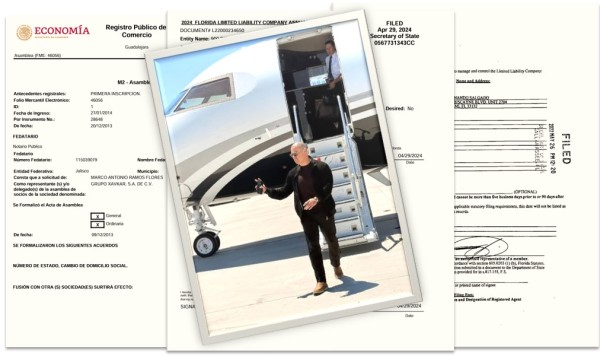
• Documents: Property registry records of Grupo Xavkar, S.A. de C.V., and administrative control by the Baja California Attorney General’s Office under Ricardo Carpio during social events.• What they prove: Appointment of administration and powers linking Álvaro Vidal Velasco and Fernando Salgado.• Journalistic relevance: Corporate and legal connection predating later denials made by Fernando Salgado.Axis 2 — State Supplier Marco Santelices
• Documents: Payment orders and contracts from the Baja California Attorney General’s Office to Promociones CHF and Fama Producciones, associated with La Familia Presenta.• What they prove: Ongoing budget flow from the security sector diverted to the entertainment circuit tied to Fernando Salgado and Marco Santelices, who is favored as a state supplier while acting as a “reporter with privileged access to information.”• Relevance: Institutional access point and potential conflict of interest, indicating alleged influence peddling.
Axis 3 — Santelices and Jesús González Lomelí (Rosarito)
• Documents: Public photographs showing direct interaction, alongside OFAC/SDN designation extract dated September 18, 2025.• What they prove: Close association with an OFAC-designated individual operating within the same sector (entertainment).• Relevance: Represents a reputational and political risk for a state supplier, suggesting potential influence peddling and narcotrafficking interference in government activities.
Axis 4 — LLC Structure (CA/FL) with Recurring Agent
• Documents: LLC records from California and Florida showing Fernando Salgado as a recurring agent/manager; matching addresses and a sequence of transactions among companies within the same network.• What they prove: The existence of a corporate architecture managing acquisitions and transfers of luxury properties through special-purpose entities, with timing and pricing consistent with money laundering typologies (layering and asset rotation).• Relevance: This scheme obscures the identification of the ultimate beneficiary and hampers the traceability of funds, aligning with patterns typical of money laundering and terrorist financing.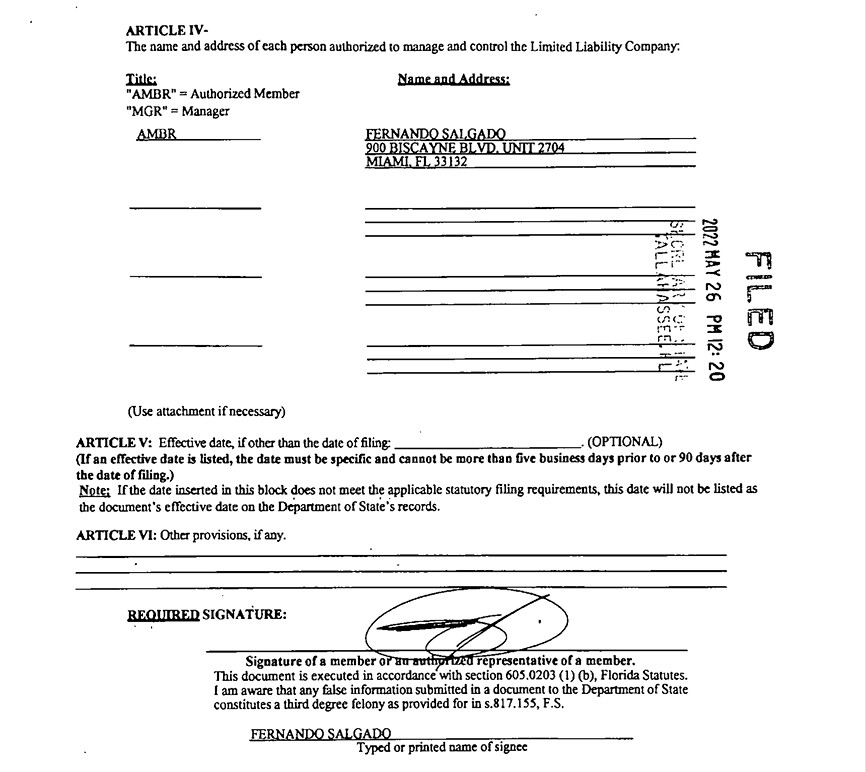 Formation of an LLC in Florida with businessman José de Jesús Hernández Fonseca, Grupo Centinela from Jalisco, and a beneficiary of the Bienestar program.
Axis 5 — Regulatory Interface: Pedro Montejo Peterson
• Documents: Municipal licenses, permits, and environmental-commercial authorizations.• What they prove: Ability to authorize or condition events and land use where the mentioned actors operate.• Relevance: Potential conflict of interest, suspected corruption, alleged influence peddling, and contracts awarded through direct municipal allocations.