
Rodolfo Soriano-Núñez Lunes, 25 de Noviembre del 2024
Gisèle Pelicot, 71, an ordinary woman who is now a world-renowned symbol of struggle, says French newspaper Libération about her sexual abuse case.
After being the victim of sexual abuse, she is the hero of millions of women: "I wanted all women who are victims of rape to be able to say 'Mrs. Pelicot did it, we can do it too'," she explains.
By Rodolfo Soriano-Núñez
In France, this will be a key week for Gisèle Pelicot. She was the victim of sexual abuse from her former husband. French newspaper Libération and other major media in France and Europe have been reporting on the potential outcomes of the ruling.
It is not as if there is an expectation that her former husband could be acquitted. Quite the opposite, Dominique Pelicot has already accepted his guilt, but at it is usual in cases like this he is playing a card frequently used by sexual predators: rendering himself as the victim of an illness leading him to seek sexual pleasure at all costs.
It will be up for the French judicial system if they buy that excuse and offer him some deal. Also, there are some doubts as to how many of the 51 males who abused Gisèle get some deal. Some of them claim Gisèle’s former husband “offered” her as part of some kind of sexual fantasy.
Back on Wednesday, November 20th, during the trial, Gisèle dismissed that idea asking “when you walk into a bedroom and see a motionless body, at what point (do you decide) to continue” with the alleged fantasy? She added, “Why did you not leave immediately to report it to the police?”
She was unaware of the extent of the abuse on her until, back in 2020, the police seized videos from Dominique. Then it was clear Giséle was the victim of some sort of elaborated abuse. That led to the probe that ultimately forced a trial.
As Libération and other French-speaking media stress out, Gisèle is now a symbol. Libération even calls her a “feminist icon” because she fought to allow for an open trial. French courts usually deal with this kind of cases in the most absolute secrecy.
The standard excuse for that is that the law protects the victims when, in actuality, French and other European and Latin American laws are set to protect the predators, with mechanisms as imposing punitive fines on media willing to use the full name of suspects.
Gisèle’s fight for an open trial forced a reconsideration from the French judiciary and even if the standard procedure remains a closed trial, at least victims of sexual abuse now have a chance to use Gisèle’s case as precedent to open their trials. It is not only about showcasing Dominique’s accomplices, but also to encourage other potential victims to come forward.
That idea is summarized in a now popular slogan in France that can be translated as “Shame must change side”, that appears in image showing support for Gisèle in France and elsewhere in Europe, as the image after this paragraph shows.
Gisèle also forced a reconsideration of French law regarding consent, since some of the 51 males accused of abusing Gisèle claimed, following old interpretations of marriage laws in France and Europe, that a husband had some right to “consent” the sexual abuse of his wife or his offspring. In that regard, Gisèle is an icon not only in France or Europe, but worldwide. The sentencing will happen around December 20th.
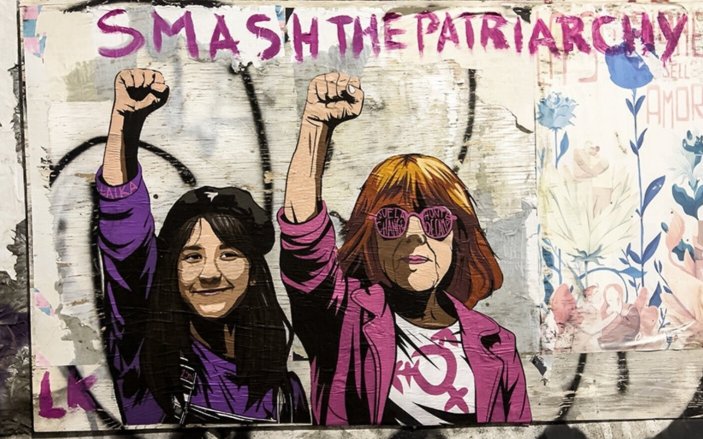
As a consequence of her case, there has been some reconsideration of other cases of violence against females in other European countries. An example appears as the main image of this piece. The graffiti has both Gisèle Pelicot and Giulia Cecchettin, an Italian college student whose then boyfriend, Filippo Turetta, murdered her on November 11th 2023.
Another cases in France
Also in France, Jean-Marc Sauvé, the former lead researcher of the most comprehensive probe on clergy sexual abuse came forward to address some concerns regarding his team’s silence on Roman Catholic priest Abbé Pierre’s cases.
Now we know that some of the victims of the French priest and war hero are in the sample of Sauvé’s landmark study. Los Angeles Press published also a profile of Abbé Pierre, linked after this paragraph.
He explained Roman Catholic newspaper La Croix last Monday, November 18th, that the participants in the study had an expectation of privacy and him and his team were willing to respect it.