Guadalupe Lizárraga Martes, 29 de Noviembre del 2011, 14:48
Years after multiple disappearances in Juarez, families uncover that authorities withheld bodies, exposing systemic failures, secrecy, and delays in identifying victims and delivering justice.
By Guadalupe Lizarraga
LOS ÁNGELES.- “They took too long to make a decision to release information,” said a public official in the halls of the prosecutor’s office, in reference to the body of Adriana Sarmiento Enriquez, who disappeared in Ciudad Juarez on January 18, 2008. Local authorities had kept the body at the facilities of the Forensic Office “for a long time,” without telling precisely how and why they had not informed her family.
Adriana was 15 years old when she was kidnapped. She and her friend Griselda took a bus from Allende High School to their home; they took the Juarez-Zaragoza route, and Griselda got off two blocks earlier. Adriana continued traveling; she was to get off the bus two blocks after her friend, on Miguel Ahumada Avenue. Then she had to walk on Francisco Javier Mina Street to take the second bus that would take her to the Mariano Escobedo neighborhood, where she was living with her parents. But she never made it home. On that particular route, where she was alone for about 12 minutes before reaching the other bus stop—the same route where three young women went missing on different dates—two of them were also killed, and their bodies are still at the morgue; the third one was identified among the audience of a TV show in Los Angeles, California, and she is still missing.
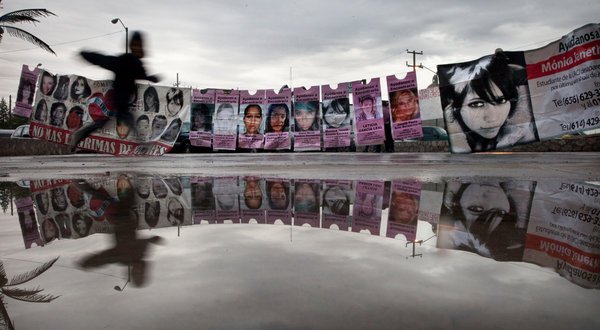
Sarmiento’s mother published her daughter’s missing information on several digital sites, asking for the public’s help. She also posted notices in the city’s downtown. However, because she was devastated, she was not able to continue working along with other mothers whose daughters were also missing.
Bodies kept for years in the morgue
“The body of Adriana Sarmiento was retained in the Coroner’s Office for about a year or more,” said a source from Los Angeles Press. This case is similar to that of Hilda Gabriela Rivas Campos, 16 years of age. She went missing in February 2008 and was murdered the same year. Her body was found at Kilometer 57 in Valle de Juarez and was kept in the Coroner’s Office for three years, until authorities decided to notify her mother on September 27, 2011, saying they had to conduct DNA testing to compare it with the sample her family had already provided.
Carmen Castillo, mother of Monica Liliana Delgado Castillo, did not have to wait that long to recover her daughter’s body. Monica disappeared in January 2011, when she was 18 years old. Her body was found in the same spot as Hilda, Kilometer 57, a few days after she was murdered. It was released to her family nine months later, along with Hilda Gabriela’s, on the same day, September 27, 2011. This occurred during a press conference organized by the State of Chihuahua Attorney General’s Office. Carmen Castillo decided not to be present.
According to my source, seven bodies also remain unidentified. Authorities have not informed the community about these remains, found in the Loma Blanca area of Valle de Juarez. It is still unclear how long they were kept at the Coroner’s Office or why this information was withheld. Meanwhile, many mothers continue searching for their missing daughters, going to the Attorney General’s Office demanding answers about their whereabouts and updates on ongoing investigations.
The body of Jazmin Villa Esparza is another case that remains in the forensic system. She disappeared on October 3, 2010, at the age of 13, and was later found murdered in the town of San Agustin, according to a confidential source from Los Angeles Press. To date, there has been no official information from the Coroner’s Office.
Her mother, Isela Esparza Morales, said in February 2011, referring to the District Attorney’s Office, that “they did not look for my daughter; nobody cared about her because there was not even an investigation.” She received no help or information, while her daughter’s body was likely lying in the morgue the entire time.
15 Bodies more
Recently, the District Attorney’s Office found 15 additional female bodies buried in a mass grave in the Valle de Juarez. Authorities have not officially disclosed this information or the location of the grave. Some of the bodies held at the Coroner’s Office were found nude, while others were clothed. The victims range in age from 17 to 20. Several show signs of violence, torture, and mutilation.
A Los Angeles Press source said officials appear to struggle with how to release the bodies to their families. “It seems they withhold them willfully. Maybe they don’t want to confront the terror and anguish of the families; it is the same story since 1993—nothing has changed,” the source said.
Of the 26 bodies of women retained in the morgue, including Adriana Sarmiento, only two have been identified and returned to their families: Hilda Gabriela Rivas and Monica Liliana Delgado, found at Kilometer 75. Another body has been identified as Jazmin Villa Esparza, found in San Agustin, but her mother has not been notified. Seven unidentified bodies were found in Loma Blanca, and 15 more—also unidentified—in the Valle de Juarez, without specifying the town.
The District Attorney’s Office faces mounting questions from the mothers of missing girls in Juarez. Meanwhile, key questions remain: Where were the bodies found? How long had they been buried? How long have they been in the morgue? Why don’t authorities release information? Why do they hide evidence? Who are these young women, and when were they last alive?
Translation by Bertha del Rivero