
Rodolfo Soriano-Núñez Lunes, 31 de Julio del 2023
A Trump sympathizer, Verástegui can impact the Mexican presidential election even if he is defeated.
The answer to that question lies in the relationship Verástegui enjoys with Patricio Slim Domit, the youngest son of Mexican telecom mogul Carlos Slim
By Rodolfo Soriano-Núñez
This is a brief account of how Eduardo Verástegui transitioned from being soap opera actor, the so-called Mexican telenovelas, to a figure in the coalition that allowed Donald Trump to become president of the United States in 2016, and how he is trying to impact the Mexican presidential election of 2024.
The account is relevant in both Mexico and the United States. Both countries will hold presidential and Congressional elections in 2024. Mexico, on the first Sunday of June, and the United States on the Tuesday of the first week of November.
Verástegui not only identifies himself as sympathizer of Trump. Back in 2020, Trump appointed Verástegui as liaison of the White House with the Hispanic and Latino communities in the United States, and offered a position in Trump’s government had he won the election that year.
In Mexico, Verástegui leads a movement called Viva México, and is a potential presidential candidate for the 2024 election. Moreover, Trump and his allies have boosted a potential presidential run for Verástegui, since 2017.
Said run was heralded first on November 25th, 2017, by ACI Prensa, a Spanish-speaking Catholic media outlet.
Three days later, ACI Prensa’s English-speaking twin, Catholic News Agency, or CNA, published an English translation of the same story highlighting Verástegui reconciliation with his faith and his commitment to Conservative Catholic values.
They did so after Mexican newspaper El Universal ran a story on Verástegui potential run as candidate of the Partido Encuentro Social, on November 22nd, 2017. Four months later, that party, joined the coalition endorsing current president of Mexico, Andrés Manuel López Obrador.
Both ACI Prensa and CNA used to be the property of the so-called Sodalitium of Christian Life, a Peruvian Catholic religious order, currently probed by Maltese archbishop Charles Scicluna, due to the sexual abuse reported there for the last 20 years or so.
EWTN, the U.S.-based Catholic media giant bought in 2014 both outlets and other smaller in German and Italian, when the sexual abuse scandal in Peru regarding the Sodalitium was affecting the credibility of their news outlets. EWTN did something similar with the National Catholic Register, that used to be the property of the Legion of Christ.
After ACI Prensa and CNA, the more extreme right-wing media outlet Church Militant described Verástegui as “a popular Catholic actor and producer (who) is considering running in the country's 2018 presidential elections.”
Must be noted that Church Militant was dismissed back in June, 2020 as a Catholic media outlet by Allen Henry Vigneron, the archbishop of Detroit, where they are located, after a racist attack on the former chair of the U.S. Catholic Conference of Bishops, and current archbishop of Washington, D.C., Wilton Gregory.
Change in dynamics
Six years later, there is a change in the dynamic. Now, the first news about a potential run for Verástegui were issued when Donald Trump himself joined a screening of Verástegui latest movie, Sound of Freedom, at his Mar-a-Lago resort in Florida.
That day, Trump issued a press release stating the mutual support for their respective campaigns both sides of the Rio Grande.
Questions remain as to why Trump endorsed Verástegui as early as he did it. Trump enjoys a good relationship with current President López Obrador, or AMLO, as he is known in Mexico, and Verástegui is not perceived in any way as close to AMLO’s party, the so-called Morena, Movimiento de Regeneración Nacional or his movement, the so-called Fourth Transformation.
AMLO went as far as to wait until December 16th, 2020, to congratulate Joe Biden on his win over Trump. He did it 38 days after as it usually happens in the United States, the media called the election and more than 30 days after other sitting presidents or prime ministers did it.
Justin Trudeau, Canadian Prime Minister did it on November 7, four days after the election happened, as did most other foreign leaders, even those closer to Trump’s brand of Conservative populism. Boris Johnson, then British Prime Minister did it the same day Trudeau did it in Canada.
Why Verástegui?
So, why does Verástegui enjoy such support from Catholic media organizations and Donald Trump himself?
The answer to that question lies in the relationship Verástegui enjoys with Patricio Slim Domit, the youngest son of Mexican telecom mogul Carlos Slim, owner of América Móvil (AMX in the New York Stock Exchange).
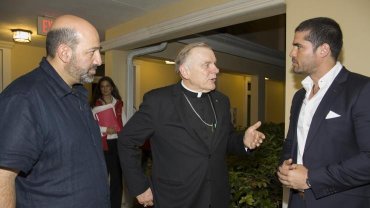
It is hard to find out public displays of the relation between Verástegui and Slim. One of the very few cases lie deep in the old archives of the Website of the Archdiocese of Miami. Back in 2013, back then, both Verástegui and Slim attended a mass presided by archbishop Thomas G. Wenski.
Wenski celebrated the mass to “consecrate City of Miami to the Sacred Heart of Jesus and the Immaculate Heart of Mary,” as the official statement says. It adds: “members of the Mission for the Love of God Worldwide” coordinated the mass. It also states that “those in attendance represented the many lay movements in the archdiocese, along with priests and religious from throughout South Florida.”
Wenski or his Master of Ceremonies appointed Verástegui to do the first reading of the Mass, and there are at least three pictures of Verástegui, Slim, and Wenski celebrating the consecration in the gardens of the Cathedral.
Verástegui doing the first reading at the mass presided by Wenski, May 30 2013.
Catholic culture sees these consecrations as protection against the evils of Communism and Marxism. That was the original intent when they became part of Catholic culture, after the alleged appearances of Mary mother of God, to three shepherds in rural Portugal, in what nowadays is the sanctuary of Our Lady of Fatima.
Part of the message issued by the Virgin herself to the shepherds asks to consecrate both the world but especially Russia to the hearts of both her and her son to guard off the evils of Communism.
Miami is a hotspot of anti-communist speech and practice. It has been ever since members of Cuban exile made Miami and Florida at large their home after fleeing Cuba in the late 1950s and early 1960s, so the consecration to the hearts of Jesus and Mary is a perfect match for the kind of Catholicism practiced in that city.
Tomás Regalado, then mayor of Miami; Archbishop Wenski; Eduardo Verástegui and Patricio Slim, May 30, 2013.
The Mission for the Love of God Worldwide is a Catholic global organization founded by John Rick Miller. Miller, who died in 2015, was a close ally of Patricio Slim. So much that, back on May 2014, when Miller’s health was already on decline, Slim received in his name one of Colombia’s highest distinctions.
The Congress of Colombia awarded Miller with “the order of merit as Grand Knight of the Nation of Colombia in recognition for his work and dedication to evangelize the Colombian people in the context of the Catholic faith.”
Also on that day, Jesuit Colombian bishop Juan Vicente Cordoba Villota delivered a “Plaque of Recognition” from the Colombian bishops to John Rick Miller “for the work he has done in Colombia”.
Cardinal Rubén Salazar Gomez, and 22 archbishops and bishops of Colombia signed the plaque.
One can get a glimpse of the kind of work Miller was doing in Colombia watching the video, produced by The Mission of Love itself, that appears at the end of this piece.
A couple of months before, in February 2014, a dozen Mexican bishops delivered a similar plaque to Miller in Tijuana. Among them it is possible to see the name of the Archbishop of Monterrey, and current chair of the Mexican conference of Catholic bishops, Rogelio Cabrera López.
Plaque awarded to Miller with the signatures of Mexican bishops and priests, February 18, 2014.
The Mission of Love claims having active members in fifteen out of thirty-two states in Mexico. As of the early 2010s, they claimed to have consecrated to their mission a flock of four million who, in the presence of the civil authorities and the bishops of their city or region adhere to the ideals of Miller’s organization.
The Mission of Love itself emphasizes the need to have the civil authorities as part of the consecration. It is a key part of the process and devised by Miller and his associates at the Mission of Love.
Next week I will continue dissecting the relationship between Verástegui, Slim, and key political players and religious leaders in both Mexico and the United States.