
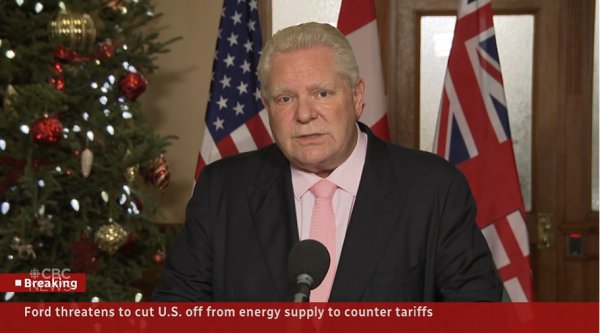
Doug Ford points out that Canada is not the problem: "The problem lies with China and Mexico, with unfair trade practices that affect both the U.S. and Canada."
Los Ángeles Press
Ontario Premier Doug Ford issued a strong warning to the United States, stating that if President-elect Donald Trump follows through on his threat to impose 25 percent tariffs on Canadian goods, Ontario will not hesitate to cut energy exports to several U.S. states.
In response to Trump’s threat, Ford made it clear that the province will use “all the tools at its disposal,” including halting electricity supplies to states like Michigan, New York, and Wisconsin, which rely heavily on Ontario’s energy exports.
“We will go as far as necessary, depending on how far this goes. We will cut off the energy we’re sending to their states. I don’t want this to happen, but my number one priority is to protect Ontario, Ontarians, and Canadians. We are the largest province, and we have a responsibility,” Ford said, emphasizing that Ontario’s response will be firm and resolute.
Energy Trade Under the Spotlight
Ontario is one of the largest exporters of electricity to the U.S., powering 1.5 million homes in 2023, particularly in key states like Michigan, Minnesota, and New York. Canadian electricity represents a crucial part of the energy supply in these states, giving Ontario significant leverage in the bilateral relationship. Ford highlighted that energy accounts for about one-third of trade between the two countries, with daily cross-border goods and services amounting to over CAD $3.6 billion (USD $2.7 billion).
Ford stressed that the trade relationship between Canada and the U.S. is vital not only for Canada but also for the economic well-being of the United States. “Any attempt to impose tariffs on our products will not only affect us but also harm the U.S. as well,” Ford warned, reminding that the U.S. is Canada’s top trading partner and daily trade interactions are crucial for both countries.
Ford Clashes with Trump: “We’re Not the Problem”
Ford was also firm in addressing Trump’s accusations, which have linked trade tensions to border security issues and the flow of fentanyl from Canada. “What I’m telling the president is that we’re not the problem. The problem lies with China and Mexico, who are engaged in unfair trade practices affecting both the U.S. and Canada,” Ford said in an interview with CNBC.
Ford sharply criticized Trump’s statements, pointing out that the real cause of trade issues lies in unfair trade practices by other countries, such as China and Mexico, not the commercial relationship between Canada and the U.S. “What’s happening is that China is sending parts and cars to Mexico, and Mexico labels them as ‘Made in Mexico’ before shipping them to the U.S. This is affecting jobs in both the U.S. and Canada,” Ford added.
Ontario Premier Doug Ford has made it clear that the province will take strong measures to protect its interests if U.S. President-elect Donald Trump follows through on his threat to impose 25 percent tariffs on Canadian goods. In a series of recent statements, Ford emphasized that Ontario would not hesitate to cut off its energy exports to key U.S. states, such as Michigan, New York, and Wisconsin, in retaliation.
Ford also reiterated that while border security is primarily a federal responsibility, Ontario is committed to supporting Ottawa’s efforts to reinforce security along the Canada-U.S. border. In a recent virtual meeting with Prime Minister Justin Trudeau, Ford requested additional officers from the Canada Border Services Agency (CBSA) and the Royal Canadian Mounted Police (RCMP) to be deployed in Ontario. Furthermore, Ford called for enhanced coordination between law enforcement agencies, more drones at the border, and an increase in the number of patrol dogs.
Energy Trade at the Center of the Dispute
Ontario’s energy exports play a critical role in the relationship between Canada and the U.S., with the province supplying electricity to 1.5 million U.S. households in 2023, particularly in states such as Michigan, Minnesota, and New York. As one of the largest exporters of electricity to the U.S., Ontario holds significant leverage in the trade relationship. Ford highlighted that energy constitutes around one-third of trade between the two nations, with daily goods and services crossing the border valued at over CAD $3.6 billion (USD $2.7 billion).
Ford stressed that the economic interdependence of Canada and the U.S. means that any move to impose tariffs on Canadian goods will not only harm Canada but also hurt the U.S. economy. “Any attempt to impose tariffs on our products will damage the U.S. economy just as much as ours,” Ford warned, reminding that the U.S. is Canada’s top trading partner and that both countries rely heavily on daily trade exchanges.
Ford Rejects Trump's Claims, Blames China and Mexico
Ford strongly rejected Trump’s accusations, which have linked trade tensions to issues of border security and the illicit flow of fentanyl from Canada. “What I’m telling the president is that we’re not the problem,” Ford said in an interview with CNBC. “The real problem lies with China and Mexico, who are involved in unfair trade practices affecting both the U.S. and Canada,” he added.
Ford criticized Trump’s stance, pointing out that the real source of trade issues comes from other countries, such as China and Mexico, not the Canada-U.S. relationship. “What’s happening is that China is sending parts and cars to Mexico, where they’re labeled as ‘Made in Mexico’ before being shipped to the U.S. This is impacting jobs in both the U.S. and Canada,” Ford explained.
Ontario’s Advertising Campaign to Strengthen Ties with U.S.
In an effort to reinforce the economic and cultural ties between Ontario and the U.S., the Ontario government has launched a multi-million-dollar advertising campaign in the U.S. The campaign underscores the interdependence of the two economies and highlights Ontario’s critical role as a trade partner.
Ontario’s Minister of Economic Development, Vic Fedeli, also traveled to Washington, D.C., where he met with U.S. officials. Fedeli emphasized the importance of energy trade between the two countries, noting that 60% of U.S. oil imports come from Canada. He warned that imposing a 25% tariff on this trade would have devastating effects, potentially causing gasoline prices in the U.S. to skyrocket.
The Future of Canada-U.S. Relations: Tensions on the Horizon
Despite Ford’s firm stance, he emphasized that Canada’s goal is to maintain a cooperative relationship with the U.S. and that his position is not one of confrontation. “We are here to strengthen our relationship, not damage it,” Ford said, reinforcing that Ontario’s actions are meant to protect the province’s and Canada’s interests, not to escalate tensions.
However, Ford made it clear that if Trump persists with his tariff threats, Ontario will not hesitate to take the necessary steps, including cutting off energy supplies, to safeguard its own economic and strategic interests. “We will use every tool at our disposal to defend Ontario and Canada,” Ford stated.
The Trump transition team has not yet responded to Ford’s warnings or the Ontario government’s comments. Nonetheless, Ford’s statements highlight the growing tension between the two countries and underscore the potential consequences if trade disputes intensify. With energy exports playing a pivotal role in the Canada-U.S. trade relationship, Ontario’s strategic leverage is becoming a key factor in the unfolding dispute.
As tensions mount, it is clear that Ontario is prepared to defend its position firmly in the face of potential U.S. tariffs, underlining the critical role energy plays in the province's economic and political strategy.
Para leer el artículo en español aquí.