
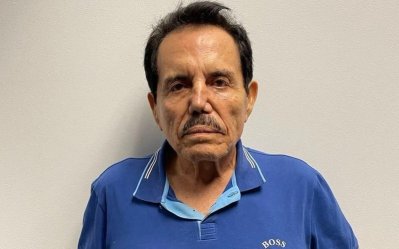
"My client did not surrender or negotiate any terms with the U.S. government,": Zambadas´s Lawyer.
New account emerges on Zambada's capture
The capture of Ismael "El Mayo" Zambada, the elusive leader of the Sinaloa Cartel, has raised numerous questions regarding its implications for the War on Drugs, the bilateral relationship between Mexico and the United States, and especially the circumstances of his transfer to U. S. authorities.
Following the announcement that Zambada was apprehended alongside Joaquín Guzmán López, son of Joaquín El Chapo Guzmán, several conflicting accounts have emerged. Initial reports suggested Zambada may have negotiated his surrender under certain conditions, while others indicated he was deceived by members of his own organization.
Statements from Zambada’s lawyer
Recent developments appear to support the latter scenario. Keegan Hamilton of The Los Angeles Times shared text messages from Frank Pérez, Zambada's lawyer, who asserts that Zambada did not surrender voluntarily or negotiate terms with the U.S. government.
"My client did not surrender or negotiate any terms with the U.S. government," Pérez stated. "Joaquín Guzmán López forcibly took my client. He was ambushed, thrown to the ground, and bound by six men in military uniforms and Joaquín himself. His legs were tied, and a black bag was placed over his head. He was thrown into the trunk of a truck, transported to an airstrip, and coerced onto a plane to the United States against his will. The only people on the plane were Joaquín, the pilot, and my client."
Deception or negotiated surrender?
On the other hand, Alan Feuer and Natalie Kitroeff of The New York Times suggest that the capture might have involved deception. According to U.S. officials who spoke to the paper, Zambada had been negotiating the terms of his surrender to the U.S. government for at least three years, possibly seeking protection for his family and considering cooperating as a witness.
Similarly, reports indicate that Joaquín Guzmán López had also been negotiating his own surrender with U.S. authorities since his father’s arrest.
Conversely, journalists such as Jesús Esquivel of Proceso and Luis Chaparro, formerly with Vice, have reported that Zambada's surrender was voluntary and coordinated in advance with U.S. officials.