
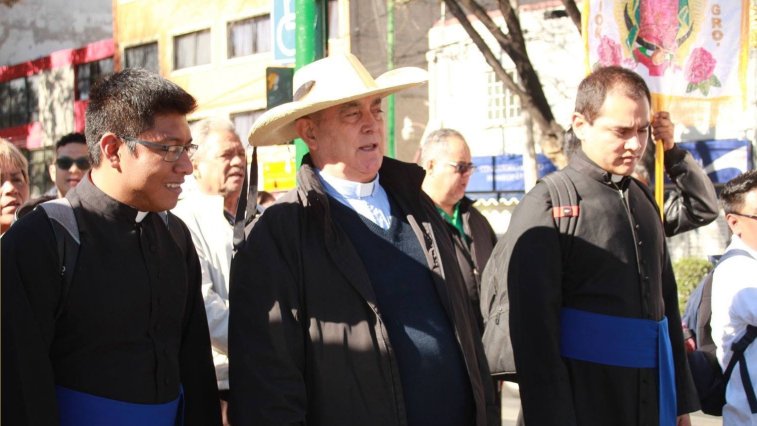
Rodolfo Soriano-Núñez Domingo, 05 de Mayo del 2024
News of the emeritus bishop of Chilpancingo going missing, marked an awful week for the Mexican Catholic Church.
The disappearance of Salvador Rangel, the 78-year-old emeritus bishop of the capital city of the state of Guerrero rapidly turned into a mediatic nightmare for the Catholic Church in Mexico.
By Rodolfo Soriano-Núñez
In a country where massacres, kidnappings, clandestine mass graves, and other acts of violence are as common as corn tortillas, news of a missing Roman Catholic bishop grab immediate attention from the media.
That is what happened last Monday when, around noon, the social media accounts of the Mexican Conference of Roman Catholic Bishops, CEM as it is known in Spanish, issued a communiqué about the disappearance of Mgr. Salvador Rangel Mendoza, a Franciscan, bishop emeritus of Chilpancingo, the capital city of the state of Guerrero, located 220 kilometers or 130 miles south of Mexico City.
Guerrero has been for the last 60 years, at least, the epicenter of a pandemic of violence in Mexico. It was there where the Mexican Dirty War played out some of its dirtiest episodes during the 1960s and 1970s.
Although less brutish than the military regimes of Argentina, Brazil, or Chile, the Mexican civilian authoritarian regime of the time had as one of its by-products an undetermined number of victims whose whereabouts remain unknown, hence the emergence of the category of the so-called “disappeared.”
In Guerrero, the disappeared are the legacy of the large-scale operations of the Mexican Armed and security forces chastising the leftist guerrillas of the 1960s and 1970s, who used the difficult geography and bad highways to their favor. Bad in the sense of being prone to frequent landslides, making hard to maintain highways and next to impossible to build a railroad connecting its major city and port of Acapulco to the rest of the country.
In 1974, one of those guerrillas kidnapped Rubén Figueroa, then governor-elect of the State of Guerrero. It was up to Sergio Méndez Arceo, then bishop of Cuernavaca, the capital of the neighboring state of Morelos, to become the intermediary in the negotiations leading to Figueroa’s release.
Once the fury of the Mexican armed forces obliterated the leftist guerrillas in Guerrero, local, national, and international criminal organizations emerged sheltered by the isolation provided by the rough geography of the mountains of the Southern Sierra Madre.
At the national and international level, the most significant of those organizations are the so-called Cartel of Sinaloa and the Cartel Jalisco New Generation. Although there are local gangs claiming to be partners with any of those two (or other) criminal organizations, it is harder to identify who are the main actors, and more so who are their partners in the state and national governments.
Dangerous liasons
As hard as when, back on October 16th, 2020, the U.S. government arrested the former (2015-8) Mexican minister of Defense, general Salvador Cienfuegos Zepeda at the Los Angeles International Airport. U.S. Authorities identified Cienfuegos as El Padrino, The Godfather of a broad network of members of criminal organizations and top officials of the Mexican armed forces. Said role, earned him charges of money laundering, and large-scale drug trafficking that the Mexican government dismissed.
The same rough geography that made Guerrero a hotbed for leftist guerrillas facilitates the activities of criminal organizations relentlessly trying to become the key players, although the Sinaloa and Jalisco cartels control the main routes to traffic drugs to both the United States and Europe.
That geography also keeps rural communities in Guerrero and other states of the Mexican Deep South isolated so, despite the massive demographic change breaking up the monolith that was religious preference in Mexico, the Catholic Church remains a major player in Guerrero.
Its four dioceses headed by the archdiocese of Acapulco and its suffragans of Chilpancingo-Chilapa, Tlapa, and Ciudad Altamirano, have a small army of more than 400 priests, forty-nine male religious, and 387 nuns, spread over 252 parishes, making the Catholic Church one of the few institutions with a true state-wide presence and, by far, the largest provider of religious services in the state.
To further complicate the role of the Church in Guerrero, four municipalities in the state belong to the diocese of Lázaro Cárdenas City, located in the neighboring state of Michoacan. At the same time, the diocese of Altamirano City takes municipalities such as Tlatlaya and Tejupilco, from the State of Mexico, as the map immediately after this paragraph shows.
Hence its ability to become a counterweight of sorts for the national and state governments and a voice with a degree of independence when dealing with national and state-wide issues, as in the case of violence.
Must be noted that, despite the amnesty issued back in 1978 by then President José López Portillo to end the so-called Mexican Dirty War, the many political reforms that have happened since the mid-1960s, and the hand-over of the state and national government from the single ruling party of yore, the Institutional Revolutionary Party or PRI after its name in Spanish, to others at the national and state level, violence remains constant in Guerrero.
The “Disappeared”
An example of how prevalent such violence is that, back in September 2014, a group of 43 students at the Teachers’ College of Ayotzinapa, a town 150 kilometers or ninety miles North of Acapulco, entered the limbo of the “disappeared”, since, there are no corpses or remains to know what happened to the students.
What is worse, the federal government at the time, led by Enrique Peña Nieto and with The Godfather Salvador Cienfuegos, as his secretary of Defense, seized the probe from the state officials.
Instead of providing a solution to the issue, the federal officials were more interested in protecting the Mexican Army’s reputation than in addressing what many believe was a massacre coming out of obscure dealings between the Army, the state government, and different criminal organizations pumping out poppy from the Guerrero highlands into the international markets.
Behind the prevalent violence over the last 70 years or so, lays the fact that economic development in Guerrero benefits the richest. Despite the glories of yore of Acapulco and Ixtapa, as two of the most famous beach destinations of the country, inequality and poverty run rampant in Guerrero. Economic development centered around those two tourist centers, concentrates wealth and opportunities in the few who can provide services to the visitors.
And, as it happens elsewhere, large-scale tourism destroys natural resources, and in Acapulco it has already harbored mega disasters as the hurricane Otis. Back on October 25th, 2023, Otis destroyed Acapulco after less than five hours of intense rains, followed by floodings, the collapse of public and private buildings, and the obliteration of thousands of private homes.
The public schools lack the most basic equipment, and most towns in the so-called Tierra Caliente (Hot Lands) are known nationwide in Mexico because of a massacre in their territories over the last 60 years or so.
On top of that, cannabis and poppy are crops as common in the Guerrero highlands that peasants surviving on them bring part of their harvest to their parishes to comply with the annual tithe.
Nobody should be surprised that, in such scenario, marred by violence and death, the Catholic Church remains a powerful institution.
It was in that context that bishop Salvador Rangel Mendoza left Huejutla, a see in the state of Hidalgo, to become in June 2015, head of the diocese of Chilpancingo-Chilapa. Observers of what happens in the Catholic Church in Mexico saw his arrival to the capital of the state of Guerrero as a positive decision of Pope Francis.
Contending explanations
His predecessor, now bishop emeritus Alejo Zavala Castro, left the diocese two years before hitting the 75-years mark. Although it is not clear what happened there, it is clear that health was nothing but an excuse to justify Zavala Castro’s early dismissal.
The contending explanations see Zavala Castro’s departure as a response to indiscipline among the 140 or so priests in that diocese. More precisely, he would have been covering up sexual abuse and other infractions to the Church’s rules on celibacy of its clergy.
Even if that is factually possible, three Catholic priests from different dioceses in that state died back in 2014. Priests John Ssenyondo, originally born in Uganda, Ascención Acuña Osorio, and Gregorio López, died at separate times in 2014 as victims of violence in circumstances that remain unknown almost ten years after their assassinations.
One year before, in 2013, father Óscar Prudenciano, a priest in Iguala, was also victim of an attack. He only saved his life because another criminal gang confronted those who attacked him and, in the middle of the mutual attacks with guns, he was able to escape.
The expectation was that Rangel Mendoza, with a reputation of being closer to the faithful and less prone to the clericalist attitudes of most Mexican bishops would help address the issues in the Catholic Church in Chilpancingo, the capital city of Guerrero.
At first, Rangel Mendoza was delivering the goods. He made repeated calls to the heads of the criminal gangs active in Guerrero to avoid violence, and some of them were willing to attend meetings, although it is almost impossible to measure the precise effects of the bishop’s messages.
Rangel Mendoza’s preaching on violence and the need to find a solution to it has been a source of conflict for him ever since the previous national government. Back in 2018, when Mexico was about to cast votes in the general election of that year, Rangel Mendoza made a plea to the local criminal organizations in Guerrero.
He called them to respect the lives of the candidates of the different parties and their relatives, since they usually become surrogate targets for the violence brought by the criminal organizations.
Back in April, 2018, the election national authority, so-called INE after its name in Spanish, dismissed Rangel Mendoza’s as a potential mediator between the authorities and the criminal organizations in Guerrero, as can be read in this story, in Spanish, from a Mexican newspaper from that year.
Target of criticism and threats
To his credit, he remained active, doing the rounds on national and local TV and radio newscasts, insisting on the need to dialogue and avoid violence. At some point, going against the consensus of the Latin American bishops on drug trafficking, Rangel Mendoza argued, back in 2016, for the need to legalize the production of poppy.
No wonder he became the target of criticism. National newspapers as Milenio, repeatedly questioned the bishop’s methods and proposals. Local media in Guerrero has been divided between those who saw the positive aspects of Rangel’s approach, and those who emphasized the contradiction in the fact that, while he was calling for peace and the legalization of drug production even if for medical purposes, he was also receiving costly gifts from violent criminal organizations.
Despite the gifts and his calls for peace, Rangel Mendoza became a frequent target of threats.
In 2022, when Rangel turned seventy-five, Pope Francis appointed another Franciscan friar as his successor, current bishop José de Jesús González Hernández. Observers of the Mexican Catholic scene perceive the Pope's choice of successor as his approval of Rangel's style as bishop.
Moreover, when dealing with the disappearance of the students at the Teachers’ College of Ayotzinapa, Rangel remained a close ally. He repeatedly joined the relatives of the students, presiding over masses at their school, in Chilpancingo’s cathedral, and at the National Basilica of Our Lady of Guadalupe in Mexico City.
It should not surprise that news of his disappearance one week ago spread like fire. However, two hours after the Mexican episcopate first posting on their social media accounts, a new message informed that he was located at a public hospital in Cuernavaca, where he has been living since his resignation as bishop in Chilpancingo.
Main problem was that there were holes in the account of how the bishop came to be considered as disappeared in the early hours of Monday, April 29th, when some of his assistants went to the local authority to fill a report as Héctor de Mauleón, a journalist specialized on police and crime information stated on Tuesday.
Moreover, by Wednesday May 1st it was known that bishop Rangel was found under the influence of illegal drugs such as cocaine, and on possession of legal drugs, as sildenafil, commercially known as Viagra.
That day, Mexican newspaper El Universal published excerpts of the toxicology report practiced to bishop Rangel when he was at the public hospital in Cuernavaca.
On Thursday, May 2nd the news about the bishop’s toxicology report and more so the silence of the Mexican Conference of Catholic bishops were the key players of TV and radio newscasts all over Mexico.
Out of control
Once news about the drugs hit social media it all went out of control for the Mexican Conference of Catholic Bishops. Later that day, its account on the social media formerly known as Twitter issued a vague statement signed by its secretary general, the bishop of Cuernavaca, Ramón Castro.
In the next to last paragraph of said statement, Castro says that as soon as bishop Rangel was able to do so, he would provide an account of what happened to him.
However, yesterday, the same social media accounts of the Mexican Episcopate issued a new statement now as a video, with lots of flashy graphics, and a bombastic soundtrack, where Monsignor Castro talks in Trumpian fashion about “fake news” (“noticias falsas”), as the screenshot immediately after this paragraph shows.
Moreover, the bishop of Cuernavaca talks about the “political use” (instrumentación política) of bishop’s Rangel case, as the next slide from the Mexican bishops' video shows.
Finally, bishop Castro doubled down on criticizing those who disqualify others based on prejudices and character assassination (“deploramos el uso de prejuicios y descalificaciones”) to insist that bishop Rangel will provide an account of his actions as soon as he is able to do so.
As a long-time observer of the Mexican Catholic Church public performance I cannot ask why if him and the rest of the Mexican bishops are as aware as he seems to be of the negative consequences of prejudice and moral disqualification are they so willing to chastise the way they do LGTBQ persons, people who identify themselves as feminist, and—overall—anyone who does not agree with them on issues of sexual morality and practice.
The full video of the Mexican Conference of Bishops is linked immediately above. It is also available at their YouTube channel. You can ask there for the subtitles in English of the video.
Bishop Castro issued a second video over Sunday May 5th. The second video was his homily in the mass he regularly presides at his Cathedral in Cuernavaca.
The second video lacks the bombastic music and the flashy effects, but it is full of innuendos and accusations of the use of what he calls "thousands of bots", organized by "You know who", which is a way to talk about Mexican President Andrés Manuel López Obrador.
As it is frequent in Mexico, Castro rendered the Church as the victim of a vast conspiracy to undermine his moral authority. An excerpt from the video appears immediately after this paragraph, although it is only in Spanish.
An excerpt from bishop Castro's homily at the Roman Catholic cathedral of Cuernavaca, Mexico, May 5th, 2024.
Active presence
Up until February of this year, bishop Rangel Mendoza was an active and frequent critic of the violence brought by criminal organizations to communities in Guerrero and other states in Mexico, as the video from a Mexican newscast from February 20th, 2024, linked immediately after this paragraph proves.
He has been also a critic of the attempts of the current Mexican government to end the probe on the forty-three students at the Teachers’ College disappeared back in September 2014. That turned bishop Rangel in an enemy of President Andrés Manuel López Obrador, who frequently attacks a subgroup of the relatives of those students who are not willing to accept the current government’s explanation of what happened to their relatives.
In that regard it is possible to assume that there is at least a theoretical chance that even the toxicology report is nothing but a fake or fabricated report to attack a leading critic of the current Mexican government, and one more case of the inability of Mexican officials to solve major criminal cases like that of the students disappeared on September, 2014.
It must be noted also that the Mexican Red Cross denied reports saying that bishop Rangel was taken from a "love motel" in Cuernavaca to the hospital where the bishop was found, but then that is not consistent with the fact that the bishop entered the hospital with no ID of his own.
In any case, the Mexican bishops could have helped themselves by providing a full medical report of bishop Rangel Mendoza. I have spoken over the last week with persons who know him personally who believe is already too old and tired to do cocaine and engage in sexual activities.
He lives in Cuernavaca because he is unable to become pastor of a parish in his former diocese as it is customary in the Catholic Church.
At Los Ángeles Press we published the response of one of the groups of parents currently working with the Mexican province of the Jesuits to bring justice to this case. Sadly, we only have a Spanish-speaking version of that story that is linked immediately after this paragraph.
President López Obrador is not shy about chastising the Jesuits and any other group or institution unwilling to accept his designs regarding a final solution to the so-called Ayotzinapa case, or on any other issue.
His daily "pressers" are artifacts designed to chastise his enemies and promote the candidates of his coalition, a major departure from Mexican practice over the last 20 years when presidents were willing to step aside and let the elections run their own course.
He does so, while going out of his way to render himself as close as possible to Pope Francis and his teachings on social issues. López Obrador frequently uses videos from Pope Francis to stress that alleged close relation, as the next video proves. The video comes from the presser at National Palace on April 25th, 2024, available only in Spanish.
A presser at National Palace in Mexico City where López Obrador shows a video of Pope Francis.