
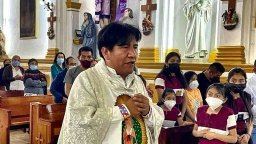
Rodolfo Soriano-Núñez Domingo, 20 de Octubre del 2024
Local police found his corpse inside a vehicle near the chapel where he had been presiding over mass in San Cristóbal de Las Casas, Chiapas.
The Mexican conference of bishops asked in a statement for improvements in the policies dealing with “violence and impunity” in Chiapas and Mexico.
By Rodolfo Soriano-Núñez
Sunday was an awful day in the Heights of Chiapas, Mexico.
Unknown gunmen killed Father Marcelo Pérez Pérez, a Roman Catholic priest in his late forties, with a long-standing story of work with grassroots organizations in his diocese.
Father Pérez died right after presiding an early morning Sunday mass at the Cuxtitali neighborhood. He was the pastor at the Sanctuary of Our Lady of Guadalupe in the Eastern side of San Cristóbal de Las Casas.
Father Pérez becomes one more victim of the violence engulfing much of the Mexican Southeastern states of Chiapas and Tabasco. Up until Friday 18th, the current government of Mexico, had a record of 1,308 assassinations in 17 days in office.
When first responders appeared, before 9 AM, Father Pérez was inside a vehicle, already dead after receiving at least four shots of an unspecified gun.
Born in 1974 and ordained as priest in 2002, Father Pérez had a long-standing career promoting projects to build peace, community resilience, and development in Chiapas. He was an ethnic Tzotzil, one of Chiapas First Nations and a frequent presence in pastoral, academic, and human rights activities aimed at finding a solution to the violence in Chiapas.
Before his appointment as pastor of Our Lady of Guadalupe in San Cristóbal de Las Casas he had served in San Andrés Larráinzar, where he was born and raised, and at Pantelhó, a township with a longstanding history of violence and severe violations of human rights.
San Cristóbal de Las Casas is the see of the eponymous Roman Catholic diocese, one of the oldest in Mexico and has been, since the late 20th century, a key player in regional and national debates about the effects of violence and the role of the Roman Catholic Church.
The church’s authority is not uncontested there, and there have been episodes of violence between Roman Catholics loyal to Rome and a faction of allegedly Traditional Catholics residing in San Juan Chamula, with deep differences with Rome and the local bishop of San Cristóbal.
There have been also episodes of violence between Roman Catholics and non-Catholics, leading to massacres and massive displacement of residents of small, isolated townships.
Back on January 1st, 1994, San Cristóbal was the epicenter of a mobilization that challenged the way the Mexican national government dealt with Mexican First Nations.
The violence subsided for a while, but over the last ten years, there has been a resurgence of violence in the state. A major driver of said violence has been the role of drug lords and their local associates trying to bring drugs from Central and South America into Mexico and the United States.
Recently, Los Angeles Press documented how the so-called Cartel de Sinaloa set a checkpoint at the Mexico-Guatemala border, a few yards from where the local headquarters of the Mexican National Guard are.
It is not as if Chiapas is nowadays a hotbed of political opposition against the current national government. Quite the opposite, the Movement of National Regeneration, the populist movement led by former President Andrés Manuel López Obrador controls the governor’s office and the state legislature.
The state voted overwhelmingly to support Claudia Sheinbaum, the current president of the country, and yet there were episodes of violence involving the three parties supporting her national government.
Despite its massive support for the current national government, Chiapas shows the second sharpest increase in the number of homicides from 2023 to 2024, as the graph appearing after this paragraph show.
There have been many warnings about the extent of the violence affecting Chiapas and the neighboring state of Tabasco. Less than two months ago, on August 23rd, Guatemalan Cardinal Álvaro Ramazzini called out the Mexican government for giving up on enforcing any control of the border between Chiapas, Mexico, and Guatemala.
It is not that there is no presence or activity of the Mexican Armed Forces, on the eve of Sheinbaum’s inauguration as President, on September 30th, at least two Mexican soldiers shot and killed at least six undocumented migrants who allegedly were unwilling to stop when the soldiers asked them to do so.
Father Marcelo had been involved more recently in massive protests asking for some improvement in the policies dealing with violence in the State. In the video appearing after this paragraph, from Father Marcelo Pérez’s funeral mass in what was his parish, it is possible to see some of banners used in some of the mobilizations that the priest was a part of in both San Cristóbal de Las Casas and the state capital Tuxtla Gutiérrez. The banners sport the word Spanish word for peace: paz.
An excerpt from Father Marcelo Perez's funerals. From the Diocese of San Cristóbal de Las Casas social media.
There is no official statement of what happened that night, but the initial explanation of the brutality of the attack against the migrants is hard to believe when one takes into consideration that they were traveling on a mid-1990s pick-up truck.
It is hard to believe that the driver of such a vehicle would have been willing to challenge the new vehicles the Mexican Army uses on a daily basis.
Father Marcelo Pérez will be buried tomorrow in San Andrés Larráinzar, his family’s ancestral hometown, ten miles or 16 kilometers North of San Cristóbal de Las Casas, as requested by his relatives.
During a mass presided by bishop Rodrigo Aguilar Martínez in what used to be Father Pérez’s parish he asked the congregation to pray for the assassins, as can be seen in the video after this paragraph (audio available only in Spanish).
An excerpt from Bishop Aguilar's homily at Father Marcelo Perez's funerals. From the Diocese of San Cristóbal de Las Casas social media.
Cardinal Felipe Arizmendi Esquivel, who was the bishop of San Cristóbal de Las Casas from 2000 through 2017, issued a statement from Toluca, in Central Mexico, where he lives nowadays.
There, he praises Father Marcelo as he ordained him back in 2002 and criticizes the “social disintegration” in Mexico that explains the violence behind this Sunday’s assassination.
The social media accounts of the Mexican conference of Roman Catholic bishops posted Cardinal Arizmendi’s statement, and it appears in Spanish after this paragraph.
The conference itself issued a statement regarding the assassination. They also praise Father Marcelo Pérez while asking for a thorough probe of his case, while asking on its second page for an improvement in the policies “to tackle the violence and impunity” affecting Chiapas and Mexico. Their statement is available only in Spanish after this paragraph.
The State Attorney’s office issued a brief statement, available only in Spanish after this paragraph offering almost no information besides the make and model of the car where Father Marcelo’s corpse was.
The next video is the final hymn of Father Marcelo Pérez's funeral mass at the parish where he was the pastor in San Cristóbal de Las Casas, Chiapas.
The congregation sings at the end of Father Marcelo Perez's funerals. From the Diocese of San Cristóbal de Las Casas social media.
Several politicians, including the President, Claudia Sheinbaum, her Interior minister, Rosa Icela Rodríguez; the sitting governor of the state, Rutilio Escandón; and governor elect, Eduardo Ramírez, issued proforma condolences about the assassination of Father Pérez Pérez.