
Rodolfo Soriano-Núñez Domingo, 01 de Septiembre del 2024
The crimes of Father Araújo prove Brazilian bishops have only avoided facing the facts about the reach of the clergy sexual abuse crisis in their country.
If the Brazilian bishops really want to address the causes of Paulo Araújo’s crimes, they must probe the very systems they set up to recruit, educate, and monitor their priests.
By Rodolfo Soriano-Núñez
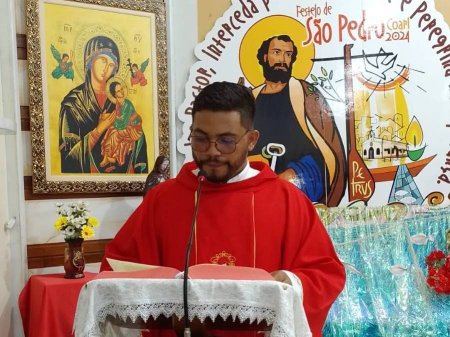
August ended with a major development in the clergy sexual abuse crisis in the Roman Catholic Church. Back on Sunday the 18th, Paulo Araújo da Silva, a young Brazilian priest, about to turn 32 years, found himself the main character of newscasts all over South America.
The State Police at Amazonas, Brazil, arrested him at the curial house of the Saint Peter’s parish in Coari, a small town and diocese on the margins of the Amazon River.
The arrest happened that morning. Araújo da Silva was there after having intercourse with a girl who recently celebrated her 18th birthday. The relationship was not new, although it was not why the police officers arrested the priest that Sunday.
What is public is that by mid-2023, the priest got pregnant at least one 14-year-old girl. When Araújo da Silva knew she was pregnant, back in September of that year, he forced her to have an abortion. Once the fetus was out of her body, he buried it clandestinely at the yard of one of his friends.
So far, the local police says that on top of the girl forced to have an abortion, there are other victims and, more importantly, Araújo da Silva used to memorialize in video his abuses. On August 18th, among the evidence taken from Saint Peter’s curial house, the police was able to seize several hundred videos.
Allegedly, Araújo da Silva used the videos to extort his victims as to keep them as such, so there is a chance that more victims will emerge in the coming weeks. This issue is relevant since Araújo was, at least up until February 2023, the spiritual advisor of the Catholic Youth at the diocese of Coari, as one message from that group’s Facebook account proves. That message was up until this Sunday, September 1st, available here.
It was not possible to know if any of his victims were either his parishioners at Saint Peter and/or if they were under his care at the diocese’s Catholic Youth Group. Perhaps the police probe will provide some answers to that question.
Father Araújo’s accomplice?
To further complicate the priest’s case, he had a partner in crime. On Thursday August 30th, police officers made a new arrest happened in Coari. This time they caught Lorena Marques, a transgender person, who allegedly helped Araújo find potential victims and tape their sexual encounters.
By then, the police had also arrested Francisco Rayner Barros Batista. Before his arrest, Barros Batista, who is not a cleric, locked out his Facebook profile. He appears as Araújo da Silva’s friend at Facebooks, as the next image, from Araújo's profile, shows.
On the 18th, the diocese issued a one-page statement. The statement is available at their social media, as it is on the Saint Peter parish’s account here is a boiler-plate statement from the diocese that could be the same anywhere from Alaska to Patagonia. A translation in both English and Spanish appears after this paragraph with a copy of the original statement in Portuguese.
That day the diocese sent other priests to provide the religious services. The bishop, whose cathedral is in the same city of Coari, visited on August 20th, as other priests from the diocese have been trying to deal with the fire set by the arrest and subsequent revelations of Araújo da Silva’s double life.
Paulo Araújo da Silva’s story as a young predator priest unable to follow the teachings he adheres to follows to the dot the plot of one of the most famous novels of the Portuguese literature, José Maria Eça de Queirós’s O crime do Padre Amaro: Cenas da vida devota (The crime of father Amaro. Scenes of a devout life), originally published in Portugal in the 1870s.
It is a novel that in the Portuguese- and Spanish-speaking worlds is synonymous with the clergy sexual abuse crisis. So much that both Mexico (2002) and Portugal (2005) produced Spanish- and Portuguese-speaking films, respectively, based on the novel.
Dismiss at your own risk
It is not as if Brazil was better suit than the rest of Latin America or the English- or French-speaking Catholic worlds. It is just that the Roman Catholic Church in Brazil has been able to dismiss the severity of the clergy sexual abuse crisis there.
As Los Ángeles Press proved back in March of this year, Brazil is one of the few Latin American countries lacking any definition as to how it will apply Pope Francis’s reforms as to set up the commissions to prevent clergy sexual abuse.
Not that the rest of the subcontinent has a stellar performance on that matter. In Mexico, the country with the second largest Roman Catholic population worldwide, only smaller than Brazil, less than half the dioceses have a commission to prevent clergy sexual abuse.
What Araújo’s arrest proves, is that despite the many efforts of the Brazilian bishops to render the Roman Catholic Church in their country as some sort of “happy exception,” there is no reason to believe that it is actually so.
Brazil has been out of the radar not because the bishops there are doing something exceptional, as Araújo da Silva’s case proves, but because there was little or no information about this kind of cases coming from there.
What has been lacking up until now is either the evidence to prove that sexual abuse happens there too, as the will from victims of it to go through the hellish experience of litigating their cases in the media, well aware of the fact that, as in the rest of Latin America, the chances of having a measure of justice are slim to none, as it is the unwillingness of the Roman Catholic bishops to acknowledge the true extent of the crisis.
The diocese of Coari has the same territory as the eponymous municipality and was originally created by Pope John XXIII back in the 1960s as a prelature. Since then, all the bishops there have been members of the Congregation of the Most Holy Redeemer, including its current leader, Polish bishop Marek Marian Piatek. Pope Francis elevated the prelature to diocese back in October 2013.
Back in 2021, the diocese reported having sixteen priests, three of them being religious. Four religious males who are not priests, and fourteen nuns or religious females, spread over ten parishes. They also reported having an average of little less than thirteen thousand Catholics per priest, a figure similar to those found in some of the less privileged areas of Mexico and other Latin American countries where even religious institutions face difficulties to fill their positions.
It should not surprise as distances are hard to cover and there is a constant need to travel to remote areas in the Amazons where communications are not always easy.
A predator’s career
Despite those limitations, the diocese seemed to thrive, at least until now. It keeps several accounts at different social media sites, mostly Facebook and Instagram. It has a radio station, whose goal is to publicize the activities of the clerics there. It also runs a website although it lacks factual information about the priests assignments, so any attempt at understanding how Araújo da Silva came to hold leadership positions with little or no oversight is impossible.
The diocese’s website no longer has information about Araújo da Silva, as can be seen here. The last parish where Araújo Silva was in charge, that of Saint Peter, no longer mentions him, (see here).
It is still possible to find some very basic information about Araújo Silva at the stored version of the diocese’s website at the Internet Archive, as can be seen here. The “live” version of that page no longer has him as cleric or priest there (see here).
Araújo da Silva’s case proves, once more, that despite the repeated attacks from the Roman Catholic hierarchy on gay and lesbian persons, who are blamed as culprits for the clergy sexual abuse crisis, the reality is that predator clerics, as predators at large, frequently are opportunistic, and will abuse of males or females, adults or minors, other clerics, or lay persons.
It is hard to know how many more details will emerge of this case. Coari is not a major metro area in Brazil, so there is no way to expect a constant coverage to this case in the coming months, but I would not be surprised if Lorena Marques, the transgender person who helped Araújo da Silva find and tape his victims, later emerge also as a victim in this story.
What should be clear by now is that characters as Araújo da Silva are not “the odd rotten apple,” nor they are the mythical “lone predator”, as the reports on Marcial Maciel told his victims back in the first two decades of this century.
They are a constant byproduct of processes of priestly formation and theological thinking, obsessed with a certain ideal of sexual purity that quite frequently fails but that a religious elite unwilling to acknowledge any doctrinal mistake from them holds them as untouchable.
Untested male
Roman Catholic Cardinals as Robert Sarah opposed a proposal to open the priesthood precisely there, in the Amazons, to married males, the so-called viri probati, or tested males in Latin, which is how the ancient Christian churches in the Mediterranean came to exist.
Sarah went as far as to use without the proper authorization an old paper written originally by Joseph Ratzinger, before the German cardinal became Pope, to further his personal war against Pope Francis.
Printing houses from the most reactionary quarters in the Roman Catholic world rushed themselves to put out paper and electronic editions in several languages of a book that rendered Cardinal Sarah as the leader of some sort of apocalyptic resistance against a dangerous “Peronista Pope”, about to destroy the Church if any change ever happened.
When the Pope and his team reacted, it was too late. Sarah and his partners in crime killed any chance of having a meaningful debate about the need to have a different model to educate and train priests in the Roman Catholic Church.
At the same time, Sarah and his allies are less than willing to develop any meaningful change in the Church as to enforce the many rules regarding clergy sexual abuse that have achieved little or nothing, despite the many clergy sexual abuse scandals over the last forty years or so.
If Araújo da Silva’s case is worth something is as evidence of how dangerous is for the Roman Catholic Church to appoint untested priests, willing to take their parishioners as hostages of their appetites.
The outcome is precisely what happened in Coari or in any of the many cases this series follows in different countries worldwide.
From last week’s set of seven cases, compare Araújo da Silva’s case to Morseo Miramón Santiago’s in the outskirts of Mexico City and it is really hard to find major differences beyond the fact that Miramón Santiago’s victim was an 11-year-old boy, while Araújo da Silva's was, so far, a 14-year-old girl.
Even if many of the issues affecting the Roman Catholic Church nowadays are the byproduct of bad faith actors as Sarah, who are unwilling to allow for any kind of sincere debate about the issues affecting that church, there are other issues at stake here.
Where it all started?
Araújo da Silva majored in theology at the seminary of the archdiocese of Manaus. That is standard practice, since small dioceses as Coari would be unable to sustain a major seminary. However, it must be clear that there is a chance that Araújo da Silva was already misbehaving there.
The bishops of Coari, and all the other dioceses sending seminarians to the Upper Seminary of the Archdiocese of Manaus (Roraima, Parintins, São Gabriel da Cachoeira, Itacoatiara, Alto Solimões, and Borba) should be concerned with what an alum of that school went to do at Coari.
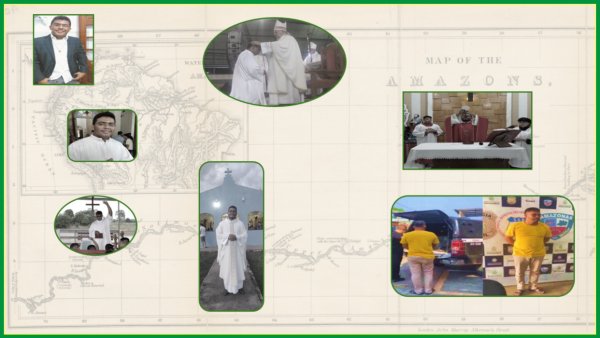
It is hard to believe that what happened with Araújo da Silva only happened after his ordination as deacon and priest in 2018, as the invitations to both ordinations after this paragraph remind us.
The fact that he went from deacon to presbyter in less than a year should be already a sign that there is a real need for a change in the way the Roman Catholic Church recruits and educate its priests, especially in places as the Amazonas.
And then, there is the issue of his first years of service at the diocese. It is clear that he cannot be blamed for the disruption caused, especially in Brazil, by the pandemic of coronavirus. But there should be some will to try to understand what happened with Araújo da Silva when he served in parishes as deacon and then later as a junior priest.
Araújo da Silva's ordination as priest was the proverbial "talk of the town". Local radio stations ran ads inviting to the ceremony. Some member of a local Catholic group uploaded the audio of said ads with some pictures of the then deacon, as can be see in the video after this paragraph.
An ad inviting to Araújo da Silva's ordination as priest, 2018. Audio available only in Portuguese.
Why was he appointed as pastor at Saint Peter’s with less than five years of service as priest? Coari needs priests, but was Araújo da Silva under the supervision of a senior cleric? Was there any supervision from the bishop or any other, older, priest? If such reports exist, what they say about Araújo da Silva?
Why was he appointed as spiritual advisor of Catholic Youth in that diocese when he was barely 30-year-old? As such, was he under the supervision of any other cleric? What kind of training justified his appointment for such position?
On February 24th, 2023, the Facebook account of the Coari Catholic Youth published a post with an eight-picture set where Araújo appeared as their “assessor religioso”, spiritual or religious advisor. The post was available until August 31st here.
If the Roman Catholic Church actually wants to address the causes and not only the consequences of the clergy sexual abuse crisis it must address the previous and many other questions on this and other cases.
As for the victims, it is hard to figure out a path leading to some substantial reparation of the damages. Although there is anecdotal evidence of the Brazilian bishops settling cases outside of the courts, there is no guarantee that something similar will happen in Coari.
Coari, sometimes spelled as Choary in English, is a large municipality, almost 58 thousand square kilometers or almost 23 thousand square miles. That makes it twice the size of Belgium, and larger than Switzerland, and almost twice the total area of the states of Massachusetts in the United States or Campeche in Mexico.
Coari is closer to the capital cities of Bogotá, Colombia, Quito, Ecuador, and Lima, Peru, than it is to Brasilia, the capital of Brazil. Even with a stellar performance of police and judges on this case, it would be hard to believe that the victims there will get the kind of deals that victims in the old, better-connected cities of São Paulo or Rio de Janeiro have had, that—so far—have prevented scandals as those that have happened in other countries.
Again, when trying to understand what is actually happening with the clergy sexual abuse crisis in Latin America, Los Ángeles Press found that there is no national body or diocesan bodies dealing with the prevention of clergy sexual abuse in the Brazilian dioceses.
Neither Coari nor its metropolis, the archdiocese of Manaus, have a commission to prevent clergy sexual abuse, so they cannot claim now that it has been a priority for them to prevent the occurrence of Father Araújo's crimes.
And Canada too
Besides this Brazilian tragedy, reminiscent of The crime of Father Amaro, August ended also with more bad news coming from Canada.
There, Father Thomas Rosica, a Roman Catholic media figure who up until 2019 was the figurehead of Salt + Light Media, a less ideological and less partisan Canadian response to the U.S. Roman Catholic and Republican EWTN step down as a major figure there when he faced accusations of plagiarizing texts and stories published as his.
Now, a lawsuit accuses Rosica of sexually assaulting a younger priest who used to work under his supervision at Salt + Light Media. Rosica is trying to keep the Canadian government out of issue claiming it should be the Roman Catholic Church who must decide whether he assaulted the junior priest or not.
Canada was a pioneer of the clergy sexual abuse crisis and despite the efforts of their leaders, naming bishops in clergy sexual abuse accusations is a common occurrence. More recently happened to the current and the former archbishop of Quebec.
Marc Armand Ouellet archbishop there from 2002 through 2010, when he jumped to a major position in Rome. Back in 2022 of Paméla Groleau, a female parishioner accused him of sexually attacking her.
Ouellet fired back suing her for defamation in Canadian courts. After that, a second woman raised similar accusations against Ouellet.
After that, in January of this year, another woman raised similar accusations against current archbishop Gerald Cyprien Lacroix.
The Vatican appointed a former Canadian judge to probe the case. Back in June, former magistrate André Denis reported there are difficulties in completing his task since the victim was unwilling to cooperate with him.