
Guadalupe Lizárraga Miércoles, 19 de Noviembre del 2025
FGR probe exposes cross-border financial network tied to Baja California officials and businessman Fernando Salgado Chávez, as documented by Los Ángeles Press.
By Guadalupe Lizárraga
Cross-Border InvestigationA federal investigation in Mexico has uncovered a sprawling financial and political network operating across the California–Baja California border region, involving public officials, private contractors, and shell companies in the United States. The probe points to patterns of financial triangulation, conflicts of interest, and the diversion of public funds in operations linked to businessman Fernando Salgado Chávez, according to documents reviewed by Los Ángeles Press.
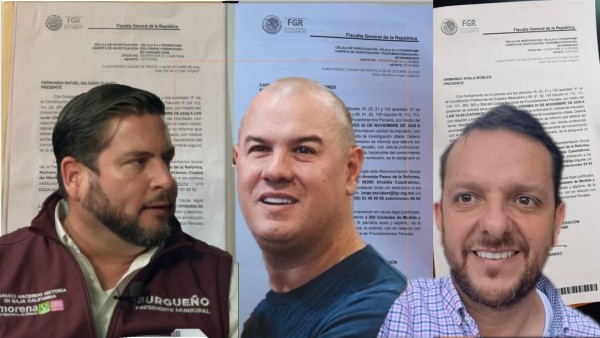
Mexico’s Attorney General’s Office (FGR) has formally charged four individuals—Carlos Alberto Torres Torres, Luis Alfonso Torres Torres, Ismael Burgueño Ruiz and Fernando Rafael Salgado Chávez—in a set of official notices dated October 29 and 30, 2025. The documents were issued by FEMDO, the specialized federal unit that investigates organized crime and illicit financial operations.
These federal filings corroborate investigative lines that Los Ángeles Press has documented for the past six months, despite efforts by the U.S. law firm Clare Locke LLP to pressure this journalist into retracting or halting coverage. On October 12, 2025, the firm sent two intimidation letters demanding an “immediate retraction,” disclosure of confidential sources, and prior review of any future reporting related to Salgado. Litigation was threatened if these demands were not met.
While Clare Locke accused the reporting of being “false,” documents and public records reviewed by Los Ángeles Press show documented business relations, public proximity, and corporate ties between Salgado and individuals sanctioned by the U.S. Treasury Department for drug trafficking and money laundering.
Media influence and public funds
The federal notices also suggest that public funds were channeled to media outlets aligned with Salgado and his political operators, Marco Antonio Moreno Santelices and Ricardo Iván Carpio Sánchez. Among them is the Tijuana-based weekly Zeta, whose reporting included uncorroborated claims against businessman Manuel Cisneros Romero, placing his son Omar Cisneros—later killed—in increased danger. When Omar’s father confronted Zeta seeking evidence, editor Adela Navarro dismissed him and later falsely claimed to press organizations that she had been threatened.
Links to cartel networks
Part of the network surrounding Salgado intersects with individuals tied to major cartel factions. Marco Santelices is connected to Jesús González Lomelí, designated by the U.S. Treasury Department as an operator for the “Los Mayos” wing of the Sinaloa Cartel. Yet Santelices also appears in public events alongside Salgado, who is routinely linked in local media to CJNG-related interests—two rival criminal organizations. Photographs show members of both circles interacting socially.
A powerful political ally: Pedro Alejandro Montejo Peterson
At the core of the structure is Pedro Alejandro Montejo Peterson, a prominent businessman who heads Tijuana’s Secretariat of Economic Development (SEDETI). Montejo runs a web of companies involved in construction, uniform manufacturing, blinds production, and cross-border import operations in both Mexico and the United States.
Although none of these activities are illegal on their face, documents reviewed by Los Ángeles Press reveal patterns consistent with conflicts of interest, simulated corporate activity, and the misuse of public resources. Montejo is widely viewed as one of Salgado’s closest allies; the other is Tijuana mayor Ismael Burgueño Ruiz, recently charged with money laundering alongside Salgado.
Montejo’s professional credentials also raise red flags. He claims to hold an engineering degree from one of Mexico’s top private universities (ITESM), but no professional license exists under his name in federal registries. Despite this, he oversees a public agency managing more than US$11 million annually.
His claims regarding his companies show similar discrepancies. For instance, he states that his company Hemtack S.A. de C.V. has operated since 1994, but state records show it was created in 2016 and entered as a government supplier in 2021.
Pedro Montejo claims that his company Hemtack, S.A. de C.V. has existed since 1994; however, official records only date back to 2016.
Insights from a confidential source
A confidential source with access to internal political and administrative information told Los Ángeles Press that Montejo and Mayor Burgueño were involved in awarding Tijuana’s annual fair to a company reportedly linked to Salgado’s network. The source adds that Montejo resides part-time in the United States, investing through cross-border financial structures.
Los Ángeles Press independently confirmed evidence showing financial flows between Montejo’s companies and INTL Builders, a shell company tied to Salgado, used to support Hemtack through billing operations between Mexico and the U.S.
The source also alleged influence peddling at the U.S. Consulate in Tijuana on behalf of selected business associates and customs brokers. Additionally, the source claims that State Attorney General María Elena Andrade has shared sensitive information with Carpio Sánchez for political leverage—an allegation that remains unverified.
A pattern of protected contracts
Montejo’s company PECOSA S.A. de C.V. has repeatedly secured public contracts despite documented irregularities. State auditors found unexecuted work, missing plans and invalid insurance bonds. Yet no sanctions followed, suggesting institutional protection.
Montejo controls an extended network of companies—Hemtack, Comdecora, Stoli Uniforms, APM Producciones, Solmex and PECOSA—many of which share addresses, partners or suppliers with entities linked to Salgado and his family. Together, they form an integrated corporate structure operating on both sides of the border.
The U.S. hub: Phase II Products Inc.
Phase II Products Inc., registered in San Diego, acts as a central link in the U.S. side of the network. Corporate filings list Theresa Davidson as CEO, Lee Hunt as CFO and Marcos Chang as secretary. Hunt also appears in corporate emails for Comdecora and Stoli Uniforms in Mexico.
Moreover, international trade databases show that Phase II, Hemtack and Comdecora share Asian suppliers and logistic routes—consistent with mirror-company structures designed for cross-border movement of capital and goods.
Florida LLCs and low-traceability financial flows
On August 20, 2025, Montejo created three Florida LLCs—Aipaso Partners LLC, Aipaso Real Estate Restoration LLC and Windansea 360 Restore LLC—all registered to the same virtual office in Doral and the same corporate agent. None report assets, staff or federal tax numbers.
The timing coincides with SEDETI’s expanded municipal budget, suggesting that the LLCs function as shell entities enabling low-visibility capital transfers.
G-Global: the logistics corridor
The network’s operational backbone appears to be G-Global, a cross-border logistics and customs brokerage firm whose services match the shipping and import needs of the companies tied to Montejo and Salgado. According to internal testimony, G-Global has been used to facilitate high-risk shipments across the border, though these claims remain unverified.
If corroborated, G-Global would function as the customs bridge allowing goods—both legal and illicit—to flow between Mexico and the United States through a coordinated chain of manufacturing, logistics and shell companies.
A protected transnational enterprise
The structure did not grow by chance. Its consolidation depended on sustained political protection. Taken together, the companies and operators linked to Montejo Peterson and Fernando Salgado Chávez exhibit a recurring pattern:
public contracts, shell companies, cross-border expansion with limited verifiable activity, and media financing designed to shield their interests.With the FGR charges now incorporated into a federal criminal investigation, the emerging picture suggests a system in which public resources were diverted into private structures masked as cross-border commerce—operating seamlessly between Baja California and the United States.