
Rodolfo Soriano-Núñez Lunes, 20 de Abril del 2026
Even if one dismissed the news about the abuse by bishop Santarsiero, it is hard to imagine Leo XIV being pleased by what happens in Peru these days.
The similarities one finds in Peru with the effects of the "culture wars" and politics as show business in the United States are just too many to find comfort.
By Rodolfo Soriano-Núñez
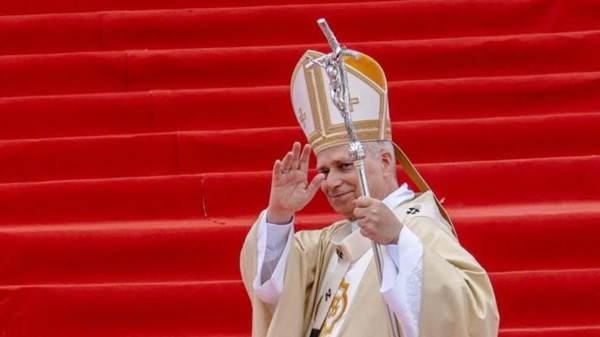
Last week, Pope Leo XIV did what few pontiffs have been forced to do in recent times: dodging explicit attacks from the leader of the military power of the day.
Donald Trump’s attempt to harass and silence him while traveling through Africa, followed the “standard operating procedure” GOP politicians have been following for many years now against U.S. Catholic bishops and priests unwilling to accept the Republican Party’s “friendly embrace.”
The only difference was not Trump’s use of Artificial Intelligence to render himself as Jesus healing a moribund patient, later deleted, and even later “explained” as him playing doctor. The issue was and remains that this time around the enemy being cornered by the so-called “most powerful man in the world” was the Pope himself, the first American citizen ever.
Trump’s attitudes, social media postings and policies, immediately grabbed support from both J.D. Vance and Mike Johnson, the Vice President and the Speaker of the House, second and third in the structure of power of the United States’ government, joined forces to try to silence the Pontiff.
Despite his, overall, quiet demeanor and less willingness to challenge his rivals than his predecessor, Leo XIV has been forced to repeatedly reaffirm his right as human and leader of his faith to talk, to openly express criticism of what happens. Francis, his predecessor, already had been forced to do something similar, little more than a year ago when, back in February 2025, Jorge Mario Bergoglio openly criticized the U.S. aggressive migration policy.
Already then, J.D. Vance, tried to play theologian with an “heterodox” take on Ordo Amoris, Latin for the Order of Love, chastised by then Cardinal Robert Prevost over his social media on February 3, 2025, while siding unequivocally with his then superior’s take on the issue of migration, as the screenshot from that message after this paragraph shows.
Back in 2025, Prevost was quoting an opinion piece by Kat Armas, published by National Catholic Reporter, reflecting the kind of shock Vance’s “correction” of Pope Francis had already then brought to Catholic communities in the United States and elsewhere.
Armas as many other theologians at the time stressed the fundamental betrayal of Vance’s take which was not because of his opposition to Francis’s take as such, but because of how deeply contradictory with established Catholic and Christian doctrine it was, more so as, already by then the Episcopal bishop of Washington, D.C. Mariann Edgar Budde, had already articulated an other-than-Catholic, Anglican, rejection of the Trump administration migration policy and its weak attempt at masquerading it as somehow Christian, as the story linked after this paragraph told at the time.
This time around, after Trump’s “chopper talk” attacking Pope Leo XIV’s stance on the war with the usual “weak-on-crime” Republican tirade, usually launched against Democrat rivals or religious leaders willing to express some support for minorities under threat, Leo XIV used his own social media while pilgriming through Algeria and Cameroon to reassert his right to speak out his mind and more specifically to criticize those who appropriate the name of God for their own benefit.
His own post in social media further down and his message to meeting on Peace, available here, prove how important was for Leo XIV to reassert what nobody could claim is a revolutionary take on Catholic theology or doctrine; nobody but Catholic convert and Trump’s Vice President, J.D. Vance.
A Peruvian state of mind
But even if his time and efforts were devoted to the details of his African trip and figuring out a solution to what happens in the United States, at least one part of Leo XIV’s brain must have been worried about what has been happening for the last two weeks or so in Peru, his adoptive country, where he was the bishop of Chiclayo.
It is not only the jigsaw puzzle that the general election in the country turned out to be, which already has Peruvians wondering what is going to happen there, but also with what is happening with Antonio Santarsiero Rosa, the bishop of Huacho, a coastal city, 75 miles or 120 kilometers north of Lima.
Santarsiero, and Robert Prevost share some traits. Both were consecrated bishops in Peru despite having been born outside of Peru; Santarsiero, the bishop of Huacho saw the first light in Italy in 1951, while the current bishop of Rome did it in 1955 in Chicago.
Both are members of relatively small religious orders. Leo XIV is an Augustine, an order that merged several monastical communities in Europe in the 13th century, with a long and celebrated membership, but also notable for having had Martin Luther as one of its members reports little less than 4,150 members, priests and brothers, to the Annuario Pontificio, the Vatican authority on statistical matters.
Santarsiero belongs to a much smaller, much younger “order,” the Oblates of Saint Joseph, with origins in 19th century Italy, with little more than a thousand members, priests and brothers included. Both ended up at some point in their adult lives working in Peru as part of their orders’ missionary endeavors, and both became bishops in the ancient land of the Inca.
The similarities, however, end there. While Prevost was for the most part an outsider to Church politics in Peru, so much Pope Francis saw in him a potential ally to induce change in the South American country’s episcopal bench, Santarsiero used his time in Peru to become an insider of Peruvian Catholic Church politics.
He was, at least until the most recent scandal shaking the Catholic Church emerged, the general secretary of the Peruvian Conference of Catholic Bishops and less than eight weeks from reaching 75, the statutory age of retirement for Catholic bishops. Not that he was a leading national figure in the Peruvian episcopate, but one who reflects how the Peruvian conference of bishop came to be what it is now.
Under Cipriani’s shadow
As bishop in Peru, and at least since his arrival to Huacho as a suffragan bishop of Lima in 2004 after a brief stint at Huarí, he was a first-row witness to the twin scandals at the Peruvian capital: the one involving the Sodalitium of Christian Life and the abuses perpetrated by Cardinal Juan Luis Cipriani Thorne.
Unlike what used to be a non-written rule at the Peruvian episcopate, favoring archbishops as its leaders, CEP, as it is known in the Spanish-speaking world, went after those two scandals for relatively unknown, minor, figures as its leaders.
The current president, Carlos Enrique García Camader, is the bishop of Lurín, another coastal city, 18 miles or 29 kilometers south of Lima. Both dioceses are suffragan to Lima; both García Camader and Santarsiero Rosa were consecrated with less than one year difference by Cipriani Thorne and Rino Passigato, the nuncio to Peru for over nine years, from 1999, when he arrived from Bolivia, until 2008, when he left for Portugal.
Both are perfect specimens of the unfettered influence Cipriani exerted over the appointment of new bishops during the last years of John Paul II’s and Benedict XVI’s tenures as Roman Pontiffs.
Their separate elections to their charges at CEP, in 2024 for Santarsiero Rosa, and in 2025 for García Camader show how, even if there was no open rift between Pope Francis and the Peruvian episcopate, the body was less than willing to appoint people willing to challenge Cipriani, who retired in 2019 from Lima and in 2020 from his appointment as member of the Council for the Economy in Rome.
Secret punishments and confrontations
Even if retired, and under a secret “punishment” issued by Pope Francis for the sexual abuse of an underage male when Cipriani was a priest with Opus Dei, he remained influential through the influence he accrued in the first two decades of this century, when John Paul II and Benedict XVI were more than willing to rubberstamp his suggestions for new bishops.
Even if Pope Francis was not originally interested, at least not publicly, in picking up a fight with Cipriani or his many allies in the Catholic Church, politics and media in Peru, over time the issue of the abuses at the Sodalitium and the sole case we know now involving Cipriani himself, made the confrontation unavoidable.
Previous installments of this series have gone in depth to the details of such confrontation so, if you want to get a deeper understanding it would be easier to go over the series of installments dealing with what seems to be the suppression of the Sodalitium. Not that the Vatican is backing away from what was one of Pope Francis’s last decisions, formalized in the last month of his life, after a brutal two-month period in a Roman hospital.
Francis made sure that there was no way to resuscitate the Sodalitium as such. Main problem is that there is a chance some of the groups and associations that shaped the “religious concern” that was that “order” could remain untouched as diocesan association of the faithful. The other is that, as it is usually the case with many religious organizations, Catholic or otherwise, the structure of property of the assets controlled by these organizations is not always transparent, straightforward or clear.
Last week this series delved into a recent suppression of a diocesan order-like organization in Tuxtla Gutiérrez, Mexico, and as that piece, linked before this paragraph, pointed out, there is a chance that Mexican organization followed the template used by the Peruvian Sodalitium which was originally perfected by both the Mexican Legion of Christ and the Spaniard Opus Dei: complex layers, onion-like, of ownership, using a series of straw firms or NGOs to promote noble goals (development, education, and so forth) sharing a common pool of leaders who would appear over several boards of directors.
It is necessary to be aware, as one of many possible examples, of how, for practical purposes, the Mexican Legion of Christ operated more than as an “institute or religious life” as it is officially described within the Catholic Church as a vessel allowing key, affluent members of the higher echelons of the religious order as such, the Legion of Christ proper, and the so called Regnum Christi (Latin for Kingdom of Christ) to participate in offshore ventures and investment funds.
Their activities are far removed from any kind of Gospel-like concern but, precisely because of that, able to attract powerful patrons, protectors and, ultimately, business partners who have a vested interest in keeping the appearance of sanctity of the firms and ventures, even if disguised as civil associations, related to this type of order-like religious organizations.
Maciel as uncovered by Berry and Olmos
One needs to remind about how, starting in the 2010s, once the Apostolic Visitation to the Legion delivered its rather weak and ineffectual “conclusions,” the hard-nosed journalism practiced by Jason Berry allowed us to get a glimpse of how much money exchanged hands over the Legion of Christ’s coffers and bank accounts.
Berry’s National Catholic Reporter 2013 story is available at the Pulitzer Center here. There he shows how a wealthy widow donated $30 million over two decades to fund both Maciel’s lavish lifestyle and the “works” promoted by his order in what U.S. courts at Rhode Island saw as akin to fraud, only uncovered by the efforts of Mary Lou Dauray, the widow’s niece to understand her aunt’s largesse towards Maciel’s order.
More details emerged in Mexico when, in 2015, Raúl Olmos originally published a series of reports at El Financiero newspaper, later turned into a book aptly titled The financial empire of the Legionaries of Christ (El imperio financiero de los legionarios de Cristo), where he was able to track-down similar cases among the wealthy elites of Northern and Central Mexico, willing to support Maciel’s alleged “anti-communist” quest, despite the many rumors and occasional evidence of sexual abuse in his order, attacking the sons and daughters of those very elites.
Two years later, in 2017, the so-called Paradise Papers offered more evidence emerged, now at a global scale of how the Legion of Christ more than a religious “order” was a financial empire, a holding firm exploiting whatever remnants of good will existed at the time in the Catholic Church, and any available loophole in the Mexican and U.S. tax codes to enrich the order and their partners in the one percent of the wealthiest citizens of both countries.
Recent explorations on the wealth of Opus Dei, such as Gareth Gore’s, and how that wealth is associated to labor exploitation further confirm what the world knew already about how predatory “orders” such as the Legion of Christ or Opus Dei have used religion to enrich and expand their ability to influence political decision-making in the countries where they operate.
It is precisely there where the Peruvian memories of Leo XIV must have struck him harder while being forced to argue his own personal autonomy, his First amendment rights as a U.S. citizen, but also the very viability of the Catholic Church as an autonomous religious institution, able to speak with some religious authority, parrhesia, as some philosophers and theologians would talk about the duty of religious leaders to candidly, boldly, address the issues affecting the lives of their communities.
It is also at that point where the pending Peruvian affairs left by his predecessor must have forced him to rethink the very role of the Papacy and what he must demand from the U.S. Catholic bishops who, despite the unsurprising support from the “usual suspects” in Chicago (Cardinal Blase Cupich), Newark (Cardinal Joe Tobin) and Washington, D.C. (Cardinal Robert McElroy), seem to be unable to actually support the sitting bishop of Rome.
Exaggerations?
As recently as last Saturday, Cardinal Raymond Burke, one of Pope Francis’s most frequent critics, dismissed the confrontations between Trump and his superior in the structure of the Catholic Church as “exaggerated.”
In the closing statement of his interview, Burke answers a question about the depth of the opposition between Trump and Leo saying:
- No. There is great respect for the Church in America, and Catholics have always contributed greatly to the life of the nation in every respect. For a long time, there was an anti-Catholic prejudice claiming that we wanted the Pope to govern the country. But doctrine has never taught that the Church must govern. We Catholics follow the Lord’s teaching to render unto Caesar what is Caesar’s and unto God what is God’s. The Church teaches moral principles but then leaves to those in authority the proper competence to make decisions.
However, if one has followed U.S. politics for the last 20 years or so, it is impossible to miss the fact that more frequently than not, rosary-carrying Catholic politicians such as former President Joe Biden were frequently the target of all kinds of attacks from the U.S. Catholic far-right when said politicians were unwilling to support the “ban on all abortions” party line promoted by Catholic Vote and other similar groups.
That on top of what Salvatore Cordleone, the archbishop of San Francisco did when barring former Democrat leader of the House Nancy Pelosi from taking communion at his diocese, where she lives, an issue that ultimately was settled by Pope Francis himself.
It is at this point, where Prevost must realize how the suppression of the Peruvian Sodalitium is anything but done, more so as their former leaders are about to hit the political jackpot if, eventually, Keiko Fujimori the winner of Peru’s first round of presidential election is forced (and she will be) to seek Rafael López Aliaga’s support.
López Aliaga, Porky, as he likes to be called, accepting the fact that he resembles the Warner Brothers cartoon character so popular all-over Latin America, is a full, numerary, member of Opus Dei and in that respect an ally of Cardinal Cipriani.
So close to Cipriani that it was at Porky’s invitation to receive an award issued by the Lima mayoralty that Cipriani went to his former see to defy Pope Francis’s secret “punishment” when he decided to go back to Lima and play, with the Mayor of Lima’s support, to be a master of the universe in the old imperial palaces of the Peruvian capital.
This is more relevant as, despite Francis’s last-ditch efforts to suppress the Sodalitium in February 2025, and Leo XIV’s already stated preference to use that order’s wealth to compensate the many victims of abuse, sexual and otherwise.
Peeling the Sodalitium onion
It is unclear how many years and teams of lawyers all over Latin America, the United States (at least in Colorado and Pennsylvania), on top of Spain and Italy in Europe will be necessary to untangle the cross haired web of Real Estate, stock, water and or mining rights, that allowed the Sodalitium to become what it was at its peak in the early 2010s, a very powerful organization, influential in Church and state politics in Peru and, to a lesser degree, influential too in Colombia, Chile, the United States, and Italy.
More so, as the Sodalitium was able to take over directly or indirectly control or influence diocesan curias, businesses and city or town councils or halls. Back in February 2025, this series offered a summary on how the Sodalitium assumed, indirectly, control of cemeteries, mines, land and water rights, in the story linked after this paragraph.
The Sodalitium business model excelled in that respect as it was able to achieve the kind of vertical and horizontal business integration one expects from graduates of the likes of IPADE, the Opus Dei, flagship business school in Mexico City, with corresponding entities all over Latin America and the English- and Spanish-speaking worlds, as they are partners in Mexico of over 73 business schools in the world.
Back in November 2025 that became evident as Leo XIV himself appointed Javier Augusto del Río Alba, the archbishop of Arequipa, as one of three “adjunct apostolic commissaries” to help the apostolic commissary, Spaniard priest Jordi Bertomeu, to continue the process to suppress the Sodalitium of Christian Life. The story linked after this paragraph already explained why that appointment has been the source of doubt for those who remain unconvinced about Leo XIV’s commitment with reparations for the many victims of the Sodalitium.
Without going over the details, which were already addressed then, it must be enough to point at this time that the vicar general at that diocese is Alberto Cristián Ríos Neyra, a full member of that now suppressed order.
Some see Del Río’s appointment in that respect as a potential source of conflict as it remains unclear where Ríos Neyra’s loyalty stand at this point, more so as he has his boss’ ear and he is actually a party on the matter involving his superior. But even if the most optimist understanding of Del Río’s appointment was accurate (that he knows who he is dealing with and, because of that, he is probably the best profile to accomplish the task) there are plenty of doubts about the future.
This is more relevant as, even if there is a record of differences and confrontations between the Sodalitium and other varieties or the Peruvian right, such as those represented by Fuerza Popular (Popular Strength), Keiko Fujimori’s party and Renovación Popular (Popular Renovation), Porky’s force, they and other parties in the Peruvian right share interests and even linkages with the U.S. GOP.
The heart of the puzzle
A key piece in that puzzle, one of several, has been Alejandro Bermúdez, a prominent member of the Sodalitium, dual citizen, and who even if formally retired from the every day operations of EWTN remains an influential figure in that allegedly Catholic media outfit, which one must keep in mind, was flagged at some point in his pontificate by Pope Francis as “doing the Devil’s work.”
When the first flares of the crisis at the Sodalitium exploded, it was Bermúdez as head of ACI Prensa and Catholic News Agency, who following the standard operating procedure displayed by the Mexican Legion of Christ, the Spaniard Opus Dei, the Argentinean Institute of the Incarnate Word, and more recently the Brazilian Heralds of the Gospel, did his best to discredit the victims.
Unlike what happens in the less regulated media markets in Mexico or Argentina, where it is possible to publish or broadcast with some expectation of freedom, Peru kept and even tightened many of the provisions inherited from the military dictatorships of the 1960s-1970s and the Alberto Fujimori regime in the 1980s-1990s under the guise of protections to the good name, honor and reputation of public figures.
One of the reasons both Pope Francis and his successor remain in the good graces of many Peruvian journalists who are veterans of the battles against the Sodalitium is because of how restrictive the Peruvian media legal framework is. Both Francis and Leo XIV have not followed Norberto Rivera Carrera’s footsteps when he, back in the 1990s, discredited and chastised from Mexico City, Mexican journalist publishing stories about Marcial Maciel’s abuses.
But as much as Leo XIV should be proud of how he helped Francis address the scourge of the Sodalitium in the Peruvian Catholic Church, one has to wonder how aware is he of how what he in his native home country and his adoptive one are the two sides of the same coin, the consequences of same bet made originally by John Paul II of turning abortion into the litmus test for Catholic policy-making.
Granted, there would be those who claim Karol Wojtyla cannot be blamed by what Trump, López Aliaga, Daniel Ortega and many other politicians in the Western hemisphere have been doing when using what John Paul II wrote in no. 71 of his 1995 encyclical Evangelium Vitae, Latin for the Gospel of life.
It would be impossible to tackle here the many debates in several language-specific Catholic worlds spurred by the interpretation of said document. Suffice to say at this point that a very restrictive, narrow, myopic understanding of the document took hold, one probably promoted by the then Pontiff himself, as he witnessed and never challenged his interpreters, especially in the English-speaking world, who reduced the issue of abortion to a yes or no, absolutist debate.
A hint of how dangerous has been for the Catholic Church in Latin America to use the abortion issue as the litmus test for its support for political leaders willing to grant the ban on any and all abortions has no better example than the way the former archbishop of Managua, the later Cardinal Miguel Obando y Bravo was willing to prop up Daniel Ortega’s return to power in Nicaragua.
Even if there are reasons to agree Ortega abused that support, it would be naïve, to say the least, to forget how many priests and laypersons in Nicaragua warned both Obando and Pope Benedict XVI and how the Catholic Church at large was willing to pay attention to such warnings, as the story linked after this paragraph told.
Peruvian Kabuki
The implications of such understanding of the issue are there for whoever wants to see beyond the kabuki of some of its main beneficiaries, LifeSite News, Frank Pavone, and other similar entities or persons in English-speaking world, and their partners in the Spanish- and Portuguese-speaking world to name only the most obvious.
Pavone’s case is worth mentioning as in the current political climate he immediately sided with Trump, completing a turn that started when Pope Francis first restricted his ministry and then, eventually, dismissed him from the priesthood.
Far from acknowledging any mistake, Pavone as many others in the far-right Catholic spheres in many languages, played victim, betting once again into turning Catholicism into a cult, as the story linked after this paragraph, dealing with the similar path followed by bishop Joseph Strickland when he decided to burn his bridges with Rome.
Even if Keiko Fujimori has never made a great deal about her own upbringing as a Nisei Catholic in Peru, she cast the right votes at the right time to be perceived as a reliable partner by most of the right in Peru and elsewhere in Latin America.
Hers is not the kind of militant Catholicism one sees in Porky López Aliaga, but whoever follows Peruvian politics knows they complement each other. The 2026 first-round results now force them back into the tandem play of 2021, where, despite overstated cultural differences, the foundations of their alliance remain untouched.
It is impossible not to wonder how a U.S. citizen such as Robert Prevost learnt and reinterpreted these issues. While Chicago politics is far from transparent, it has never been as fractured or unpredictable as the Peruvian scene. They share certain traits; they rhyme.
The rhyme is unmistakable in the aftermath of the April 12 first round. Porky’s party has pivoted to the MAGA playbook, leveling claims of “monstrous fraud” that remain entirely unsupported by evidence.
Given the precedents in the United States and Latin America, Porky’s fraud claims appear to be a contraption designed to cast the Opus Dei mayor as a victim of the “Caviar” establishment. This manufactured victimhood builds a brand of “street-cred” modeled directly after Donald Trump or Andrés Manuel López Obrador from Mexico.
The situation in Peru mirrors the “post-stamp” arguments about how “unreliable” voting over the United States Postal Service is in MAGA parlance. There were delays, and some elections sites were forced to reopen on Monday, but given the new normal of election victimhood at a global scale, Porky is trying to weaponize those issues to achieve, as did Trump and López Obrador, the status of a martyr. He is weaponizing administrative delays as proof of a vast conspiracy to prevent him from winning.
To make matters worse, Prevost learnt to move in that universe in a diocese where the influence of Opus Dei was evident everywhere, including an altar at the Chiclayo cathedral dedicated to Josemaría Escrivá de Balaguer, the founder of the Spaniard order-like organization.
More significantly, he dealt with the entrenched, deeply clericalist views of the priests formed by his predecessors, both close to the very same structure of which Porky López Aliaga is a key member. The story linked after this paragraph offers a glimpse at Prevost’s tenure at Chiclayo.
It is impossible not to wonder how, whether when retracing Augustine of Hippo’s steps in contemporary Alger or when attending a meeting on peace in Cameroon, Leo XIV, Robert Prevost Martínez, as he styled himself upon becoming a Peruvian citizen to honor his mother’s lineage as all Latin Americans do with our double last name, realized he is now a refugee from his own two homes.
The President of his country, the United States dismissed him, as if he was a “weak-on-crime” Democrat candidate to alderman in Chicago, and he must wonder if it makes sense to go back to a Peru where he would have to run the risk of being hijacked by Porky López Aliaga’s party’s machine. Perhaps, when doing so, he was able to better understand why Jorge Mario Bergoglio was never able to go back to Buenos Aires.
Perhaps Leo XIV realized at that point what whether at the Potomac or the Rimac, the waters of politics are just as muddy. He has seen the GOP and Keiko and Porky play the same script, pretending to be the heroes protecting life from inception, barring all forms of abortion, while destroying the lives of victims of clergy sexual abuse, from Washington, D.C. to Lima, and beyond.
For the time being, he was forced to teach his own Church, once again, something that Augustine of Hippo was already aware in the twilight of the Roman Empire: religious organizations cannot bet their own future on the fortune of the polity, not even when it is the most powerful empire of the age.
Post-Data
Going back to Santarsiero’s case it is impossible not to see it as an attempt from a far-right outlet in the Spanish-world, Infovaticana, to use a victim’s plight.
The case as such is credible not so much because of Infovaticana, but because there is a clear record of Santarsiero being the kind of bishop unwilling to acknowledge or accept those issues whether in his own behavior or in clergy under his care.
As far as it has been possible to track down the case, nobody is questioning the abuse as such. The main dispute, so far, is whether the abuse happened when the victim was an underage or an adult. This series’ position is that when doing so, news outlets using that “distinction” ultimately help the predators find an easy excuse to their behavior.
Even if the abuse happened when the victim was already older-than-18, it is abuse. That has been the position as stated in the story linked immediately after this paragraph from Mexico City.
As it happened recently in Spain with bishop Rafael Zornoza Boy of Cádiz, the accusations against Santarsiero come at relatively no cost for the Catholic Church in Peru and even for the diocese of Huacho, as the crime, at least for the purposes of Peruvian law has already expired and, unlike what one finds in the United States, France, Germany, and more recently Spain, there is no expectation of any change in Peruvian law to let this kind of cases prosper. Something similar can be said about Canon Law.
The story linked after this paragraph offered more details about Zornoza’s case and why it was a relatively “safe risk” for the Conference of Catholic Bishops of Spain to accept that the abuse happened even if, as recently as last week the charges were dismissed and Zornoza will be able to enjoy his retirement. See the section titled “A first ever in Spain.”
If any, the sole consequence is the condemnation of Santarsiero’s distant and arrogant pastoral style, and an opportunity for the Peruvian Conference of Catholic Bishops to learn from the positive experiences in the U.S, France, Germany, and Spain, or to remain in the institutional void undermining their own moral authority that all Latin American conferences of Catholic bishops inhabit nowadays.
One only needs to see what is about to happen North of Lima, in Bogotá, the capital of Colombia, where a top tribunal there issued a final sentence regarding the obligation of the Colombian bishops to open their archives and make public the information about assignments of their priests.
A previous installment of this series went over the Colombian case through an interview with Miguel Ángel Estupiñán, one of the journalists who promoted the case now finalized by the Colombian judiciary authorities. That installment is linked at the very end of this piece.
Even if the Colombian Conference of Catholic Bishops issued a proforma statement (see above in Spanish) acknowledging the ruling, it is hard to imagine them complying immediately with it. What is expected is a protracted battle to keep as many names of priests as secret as possible to make it almost impossible for victims of clergy sexual abuse to identify their predators.
* * *
A summary of this piece is available as audio after this paragraph.
Your browser doesn't support HTML5 audio. Here is a link to the audio instead.
Note on production: The text of this summary was written and edited solely by the author. The delivery of the audio summary was achieved using a high-quality, text-to-speech engine Microsoft Word for Web. The AI was used for voice generation only, not content creation.