
Jesusa Cervantes Martes, 08 de Agosto del 2023, 18:39
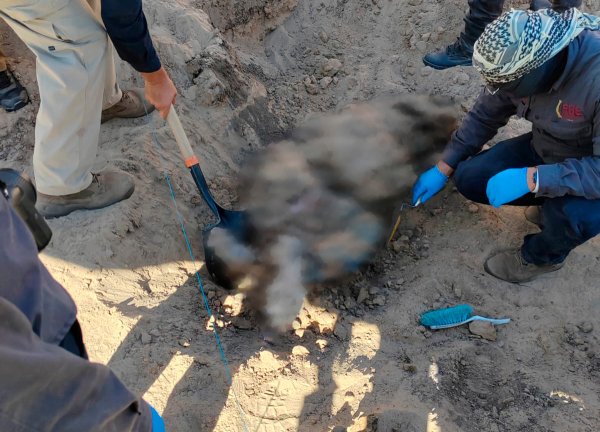
In the Narco Cemetery, they find the body of a young woman with signs of having been buried alive.
By Jesusa Cervantes
She liked soft colors: light blue pants, light blue socks, probably, and lilac underwear. A tall woman measuring between 1.65 and 1.68 meters, her sneakers might have been size 9, and the last minutes of her life were experienced in intense pain. At least that's what the fetal position in which her body was found suggests.
In terms of numbers, the girl with the pastel colors is the 16th among the skeletal remains found in the narco-cemetery of the Miguel Alemán neighborhood, located between the states of Sonora and Baja California. However, in life, she wasn't just a number but perhaps a beautiful young woman, with a free spirit, fearless, and long hair. We don't know.
She probably has a mother and a father still searching for her, or children waiting for her, or a husband who doesn't understand why she disappeared. Regardless, this, the third woman discovered in the grim area of the Mexicali Valley, has a story her captors tried to erase by burying her, causing immense pain to her and those close to her.
Unlike the 15 bodies previously discovered in the federal area of the Miguel Alemán neighborhood, this girl with a preference for pastel colors was located when other bodies were also found on private property, near the neighborhood area.
Details at the State Attorney General's office led by Ricardo Iván Carpio are lacking. On the contrary, as evident in his press conferences, his statements are confusing. Last Friday, the day of the discovery, the department reported through three brief paragraphs:
"...investigative and intelligence work by the special group formed to address cases of missing persons led to the investigation and RAID of a ranch in the Miguel Alemán town...", reads the first paragraph of August 4th.
"At this time, the discovery of a deceased body buried in said area is confirmed..."
As can be read, it might seem that the body of the girl with pastel colors was found in the raided ranch. However, it was confirmed to this outlet that the girl was discovered in the federal area. Additionally, two ranches were raided, one near the mentioned area and another along the border with the United States.
There, the discovery was more gruesome; between 3 and 4 bodies were detected, but only one was extracted, as the depth at which they were buried prevented the agents from the attorney's office from continuing the search with just picks and shovels. What could be extracted was a body. This is unofficial information that was corroborated by elements of the attorney's office.
As reported, search efforts resumed last week. Mondays, Wednesdays, and Fridays correspond to the collectives Madres Unidas y Fuertes, Buscando a Paola y desaparecidos, and Unidos por nuestros desaparecidos. Tuesdays and Thursdays are for collectives arriving from other areas of the state or country.
On July 14th, the first skeletal remains were found. Four of them; from there onward, the astonishment hasn't stopped; day by day, the macabre discoveries are laid bare. On Friday, August 4th, the girl with pastel colors was located just over a meter deep.
"She was alive when they buried her. No lifeless body falls into the fetal position. The strong imprint of her sneakers reveals that she was standing in what would become her grave; they probably shot her or hit her in the abdomen, causing her body to fall to the left side. Upon reaching the bottom, it ended up in the fetal position, a movement humans’ resort to when experiencing intense stomach pain," deduces a doctor upon seeing the photograph of the girl, who prefers to remain anonymous.
And while the forensic area of the State Attorney General's office analyzes the remains of the girl with pastel colors, those who have lost contact with their friend, sister, mother, daughter, coworker, schoolmate, or neighbor will approach the authorities to, after long hours of waiting, learn whether the remains are those of their missing loved one and to understand how, why, where, at what time her life was taken away.
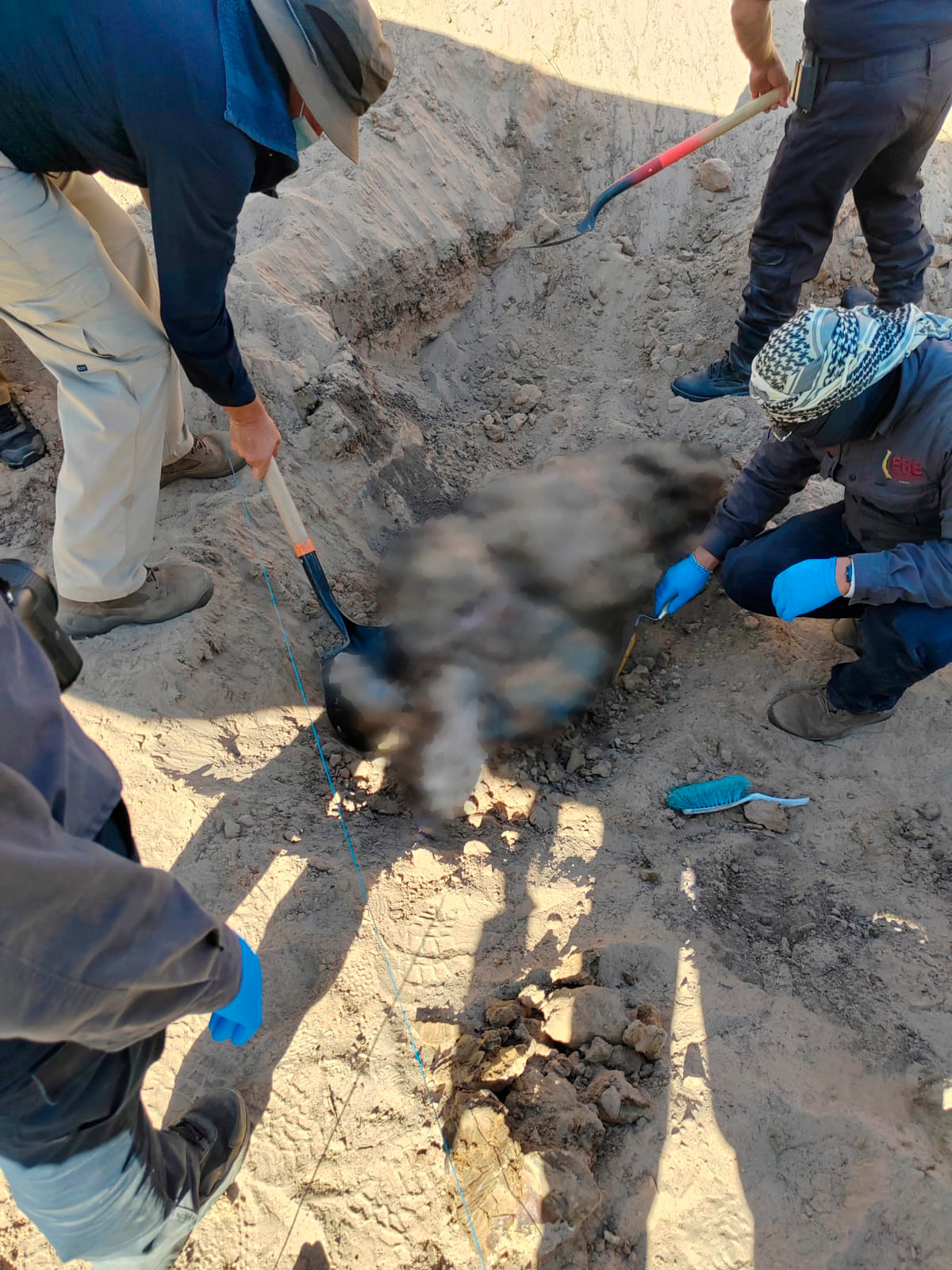
A dome for the girl with pastel colors
On August 1st, members of collectives from Mexicali who have searched with pick and shovel in the Miguel Alemán neighborhood traveled to the city of Tijuana to protest against other search groups that have occupied the Local Search Commission facilities since July 14th.
Paola Sandoval, spokesperson for the State Movement United for the Disappeared of Baja California, told Tijuana's media that they won't end the occupation until Governor Marina del Pilar Ávila Olmeda receives them.
Two of their main demands stand out: the removal of the head of the CLB, Rafael Hernández Murrieta, and the lack of attention to some Tijuana collectives.
On the Mexicali side, the groups are asking for the release of the offices so that the excavator, a drone with thermal camera, and a dome for temporary body storage, among other equipment, can be delivered and used in the searches carried out in the Miguel Alemán neighborhood.
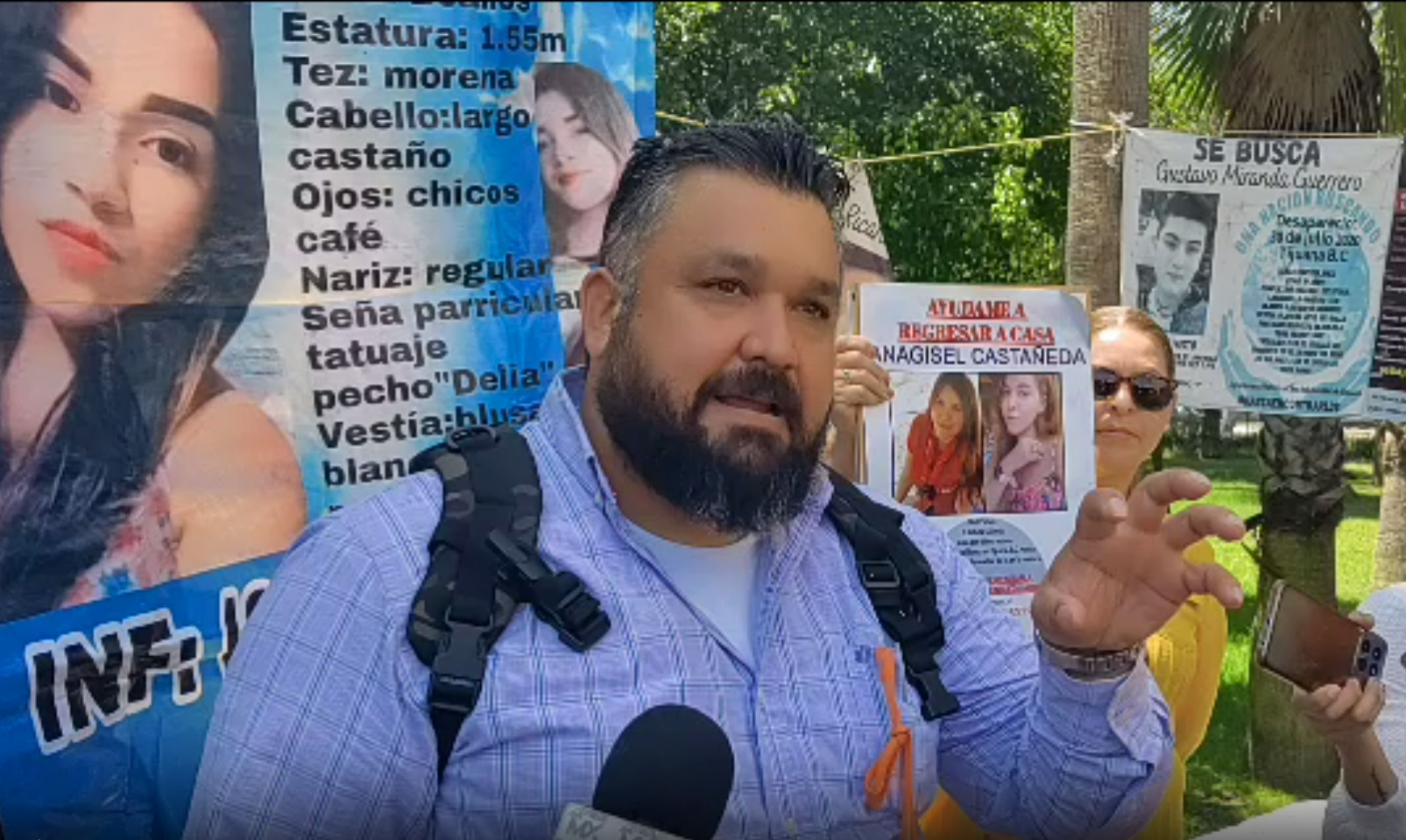
Gonzalo Moreno Márquez, father of Kevin Moreno, a young man who disappeared on March 26, 2022, from the parking lot of Terraza Shot's bar, located in the nightclub area of the city of Mexicali, and who participated in the demonstration, recalled that during the search in the Mexicali desert, 20 state agents succumbed to "heatstroke" while digging only with picks and shovels, "when the commission has an excavator."
Last week, Infosavia reported that from 2020 to 2022, the federal government provided the Local Search Commission of the state with 95.4 million pesos, and another 50 million pesos (3,125,000 dlls) are allocated for 2023, totaling 145.4 million pesos (9,087,500 dlls). In addition, the government of Baja California contributed just over six million pesos in 2022.
Among the demands of the various collectives is not only the backhoe, which would facilitate the searches, but also the "temporary storage and protection dome for up to 48 corpses."
None of the collectives have seen the dome, but they know it exists. Moreover, the collectives believe that it was acquired with federal resources allocated in 2022. However, that wasn't the case.
According to documents from the Superior Audit Office of the Federation (ASF), an auxiliary body of the Congress of the Union, in the review of the government's 2021 expense account, it was revealed that the government of the Morena party's Jaime Bonilla Valdez received 51,823,300 pesos, of which 51,349,000 pesos were spent, and 474,300 pesos (29,643.75 dlls) were returned to the federation.
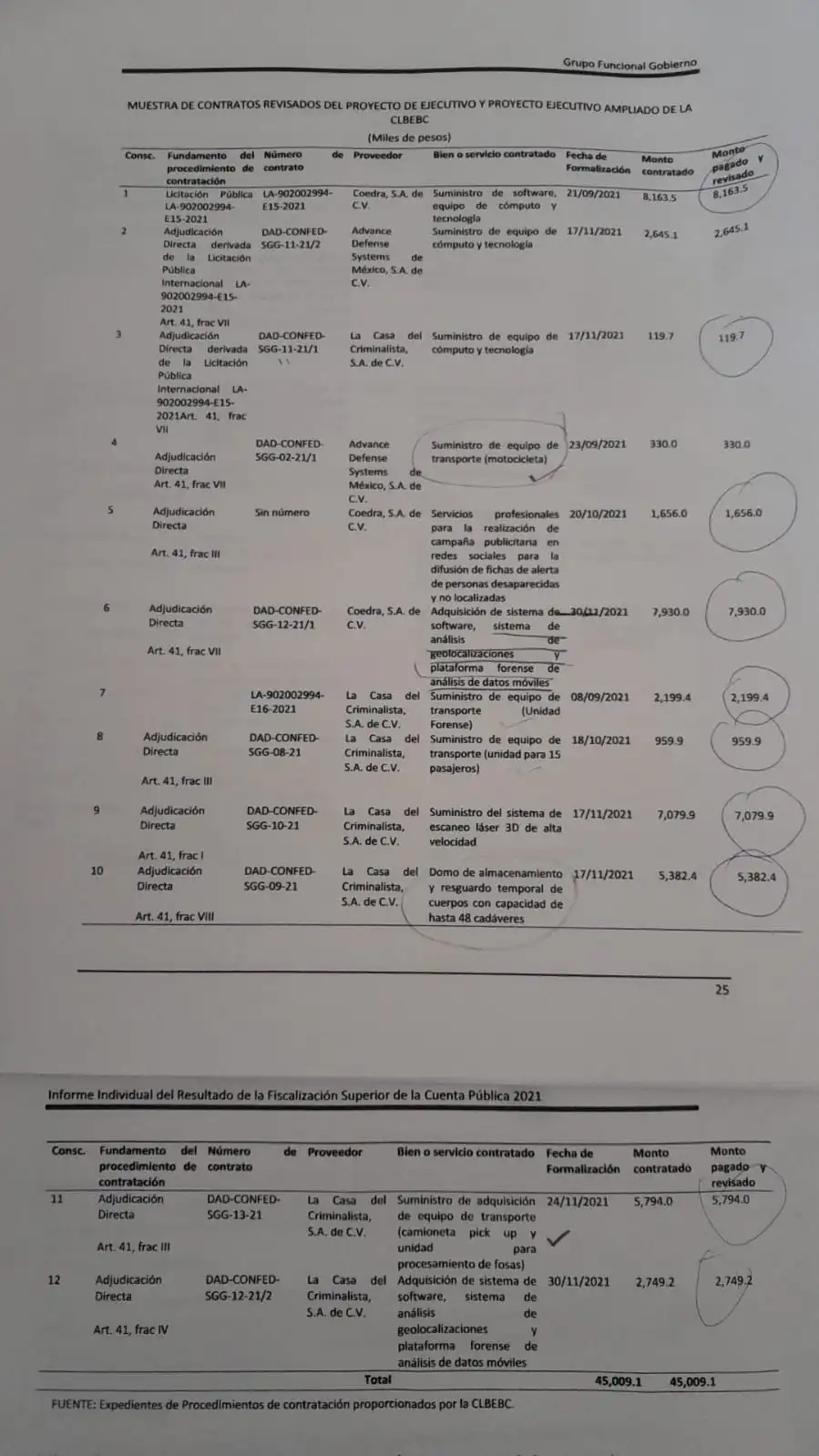
Therefore, it was up to the government of Jaime Bonilla Valdez to make the purchases. Among the most expensive purchases was precisely the acquisition of the temporary storage dome for 48 bodies, costing 5,382,400 pesos (336,400 dlls), another significant expense was a pick-up truck and a unit for processing graves, costing 5,794,000 pesos (362,125 dlls).
The supply of a high-speed 3D laser scanning system, with a payment of 7,079,900 pesos (442,493.75 dls); a software system, geolocation analysis system, and mobile data forensic analysis platform for 7,930,000 pesos (495,625 dlls), and another software supply, computer equipment, and technology for 8,163,500 pesos (510,218.75 dlls), all according to ASF data.
Out of the slightly more than 51 million pesos (3,187,500 dlls), ASF took a sample of expenses totaling 45 million pesos (2,812,500 dlls), corresponding to 12 contracts with the three aforementioned companies.
The acquisitions are rife with irregularities, such as the fact that the authority never provided evidence of having conducted market studies or inviting at least three people. Of the 12 contracts reviewed, 11 were awarded directly, meaning the government of Jaime Bonilla decided who to buy from.
One noteworthy aspect is that in reviewing the public accounts of all the CLBs in the states, 16 of them resorted to the same two suppliers: Coedra and La Casa del Criminalista.
For what concerns Baja California, the most serious issue is that the material acquired in 2021 arrived at the end of the year when Marina del Pilar Ávila Olmeda was already governor.
The federal authority's review was conducted in 2022, and after analyzing the contract irregularities, they visited the CLB offices in Tijuana to verify the existence of all purchases. The gravity of what was found has no explanation other than either Rebeca Vega's lack of capability, who is in charge of the CLB on behalf of the General Secretariat of Government headed by Catalino Zavala, or indifference and lack of empathy for the families of the disappeared.
The authority's report reveals that the acquisitions were indeed made, and they are in the Tijuana offices, but they are packaged, meaning they have never been used despite the crisis of the disappeared people facing the state and the use of just picks and shovels by collectives and authorities in their fieldwork.
Unused equipment for 1.5 years
The dome that Gonzalo Moreno, Kevin Moreno's father, has been demanding, which would have been useful for the girl with pastel colors discovered last Friday, has always been in the CLB offices unused, according to the ASF report: the body dome, the van, the unit for grave processing, the geolocation analysis system, and the mobile data forensic analysis platforms all lack theft insurance policies, and there is no one in the CLB to watch over the equipment to prevent theft.
So, all the equipment does exist, it is there, or at least until April of last year, it was in the CLB offices, which are now occupied by different Tijuana collectives, although they argue that there are only picks and shovels.
The question is where this equipment physically is. Is it in the state government's warehouse? Is it in the Offices of the Chief Officer? Are they still in the CLB facilities? Or do they no longer exist, were they stolen, sold, or simply disappeared? These are questions that Rebeca Vega and Governor Marina del Pilar Ávila Olmeda will have to answer.
Negligence and Plunder
The Superior Audit Office of the Federation found that two video projectors were stolen, and the state authority even submitted a report as evidence of the theft.
It also discovered that a forensic team for photography, received on November 20, 2021, and stored in the CLB facility's warehouse, which had not been used, was still in its original packaging. Similarly, two sets of forensic lights received on December 20, 2021.
Another revealing fact from the federal authorities: equipment was purchased that is not being used by all the agencies involved in identifying skeletal remains, making the use by the CLB less effective. Evidence of the existence of the technical manual and memory for its use is also absent. Evidence of training for software use is also lacking.
"...in contract DAD-CONFED-SGG-12-21/1, the following was determined: a) Item 1 'Context analysis system', Item 2. 'Forensic portal for identification and claiming of corpses', Item 3 'Follow-up and evaluation system for the standardized protocol', and Item 4 'Forensic cemetery and corpse administration and control system'...the commission reported that for its proper use, information generated by the state prosecutor's office, municipal authorities, and public security is required, but they are only working with CLB reports, which limits their use for which they were acquired..."
Another case where information from other agencies was lacking and which renders the purchased software inoperative is related to contract LA-902002994-E15-2021, which concerns the "Forensic system for registering anthropometric measures of the human skull, three-dimensional modeling, and aging of photographs to compare similarities with the database of missing persons." Not all the information required to operate the purchased system is provided, rendering its purchase inoperable.
And the indifference continues. The existence of the two 3D laser scanners, costing 7,079,900 pesos (442.500 dlls.), which were received on December 15, 2021, was confirmed, but they are still in their packaging, so they have not been used.
The same occurred with two computers that were still in their original packaging. An even worse case, in the purchase of five portable radios, they have not been used "as the company that provides the communication network compatible with the equipment does not have service in the state," which only shows that the government of Jaime Bonilla did not conduct a market study.
The incapacity of the Bonilla government and the indifference of the current one have resulted in at least 51 million pesos, which the federal government provided for the acquisition of equipment in the search for missing people, being wasted up until now. While collectives from all over the state continue to demand the delivery of the equipment, which includes all-terrain vehicles (raizers), vans, radios, vests, LED lamps, high-speed 3D laser scanning systems, multi-post for rescuing bodies from wells, three Urban vehicles, a quad bike, and even a boat, equipment that no one has seen.
