
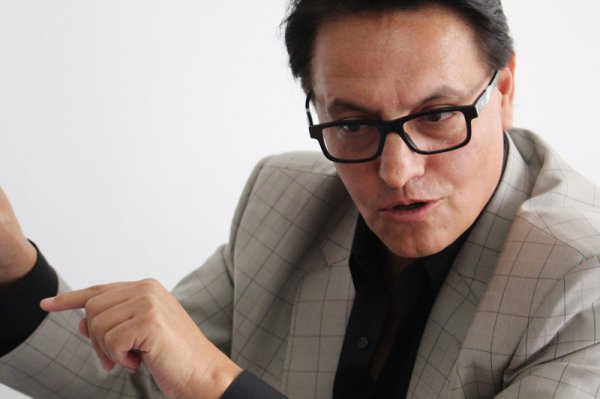
Guadalupe Lizárraga Jueves, 10 de Agosto del 2023, 13:54
Verástegui was evacuated from Ecuador at the moment of Fernando Villavicencio's assassination.
Fernando Villavicencio, a critic of politicians and businessmen who financed former president Rafael Correa.
By Guadalupe Lizárraga
Fernando Villavicencio, in addition to being a journalist, was an uncomfortable figure for both the right and those who present themselves as the left in Latin America. His assassination, by multiple gunshot wounds to the head, took place yesterday in Quito as he was leaving a massive campaign event amidst a crowd and with an escort, highlighting the transcontinental axis of the drug trade.
Media reports immediately linked this tragic incident to the Sinaloa Cartel. In June, Villavicencio uploaded a video to his social media denouncing threats from this drug trafficking group and directly referring to it as "Fito," which alluded to former president Rafael Correa.
The candidate had evidence to support the claim that former Ecuadorian president Rafael Correa, known as "El Fito," was part of one of the most powerful cartels in Latin America, namely the Sinaloa Cartel. An investigative report titled "The Cartels of the Middle of the World," published in December 2018 on periodismodeinvestigacion.com, revealed several photographs showing Correa with members of the Sinaloa drug trafficking group.
The report includes an infographic describing each character in the most revealing photograph: Rafael Correa Delgado, alongside José Antonio Aguilar Orozco, Darwin Stalin Gómez Vélez, and Édgar Fernando Sandoval Puga, all involved in various anti-narcotics operations.
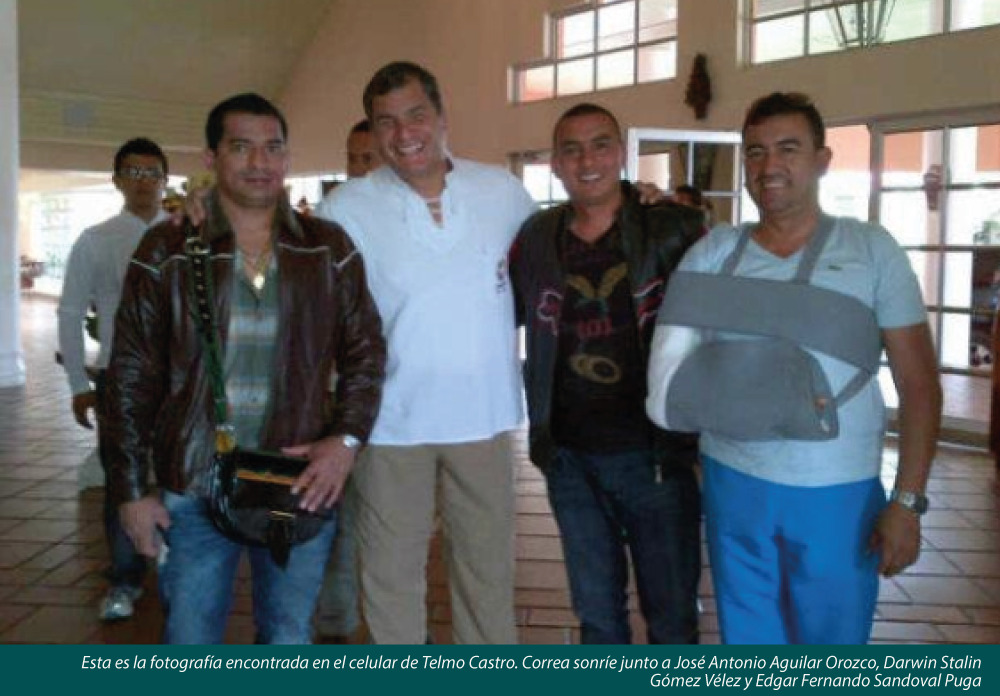
This photograph was obtained from the cell phone of Telmo Castro, captain of Ecuador's military intelligence.
The journalistic investigation is supported by the research of the Transnational and International Organized Crime Prosecutor's Office (FEDOTI). This work also shows that Ecuadorian military personnel from intelligence units were collaborating with the Sinaloa Cartel to transport up to 500 kilograms of cocaine per shipment from Colombia to Mexico. Meanwhile, as Fernando Villavicencio had denounced, Ecuador had become a transit country.
In June of this year, Fernando Villavicencio delivered a powerful message addressing sensitive issues such as the alleged connections between Mexican and Colombian criminal organizations and Mexican President Andrés Manuel López Obrador.
He referred to Mexico as the "progenitor of the cartels" and called for the intervention of the United States through intelligence operations to halt drug trafficking. Through dozens of videos on his Facebook profile, he centered his electoral campaign on the proposal to eradicate drug trafficking: "The major cartels, he said, were not born in Ecuador; this is a peaceful country."
"Our homeland is the greatest victim of the criminal operations of the largest drug trafficking mafias in the world, but these mafias and cartels are not Ecuadorian," he stated in one of his presentations on July 30, with nearly 30,000 views.
In several videos, Villavicencio frequently reiterated that the mafias were from Mexico and mentioned the two main drug cartels, the Sinaloa Cartel and the Jalisco New Generation Cartel.
"Neither the cocaine is ours, nor the mafias are ours. But they use our homeland as a transit, storage, export, and money laundering territory," the presidential candidate said in a video on his Facebook account.
Media Reactions
One of the news portals that was following Villavicencio's criticisms of López Obrador was Eje Central, run by Raymundo Rivapalacio. However, following the announcement of the assassination of the Ecuadorian presidential candidate, the post on the X platform containing Villavicencio's video referring to the Mexican president and drug cartels was deleted. Eje Central deleted its X post when it had only 2 views at 21:42 hours in Mexico City and 23:42 hours in Quito. Five hours had passed since the assassination of the candidate, which occurred at 18:20 local time in Quito, and there were already reports of nine injured victims, including an assemblywoman and two police officers.
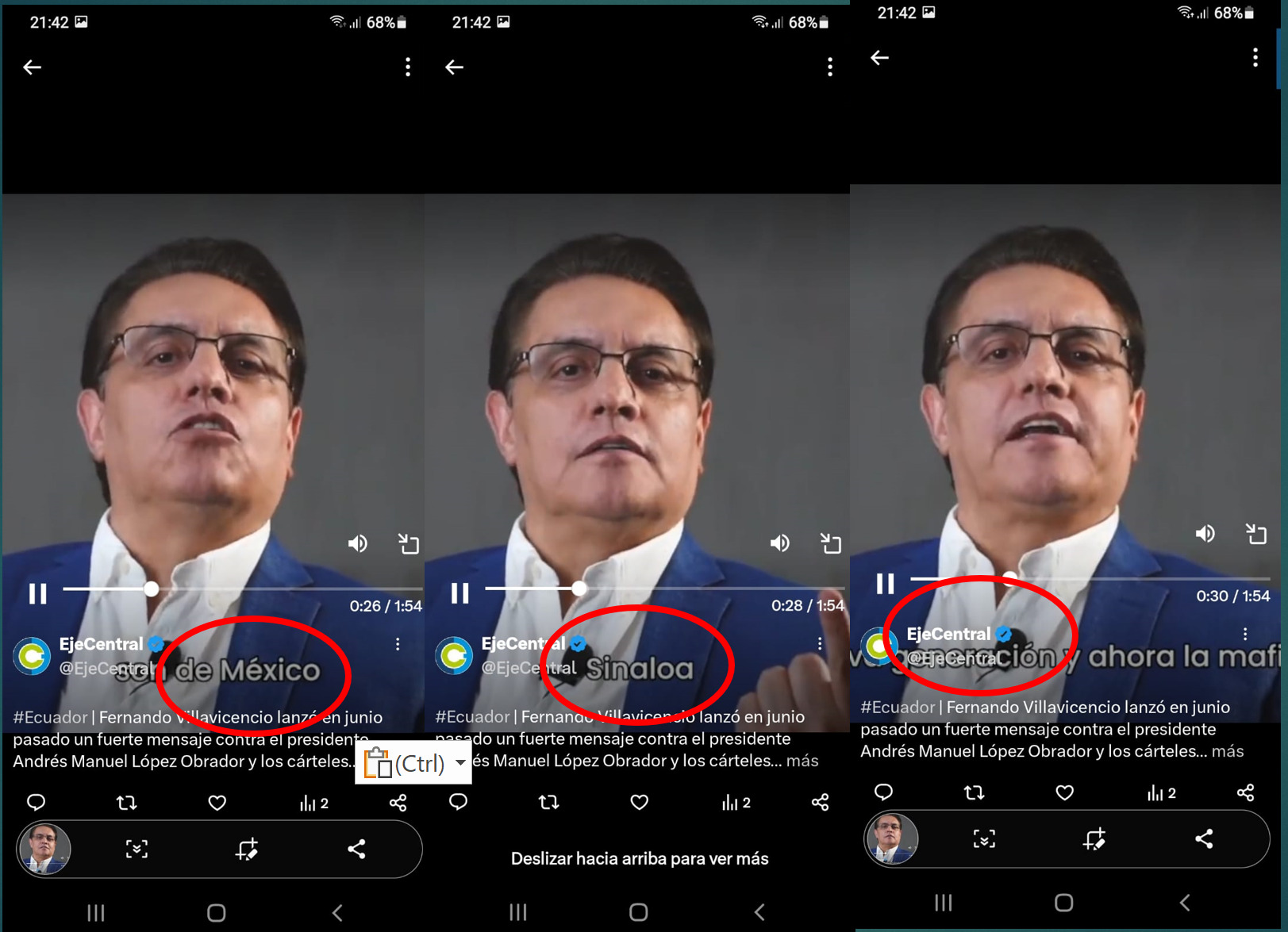
Video deleted from platform X after the announcement of the murder of Fernando Villavicencio.
Threats before the assassination
Presidential candidate Fernando Villavicencio uploaded a video on Tiktok about the threat he received from former president Rafael Correa, whom he identified as part of the Sinaloa Cartel and referred to as "Fito."
In the video, he stated that he would establish a maximum-security prison for crime bosses, including "Fito" and other narcotraffickers.
"We will combat drug trafficking as part of a transnational strategy, working on the extradition of the drug lords. We will not allow these criminals to continue destroying our country. We will work with our international allies to dismantle their networks and bring them to justice. We will not rest until these gangs are defeated!".
We are making a police report public through the media, which reveals a significant threat from one of the bosses of the Sinaloa cartel. I am referring to the alias 'Fito', who has issued a threat against me and my campaign team. This warning indicates that if I continue to expose him and his organization, they will either launch an attack against me or make an attempt on my life.
Fernando Villavicencio, the journalist and presidential candidate of Ecuador, gave a message last June against President Andrés Manuel López Obrador for his tolerance of Mexican and Colombian cartels. His most forceful statement was, "The authorities make deals with the narco."
Critiques of Financial Power
Villavicencio was also critical of transnational financial power. The news portal Alteridad.net revealed this in one of its interviews when he publicly announced his presidential ambitions. In his critique of the group of multimillionaire businessmen who have influenced the politics of Ecuador and other Latin American countries, he mentioned that they were a "blend of ideologies" ranging from Stalinism to Opus Dei.
"However, it was the left that provided the theoretical framework, the symbols, and the history to someone who had never before been burned by the coal of social struggle. A naive and blind left was dazzled by an eloquent and charismatic young man without measuring what was behind that figure. The left couldn't see who Rafael Correa really was and was deceived, which makes the left also responsible for the disaster it caused," he emphasized in an interview with alteridad.net on January 22, 2020.
He specified that "Correa's relationship and agreements with international groups and figures such as the FARC, Lula, and Chávez, and with transnational companies like Petrobras and Odebrecht, funded Correa's campaign. Even Carlos Slim, one of the wealthiest men on the planet, intervened."
During the Assassination
While journalist and presidential candidate Fernando Villavicencio was getting into his car at the end of a campaign event, he was shot in the head. At the same time, Ecuadorian President Guillermo Lasso and his wife were socializing with Mexican actor Eduardo Verástegui.
According to entertainment media reports, Verástegui was going to screen his recent film 'Sound of Freedom' for the Lasso family. As soon as they learned of the assassination, Verástegui was assisted by authorities in leaving the country on a private plane.
The reasons for the Ecuadorian government allocating public resources to evacuate a Mexican actor who was visiting Quito for commercial purposes are unknown. However, it is certain that there is a relationship between Verástegui and Carlos Slim, as has been evidenced in recent works by Rodolfo Soriano Nuñez in Los Angeles Press. These relationships are the ones Fernando Villavicencio referred to in his criticisms of the billionaire backers of Correa's campaign, alluding to Opus Dei.
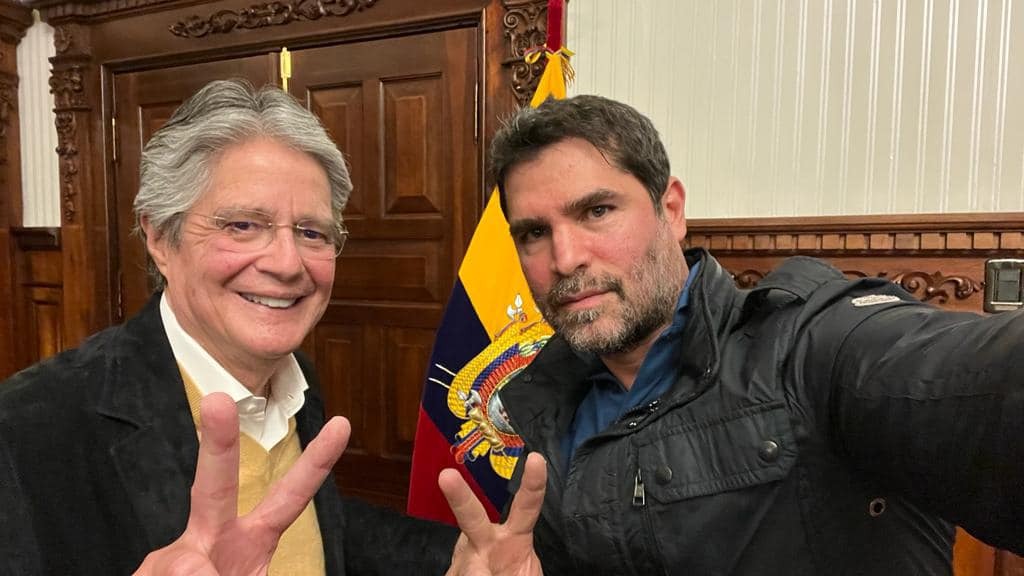
Eduardo Verástegui con el presidente de Ecuador Guillermo Lasso, miembro del Opus Dei, con quien departía en Quito al momento en que se asesinaba al candidato presidencial Fernando Villavicencio.
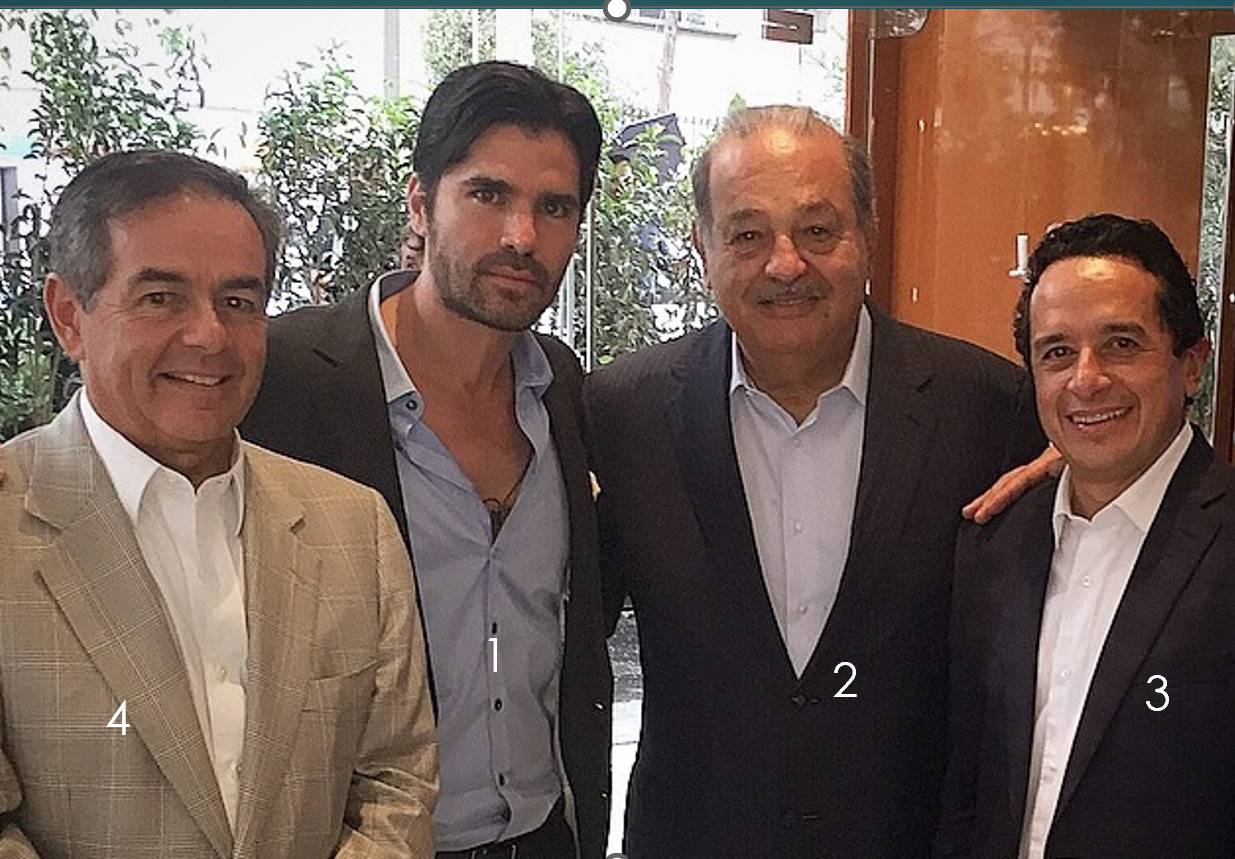
Eduardo Verástegui con el millonario Carlos Slim (2), el embajador de México en Canadá y amigo del presidente López Obrador, Carlos Joaquín González (3) y el actor Daniel Goñi (4).