Rodolfo Soriano-Núñez Lunes, 20 de Octubre del 2025
French survivors of abuse at the Catholic school of Bétharram reach a preliminary agreement, while NGOs there call a rally at the bishops’ HQ in Paris.
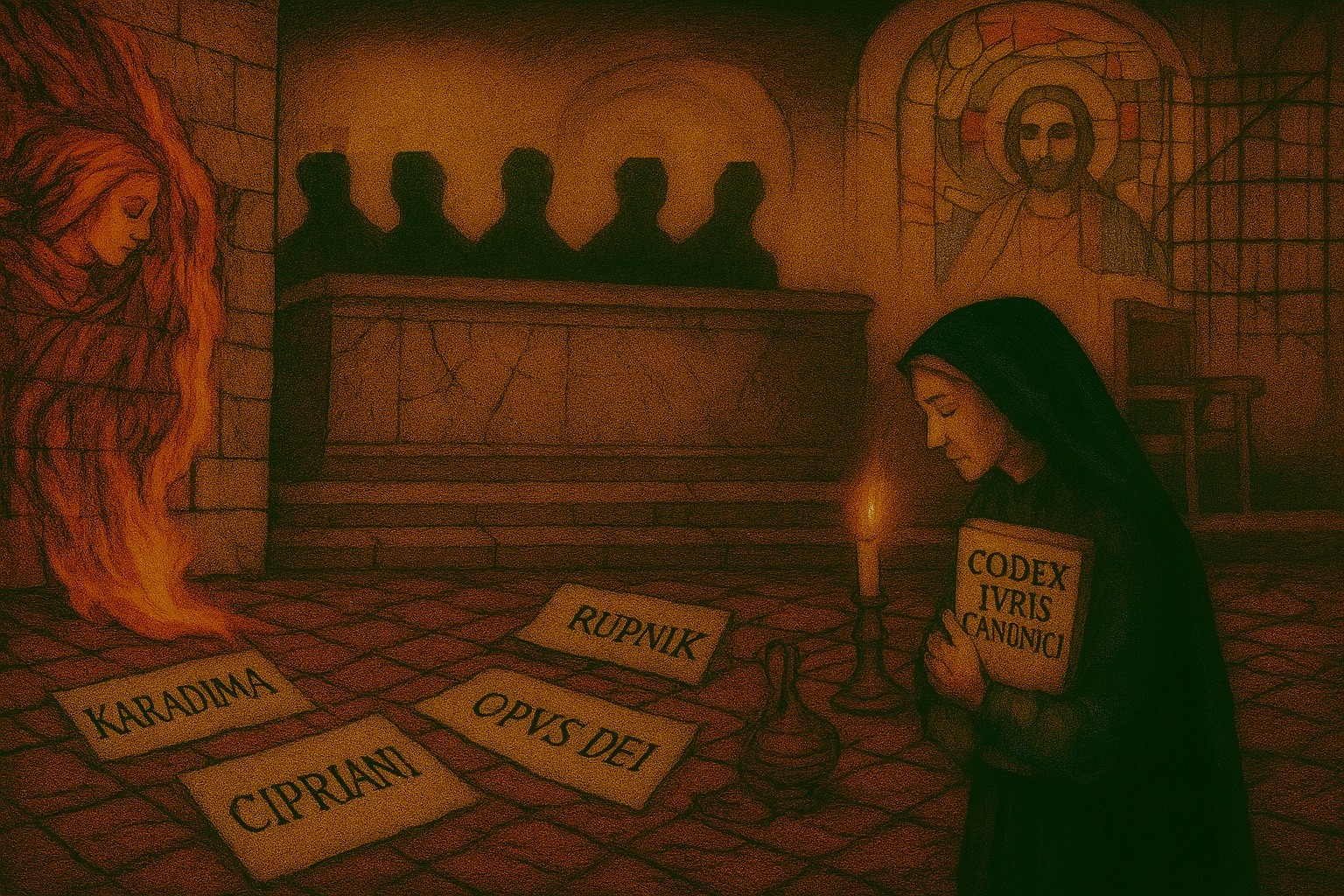
Rome reopens Rupnik's abuse case, while Nuns vs The Vatican, a documentary, tells the story of his victims. Is there reform at Opus Dei in Leo XIV’s agenda?
A summary of this story in audio is available after this paragraph.
By Rodolfo Soriano-Núñez
A series of key developments in the clergy sexual abuse crisis in the Catholic Church over the last few weeks merit attention and commentary.
Among the most notable it is possible to enlist three developments. The first, the publication of the II Annual Report of Tutela Minorum, the entity created by Pope Francis to prevent clergy sexual abuse.
Then, Pope Leo XIV’s decision to reopen with a new panel of judges the case of noted former Jesuit Marko Rupnik. Despite the Society of Jesus’ decision to expel him from that order, he remains a priest.
The new trial is more relevant as Nuns vs. The Vatican, a documentary recently premiered in Toronto, describes in all its misery the revictimization of Rupnik’s victims by different entities of the Catholic Church.
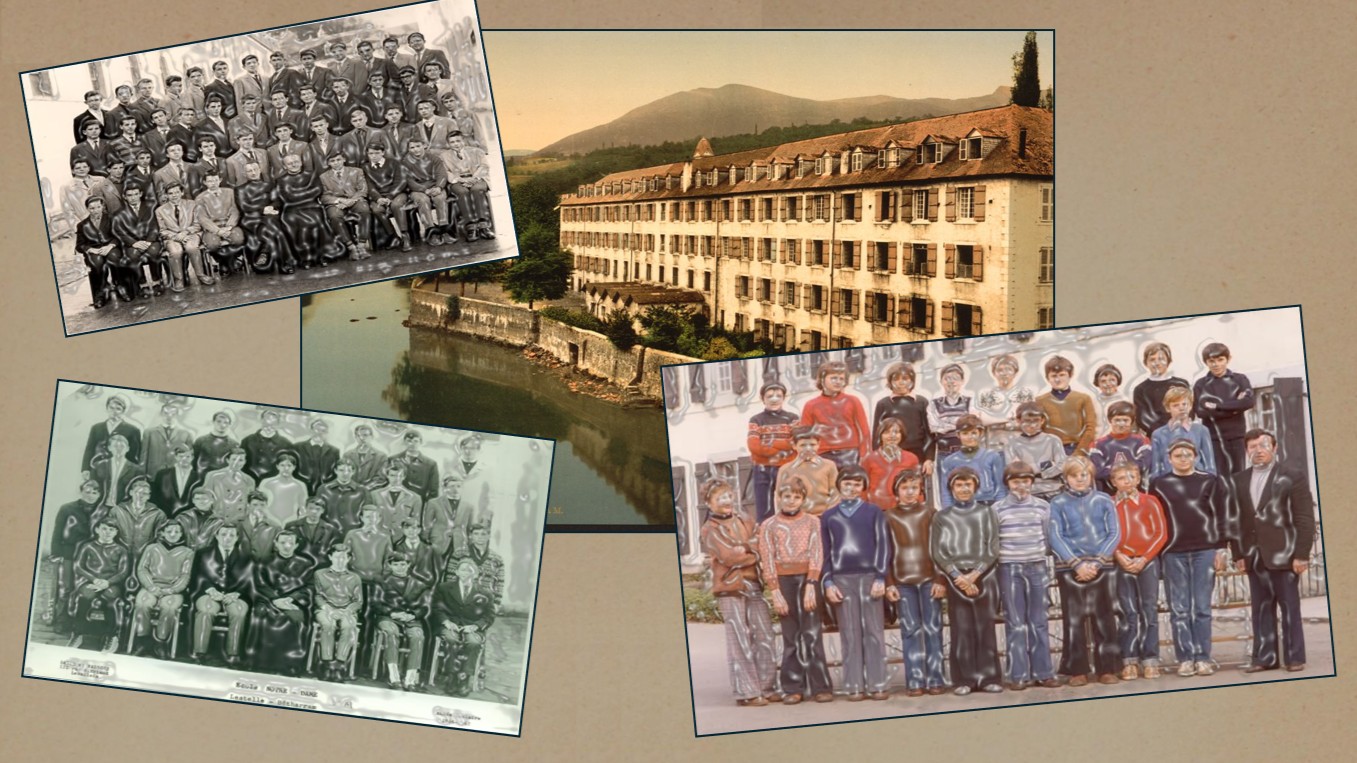
In France there are news about a settlement to offer a maximum of 60 thousand euros to each victim of the Catholic school of Our Lady of Bétharram. The decision came after the order had been already offering partial compensation to some of the French victims of the order.
It would be impossible to dismiss the anger prompted in Chile by President Gabriel Boric’s visit to Leo XIV and to Jorge Mario Bergoglio’s tomb, The criticism reflects deep-seated dissatisfaction of survivors there with what, back in 2018, seemed to be an Earth-shattering decision to force the resignation of all Catholic bishops there. Ultimately, most of the bishops remained in their posts, and sadly there were never true measures of restorative justice to the survivors.
Finally, one must pay attention to how media close to Opus Dei, the organization, akin to an order, founded in Spain by Josemaría Escrivá de Balaguer, are spreading “news” about a major reform that they render as destroying its original design.
Tutela Minorum
As far as the second annual report of Tutela Minorum it is noticeable that this time around the report is available in full and as an executive summary in English, French, Italian, Portuguese, and Spanish. German would be the only “major” language not included. In that respect, Tutela Minorum seems to be aware of the need to acknowledge the global dimension of the clergy sexual abuse crisis.
Next week’s installment of this series will delve deep into the claims made by Tutela of the reach of the changes promoted up until now. One needs to be aware, however, that most of the claims made by the national conferences of Catholic bishops about their own accomplishments are self-reported and not actually verified by Tutela or by an independent entity.
That is relevant because back in 2024, the Mexican conference of Catholic bishops claimed full compliance when in actuality there is no evidence of it, not even now, one year after they made that dubious claim, as the story linked after this paragraph tells.

English Edition
The Catholic Church’s report on clergy sexual abuse
This year there is no country from Latin America, and the sole Spanish-speaking country included in the report is the only African country where Spanish retains official status, Equatorial Guinea.
The bulk of the report is centered in the cases of Italy and Portugal, with an assortment of cases from Africa and Asia, including South Korea and Japan. Next week’s installment will go into the details of what the report says about Italy and Portugal, two prime and contrasting examples of how the European bishops have been trying to avoid and to face, respectively, the challenges posed by the clergy sexual abuse crisis.
In the meantime, it is worth noticing that a feature in this year’s report is a whole section where the authors go over narratives of survivors of clergy sexual abuse offering details about their experience. There, on page 40 of the English-language version, it is possible to find paragraphs devoted to “retaliation by Church leaders against victims/survivors” and, closely relate to it, one dealing with “Victim-blaming, stigma, and community rejection: Upholding a culture of silence.”
In stressing, among others, those attitudes of the hierarchy, the report summarizes survivors’ narratives confirming, as a previous installment of this series pointed out, how there is an issue of under-, not over-reporting of clergy sexual abuse in the Catholic Church. Otherwise, why would Tutela talk about “retaliation” and the of the interest of “upholding a culture of silence”? It is a wat to talk about how the Catholic hierarchy is still engaged in discrediting victims willing to come forward by keeping the number of reports as low as possible.
The executive summary of the report is available in the box below as a PDF or in full at Tutela Minorum’s website here.
Also, it should be noted that Tutela’s report makes an explicit call to hold the Catholic hierarchy to account on the clergy sexual abuse crisis. In that regard, it is even harder to understand why Pope Leo XIV decided to express concern to Crux about “innocent priests” being falsely accused, as a previous installment of this series, linked below, explained.
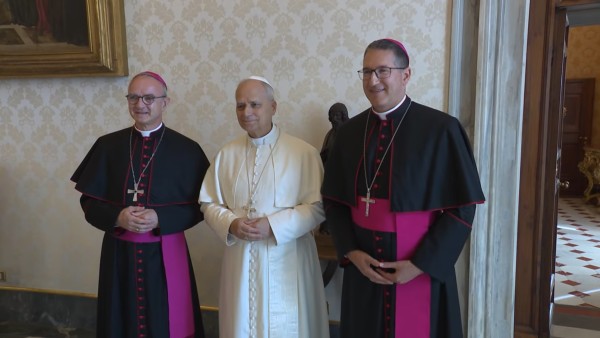
Update: This Monday 20, by the way, Pope Leo XIV had an audience with Ending Clergy Abuse, a major global NGO representing survivors of clergy sexual abuse all over the world, with representatives from different countries. There is a chance some information will emerge later. Sadly, as if they were trying to hide something, the audience with this group appears only in the Italian version of the Holy See's website and not in the Spanish or in the English versions of it. The reasons to hide or to not report these meetings are hard to grasp, and make it hard to actually believe Rome is aware of the extent of the damage.

Our Lady of Bétharram
On Tuesday October 14, French newspaper Le Monde published a story with some of the details on the agreement announced late the previous day. Sadly, Le Monde keeps most of its stories behind paywalls, so in order to access to some of the details of the agreement one needs to peruse the local French media, as in the case of SudOuest (content in French), where the details about an average compensation of 35 thousand euros and a ceiling of no more than 60 thousand euros are available.
The total estimated sum that the order will have to disburse to settle the complaints in France is of a minimum of three million euro, almost 3.5 million U.S. dollars, at the exchange rate of Wednesday October 15.
The agreement is valid only for French nationals or persons who were victims at the school located in Pau, in the Pyrenees, in Southern France, and not to the potential victims of priests or religious brothers associated to that order in other countries where that order has been active, even if they were victims of the same French predator priests.
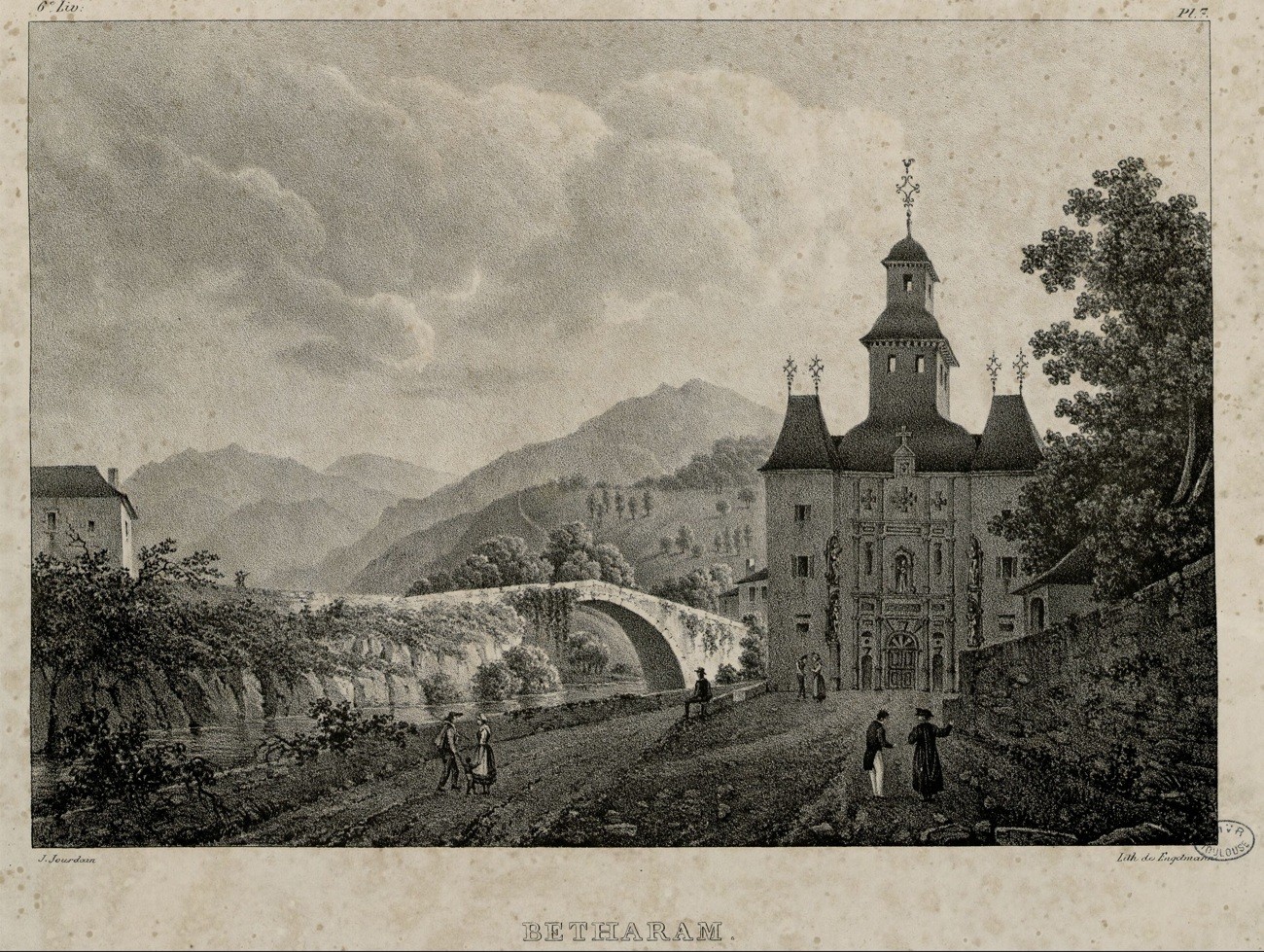
Despite its limitations, both geographical and of the amounts considered, the Bétharram agreement sets a significant financial precedent within the French Church, establishing a definitive, albeit debated, measure of institutional accountability.
This is more relevant since, so far, there are at least 14 cases of abuse at schools owned and/or operated by the order behind the French school in Cote d’Ivoire, a Sub-Saharan African country, in the Atlantic coast of that continent.
The aforementioned Le Monde revealed, over their website, on Tuesday 14, some details of one of such cases (content in French, behind a paywall).
Back in 1990, Benat Ségur, who was the vicar at the parish of Saint Bernard at Adiopodoumé, in Abidjan, the country’s capital city, attacked Sylvestre D., a then underage member of the parish choir.
Ségur has been accused of attacking and/or abusing at least another 13 French students, some of them during his tenure as professor and later as headmaster of the Catholic school of Bétharram (1983-8). Ségur died in 2010, so it is very hard to pursue any case in courts in either France or Cote d’Ivoire.
That there was the clear risk of more victims of clergy sexual abuse at the hands of the members of the order behind the Catholic school of Bétharram is the reason why this series has been following what happens there.
Not only the order owning Bétharram but many other orders from France and other European countries have a long story of pastoral and teaching activities in Latin America, Africa, and Asia. That is the reason why, back in June, this series went over what has happened there with some detail in the story linked after this paragraph.
English Edition
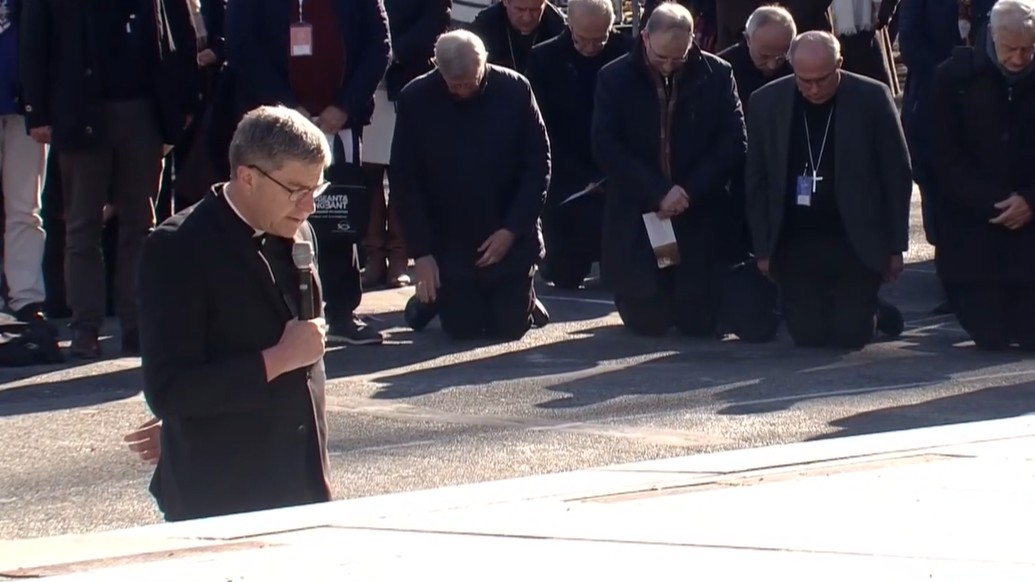
Bétharram, a mirror for all countries to look at
Similarly, Camille Rio, a French Catholic priest, sharp critic of what his Church has done to deal with the clergy sexual abuse crisis, published at Los Angeles Press an essay offering a closer and bolder look at what is behind the abuse in that school, linked after this paragraph.
Rio’s piece hinted the chances that a settlement was already about to happen, as confirmed last week and the potential consequences that said agreement will have for the cases there, in other regions in France and other countries in the French-language world.
English Edition
Bétharram: Sacrificing the head so the body may live
Encouraging but not enough
As encouraging as the news of an agreement at Our Lady of Bétharram are, in France there is already an intense debate about it. Some of the victims who think the compensation is not enough, as those who were victims only of physical or psychological abuse will not be included.
On top of that there is the issue of the quarrels and acrimony between the different groups claiming to represent the survivors of Bétharram. That is a feature of the crisis in several countries. The victims of abuse find hard to trust even other victims and that opens the door to frequent mutual accusations that, from a distance, are really hard to measure and understand.
Despite those difficulties, it should be noted that, on top of the announcement dealing with Bétharram there was, over last week, another encouraging development. One of the French groups of survivors, the association From words to action is calling other similar groups in France to rally at the French bishops’ headquarters in Paris on November 8.
It is hard to figure out how many people will attend, but the very fact that some of the groups in France are aiming a mobilizing themselves to challenge the French bishops on this issue is something hard to find in Latin American countries, where most victims live very isolated lives, with little or no interest in rallying together with other survivors and even less on publicly confronting the Catholic hierarchy.
The French-language original poster calling for the mobilization appears after this paragraph, and a full translation to English after it. The message is also available at Facebook in French here.
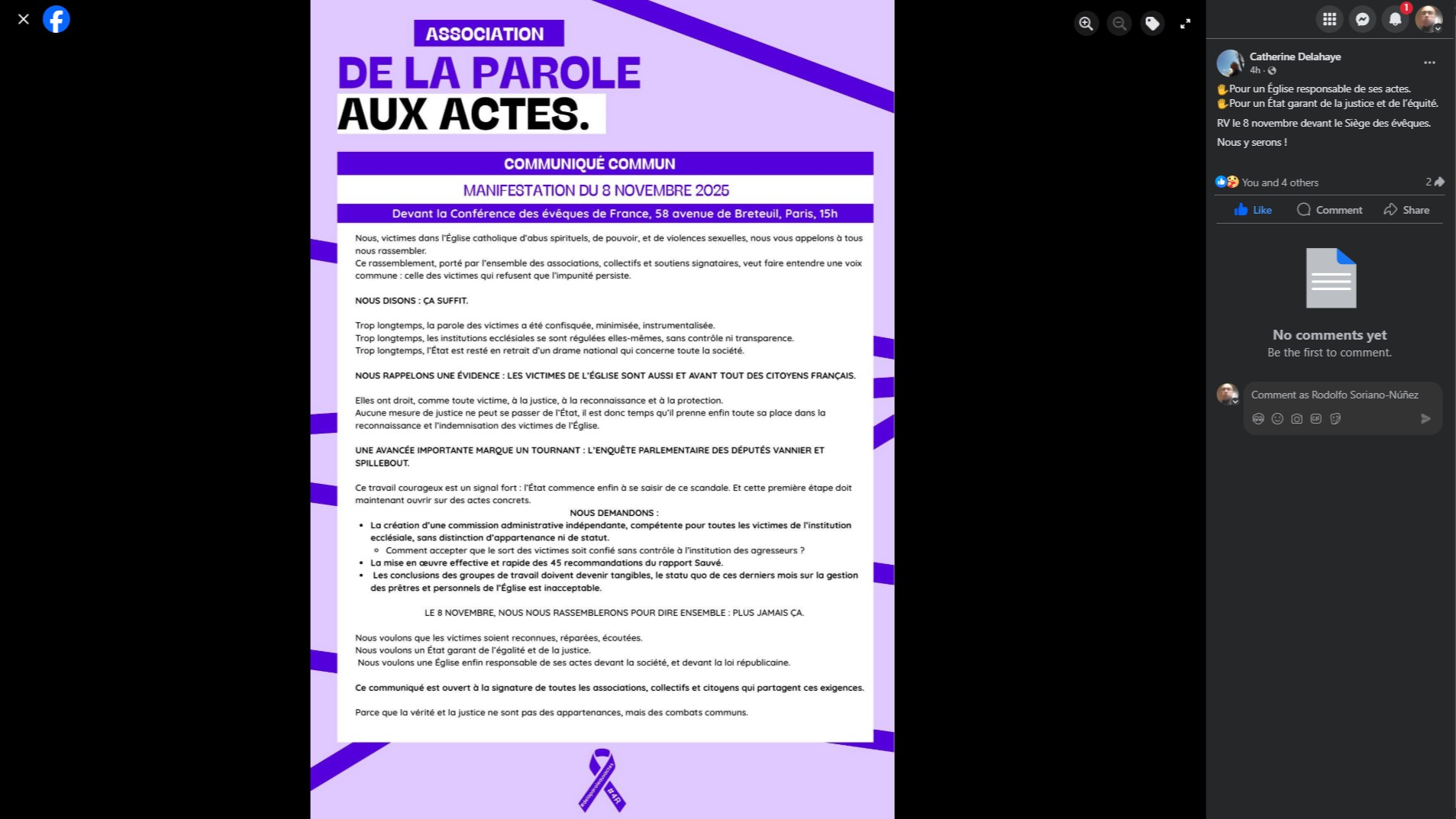
Association From Words to Action
Joint Statement
Rally November 8, 2025
At the building of the Conference of Bishops of France, 58 Avenue de Breteuil, Paris, 3 p.m.
We, victims of spiritual and power abuse, and of sexual violence in the Catholic Church, call on you all to come together.
This rally, led by all the signatory associations, collectives, and supporters, aims to raise our common voice so it is acknowledged that we are the victims who refuse to allow impunity to persist.
WE SAY: ENOUGH IS ENOUGH.
For too long, the voices of victims have been confiscated, minimized, and exploited.
For too long, Church institutions have regulated themselves, without oversight or transparency.
For too long, the State has remained in the background of a national tragedy that concerns all of society.
WE ARE PROOF OF WHAT SHOULD BE OBVIOUS: THE VICTIMS OF THE CHURCH ARE ALSO, FIRST AND FOREMOST, FRENCH CITIZENS.
They have the right, as any other victim, to justice, recognition, and protection.
No justice measure can be achieved without the State, so it is time for it to finally take its full role in recognizing and compensating the victims of the Church.
AN IMPORTANT STEP FORWARD MARKS A TURNING POINT: THE PARLIAMENTARY INVESTIGATION BY MEMBERS OF PARLIAMENT VANNIER AND SPILLEBOUT.
Their courageous work sends a strong signal: the State is finally beginning to address this scandal. And this first step must now lead to concrete action.
WE DEMAND:
- The creation of an independent administrative commission, competent for all victims of the Church, regardless of affiliation or status.
- How can we accept that the fate of victims is entrusted without restraints to the institution controlled by the aggressors?
- The effective and rapid implementation of the 45 recommendations of the Sauvé Report.
- The conclusions of the working groups must become tangible; the status quo of recent months regarding the management of priests and Church personnel is unacceptable.
ON NOVEMBER 8, WE WILL GATHER TO SAY TOGETHER: NEVER AGAIN.
We want victims to be recognized, compensated, and listened to.
We want a State that guarantees equality and justice.
We want a Church that is finally accountable for its actions before society and before the law of the Republic.
This press release is open for signature to all associations, collectives, and citizens who share these demands.
Because truth and justice are not affiliations, but common struggles.
Days after the announcement in France, by the end of the week, in the United States news came from the diocese of Albany, New York. The payment there will be of eight million USD. As it is usually the case, the process allowed for the emergence of "old" new cases, involving priests who used to hold key positions in the diocese, and who enjoyed a measure of fame and respect in their dioceses.
Edward Bernard Scharfenberger, the bishop there, can claim to have been able to address the pending cases, joining other Catholic dioceses, as well as other churches, schools, and other organizations reaching settlements to compensate their victims, despite the fact that the cases had already prescribed for the purposes of penal law.
In the installment of this series linked after this paragraph, Los Angeles Press went over some of the Catholic dioceses in the state of New York that have been able to settle with their victims.
The settlement, revealed on Friday 17, also places the spotlight on Scharfenberger's approaching retirement; at over 77, he is one of the oldest bishops still leading a diocese in the United States, meaning Rome must soon decide who will succeed him now that this major liability is settled.
Update: Early on Monday, Pope Leo XIV appointed former auxiliary bishop of Boston, Mark William O’Connell, as the new bishop of Albany. Cardinal Seán Patrick O'Mailley promoted O'Connell back in 2016.

Chilean reveries
In that regard, as limited as the partial agreement regarding Bétharram or the uncertainty of how many survivors and lay persons will be willing to attend the rally outside the French conference of bishops, watching these developments from Latin America it is hard not to praise them.
From Mexico down to Chile and Argentina, there is no similar agreement for the many victims of different religious “orders” and much less for the victims of diocesan priests.
Not to say that there is settlement at all. Some cases have been settled, most of them in private, with little or no transparency. In doing so, it remains hard and even impossible to actually gauge the scale of abuse, and more so the institutional aspects of it.
Regardless of the limitations at Our Lady of Bétharram, the fact that a relatively large number of survivors will be compensated by the order behind the school, reveals the institutional and systemic nature of the abuse there, and allows for a better understanding of how abuse of such scale was possible there.
It also allows to figure out where other potential victims of the priests who perpetrated abuse could be, as there are ways to trace, at least partially, assignments in other countries.
The relative success of the French survivors of abuse at Our Lady of Bétharram is more relevant when one goes over the criticism the survivors of clergy sexual abuse made of Chilean President Gabriel Boric’s decision to go to Rome, hold a meeting with Leo XIV and visit Pope Francis’s tomb in Saint Mary the Major and posting over his social media, without acknowledging the scale of the crisis of clergy sexual abuse in that country.
A measure of said scale is at a piece recently published in this series about the loss of both members and trust in the Catholic Church in Chile and another six Latin American countries, linked after this paragraph.
Roman travel
It is relatively easy to understand why Boric would want to go to Rome, have a meeting with Leo XIV, and even going to Saint Mary the Major, but it is also easy to see how misguided was for Boric to avoid a meaningful public, official, reference to the clergy sexual abuse crisis in his country.
Both Leo XIV and Boric acknowledged Francis’s courage to eat his words after he tried a last-ditch defense of his appointment of Juan de la Cruz Barros Madrid as bishop of Osorno, but putting aside his will to acknowledge a mistake there, it is hard to find any actual major change in how clergy sexual abuse is handled by both the Catholic hierarchy and the government in Chile.
This lack of enthusiasm for true change is affected by the difficulties Chile has had to settle its constitutional future, marred by two Constitutional conventions whose outcomes were not endorsed by the population in the referenda required to settle that kind of questions there.
But neither the Conference of Chilean Catholic Bishops nor Rome, have tried to address the issues, as cases such as that of former Jesuit Felipe Berríos del Solar, remain a contentious issue.
One only needs to remember that, even if Pope Francis was willing to demand the resignation of the whole bench of Chilean bishops, the resignations that actually happened left the aftertaste all too common in Latin America: no actual punishment for predators and those helping them in the dioceses and religious orders, no compensation for the many victims, and no acknowledgment of the actual scale of the abuse.
Before Boric’s meeting with Leo XIV, the Chilean Network of Survivors of Clergy Sexual Abuse published an open letter criticizing the Chilean President’s unwillingness to address sexual abuse, clergy or otherwise in his country, while stressing the contradictions between the promises he made as a presidential candidate, and the reality of his government.
Their letter is available in Spanish here. They call him to deliver on his promises, reminding him how he originally described his government as “feminist.”
After the meeting with Leo XIV and Boric’s visit to Francis’s tomb in Saint Mary the Major, the Chilean survivors expressed their criticism of Boric in the message posted in what used to be Twitter available after this paragraph.
There, the survivors network stresses how there have not been an official probe of the Chilean judiciary regarding cases such as Karadima, and how ultimately, in their opinion, archbishop Charles Scicluna, the official of the Dicastery for the Doctrine of the Faith “supplanted” the Chilean authorities.
Rupnik, again
This is more relevant as the last few days were also marked by the news of a new trial of Marko Rupnik. As it happened with Berríos del Solar, Rupnik’s abuse was heterosexual.
The detail is relevant as Canon Law is heavily affected by a double standard with which it punishes abuse. When a priest attacks an underage male, there is a higher chance of a relatively fast defrocking, although there are cases where the labyrinth-like Canon Law finds excuses to not defrock.
That has been the case of Argentine priest Julio Grassi, who is currently purging a years-long sentence after being declared guilty of abusing underage males and yet, he remains a priest. He is the first of the stories in the installment of this series linked below.

English Edition
Seven stories of clergy sexual abuse
When the targets of aggression are females, Canon Law is more than willing to excuse the priest’s predatory behavior, as it is perceived only as an infraction to the priest’s vows. That kind of abuse does not fall under the far more negative criminal types, for the purposes of Canon Law, of male same-sex abuse and more so, same-sex abuse of male minors.
In that regard, as much as it will be interesting to follow Rupnik’s trial, it is hard to be enthusiastic. First, the rules of evidence and discovery in Canon Law are more arcane and harder to grasp than those regulating penal or civil trials, whether in countries following the Common Law tradition or in those following the French Code tradition.
Also, it is worth keeping in mind he will be on trial with the same set of rules of his previous trial, and there is no way to think about a specific reform to the Code of Canon Law just to accommodate this new trial.
What is left, then, is the perception that the Holy See is aiming to render this new trial as a novelty of sorts, although even in that respect the Dicastery for the Doctrine of the Faith’s statement, available here, falls short.
The 76 words of the press release do not reveal who will be the five judges involved in the trial. There is no information about how many will be females, how many will be clerics. Much less do we know how many of the females will be lay persons, nuns or how many will be canon lawyers working for organizations such as Opus Dei, where it is almost impossible to draw a distinction between real laypersons and members of a religious order.
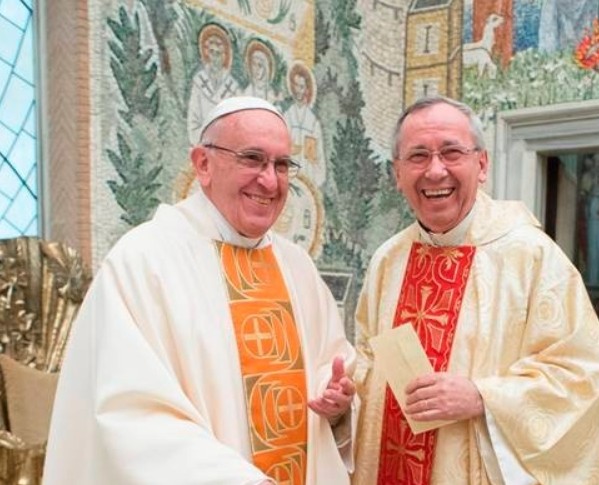
Moreover, one needs to take into consideration that if there is a ruling condemning Rupnik, it will be open to all the usual endless stream of appeals that can stall similar cases for decades, while Rupnik remains a priest.
He remains such because right after Father Arturo Sosa, global leader of the Jesuits, expelled Rupnik from that order, bishop Jurij Bizjak of Koper, Slovenia accepted him as a diocesan priest, prompting a flurry of criticism.
Besides Sosa’s decision to expel Rupnik, back in 2024, the U.S. Jesuit magazine America (behind a paywall), published a piece acknowledging the scale of the abuse.
One must keep in mind that Rupnik has supporters in the hierarchy, and among laypersons who, for whatever reason, are very happy to keep photographs of his mosaics or, even more, to go to Catholic landmarks to take selfies in the vicinity of the mosaics.
As proven by the Jesuit’s expelling Rupnik from the order in June 2023 and running a story in one of their magazines on the scale of the abuse in 2024, there is no doubt that the Catholic hierarchy is aware of Rupnik’s predatory behavior.
Despite that, two months after Sosa’s “punishment,” in May 2024 and again in May 2025, the Brazilian bishops were more than willing to bless the mosaics Rupnick used to decorate the Basilica of Our Lady of Aparecida, the largest Marian Catholic sanctuary in the world.
The same could be said of how, despite the criticism they face up until now, the account of the Conference of Catholic Bishops of Spain at what used to be Twitter, still sports a picture of one of the mosaics Rupnik installed at the headquarters of the Spanish prelates in Madrid.

One of the few major players in the Catholic Church apparently willing to acknowledge how contradictory is to keep Rupnik as some sort of Catholic celebrity are the French bishops. In March 2025, they decided to cover the mosaics Rupnik installed in the Basilica of Our Lady of Lourdes.
In that regard, the issue is not whether or not Rupnik is innocent or guilty. The issue is if there is some will to actually punish predatory behavior such as Rupnik’s, Berríos’s, and many other clergymen who, for whatever reason, abuse females instead of young, underage boys.
Again, the issue is not whether or not Rupnik is guilty. The issue is how the Catholic Church understands the difference between attacking a boy as compared to doing so with a girl or with an adult female. That is why as soon as Sosa expelled Rupnik, Bizjak was able to accept the predator as a priest in his diocese.
One also musk keep in mind that besides Bizjak’s support, and according to different sources Pope Francis’s support, Rupnik’s career was supported by Angelo de Donatis. De Donatis is not a mere bishop. He is a Cardinal, and back in 2017, Pope Francis appointed him as his vicar for the diocese of Rome.
That means that even if the Pope holds as one of his titles that of “bishop of Rome,” the actual, everyday management of the diocese of the Italian capital was De Donatis’s responsibility. As such, De Donatis had authority over the Centro Aletti, the entity Rupnik used as some sort of container for his activities as an artist, a priest, and a celebrity.
The center is still located in Rome, at the Via Paolina, and as such required approval from the diocese which was one of De Donatis’s duties as the Vicar General of the diocese of Rome.
Francis promoted De Donatis to Cardinal one year after appointing him his vicar, and remained as such until 2024, when the Pope appointed him the Major Penitentiary of the Apostolic Penitentiary. So, it is impossible not to think of them as having a close relationship.
The Apostolic Penitentiary is one of the three tribunals of the equivalent of Judiciary of the Holy See. It is similar to an appeals tribunal where those punished with excommunication and other, so-called, “censures” can appeal rulings dealing with penalties reserved to the Holy See, as those issued against predatory priests.
When news begun to spread about how Rupnik abused some of the females working for him at the Centro Aletti, Francis lifted the prescription of Rupnik’s crimes (for the purposes of Canon Law) and played a role in Arturo Sosa’s decision to expel the Slovenian cleric from the Jesuits.
It was one more of the many scandals he was forced to dealt with during his pontificate and, on top of that, it hit him closer as there were accusations about him protecting Jesuits accused of that kind of predatory behavior.
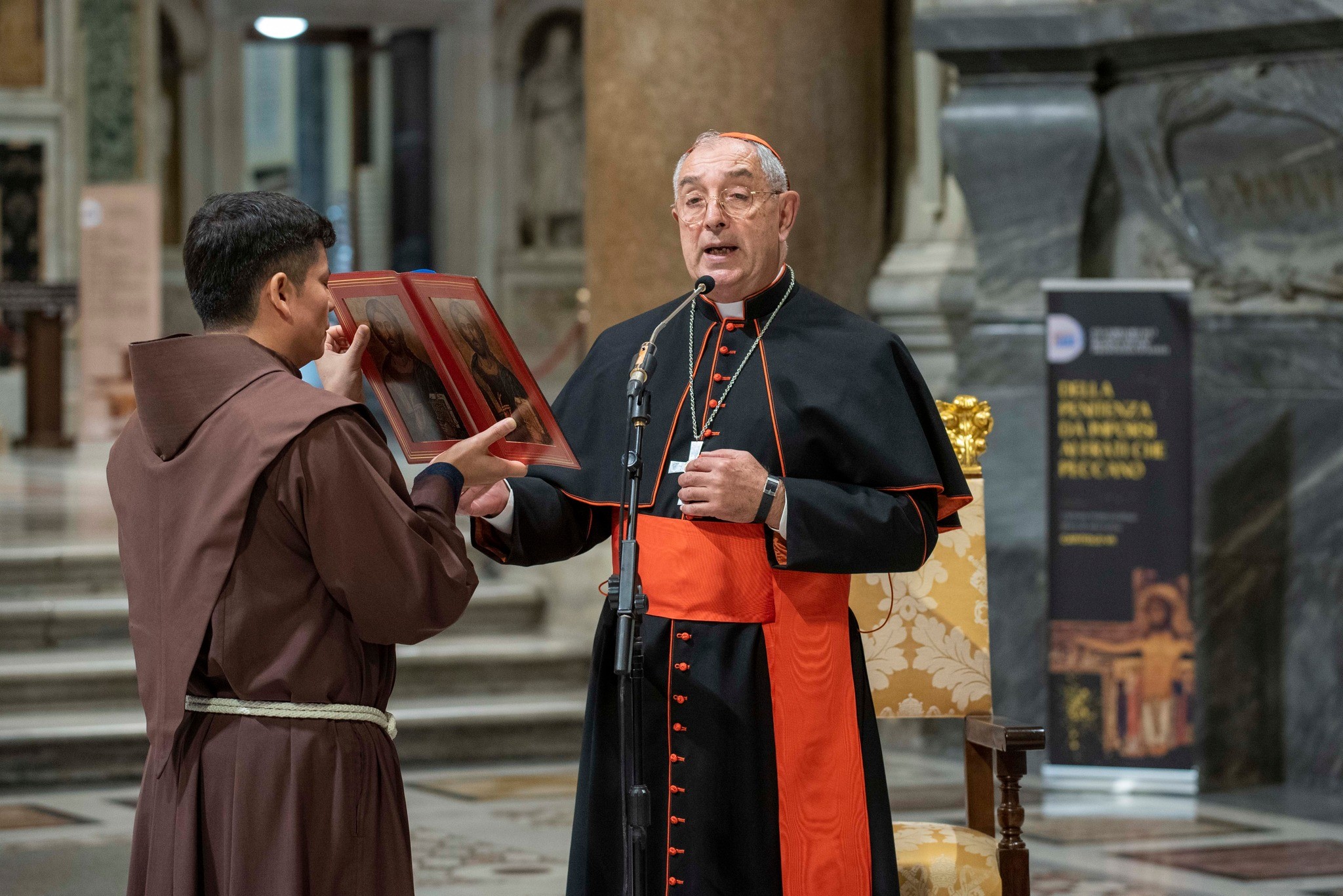
Angelic Cardinal
Cristina Inogés Sanz, Spaniard theologian and advocate of clergy sexual abuse victims in Europe, was willing to publish a piece in a Catholic magazine in Spain where, even with some hyperbole, she named De Donatis as a key supporter of Rupnik’s impunity (opens content in Spanish).
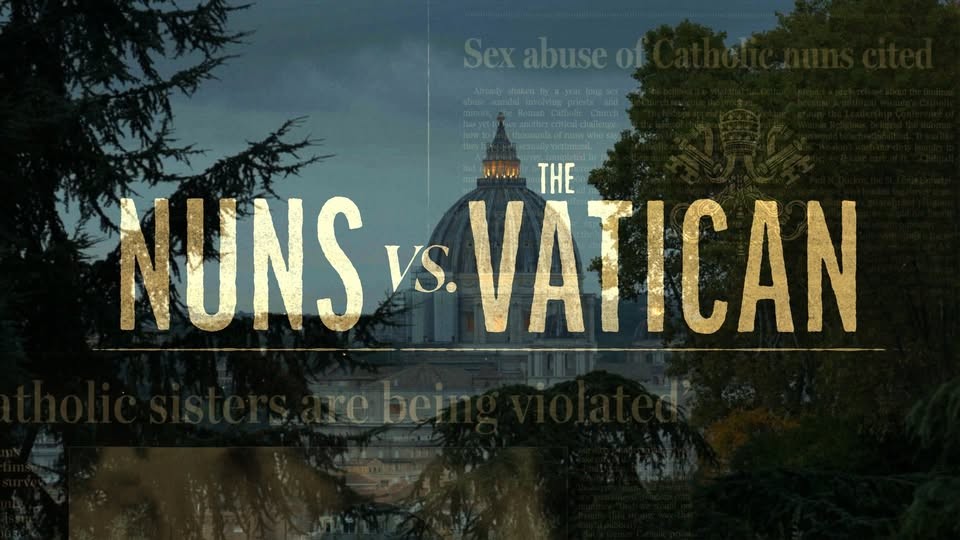
Rupnik’s case is more relevant because, six weeks ago, the Toronto International Film Festival premiered Nuns vs. The Vatican, a gut-wrenching documentary directed by Lorena Luciano built precisely on the experience of the religious sisters who were the targets of Rupnik’s repeated attacks.
More shockingly, the documentary offers testimonies of other females who were the target of the Vatican’s fury for trying to address the Rupnik case and many others where nuns and lay females were the victims of accomplished sexual predators with friends in high places in the Catholic hierarchy.
The criticism brought by Nuns vs. The Vatican is hard to dismiss when one sees some of the pages of the Centro Aletti and finds that even if diminished, as to reduce his role there, Rupnik still is credited by that entity as the chair of the Spiritual Art Workshop and president of the Theology Workshop.
What is worse. His bio at the Centro Aletti (see the image below or click here, although most of the content is only available in Italian) still has him as holding key positions in Rome. An unofficial translation of Rupnik’s bio at the website says:

- Born in 1954 at Zadlog, Slovenia, he was a member from 1973 until 2023 of the Society of Jesus. After philosophy, he studied at the Accademia di Belle Arti in Rome and theology at the Gregorian University. Was ordained priest in 1985. In 1991 he earned a PhD at the Faculty for the Study of Missionary Work at that university with a dissertation supervised by Father Špidlík (later Cardinal Tomáš Josef Špidlík, a Jesuit and Rupnik’s mentor). In September 1991, he lives and works at the Centro Aletti in Rome of which he became Headmaster until the end of 2020. He taught at the Gregorian University and at the Pontifical Liturgical Institute. In 1995 he became the chair of the Spiritual Art Workshop. He was appointed consultor of the Congregation for the Clergy, of that for the Divine Worship and the Discipline of the Sacraments, and the Pontifical Council for the Promotion of the New Evangelization. Coupled with his artistic and theological endeavors he always developed a pastoral activity, mostly over conferences and leading numerous courses and spiritual exercises.
Rupnik’s bio at the Centro Aletti is written in such a way that there are no actual dates for his tenure at the congregations (now dicasteries) of the Roman Curia. The bio actually seems to imply that he is still working for those entities in Rome. Even his exit from the Society of Jesus is presented with no warning about the many accusations of sexual abuse brought against Rupnik.
That is the reason it is so hard to believe the narrative of the abominable lone predator, told many times over from Marcial Maciel in Mexico to Fernando Karadima in Chile. Keeping Rupnik’s profile, bio, and the many pictures and stories portraying him as a celebrity of sacred art in the Catholic world, is not only the byproduct of his machinations, but the result of the will of those working nowadays at Centro Aletti.
It is impossible not to wonder why Maria Campatelli, the current Headmistress of the Centro Aletti, is willing to legitimize Rupnik the way she does. Something similar could be said about the current Vicar General of the diocese of Rome, Cardinal Baldassare Reina who has the authority to oversee what the Centro Aletti does.
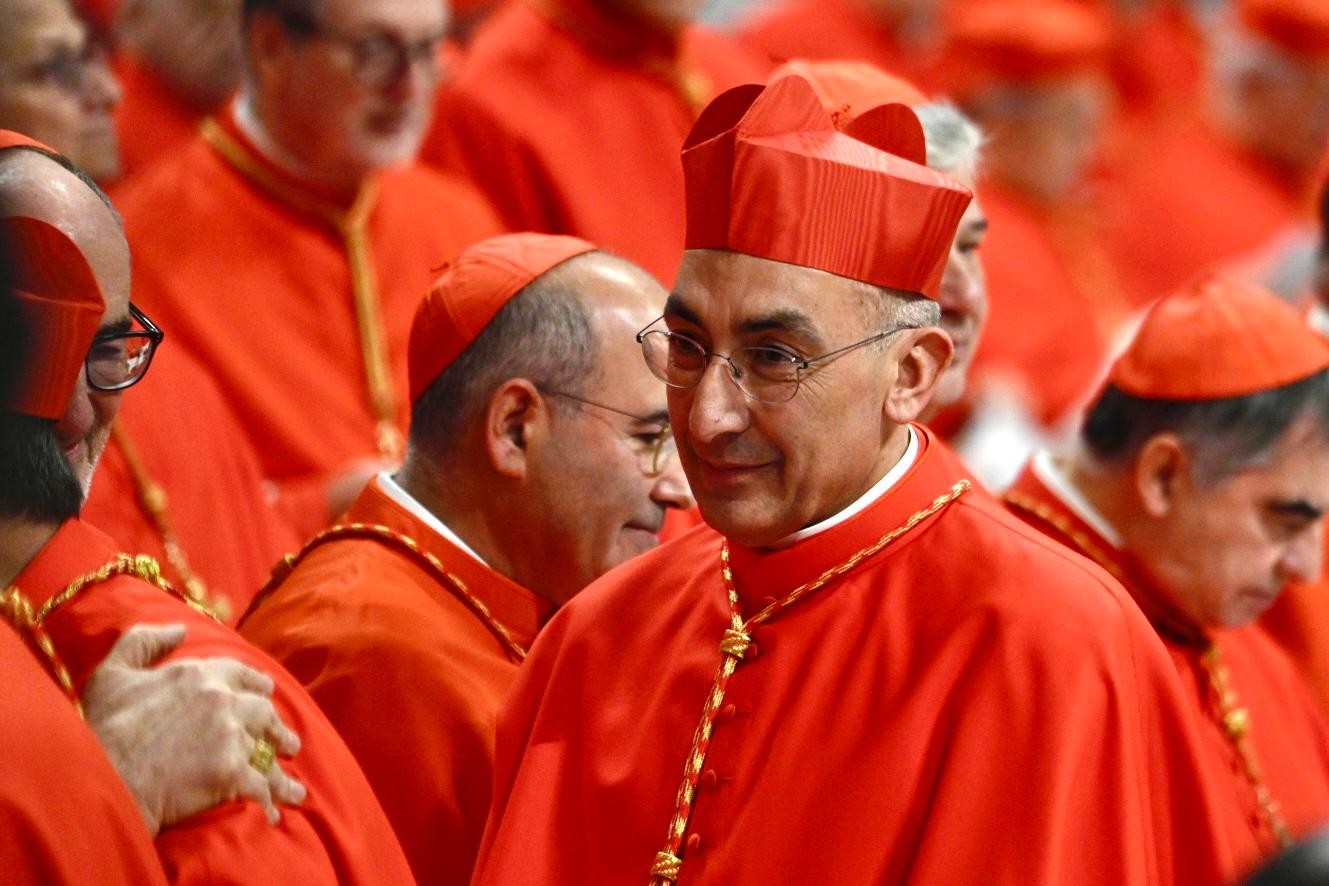
Pope Francis appointed Reina after promoting De Donatis to the Apostolic Penitentiary, he also promoted Reina to Cardinal during his last consistory, on December 7, 2024.
There are no recent news about Rupnik, especially not about the new trial, so most of the materials published by the Centro Aletti web are still displayed as a promotion of Rupnik's books and installations, available for whoever goes there to read celebratory, flattering, stories about his alleged contribution to sacred art.
Nuns vs. The Vatican will be screened at the Doc NYC Festival. It will be possible to watch in person in New York City on November 15 at 1:45 pm at the Angelika in the Village East and at the IFC Center on November 20 at 2 pm, and online from November 16 through 30 here.
The producers keep a Facebook profile where it is possible to find additional information about the documentary and its future screenings. It is available here.
Opus Dei, again
Finally, as far as this review of key developments in the clergy sexual abuse crisis over the last weeks, the rumor mill in Rome talks about an imminent deeper reform of the structure of the Opus Dei.
Even if one was willing to believe that there is some actual will to follow through with it, it is unclear how deep will Pope Leo XIV would be willing to go on that issue.
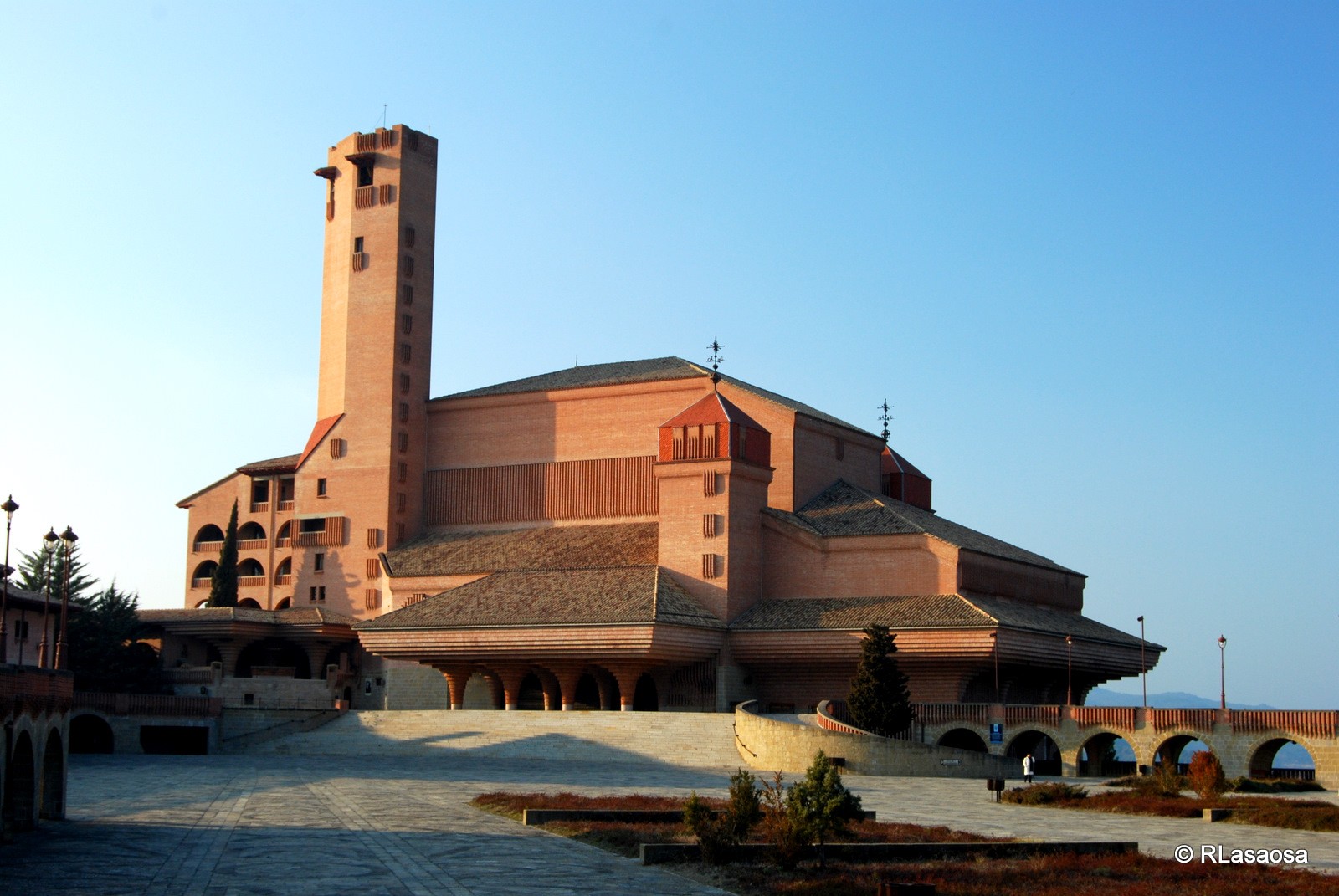
It is clear that, unlike the attitudes one would find 20 or 30 years ago in the Conference of Bishops of Spain, of blind support for the Opus Dei, the conflict between the bishop of Barbastro-Monzón and the so-called “personal prelature” over the property and control of Torreciudad, a Marian sanctuary whose origins go back to the 11th century.
Escrivá de Balaguer, the Opus Dei founder, reached an agreement back in the 1960s to take full control of a small chapel that was incorporated in what is now the sanctuary of Torreciudad.
It would be impossible to go over the details of the differences. What matters is that, for the first time in more than 40 years, there is a bishop in Spain willing to challenge the power of Josemaría Escrivá de Balaguer’s order.
The bishop is Ángel Javier Pérez Pueyo, he is member of a much smaller entity similar to an order, the so-called Brotherhood of Priests Diocesan Workers of the Heart of Jesus (and with content in Spanish here and here), active for the most part in Spanish-speaking countries, although with some members coming from countries where Spanish is not the native language.
It is unclear how the issue will be solved as it is clear that Opus Dei is unwilling to give up their claim that the now deceased former bishop of that diocese Jaime Flores Martin, who was a member of the same order as Pérez Pueyo, gave away the full control of the old chapel “in perpetuity,” as this official statement by the Opus Dei states, (available only in Spanish).
Unlike the way the Opus Dei is willing to broadcast their differences with Pérez Pueyo, the diocese’s website (content in Spanish) has no statement regarding the conflict.
However, the perception is that, as usual when dealing with Opus Dei, there is a degree of overreach and even some dismissiveness in their attitude towards bishop Pérez Pueyo.
All about control
As members of powerful families in the Spaniard and Latin American elites, Opus Dei members are used to have their way in almost any issue.
The dismissiveness is not limited to Pérez Pueyo. There are hints of such attitude in the relations of the prelature with bishops at large, as members of the Opus Dei perceive themselves as a separate entity from the larger Catholic Church, “a church within the church,” with a parallel structure that frequently dismisses the authority of local bishops.
In Barbastro-Monzón a key issue is that before his current position as archbishop of Barcelona, Cardinal Juan José Omella Omella was the bishop of that diocese (1999-2004), a period when Opus Dei consolidated its control over Torreciudad. Omella is the current president of the Conference of Catholic Bishops of Spain and even if he is already 79, he remains an influential figure in the Catholic Church in Spain and elsewhere.
In that regard, Pope Leo XIV has a chance to assert his authority over the Opus Dei. He had a private meeting on Monday October 6, with Cardinal Juan Luis Cipriani, the former archbishop of Lima, Peru, who paraded in clerical garments during Pope Francis’s funerals, despite the “punishment” the Argentine pontiff set upon Cipriani, after the Peruvian Cardinal was found guilty of abusing a male minor under his care while he was a priest.
Francis had already set some limits on the power of the Opus Dei when he decided to not grant the ordination of the superior of that organization, the so-called prelate, as bishop. Francis also appointed a representative to deal with the differences between the Opus Dei and the diocese, archbishop Alejandro Arellano Cedillo, but there has been no actual solution.
It must be noted that, during his time as bishop in Peru, Robert Prevost had to deal with the effects of over 20 years of control by the Opus Dei of the diocese of Chiclayo, and even if there were no visible signs of conflict, there were major differences with the priests who used to work with his predecessors at that diocese.

English Edition
Leo XIV and the risk of victims remaining pawns
Prevost was more willing to acknowledge a role for the lay persons, while the priests who had been at Chiclayo under bishop Ignacio de Orbegozo or bishop Jesús Moliné Labarté there did their best to keep lay persons at bay, as the story linked before this paragraph explains.
A previous installment of this series, linked after this paragraph, went over a case of clergy sexual abuse in Chiclayo that keeps haunting Leo XIV. Once again, as the victims were females, it was far more difficult to defrock the accused priest, despite the fact that he attacked at least three sisters of a same family in that diocese.

English Edition
From Chicago to Chiclayo, sexual abuse victims are pawns
However, it is difficult to gauge how far will Leo XIV will be willing to go when it is unclear if he actually wants to deepen Pope Francis’s reforms on hey issues, and when he seems to be interested in avoiding conflicts with the most radical conservative wings of the Catholic Church in the United States, where Opus Dei is influential.
Back in 2024, Gareth Gore published a detailed account of the kind of relation Leonard Leo, widely credited as the architect of the current Supreme Court of the United States, has had with Opus Dei over the last 20 years or so. His piece is available here.