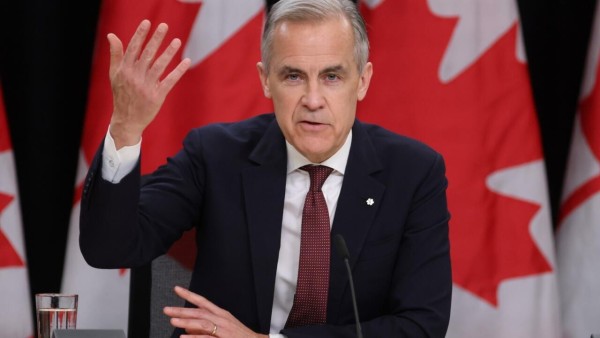
The effort, spearheaded by Mark Carney, highlights a broader shift among middle powers toward multilateral coordination.
Los Ángeles Press
Canadian Prime Minister Mark Carney has taken U.S. President Donald Trump by surprise by leading negotiations toward a vast new trade alliance uniting Europe and the Indo-Pacific—an initiative widely interpreted as a direct effort to counter Trump’s MAGA-driven trade agenda.
According to Politico, the talks bring together the European Union’s 27 member states and 12 Indo-Pacific economies that belong to the Comprehensive and Progressive Agreement for Trans-Pacific Partnership (CPTPP). If consolidated, the framework would link nearly 40 countries, forming one of the largest economic groupings ever attempted.
Canada is steering the discussions, which reflect Carney’s view that so-called “middle powers” must band together to blunt the impact of unilateral tariffs and economic pressure. The objective is not only to expand trade but also to knit supply chains across North America, Europe, and Asia in ways that reduce exposure to policy shocks emanating from Washington.
A senior Canadian government official, quoted by Politico, confirmed that the negotiations are advancing. “The work is definitely coming along,” the official said. “We’ve had very fruitful discussions with partners around the world.” While no formal agreement has yet been announced, officials involved describe the process as substantive and increasingly coordinated.
Japan has emerged as a key voice from the Indo-Pacific side. Yasutoshi Nishimura, Japan’s minister of economy, trade and industry, said Tokyo sees clear advantages in closer trade integration between the EU and CPTPP members. Expanding commerce among these economies, he argued, would directly strengthen supply-chain resilience, a priority after recent global disruptions.
Carney made the political and economic case for such coordination last month at the World Economic Forum in Davos. In a blunt assessment of the global order, he said the world is no longer moving through a smooth transition but a structural break, marked by the growing use of tariffs, financial systems, and supply chains as tools of leverage.
He predicted that allied nations would respond by diversifying trade relationships and reclaiming economic autonomy. A successful agreement, Carney said, could eventually encompass a market of roughly 1.5 billion people, with far-reaching consequences for global trade patterns.
For diplomats and trade analysts, the signal to Washington is clear. As President Trump continues to rely on aggressive tariff policies, Canada is positioning itself at the center of a multilateral effort designed to limit the reach of MAGA-era economic nationalism. Though still in its early stages, the scale of the proposed alliance already represents one of the most significant coordinated challenges to U.S. trade policy in years.