
Rodolfo Soriano-Núñez Domingo, 20 de Agosto del 2023
Verástegui adheres to a version of political Catholicism promoting an apocalyptical and authoritarian view of the world.
The wealthiest family of Mexico has been behind Verástegui’s deep dive in politics in Mexico and the United States and it is not an amateur endeavor.
By Rodolfo Soriano-Núñez
Over the last three weeks I have been trying to explain how Eduardo Verástegui, the Mexican soap-opera actor who appears as one of the producers of Sound of Freedom is the visible head of a vast project to build theocracies on both sides of the Rio Grande.
It is important to emphasize that the will to build said theocracies would exist with or without Verástegui, ultimately a figurehead, and even without Patricio Slim, the most ideological of Carlos Slim’s six children (Carlos junior, Marco Antonio, Patricio, or Patrick when doing business in English-speaking countries, Soumaya, Vanessa y Johana).
The model as such would exist although probably not as articulated as it is nowadays on both sides of the border between Mexico and the United States. Christianity and Catholicism were born with an aspiration to become universal, global, religions with little or no regard for political borders and similar barriers.
Over the last 150 years, despite mutual distrust and racism, Mexico and the United States have built an economic relation whose only rival is the one the United States itself has with Canada.
Mexican Catholicism ultimately survived the 1926-9 catastrophe of the Cristero war because of the active intervention of Catholics, both laypersons and hierarchy from the United States. Conversely, growth in the Catholic Church north of the Rio Grande was driven during the 1980s, 1990s and the 2000s, the by the growth of the Mexican communities in the U.S.
But Catholic bishops in the United States must be aware that, unlike those Mexicans leaving Puebla, Oaxaca, and other rural areas of Mexico for no political or ideological reasons, Venezuelans and other newly arrived Latinos in the U.S., are deeply ideological. One could even argue that they are in the United States because of their fierce opposition to Hugo Chávez and Nicolás Maduro, and not because they were just poor people entering a border as open as the U.S.-Mexico border used to be at the end of the 20th century.
Catholicism on both sides of the Rio Grande faces a new reality that includes the Make America Great Again movement, a more ideological and racists Republican Party and conservative Mexicans with political and business interests on both sides of the border betting big on Verástegui’s mix of macho politics, Catholic imagery, and anti-“woke” verbose posturing.
Unlike the old pictures of César Chávez mixing variations of the eagle in the Mexican flag with images of Our Lady of Guadalupe during the strikes of the 1960s and 1970s to seek basic rights for the families picking tomatoes and apples on the fields, now Latino political Catholicism in the United States is as ideological as the Cuban exile has been in Miami for the last six decades or so.
Sadly, that will boost rather than restrict the dangerous tendency to see each election as an all or nothing event defining the issues of the so-called “culture wars” issues: abortion, gay marriage, etc.
This version of political Catholicism, fueled by the wealthiest family in Mexico, promotes a rather apocalyptical and authoritarian view of the world in which there is no room for political agreements, but only the fiercest opposition to whatever the leaders of this loosely articulated movement define as their existential, their vital foes: “wokeism” (whatever that is), Marxism, socialism, and—for that matter—any idea of the world they do not like or accept.
Mexican politics have also helped the partnership. On the one hand, there is the violence that drive Mexicans mad these days, with more than 163 thousand homicides since Andrés Manuel López Obrador took office back in December 2018, for a daily average of 94.5 violent deaths a day.
There is the brutal concentration of income and wealth, and the very difficulties that the Mexican political class has had to figure out what to do with Donald Trump. It was not only Enrique Peña Nieto who willingly lend the then presidential residence of Los Pinos to Donald Trump before he was even nominated a candidate, seven years ago, back in 2016.
López Obrador himself, as well as members of his cabinet and even some of his closest, most loyal allies in the Mexican “radical” left of his party, who also happen to write for English-speaking audiences in far-left magazines, share the “sympathy for the oppressor” that lies deep in the relation with Trump.
On top of that, one must take into consideration one more reason to worry about the drive to building theocracy that shapes Catholicism nowadays in Mexico: its oligarchic nature. It is not the “people of God” who, on their own, are finding religion as the source of inspiration for a renewal of politics. It is a process driven, lead, by the wealthiest family in Mexico and their business and political associates.
This process has a clear relationship with a political tradition of the United States that has been a taboo in Mexico for the last 150 years or so: mixing religion and politics. If in the United States it is almost unavoidable that a political speech from a Republican or Democrat will end with a “God bless America” or some other theological reference, in Mexico that is almost unheard of.
Same way it would be unthinkable and perhaps illegal to find in Mexico a policy think-tank as America First Policy Institute openly talking about the “Biblical foundations” of their policy proposals.
In any case, there is no way to pretend this is not happening. My role as a sociologist doing journalism is to highlight, to stress the emerging contradictions I am looking at and to try to understand how they came to exist, and what are their current and potential effects.
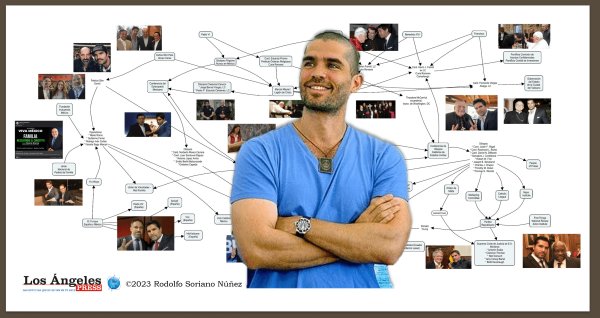
A map of Citizen Verástegui's world.
(Click on the map with the secondary button of your pointing device and request the image on a separate tab)
I will only add that the mixing and matching of religion and politics in Mexico and Latin America at large is especially dangerous due to the oligarchic nature of politics in Mexico and the rest of the region. It is not only that Verástegui hangs around with people with deeply seated antidemocratic beliefs and practices.
It is that his boosters come from the top earners, the richest of the region who share little or no interest in addressing real issues, while promoting the idea that jailing females having spontaneous abortions, as Dafne McPherson in Querétaro, will address all our troubles.
The map I am presenting here does not pretend to be exhaustive. It is more the representation of some of the most relevant connections that explain Verástegui role as a leading figure in this attempt at building theocracy on both sides of the Rio Grande.
I have left out many more pictures harvested from Verástegui’s and his allies’ social media accounts and websites. They tell part of the story of how radical Conservatives in the United States and Mexico build a narrative about themselves, about their role in public life and the “solutions” they offer to issues affecting us all.
The origins
The pictures 1 through 5 are about the origins of Verástegui as a disciple of the Legion of Christ. During the series I offered an account of that relationship. I would only add that, on top of Marcial Maciel’s relation with John Paul II, he had a very good one with Paul VI as depicted in picture one where they appear with Flora Barragán de Garza. It was Pope Montini who gave Maciel control of the then prelature of Chetumal, now the diocese of Cancún-Chetumal, located in the Mexican premiere holiday destination of Cancún, and that gave Maciel as the Legion's superior a say in who would be the prelate, a special type of bishop, but a full member of the Mexican conference of .Catholic bishops.
Picture 2 portrays Maciel and Argentine Cardinal Eduardo Francisco Pironio. He was then the prefect of the Congregation for Religious Orders and Secular Institutes. He was, as such, in charge of overseeing all the religious orders in the Catholic Church. The picture captures the moment when Pironio authorizes in 1983 the rules of the Legion of Christ. To Pironio’s left is current Cardinal and member of the Legion of Christ Fernando Vérgez Alzaga.
Many narratives of Maciel’s abuses and complex operations to cover up his or others’ abuses within the Legion of Christ have Vérgez as the guy in charge of “spreading the joy”, that is to say of delivering money to buy out the silence of bishops and cardinals in Rome.
After Pope Francis appointed him as Cardinal in August 2022 many were conflicted by this appointment. He is also the current President of the Pontifical Commission for Vatican City State, and as such he is an influential figure in Francis’s Roman curia since he is also the member of the Council of Cardinals.
Picture 3 has Verástegui next to bishop Pedro Pablo Elizondo Cárdenas, the last prelate of Chetumal and first bishop of Cancún-Chetumal. Elizondo is a member of the Legion of Christ and, as prelate he was appointed in 2004 by John Paul II at the suggestion of Marcial Maciel, then superior of the Legion.
Picture 4 comes from a video now making the rounds over social media about the 20th anniversary of the wedding of Marco Antonio Slim Domit, Carlos Slim’s second son. The wedding was presided back in February 1999 by Marcial Maciel himself and then bishop of Ecatepec, near Mexico City, Onésimo Cepeda Silva.
Monsignor Cepeda used to work as an attorney for Carlos Slim senior and many accounts of his own legendary wealth put him as a partner, not as an employee of Slim’s financial empire.
It must be noted that Maciel also presided over the wedding of Carlos Slim senior back in 1966. Maciel was also a key player in a tribute offered to Slim in New York City on June 9th, 2004, by some of his wealthiest friends in Mexico, the United States, and elsewhere.
Picture 5 captures the now infamous moment in which Verástegui met Pope John Paul II in Rome back in 2004. I have provided a detailed account of the origin and implications of that picture in the first installment of this series.
Picture 6 has Verástegui and then archbishop of Mexico City, Norberto Rivera Carrera during the promotion of Verástegui’s Little Boy film. Rivera and Maciel were extremely close allies since Rivera’s appointment as bishop of Tehuacán, in the state of Puebla. When the accusations emerged in the Mexican media as translations and/or additions to Jason Berry’s reporting in U.S. media of the abuses occurring in the Legion of Christ, Rivera was one of the most vocal advocates of Maciel. He once challenged a Mexican journalist to reveal who was paying his reporting on Maciel’s abuses. Picture was taken in 2015.
Worldwide mission
The pictures labeled 7a, 7b, and 7c come from one single mass in the Catholic Cathedral of Miami, Florida. That was the day when that city was consecrated to the Mission of Love Worldwide on May 30th, 2013, as I narrated in the first installment of this series.
That mission, which I see as a turning point for the purposes of this account of Verástegui’s role in Mexican and U.S. public life was launched by John Rick Miller, who appears in picture 7d when he attended the consecration of the Judiciary of Panama. I provided some details of that episode on the third installment of this series. The picture is from 2011.
Picture 8 is from 2012 and portrays Verástegui and, among others, the current head of the Archdiocese of Boston, Cardinal Sean O’Malley. Verástegui frequently publishes pictures with Cardinal O’Malley who is the head of the Vatican Commission for the Protection of the Minors, the so-called Tutela Minorum, whose newly appointed secretary, Father Andrew Small has been criticized for the way he funded the commission. I wrote a piece on Small’s troubles at Tutela Minorum recently, but it is only available in Spanish here at Los Ángeles Press.
In the same picture one can see former Cardinal Theodore McCarrick. I cannot go into the detail of the many issues McCarrick is facing as a defrocked priest nowadays, suffice to say that the Holy See issued a full report on him and his role in the sexual abuse crisis.
In that picture one can find also archbishop Carlo Maria Viganò, then nuncio in the United States and now one of Pope Francis’s declared foes. He has gone deep into the wormhole of all types of conspiracy theories. That picture was reposted by Father Small when Viganò started his current campaign of attacks on Pope Francis to dispel the idea that Francis was protecting McCarrick.
The picture comes from Cardinal Sean O’Malley’s blog, and it is available here. Verástegui was at that time promoting his then recent movie on the Cristero War (1926-9) in Mexico. Cardinal O’Malley writes this about meeting him: “One of the special guests of the evening was Eduardo Verástegui, whom some of you may know from the ‘Bella’ movie and is starring in the new movie For Greater Glory. I was very pleased to be able to meet him”.
Frequent fliers
Picture 9 is a frequent flier in social media. Portrays Cardinal Raymond Burke and Verástegui. It has been used repeatedly by Verástegui's fans on both sides of the fence to prove how “orthodox” he is. Burke’s positions are not as radical as Viganò’s but they are closer to each other than any of them are to Pope Francis's whose authority is frequently challenged by both of them.
It is worth mentioning that Verástegui expressed support over his social media accounts for Viganò’s stand against vaccines during the coronavirus pandemic.
Picture 10 is also a frequent flier in Verástegui’s social media accounts. It was taken when Pope Benedict XVI came to Mexico in early 2012. Besides Pope Ratzinger and Verástegui one can see then nuncio in Mexico and current nuncio in the United States, French archbishop Christophe Pierre, who introduced Verástegui to the then Pope in one of the more intimate gatherings that happen during papal visits to Mexico and any other country of the world. Even if those more intimate gatherings are frequent, it is not easy to be invited to them, much less to be introduced to the Pope by the sitting nuncio.
On the other side of the map, Picture 11 has Verástegui and Carlos Slim Helú, or Carlos Slim Senior as he is known in the English-speaking world. The picture was taken, as far as I can tell, in Mexico City back on June 14th, 2015, and it was shared by Verástegui.
Picture 12 is one of the few available pictures of Patricio Slim or Patrick Slim as he is credited in the Sound of Freedom movie, and Eduardo Verástegui. It was taken at the Auditorio Nacional in Mexico City in June 2016, and posted by Verástegui.
Pictures 13a through 13d are of some of Patricio Slim’s closest political operators in Mexico. On Picture 13a Slim appears next to Guillermo Ferrer back in 2019. Between them it is possible to see Jolette H. Navarrete. The picture was published by Ferrer over his social media accounts. He is one of the most active members of Slim’s team.
Another member of that team is Vicente Segú Marcos, who appears alone on Picture 13b. The image was cropped from a larger picture. He appears as producer of Verástegui's Little Boy at the Internet Movie Data Base, and local media in the Mexican state of Sonora provided an account of his role as part of Slim’s anti-abortion movement in Mexico back in 2020. Segú plays a major role in some of the foundations promoted by Slim.
Back in 2017, after the Spanish newspaper El País published a story on Slim highlighting Segú's role. Some data about donations to those foundations emerged with Margarita Zavala, Mexico’s former first lady as one of their donors. More recently, he appears as partner of a corporate law firm in Mexico City.
Picture 13c comes from one of Verástegui’s postings on social media. There he shares a link to Mario Romo’s podcast. Mr. Romo also belongs to Slim’s political operations team.
Finally, as far as this subcategory is concerned, Picture 13d renders Verástegui and former state representative in the State of Mexico, the jurisdiction surrounding Mexico City, Rodrigo Iván Cortés.
Spain and the rest of Latin America
Pictures 14 through 18b deal with Verástegui’s political relations in Spain and Latin America. Picture 14 is one of the many pictures with the leader of Vox, the neofascist, neo Francoist party in Spain, Santiago Abascal. Verástegui has been adamant in showing his support for Vox every time there is a national or provincial election in Spain, and Abascal and his people reciprocate through the many platforms their teams support in Spain.
As the map depicts, besides Vox, the political arm of the movement, there are at least two relatively well known websites dealing with information on the global and Spanish Catholic Church, Actuall and Infovaticana. Actuall does an effort to follow certain basic niceties of Spanish-speaking Catholic journalism, like avoiding personal attacks on Pope Francis. Those niceties are lost on Infovaticana which frequently goes into the conspiracy theory mode that one can find in some English-speaking Far-right Catholic content distributed over EWTN and more so on Gloria TV.
Besides the party and the media, the Spanish far-right operates out of three “separate” platforms that, in my experience, are almost undistinguishable from each other: Yo Influyo, Hazte Oír, and Citizen GO. They have local operations in some Latin American countries and all of them, the political party Vox, and Infovaticana have some degree of affinity with the so-called Yunque.
Yunque literally means anvil in Spanish, and it is one of the most secretive organizations trying to build Catholic inspired theocracies in Mexico and Spain. Back in 2017, seeking to legitimize themselves, some of their leaders accepted for the first time in public their very existence and the role they have played in trying to articulate a political Catholicism both in Mexico and in Spain.
The reasons to attempt doing so not only in Mexico and Spain but in other Latin American countries and in the United States do not require too much effort or imagination.
Picture 15 is an example of the kind of campaigns that one of the most radical groups of this variety of political Catholicism do in Latin America these days. Comes from the website of Voto Católico Colombia (Catholic Vote Colombia). They have deep affinities and linkages with Catholic Vote in the United States. What is interesting of their campaigns is how they mimic the style of Colombian tabloids from the 1980s and 1990s about violence in that country to talk about a resolution from the Colombian judiciary back in 2022, depicting the magistrates as killers after they allowed for some exceptions regarding abortion in that South American country.
Also associated to the local chapters of Catholic Vote in Peru and Ecuador, pictures 16 and 17 have Verástegui side by side with Rafael López Aliaga, current mayor of Lima, Peru’s capital and largest metro zone, and Guillermo Lasso, the current President of Ecuador.
Lasso and López Aliaga are both members of the Spanish religious order/movement Opus Dei. Lasso’s picture was taken in 2022 and López Aliaga’s in August 2023 as part of Verástegui’s continental media blitz in Latin America to promote Sound of Freedom.
I cannot go into the details of what is Opus Dei, suffice to say at this point that even if there are some differences between the Mexican Legion of Christ and the Spanish Opus Dei they share a common understanding of the Church, and the political history of Spain and Latin America.
Pictures 18a and 18b have Verástegui with two members of the Bolsonaro family. At Picture 18b, Verástegui appears with the former President Jair Bolsonaro. It is not clear when or where the picture was taken, but Verástegui shared it back on March 23rd, 2023.
On picture 18a, Eduardo Bolsonaro receives a jersey from the Mexican national soccer team at the Conservative Political Action Committee meeting celebrated in Mexico City in November 2022. It is worth noting that, in the back of Bolsonaro, appears in very big, and very bright letters the logo of Citizen GO.
The relation with the Bolsonaros is relevant also because it provides links and associations with the very powerful Tradition, Family, and Property, a Brazilian conservative group, with branches in Argentina, Colombia, the United States, and several European countries, and a key player in the turbulent world of the relations between religion and politics.
Conservative USA
Pictures 19a through 19d have Verástegui with key members of the conservative political establishment in the United States. He shares the frame with all the right people: Steve Bannon, Donald Trump, Clarence Thomas, and current Speaker of the House Kevin McArthy, respectively.
On top of these four pictures, I was able to harvest many more with the likes of Arizona’s Kari Lake, GOP representative Marjorie Taylor Green, and—to my surprise—political dinosaur Roger Stone. Even if Stone is well known in the United States, he is virtually unknown in Mexico.
One needs to be a U.S. political junkie to be aware of who Stone has been over the last 50 years to pick him and try to get a picture with him. It is clear for me that someone with very deep knowledge of the history of political Conservatism in the United States whispers names like that of Stone to a Mexican soap-opera actor who only attended language and acting lessons while living in the United States.
It is hard for me to believe that choices as that of seeking a picture and to post said picture with Roger Stone are spontaneous or made by “a dude” who is learning as he goes while navigating the tumultuous waters of political conservatism in the United States.
Same must be said of a series of pictures Verástegui took of himself mimicking the portraits of presidents John F. Kennedy and Ronald Reagan. Why those two, and not others? Again, my perception is that he gets very accurate, professional, clues as to the kind of messages he must deliver while acting as a political operative in the United States.
Wealth and influence
On the lower left corner of the map there are five pictures of Verástegui with Mexican politicians. Unlike those from the United States, with no attempt from Verástegui to reach across the American political aisle, in Mexico he moves with relative ease from appearing with members of the Conservative Partido Acción Nacional, PAN, to members of the ruling “leftist” National Movement of Regeneration (Morena, after its monicker in Spanish) or of the former ruling PRI (Partido Revolucionario Institucional) Party, as in the case of the former governor of the state of Hidalgo, Omar Fayad (Picture 20b).
He even poses with advocates of abortion as the former secretary of the Interior and current senator Olga Sánchez Cordero, and with officials elected from smaller parties as current governor of the state of Jalisco, Enrique Alfaro Ramírez (20c).
In the last picture of that group, 20e, Verástegui appears with Carlos Slim Domit, or Carlos Slim junior, as he is known in the English-speaking world, Slim’s wife, María Elena Torruco (blue dress), former British Royal Sarah Ferguson (wearing a green dress), and to the extreme left, Felipe Calderón Hinojosa, a member of Conservative PAN and former President of Mexico (2006-12).
Torruco is relevant also, among other reasons, because she is the daughter of current Mexican minister of Tourism, Miguel Torruco Marqués, one of current President Andrés Manuel López Obrador’s closest allies.
Legionary doors
Finally, picture 21 portrays Verástegui on a deep bow while receiving a blessing from Pope Francis. I do not think that Verástegui is close to Francis, since most of his associations in the U.S. Conference of Catholic Bishops are with bishops openly confronted with Francis.
However, my sense is that precisely because of the kind of challenges Francis faces repeatedly from American bishops who despise his agenda, he needs to keep that door open. It is a door ultimately associated with the Legion of Christ that have two of its members in the Roman Curia.
On top of already mentioned Cardinal Vérgez, there is bishop Brian Farrell, secretary of the Pontifical Council for Promoting Christian Unity.
Also, closely associated with the Legion of Christ, there is, as I pointed out in a previous installment of this series, Cardinal Kevin Joseph Farrell. The brother of bishop Brian, Kevin is the former bishop of Dallas, Texas, and the former auxiliary of Washington, DC, where he shared the limelight with former Cardinal Theodore Edgar McCarrick, who consecrated him as bishop back in 2001.