
Rodolfo Soriano-Núñez Martes, 12 de Diciembre del 2023
A look at what the U.S. Catholic far-right is doing with the image of Our Lady of Guadalupe.
The image of Guadalupe is not alien to political use. Mexico was born from the political use of the image, but there is no precedent for what the U.S. Catholic far-right is doing right now.
By Rodolfo Soriano-Núñez
A hallmark of Mexican Catholicism since the 16th century has been devotion to Our Lady of Guadalupe. That devotion was political from the beginning.
Whether to resist Spanish domination, whether to integrate into Spanish domination, or to hide in the mestizo image of the mother of Jesus Christ the ancient Mexica goddess Tonantzin or Nonatzin, the very devotion to Our Lady of Guadalupe was born political and remains as such until today.
What is new, however, is that historically being a sign of the different forms of resistance, survival, and even open subversion to Spanish domination or, in a more general sense, to political domination in Mexico, now—increasingly—the image is used by the most reactionary elements of the U.S. Catholic far-right to render themselves as authentic Catholics.
To do so, the U.S. Catholic far-right rewrites the history of Mexico, the history of the United States-Mexico relationship, including the invasion of 1846, which was predicated—among other elements—on the “need” to purify the rather corrupt Mexican Catholicism, as well as the history of Mexican Catholicism itself.
The U.S. Catholic far-right is not alone in these efforts. Similar attempts have occurred in Mexico to appropriate or to give new meanings to the apparitions of Our Lady of Guadalupe.
This has been the case despite the disdain with which the Catholic hierarchy, embedded in the government of what was New Spain, treated the devotion to Our Lady of Guadalupe. Said relationship was so symbiotic that over the three centuries of Spanish rule in what is nowadays Mexico, the position of viceroy of the colony of New Spain fell on six archbishops of Mexico City, two bishops of Puebla, and one of Yucatán.
In that sense, there was no way to dissociate the religious from the political and part of the religious in colonial Mexico was, whether we wanted it or not, the devotion to Our Lady of Guadalupe.
The political nature of the devotion has continued even despite the alleged existence of something called a “secular State” in Mexico that is so difficult to prove as demonstrated by the way in which the Mexican State has been involved directly or indirectly in the reconstruction of temples from the colonial period, as in the construction of new places of worship.
There is no better example of this than the current Basilica of Guadalupe and its complex of buildings, monuments, and shopping centers, which would have been impossible to build without the participation, to a greater or lesser extent, of all the federal governments and the governments of the former Federal District in the last seventy years, at least, regardless of the political orientation of said governments.
In that sense, the politicization and even over-politicization of Guadalupe devotion is not new. It has been part of the Mexican national political debate at least since when the civil authorities and the Archbishopric of Mexico City, unable to suppress the cult, were forced to accept the construction of the first Indian Chapel in 1649.
Idolatry
That the first chapel was built more than a century after the apparitions of December 1531 is a political fact. What is more, the name of that first temple as Chapel or Parish of Indians refers to the very nature of political domination in New Spain: it was founded on the preeminence of the peninsular Spaniards, even over those who were their children. on this side of the Atlantic.
The recognition of the existence of such devotion, however, was not translated into a concrete material expression of the practice until 1649, and even at that time, the cult occurred in what were then hills and plains outside of Mexico City, whose northern boundary was in the House of the Consulate, near Tlatelolco in what is nowadays the northern boundary of Mexico City's downtown.
What is more, devotion was frequently reduced to the status of fable or idolatry. That idea of the devotion to Our Lady of Guadalupe as idolatry was not invented by the liberal radicals of the 19th century, the so-called comecuras, literally those who “eat the priests”. It was coined by Spaniards born in Spain, the so-called peninsulares, many of them clerics, who viewed the practices of “the natives” with disdain.
It was only after 1649 that, gradually, the official Catholic cult was admitted in the temples of the old Colonial city: the cathedral and its tabernacle, the so-called Church of La Profesa, originally the church of San José del Real or the church of the old monastery of Santo Domingo, among others, the “Indian” devotion that was associated to Our Lady of Guadalupe.
In Mexico itself there is a clear interest in disassociating the devotion to Our Lady of Guadalupe, the so called Guadalupanismo and Catholicism from the most racist and despotic aspects of Spanish domination, as if the “Indian” cult in an “Indian parish” had occurred in an ahistorical vacuum, lacking institutions, religious or civil.
These reinterpretations, revisionist in many ways of the Mexican Catholic history, go hand in hand with the more clearly revisionist efforts of some Mexican academics who have bought into the idea that New Spain was not actually a colony, because it had a of government different from that of the thirteen colonies from which the United States emerged in 1776.
I believe that this debate is part of the same revisionist efforts that have animated for centuries the so-called Pink Legend or White Legend of the Conquest by Spain of its empire, as well as the very idea of the so-called Hispanidad.
Hence, without trying to stop or denounce it, I cannot help but be surprised at the way in which characters who feed the worst instincts of the old American racism, such as Raymond Leo Burke or Joseph Strickland, reappropriate the symbols of the Catholicism and the Mexican devotion to Our Lady of Guadalupe.
Burke, the cardinal recently sanctioned by Pope Francis, is the visible head of a sanctuary in the state of Wisconsin that, those who know it, describe as a “medieval castle.” His website can be visited here.
Burke's sanctuary, located in what was his first diocese, that of La Crosse, Wisconsin, presided over by the Franciscan William Patrick Callahan, is one of the best examples of the way in which the U.S. Catholic far-right appropriates elements of Mexican Catholicism for their purposes.
As can be seen in the sketch immediately before this paragraph, just in front of the main temple in the sanctuary, a so-called “Memorial to the Unborn” was built, in other words, a memorial to the victims of what Burke and other bishops in the more radical wing of the United States Conference of Catholic Bishops consider—according to a statement released on November 15—the preeminent political issue: abortion, which is available here.
In addition to Burke and his Shrine of Guadalupe, it has been notable the way in which Joseph Strickland, who was recently dismissed from the diocese of Tyler, Texas, has tried to tie his understanding of Catholicism in the United States today with the way Mexicans fought the very anti-Catholic governments of Plutarco Elías Calles and Emilio Portes Gil during the so-called Cristero or Cristiada War (1926-9).
The problem, of course, is that—as far as it is possible to observe—Joe Biden is very far from acting in contemporary United States as Plutarco Elías Calles did in Mexico a little less than a century ago. There is no law in the United States that, as an example, gives the governors the power to decide how many priests can exercise their duties in any given state, as the original wording of section 130 of the Mexican 1917 Constitution used to do.
And there is Napa Institute, a Think-Tank of the U.S. Catholic far-right that made Joseph Strickland one of its favorites in the last months of his tenure as bishop in Tyler, Texas.
The image that appears below shows part of the concept map describin Eduardo Verástegui's networks in Mexico, the United States, Spain, and some Latin American countries.
Those interested in knowing how the relationships between the groups and people mentioned in the concept map are explained, can go over the story in which this concept map was originally published, which appears linked immediately after this paragraph.
The Napa Institute uses a logo with the face of Our Lady of Guadalupe, as can be seen in the image a little later in this text, which shows two variations of that logo.
The origins of the Napa Institute also reveal some of the features of contemporary far-right Catholicism in the United States that bets on religion colonizing, subduing, and dominating the political. On building theocracies in the United States and elsewhere.
Behind the Napa Institute is Timothy R. Busch, a lawyer who manages investment funds in California with enough money to put his name on anything he wants. In 2016, he donated $15 million to the Business School at the Catholic University of America, the largest donation ever to that university.
Busch’s willingness to donate money to Catholic colleges and universities in the United States was not limited to Catholic University of America. His generosity also touched Notre Dame, although there was a vigorous reaction from scholars who expressed their concern about the money donated by both Busch and Charles Koch.
Koch’s ties to the Catholic far-right in the United States have also been explored by ProPublica in a series that Los Angeles Press has translated to Spanish. The one about Koch’s ties to Clarence Thomas appears immediately after this paragraph.
A little earlier, in 2008, Busch founded the so-called Magis Institute with the Jesuit Robert J. Spritzer. Magis, literally means more in Latin and is a key element of Jesuit spirituality, in which Pope Francis was also trained, although it must be clear that Spritzer and Jorge Mario Bergoglio have a very different understanding of this concept that is explained by the Jesuits at Xavier University here.
The education of Pope Francis
Busch is also part of the small group controlling the EWTN cable TV network, which plays a key role in Donald Trump’s communication strategy and is obsessively dedicated to criticizing and attacking Pope Francis on pretty much any issue.
So much so that, at some point, back in 2021, Francis publicly expressed his annoyance at the way he has been attacked by that network.
Back on September 2021, during his visit to Slovakia, Francis said of EWTN during a meeting with the Jesuits of that central European country, as reported by the Jesuit magazine La Civiltà Cattolica, and later, in the English-speaking Catholic world by the Jesuit magazine America:
There is, for example, a large Catholic television channel that has no hesitation in continually speaking ill of the pope. I personally deserve attacks and insults because I am a sinner, but the church does not deserve them. They are the work of the devil. I have also said this to some of them.
Busch is also close to the Acton Institute, one of the most recalcitrant right-wing groups in the English-speaking Catholic world that, as an example, back in 2015 reproached Bergoglio for not being an enthusiastic fan of capitalism and, above all, that during his trip to the United States he did not reproach Barack Obama for his position on abortion.
Acton Institute, as many other actors in the far-right corner of the Catholic Church think Francis is ignorant on economic matters, as can be read in this text and that his trip to the United States was part of his education.
As in the case of the Koch brothers and many other American billionaires, Busch has made his anti-abortion position the vehicle to promote a way of understanding current laws in the United States, as well as the very way in which judges, magistrates, and justices at SCOTUS are selected.
At Los Angeles Press we have pointed out this issue on our own stories, such as the one that appears immediately after this paragraph about the links of Clarence Thomas and Amy Coney Barrett with the U.S. Catholic far-right.
We have also pointed out this issue with the translation of stories originally written by ProPublica about the way in which the U.S. Catholic far-right took control, through Leonard Leo, of the Supreme Court of the United States.
On this issue it is worth noting that one of the following photographs come from that ProPublica story about Leo. That picture shows how in Leo’s New England mansion there is a banner bearing the image of Our Lady of Guadalupe.
That the U. S. Catholic far-right has made abortion a priority is no coincidence. It is part of a clear strategy that allows them to control a relatively disciplined electoral bloc that they can mobilize whenever they want and for whatever they want.
The bishops of the United States know the risk posed by the politicization of the abortion issue. They themselves recognized it back on June 28th, 2023, when they published a statement available here, that questioned the arguments of 31 Democratic members of the current House of Representatives who think that
Catholic teaching honors religious pluralism, declaring that the right to practice one’s religious beliefs must be protected, as well as the right to be free from the religious beliefs of others. Our faith and our country’s Constitution demand that no person impose a single religious viewpoint into law or regulation.
The statement of the 31 Catholic Democrats, led by Rosa L. DeLauro of Connecticut’s third district, is a warning call about the risk of trying to build a Catholic theocracy. Its full text can be read here.
The history of Mexico is, in many ways, the history of the infinite mutations of the understanding of the apparitions of December 1531. The image has been used practically by the entire Mexican political spectrum with some notable and inevitable exceptions.
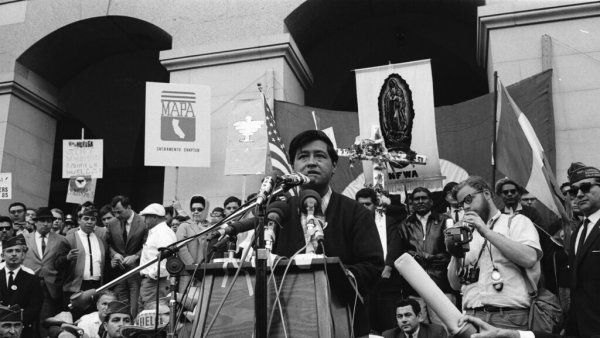
In the United States, Our Lady of Guadalupe has been used before to mobilize Latinos living in that country. As can be seen in the main photograph in this story César Chávez carried images of Our Lady of Guadalupe to almost any rally he organized during the agricultural workers' strike in the sixties and seventies and more recently Our Lady of Guadalupe has been used as a flag of those defending the rights of people trying to migrate and get, within the framework of current law in the United States, the status of a refugee.
When John F. Kennedy visited Mexico City with his wife back in the Summer of 1962, they visited the old Basilica of Guadalupe, as can be seen in the image below.
However, the use of Our Lady by the U.S. Catholic far-right is a novel development. In Mexico, devotion to Our Lady of Guadalupe has been almost always about resisting power, not about building a theocracy. More so because of the way they try to align US legislation to turn the country in a theocracy, which is what the 31 Democratic representatives were trying to say to the US Roman Catholic bishops who almost immediately rushed to refute.
It is difficult to predict how far the U.S. Catholic far-right will take the cultural and political appropriation of the image and narrative of the apparitions of Our Lady of Guadalupe.
Writing from Mexico, as a lifelong neighbor of the Basilica—except for the time I lived in New York and Buenos Aires—I cannot help but think of these developments as a kidnapping of the image and the narrative of the Nican Mopohua, the so-called “Guadalupan Gospel” (full text in English available here), of which an image of the copy kept in the New York Public Library is presented immediately after this paragraph.